

Over RMB 8 Billion Raised in China's AI-Driven Drug Discovery Sector in 2021: Four Fundamental Drivers Behind the Boom | 2021 Annual Review
In 2021, the domestic AI drug discovery sector continued the capital market fervor of 2020, sparking a wave of “rapid and aggressive” development.
Whether “veterans” or “newcomers,” leading AI drug discovery companies have gained recognition in the capital markets. VCBeat has compiled and analyzed the 2021 financing activities of more than 40 AI drug discovery enterprises in China.
According to incomplete statistics from VCBeat, there were a total of 34 financing events in China’s AI drug discovery sector in 2021, among which three did not disclose the financing round and four did not disclose the financing amount.In China, 34 financing events in the AI drug discovery sector involved a total funding amount of RMB 8,345,213,600, with an average single-round financing amount of RMB 245,447,500.
Note: In this statistical analysis, financing amounts for undisclosed events are recorded as zero; financing amounts described as “tens of millions of yuan” or “over ten million yuan” are uniformly counted as 10 million yuan; and financing amounts described as “hundreds of millions of yuan,” “over 100 million yuan,” or “exceeding 100 million yuan” are uniformly counted as 100 million yuan.
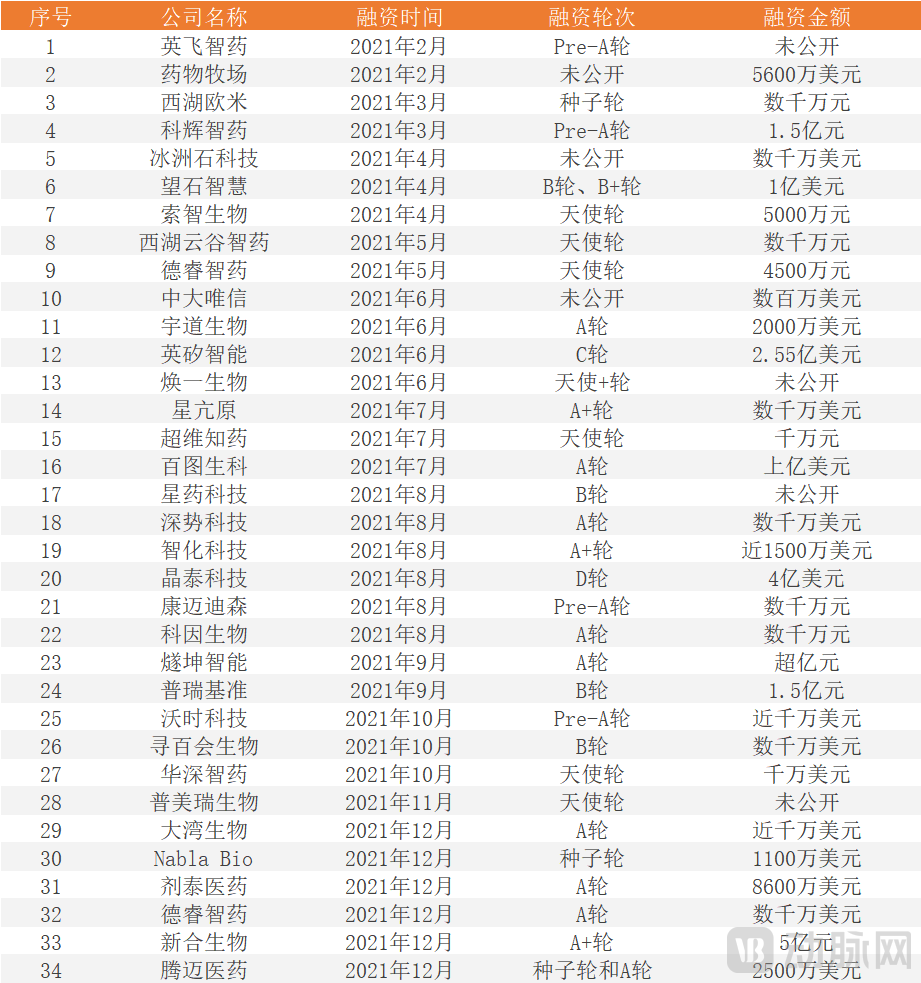
Overview of Financing in China’s AI Drug Discovery Sector in 2021
Among the 34 financing events in China’s AI drug discovery sector, nine companies were at the seed/angel stage, accounting for 26%; the largest number, 16 companies (47%), were in Series A rounds; four companies (12%) were in Series B rounds; only one company, Insilico Medicine, was in a Series C round; and likewise, only one company, XtalPi, was in a Series D round.
It can be seen that,Most startups in China’s AI-driven drug discovery sector are still in the early stages of financing, with funding rounds concentrated at the seed/angel and Series A levels; companies that have reached Series B or beyond account for less than one-third of the total.Currently, in China's AI-driven drug discovery sector, only Insilico Medicine (Series C) and XtalPi (Series D) have entered the late-stage financing phase, with no AI drug discovery companies having gone public yet.
Overall, the AI-driven drug discovery sector in China is still in its early stages of development, with a long way to go before reaching industrial maturity. Meanwhile, the aforementioned statistics indicate that the field remains welcoming to new entrants, offering substantial opportunities for rapid growth at this current stage.
In 2021, the total financing amount in China's AI drug discovery sector exceeded RMB 8 billion, a substantial sum. The enthusiasm from the capital market has fully validated the fervor in this field, underscoring the unstoppable trend of convergence between information technology (IT) and biotechnology (BT).
So, what are the underlying drivers fueling the rapid growth of AI in drug discovery?
First, there have been continuous breakthroughs and developments in AI technology in recent years.
From AlphaGo in 2016, AlphaZero in 2017, and AlphaFold in 2018 to the current AlphaFold2, the continuous breakthroughs and significant advancements in deep learning algorithms, coupled with a substantial increase in computing power, have allowed us to clearly feel the震撼 force of development in the era of artificial intelligence. Notably, the groundbreaking achievements made by DeepMind’s AlphaFold2, launched in July 2021, in addressing the “protein folding problem” have been hailed as solving “a problem that has plagued biologists for 50 years.”
Previously, complex protein structures could only be determined through laborious experimental analysis; however, rapid computational predictions are now feasible for thousands of proteins and their interacting complexes. DeepMind has announced that AlphaFold2 has predicted over 350,000 protein structures, covering 98.5% of the human proteome as well as proteins from 20 other organisms. Meanwhile, the accelerated accumulation of big data in biomedicine, driven by breakthroughs in biotechnology and declining costs, has provided the objective conditions necessary for the application of AI in the biomedical sector.
Second, the COVID-19 pandemic has driven unprecedented market attention to the biopharmaceutical industry, with growing demand for the application of new technologies and methodologies, thereby stimulating robust growth in the AI-driven drug discovery market. As a cross-disciplinary field with immense market potential, “AI + Drug R&D” has attracted significant investment capital from both the TMT (Technology, Media, and Telecom) and healthcare sectors.
Since the outbreak of the coronavirus disease 2019 (COVID-19) pandemic, an increasing number of biopharmaceutical companies and research institutions have integrated artificial intelligence (AI) into their operations to achieve innovative breakthroughs and accelerate drug development. A particularly illustrative example is the significant reduction in the development timeline for COVID-19 vaccines, facilitated by AI. Shortly after the emergence of the novel coronavirus, Chinese scientists identified the viral genetic sequence in January 2020. Within three months, the protein structure was resolved, and within the following month, the mechanisms of virus-host interaction were elucidated. By the end of 2020, vaccines had entered clinical trials, and mass deployment began in 2021. Whether involving inactivated vaccines or mRNA vaccines, this represents perhaps the most rapid instance in human history where AI has accelerated vaccine development.
Furthermore, amid the rampant spread of COVID-19, AI also delivered outstanding performance in the pharmaceutical industry’s race to find a cure. On November 19, 2020, the U.S. FDA granted Emergency Use Authorization (EUA) for the combination therapy of baricitinib and remdesivir, for the treatment of confirmed or suspected patients requiring supplemental oxygen, invasive mechanical ventilation, or extracorporeal membrane oxygenation (ECMO). Unlike other specific anti-COVID-19 drugs, it was not humans but AI that discovered baricitinib’s ability to block SARS-CoV-2 infection and exert anti-inflammatory effects.
Baricitinib is an inhibitor of JAK1 and JAK2 in the Janus kinase family. After its initial approval in Europe in 2017, it has been marketed in more than 70 countries, primarily for the treatment of moderate to severe rheumatoid arthritis. The drug was originally developed by the U.S. company Incyte, with Eli Lilly and Company later obtaining authorization for its promotion. In 2019, global sales of baricitinib reached $426 million.
As early as February 3, 2020, the UK-based company BenevolentAI published a paper in The Lancet stating that its AI platform, by searching through vast amounts of scientific literature, identified baricitinib as a potential treatment for COVID-19. On May 8, Eli Lilly initiated the ACTT-2 Phase III clinical trial evaluating the combination of baricitinib and remdesivir, with results announced in October. Eli Lilly reported that clinical trial data demonstrated a significant reduction in mortality among critically ill patients; compared with remdesivir monotherapy, the combination therapy reduced mortality by 60% and 43% in two patient subgroups, respectively.
In the face of the COVID-19 pandemic, AI has demonstrated remarkable efficiency.
Third, the continuous announcement of exciting breakthroughs by various AI-driven drug discovery companies has kept the sector’s momentum surging. The initial public offerings (IPOs) of several high-profile AI drug discovery firms, including Schrödinger, Relay Therapeutics, Recursion Pharmaceuticals, and Exscientia, have further fueled the AI drug discovery market, attracting an even greater influx of capital.
In February 2020, DSP-1181, a long-acting serotonin receptor (5-HT1A receptor) agonist co-developed by the UK-based company Exscientia and Sumitomo Pharma, initiated Phase I clinical trials in Japan for the treatment of obsessive-compulsive disorder (OCD). Exscientia claimed that this candidate molecule is the world’s first AI-designed drug candidate to enter clinical trials, with the entire project taking less than one year from concept to clinical initiation.
In February 2021, Insilico Medicine announced the world’s first discovery of a preclinical candidate compound with a novel mechanism for the treatment of idiopathic pulmonary fibrosis (IPF) using AI. This project shortened the new drug development cycle to 18 months and reduced costs to $2.6 million, significantly outperforming the traditional averages of 2–5 years in duration and $10.98 million in investment.
Subsequently, in April–May 2021, Exscientia announced that its second AI-driven drug candidate (EXS-21546; an A2A receptor antagonist; indications include pancreatic cancer, lung cancer, and others) and its third AI-driven drug candidate (DSP-0038; a dual-acting agent functioning as a 5-HT1A receptor agonist and a 5-HT2A receptor antagonist; indicated for Alzheimer’s disease) had both entered clinical development.
In December 2021, Insilico Medicine announced the discovery of two preclinical candidate compounds targeting PHD2—ISM012-077 and ISM012-042—within 12 months, for the treatment of renal anemia and inflammatory bowel disease, respectively.
In the secondary market for AI-driven drug discovery, several star companies—including Schrödinger, Relay Therapeutics, Recursion Pharmaceuticals, and Exscientia—have garnered significant enthusiasm from investors.On their respective listing days, Schrödinger, Relay Therapeutics, Recursion Pharmaceuticals, and Exscientia saw their stock prices rise by 65%, 75%, 73%, and 38%, respectively. Notably, as the first AI-driven drug discovery company to list on the NASDAQ, Schrödinger’s share price surged from its initial public offering (IPO) price of $17 to nearly $100 at its peak. In terms of overall market capitalization, these companies currently hover in the range of approximately $2.5 billion to $3.5 billion.
Recently, UK-based AI drug discovery star BenevolentAI also announced that it would merge with Odyssey Acquisition (AMS: ODYSY) through a SPAC transaction. The combined company is expected to list on Euronext Amsterdam in the first quarter of 2022.
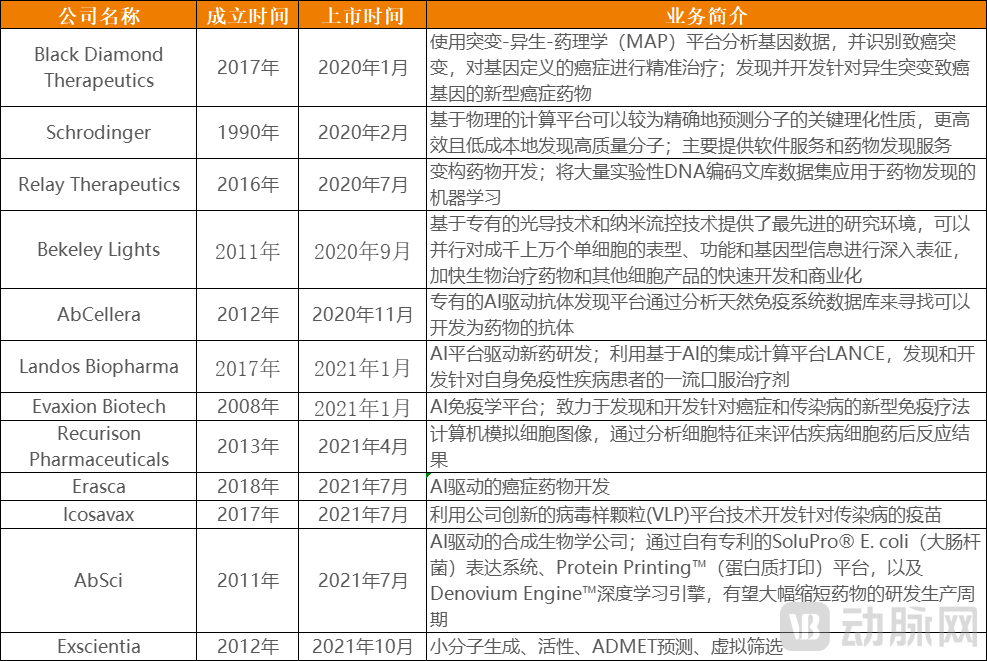
Global Listed AI Drug Discovery Companies
(Source: Compiled from public information; incomplete statistics. Data as of December 31, 2021.)
The entry of multiple multinational pharmaceutical companies and internet tech giants into the field of AI-driven drug discovery has served as a catalyst for the sector’s surging popularity.
In June 2021, PharmExec (U.S. Pharmaceutical Executive magazine) announced the 2021 Top 50 Global Pharmaceutical Companies list. VCBeat conducted a statistical analysis of the AI drug discovery initiatives undertaken by the top 10 global pharmaceutical companies. The results showed thatAll of the global top 10 pharmaceutical giants have established a presence in the field of AI-driven drug discovery.The specific statistical results are as follows:
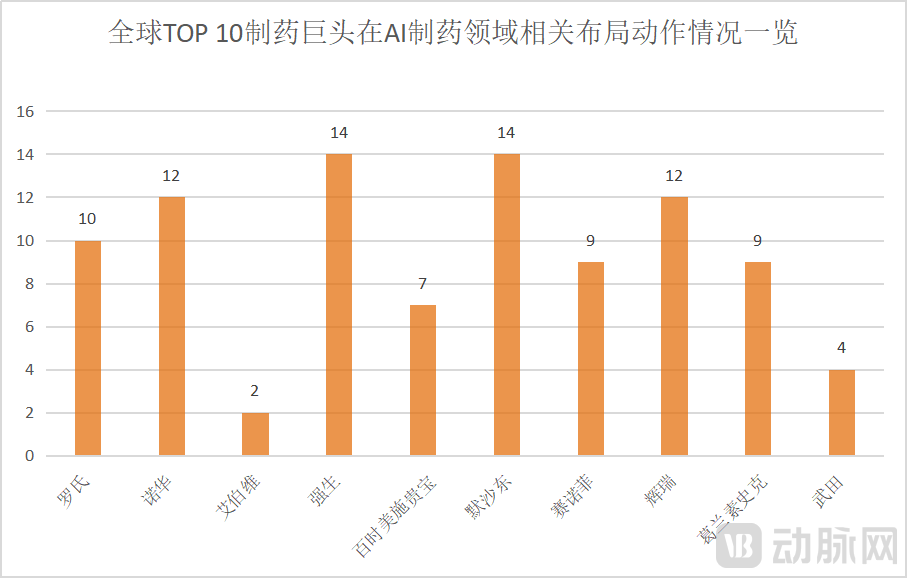
Overview of AI Drug Discovery Initiatives by the Top 10 Global Pharmaceutical Giants
(Ranked from left to right: Top 10 Pharmaceutical Companies)
(Source: Official company websites and other public information; this is an incomplete statistical summary. Data cutoff date: December 31, 2021)
Among the global top 10 pharmaceutical giants, Johnson & Johnson and Merck & Co. have been the most active in deploying AI-driven drug discovery initiatives, each undertaking 14 related activities. They are closely followed by Novartis and Pfizer, with 12 initiatives each. Roche (10 initiatives), Sanofi (9 initiatives), and Pfizer (9 initiatives) show similar levels of engagement in AI-based drug development. Bristol Myers Squibb, while slightly less active, still demonstrates considerable momentum with 7 related initiatives. Takeda and AbbVie have undertaken 4 and 2 initiatives, respectively, in the field of AI-driven drug discovery.
On November 4, 2021, Alphabet, the parent company of Google, officially introduced its newly established AI-driven pharmaceutical company, Isomorphic Laboratories, through a blog post. The company will leverage research from DeepMind, Google’s artificial intelligence laboratory, to further explore the application of artificial intelligence (AI) in drug discovery. If the development of AlphaFold represented Alphabet’s initial foray into applying AI technologies in the life sciences sector, the establishment of Isomorphic Labs signifies Alphabet’s formal commitment to pioneering the field of AI-driven drug discovery and development.
In fact, it is not only foreign IT giants like Google that are “pioneering new frontiers” in the field of AI-driven drug discovery, riding the wave of market hype while further fueling industry enthusiasm; domestic IT giants have also been actively engaging in the AI drug discovery sector over the past two years.Frequent Moves”, while catering to market enthusiasm, further drives the continuous rise in heat within this field.
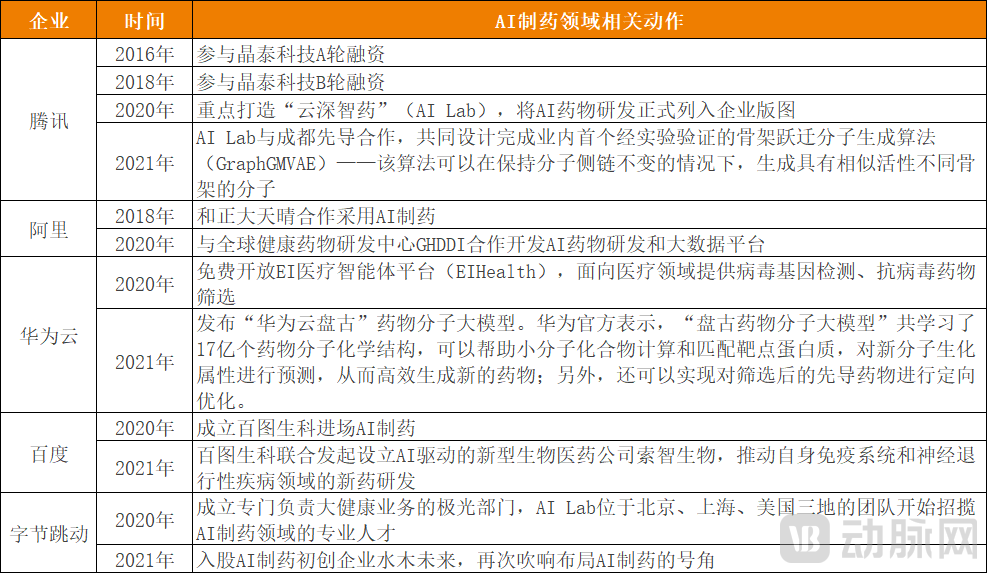
Recent Moves by Internet Giants Entering the AI Drug Discovery Arena
(Source: Compiled from public sources; incomplete statistics. Data as of December 31, 2021)
Tencent
As early as 2015 and 2018, Tencent participated in the Series A and Series B financing rounds of XtalPi, now a leading AI-driven drug discovery company. In 2020, Tencent further solidified its commitment by launching “Yunshen Zhiyao,” formally integrating AI-powered drug R&D into its corporate strategy. In August 2021, Tencent AI Lab collaborated with HitGen to jointly design and complete the industry’s first experimentally validated scaffold hopping molecule generation algorithm (GraphGMVAE). This algorithm can generate molecules with different scaffolds but similar biological activities while keeping the side chains unchanged. The research findings were published in the latest issue of ACS Omega, a journal of the American Chemical Society, providing greater inspiration for medicinal chemists in molecular design and helping reduce costs while improving efficiency.
Alibaba Cloud
In September 2018, Alibaba Cloud, a subsidiary of Alibaba Group, announced a collaboration with Chia Tai Tianqing Pharmaceutical to leverage AI in drug discovery. Compared with traditional computer-aided drug design (CADD) methods, this new approach can improve screening accuracy by 20%. In January 2020, Alibaba Cloud partnered with the Global Health Drug Discovery Institute (GHDDI) to develop an AI-driven drug R&D and big data platform.
Huawei Cloud
In April 2020, Huawei Cloud opened its EI Health platform (EIHealth) for free use, providing services such as viral genome testing and antiviral drug screening to the medical sector. In 2021, Huawei Cloud collaborated closely with the Shanghai Institute of Materia Medica, Chinese Academy of Sciences, to launch the Huawei Cloud Pangu Drug Molecule Model, a large-scale model specifically designed for the field of drug research and development. This model empowers AI-driven drug design across the entire process, aiming to help pharmaceutical companies adopt a new paradigm of AI-assisted drug discovery and development. Built upon Huawei Cloud’s one-stop medical R&D platform, EIHealth, the Pangu Drug Molecule Model has learned from the chemical structures of 1.7 billion drug molecules. In terms of drug generation, it achieves deep representation of unique information on small-molecule compounds, computational analysis and matching with target proteins, and prediction of biochemical properties of new molecules, thereby enabling efficient generation of novel drug molecules. For drug optimization, it facilitates targeted optimization of screened lead compounds.
Baidu
In September 2020, Baidu founder Robin Li, as the lead initiator, and Liu Wei, CEO of BV Baidu Venture Capital, jointly founded BiotoLife to enter the AI-driven drug discovery sector. Robin Li personally serves as the company’s Chairman, while Liu Wei, as a co-founder, serves as its CEO. BiotoLife is dedicated to accelerating the research and development of innovative drugs and precision life science products, such as those for early screening and diagnosis, by leveraging high-performance biological computing and multi-omics data technologies. Its LinearFold algorithm reduced the time required for predicting the secondary structure of the full genome of the novel coronavirus from 55 minutes to just 27 seconds, achieving a 120-fold increase in speed.
In April 2021, Biotope, Viva Biotech, and Dr. Xu Daqiang’s team jointly announced the establishment of an AI-driven innovative biopharmaceutical company—SuoZhi Bio—and completed a RMB 50 million angel financing round. SuoZhi Bio focuses primarily on the research and development of novel drugs for autoimmune diseases and neurodegenerative disorders, aiming to establish a new AI-based paradigm for drug discovery. The financing round was led by Biotope, with participation from Viva Biotech. As strategic investors, Biotope and Viva Biotech will provide comprehensive support to SuoZhi Bio in areas including AI technology, computational power, foundational multi-dimensional data, protein structure analysis, and new drug R&D.
ByteDance
At the end of 2020, ByteDance established the Aurora Department, dedicated to its digital health business, while its AI Lab teams in Beijing, Shanghai, and the United States began recruiting professionals specializing in AI-driven drug discovery. In October 2021, ByteDance took an equity stake in Shuimu Future, an AI drug discovery startup, further signaling its strategic expansion into this field. According to its official website, Shuimu Future primarily provides technical services and support to innovative pharmaceutical companies and research institutions. Leveraging core technologies in cryo-electron microscopy, computational chemistry, machine learning, and high-performance computing, the company drives digital innovation in areas such as small molecules, antibody therapeutics, protein degradation, and gene therapy, aiming to significantly enhance the efficiency and success rates of drug development for innovative pharmaceutical enterprises.
Fourth, the booming development of China’s biopharmaceutical industry, government support for innovative drugs, and the market’s urgent demand for source innovation and new technological breakthroughs are key drivers behind the surge in AI-driven drug discovery and development.
Whether it is accelerating the review and approval of innovative drugs, encouraging high-quality innovative pharmaceuticals to align with international standards, implementing the Marketing Authorization Holder (MAH) system, or introducing new policies under Chapter 18A of the Hong Kong Stock Exchange and launching the STAR Market, China—from the national government to local authorities—is actively strategizing and supporting the development of the biopharmaceutical industry.
On one hand, with the implementation of the “4+7” volume-based procurement policy, profit margins for generic drugs have been further squeezed. The era of high gross margins for generics has come to an end, and the value proposition of “pseudo-innovative” drugs—such as me-too and me-worse agents—as well as generic drugs has been significantly compressed. Consequently, China’s biopharmaceutical industry is urgently seeking further upgrading.
On the other hand, the development of new drug molecules has become increasingly challenging, characterized by high costs and prolonged timelines. The difficulty in developing innovative drugs is growing—a problem that major pharmaceutical giants have been facing in recent years: the overall return on investment (ROI) for drug R&D continues to decline. Global leading pharmaceutical companies spend billions of dollars annually, yet the FDA approves only a few dozen drugs each year. The pharmaceutical industry urgently needs new technologies to break through the current bottlenecks in drug discovery and development, and pharmaceutical companies are in dire need of novel solutions with lower trial-and-error costs.
The integration of IT and BT undoubtedly brings greater possibilities for drug innovation in China, promising to help the industry reach for the more elusive fruits in new drug R&D—novel targets, undruggable targets, and First-in-class drugs. The pursuit of innovation and the need for cost reduction and efficiency improvement are driving pharmaceutical companies to accelerate their adoption of AI.