

Medical Tourism Rebounds Post-Pandemic: Malaysia’s Strategic Pivot and Core Offerings
Cross-border flows drive the movement of resources, and healthcare is no exception. The emergence of medical tourism serves as testament to this fact. As early as 2013, the State Council issued the “Several Opinions on Promoting the Development of the Health Service Industry,” proposing to “encourage regions with appropriate conditions to develop wellness, sports, and medical health tourism for both international and domestic markets.” This initiative further promoted the development of medical tourism and implicitly affirmed its economic and social value.
As overall consumption levels in China rise, the demand among domestic residents for high-end medical services abroad continues to grow, driving robust momentum in the medical tourism market. According to a research report by U.S.-based market consulting firm Transparency Market Research, the global medical tourism market is projected to expand from its current size of $10 billion to $30 billion by 2019, reflecting a compound annual growth rate (CAGR) of 17.9%.
However, the impediments posed by the global COVID-19 pandemic to the development of the medical tourism industry are also evident. Under the shadow of the epidemic, the industry’s growth has slowed across the board. How can medical tourism truly realize its value and emerge from the impact of the pandemic?
Recently, VCBeat conducted an interview with Mohd Daud Mohd Arif, CEO of the Malaysia Healthcare Travel Council (MHTC). Mr. Mohd Daud provided an overview of Malaysia’s healthcare tourism development model and shared his outlook on the sector’s future, offering valuable insights for the industry’s growth.
Next, VCBeat will analyze Malaysia’s medical tourism initiatives based on its conversation with Mohd Daud Mohd Arif, using the measures proposed by the Malaysia Healthcare Travel Council (MHTC) in response to the pandemic as a starting point to identify actionable insights for the development of medical tourism in the post-pandemic era.
Typically, the evaluation and understanding of a medical tourism program can be approached from six aspects: price, offerings, distance, service experience, language communication, and medical standards.
At the pricing level, the Malaysian Ministry of Health has established maximum charge standards for medical services, ensuring the reasonableness of healthcare prices through policy measures., thereby reducing the financial burden on patients and ensuring a sufficient number of patients travel to Malaysia to receive medical services.
Mohd Daud Mohd Arif shared with VCBeat data on medical pricing in Malaysia from 2020, which indicated that patients could save 60% to 80% on healthcare costs by receiving treatment in Malaysia, where medical service prices are kept at a relatively low level.
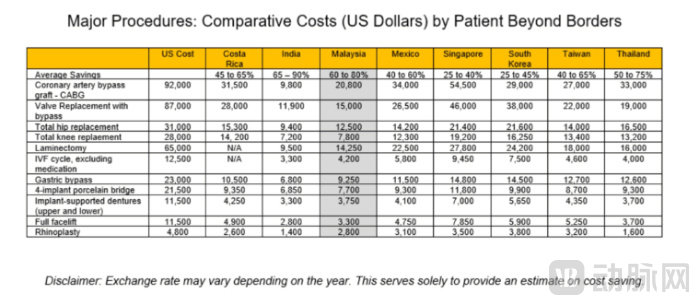
Source: Patients Beyond Borders, 2020
Policy support has given Malaysia an edge in developing its medical tourism sector. However, Mohd Daud Mohd Arif told VCBeat that, beyond the pricing of medical services, Malaysia also focuses on the development of other related offerings.These include Malaysia’s tourist attractions, a multilingual healthcare system that accommodates the language preferences of medical tourists from across Asia and around the globe, the quality of medical services, and core medical offerings. Furthermore, Malaysia continuously refines its service positioning and strategic direction to drive the development of its local healthcare industry, thereby enhancing the appeal of its medical tourism programs to international visitors.
As a result, the number of medical tourists in Malaysia increased by 90% between 2011 and 2019, with revenue reaching RM 1.7 billion (approximately RMB 2.57 billion) in 2019 alone.
As mentioned above, the evaluation and understanding of a medical tourism project can be approached from six aspects, including price, distance, services offered, and level of medical care. Patients’ choice of medical tourism destinations also depends on these factors.
According to the “Special Research Report on China’s Overseas Medical Tourism Market 2016” by Analysys International, Malaysia’s key strengths as a medical tourism destination lie in oncology and in vitro fertilization (IVF). Currently, Malaysia is also making significant strides in the treatment of cardiovascular diseases and hepatitis C.
Mohd Daud Mohd Arif shared with VCBeat an overview of the development of in vitro fertilization (IVF) in Malaysia, stating:“For patients facing infertility, we have advanced treatment options, such as fertility assessments leveraging oncofertility and AI technologies. Meanwhile, eight of the 30 fertility centers worldwide accredited by the international RTAC are located in Malaysia. Driven by technological advancements and the concentration of medical talent in Malaysia, the success rate of in vitro fertilization (IVF) in the country has now increased by 50%.”
Malaysia, which places significant emphasis on the development of its medical tourism industry, has not limited its focus solely to expanding medical services. Instead, while continuously enhancing its healthcare capabilities, it has established collaborations with enterprises and institutions such as health management companies, thereby building a bridge between the two regions.
In 2019, to provide Chinese medical tourists with more convenient access to Malaysian healthcare services, MHTC partnered with Xiamen Tai Dongfang Health Management Co., Ltd. to establish the first Malaysia International Referral Centre (MIRC) in China., helping to build a communication bridge between partner hospitals in Malaysia's healthcare industry and Chinese patients, thereby facilitating consultations for those seeking fertility treatments. Currently, MIRC has three branches, located in Hangzhou, Tianjin, and Fuzhou respectively.
Through MIRC China, medical tourists can receive on-site consultations before departing for Malaysia to undergo in vitro fertilization (IVF) treatment. They can also have secondary consultations with Malaysian specialists via video conference or in person. MIRC China assists with visa applications and itinerary arrangements to ensure a smooth arrival in Malaysia. Additionally, it continues to provide medical consultation services to patients after their return.
In 2021, MHTC also signed two separate memoranda of understanding (MoUs) with the International Medical Exchange and Cooperation Committee (IMECC) of the China Non-Public Medical Institutions Association and with Hangzhou Rende Obstetrics and Gynecology Hospital, respectively, to jointly enhance the healthcare experience for Chinese medical tourists.
Moreover, over the past decade, Malaysia has gained widespread recognition as a regional hub for cardiology in Asia. Currently, Malaysia boasts 11 member hospitals, more than 200 cardiologists, and 58 cardiothoracic surgeons, all of whom possess extensive practical experience in delivering cardiac-related treatments.
It is worth mentioning the National Heart Institute (Institut Jantung Negara), one of Malaysia’s leading flagship hospitals for cardiology. The National Heart Institute is the largest cardiology center in Southeast Asia and a world-renowned, internationally accredited heart center. Since its establishment in 1992, the National Heart Institute has treated 3.7 million patients from numerous countries around the globe.
In 2020, the National Heart Institute of Malaysia achieved another milestone by becoming the first hospital outside the United States to successfully implant the Micra AV pacemaker. In August 2021, the National Heart Institute of Malaysia became the first hospital in Asia to successfully perform a novel therapeutic procedure for patients with tricuspid regurgitation or heart valve leakage.
In terms of medical technology, the National Heart Institute of Malaysia has frequently achieved breakthroughs and delivered numerous accomplishments, which have become its core competitive advantage in attracting a large number of patients to seek treatment in Malaysia.
Mohd Daud Mohd Arif stated: “In the process of establishing Malaysia as a hub for cardiology in Asia, the close collaboration between the National Heart Association of Malaysia and the Ministry of Health has also played a significant role. This partnership has further enriched our expertise in the field, fostering the development, research, and improvement of cardiac treatments and healthcare service quality.”
The COVID-19 pandemic led to border closures and travel restrictions. Many segments of the medical tourism value chain were severely impacted, including travel agencies, hotel operators, health promotion organizations, tour guides, and logistics service providers. For an industry heavily reliant on international travel, the pandemic delivered a significant blow.
Mohd Daud Mohd Arif stated: “This is particularly critical for patients with conditions such as heart disease and cancer, who require frequent travel between two locations to receive timely treatment; as it becomes increasingly difficult for healthcare institutions to provide continuous medical services, there is a greater need to develop robust countermeasures to address this challenge.“When most countries around the world, as well as Malaysia, closed their borders, Malaysia introduced relevant plans and policies to ensure the development of medical tourism.”
In response, MHTC has provided numerous solutions.
First is the “medical travel bubble” scheme.To ensure the continuity of care, particularly for patients requiring urgent treatment for conditions such as heart disease and cancer, Malaysia has implemented a specialized “Medical Travel Bubble” initiative since 2020. This program guarantees a seamless process for patients from the moment they depart their home country until they arrive in Malaysia and complete their treatment. Throughout this process, the Malaysia Healthcare Travel Council (MHTC) adheres to strict standard operating procedures.
Secondly, MHTC and the Malaysian Ministry of Health jointly released the "Malaysia Healthcare Tourism Industry Blueprint 2021-2025," aiming to enhance the medical tourism experience for patients through phased recovery and reconstruction, while strengthening and developing Malaysia's distinctive healthcare services.Meanwhile, to achieve the goals set forth in the Blueprint, the Ministry of Health and MHTC launched the “Malaysia as the Hepatitis C Treatment Hub of Asia” initiative in 2021 to provide effective treatment regimens for patients with hepatitis C virus infection.
Finally, Malaysia will also establish digital infrastructure such as digital diagnosis and treatment channels., build and promote more sustainable immersive medical tourism services, optimize hospitals' telemedicine infrastructure, implement medication delivery services, and even improve cross-border electronic payment processes.
In summary, for the medical tourism industry to continue playing its role during the pandemic, it is essential to maintain confidence in overcoming the challenges posed by the outbreak, remain sensitive to industry developments, and promptly propose corresponding solutions.More importantly, healthcare institutions must develop their core competitiveness, cultivate specialty services to attract patients, and implement comprehensive improvements across processes, infrastructure, and services throughout the entire patient journey to ensure a smooth care experience.
In this regard, Mohd Daud Mohd Arif also provided a summary of his insights on medical tourism.“The COVID-19 pandemic has posed numerous challenges to the medical tourism industry. As the pandemic persists, we believe that patients are unlikely to engage in cross-border medical care on a large scale and will instead opt for alternative treatment options. Therefore, healthcare institutions and corresponding medical tourism destinations must establish relevant standard systems and develop supporting infrastructure to provide patients with safer treatment experiences, ensuring their safety and peace of mind throughout both travel and treatment.”