

Baxter's $12.5 Billion Hillrom Acquisition: Forging a New Growth Curve in Healthcare Transformation?

Baxter
Disease Treatment Product Developer
“By the time you know where you should be heading, you often no longer have the opportunity to go.”
— Charles Handy
Charles Handy, the most renowned management guru in contemporary Britain, stated this when elaborating on his “Second Curve Theory.” He believes that any growth curve will eventually slide past the vertex of the parabola, which represents the limit of growth. The secret to sustained growth lies in initiating a new S-curve before the first one declines.
On December 13, 2021, healthcare giant Baxter International announced the completion of its acquisition of Hillrom. Reportedly, Baxter acquired Hillrom at a cash price of $156 per share, with a total equity value of approximately $10.5 billion and an total enterprise value of approximately $12.5 billion, including assumed debt.
With 18 days remaining until 2022, this acquisition clearly became the second-largest transaction by value in the global medical device sector in 2021.
As a global giant with stable operations, Baxter has been seeking new growth opportunities. Hillrom’s connected care and patient monitoring businesses complement Baxter’s hospital care portfolio perfectly. Baxter stated that this acquisition will accelerate its vision to transform healthcare and advance patient care globally—from hospitals to homes—thereby driving faster business growth for the company.
This article seeks to explore how this global giant in medical consumables and devices was born and grew, focusing on the development of its renal care business and how it forged its second growth curve in the process.
From Intravenous Infusion Products to a Global Dialysis Giant
According to Baxter’s 2020 annual report, its global sales totaled $11.7 billion in 2020. Sales grew by 3% on a reported and constant-currency basis, and by 2% on an operational basis.Among them,From the perspective of business content,The Renal Care business accounted for the largest share of revenue, generating nearly $3.8 billion, a 3% year-over-year increase;In terms of regional distribution,The Americas account for the largest market share, at 54%.

Source: Baxter 2020 Annual Report
How has Baxter achieved an annual revenue scale exceeding $10 billion since its founding in 1931?
1# Dedication: Saving and Sustaining Lives
Since the mid-19th century, Chinese society has experienced intense collisions with Western civilization. During this process, Western medicine gradually made its way into China, but its development was exceedingly slow. Peking Union Medical College, the earliest medical school in China to offer an eight-year clinical medicine program and undergraduate nursing education, was founded in 1917 with funding from the Rockefeller Foundation.
What does this have to do with Baxter? Its founder, Don Baxter, was one of the leaders involved in establishing Peking Union Medical College.
During this period, Dr. Baxter participated in relief efforts for a cholera outbreak in a rural area. However, the experience left him deeply regretful and shocked: many patients lost their lives due to severe fluid loss. The fragility of life made this experience unforgettable and became one of the catalysts for his determination to develop sterile intravenous infusion solutions.
With Dr. Baxter’s return to his home country, we turn our attention to the United States in the early 20th century, where the overall healthcare infrastructure was still under development. For instance, at that time, only a few large research centers and university hospitals were capable of producing intravenous infusion solutions, and the lack of quality standards posed significant challenges for clinical treatment.
Baxter was born out of the commercialization of sterile intravenous solutions. In 1931, Ralph Falk and Dr. Baxter founded Don Baxter Intravenous Products Company to sell intravenous solutions to hospitals in the U.S. Midwest, becoming the first manufacturer to commercially compound intravenous infusions.
Shortly after its establishment, Baxter introduced the TRANSFUSO-VAC sterile vacuum blood collection and storage container, extending the blood storage period to 21 days. On its tenth anniversary, Don Baxter Intravenous Products Company was renamed Baxter Laboratories, and converted an automobile showroom in Illinois, USA, into its first manufacturing facility.
2Soaring: Dual Drivers of R&D and M&A
After a decade of exploring corporate development, Baxter has begun to enter a period of business breakthrough.
In the Field of Blood Storage, Baxter expanded its product portfolio. In 1941, it launched the Plasma-Vac storage container, achieving for the first time the separation and storage of plasma from whole blood. In 1948, it introduced soft-pack plastic blood collection containers.
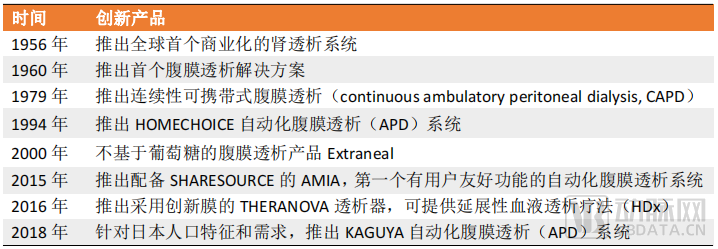
In the Field of Nephrology Dialysis, Baxter’s explorations followed closely. In 1956, building on the first “artificial kidney” constructed by Dutch physician Willem Kolff using wooden slats, orange juice cans, and cellophane, Baxter launched the world’s first commercial renal dialysis system. In 1960, it introduced the first peritoneal dialysis (PD) solution.
As a result, Baxter established two core product lines—blood storage and dialysis consumables—propelling the company into its first phase of rapid growth.During this period, Baxter established new business divisions and production facilities, and began expanding its international operations. In 1954, Baxter opened an office in Belgium, extending its business into Europe.
In 1961, Baxter was listed on the New York Stock Exchange. Following its IPO, Baxter further accelerated its technological R&D innovation and business expansion.
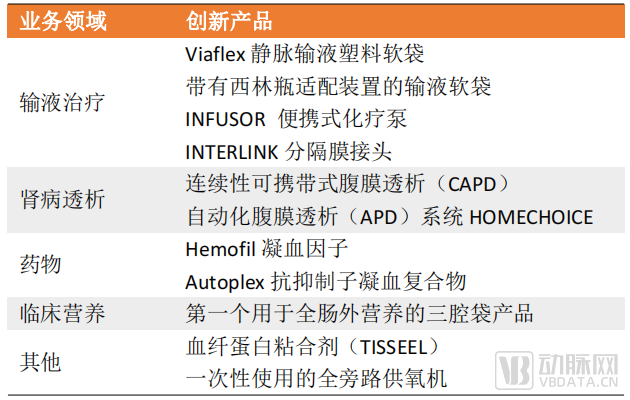
Incomplete Statistics of Baxter’s Innovative Products from the 1960s to the 1990s Source: Baxter Official Website, Siyu Medical Device Observation
As it reached a certain stage of development, the wave of acquisitions came with the company's strong capabilities. Baxter initiated its first wave of acquisitions in the 1950s, among which the acquisition of Hyland Laboratories made it the first company in the United States to offer human plasma products. Since then, a series of acquisitions have enabled Baxter to launch more new products and technologies.The company thus entered Version 1.0 of diversified operations.。
Diversification is an expansion-oriented corporate strategy. In this process, Baxter has evolved into a large-scale multinational corporation. In 1978, its sales revenue reached the $1 billion mark, six years after it first appeared on the Fortune 500 list.
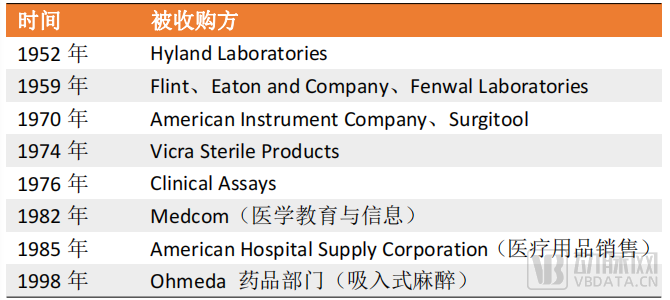
Baxter’s Incomplete Statistics on Acquisitions from the 1950s to the 1990s Source: Baxter Official Website, Siyu Medical Device Observation
Baxter’s management continues to diversify its business to drive greater growth for the company. However, amid this process, the complex market environment has served as a sobering reality check for Baxter at the height of its momentum.
First, policy-driven declines in sales of dialysis consumables. To cope with this pressure, Baxter continued to diversify its business and adjusted its R&D direction for products, but such adjustments lagged behind the pace of market changes, and the company’s development began to enter a downturn.
No sooner had one wave fully subsided than another arose. In 1985, Baxter’s merger with American Hospital Supply Corporation proceeded less than smoothly, prompting significant business restructuring. Meanwhile, fines and lawsuits came in quick succession, plunging Baxter’s development to a historic low.
Following business divestiture and restructuring, Baxter launched the “Network 2000” initiative to realign its strategic priorities, marking the emergence of version 2.0 of its diversified operations.
During this period, Baxter divested low-relevance businesses, refocusing on core areas such as renal care, blood-related products, and pharmaceutical development, while prioritizing hospital services, technological innovation, and international business expansion.
Among these, R&D and M&A remain the two pillars driving its rapid growth. Since the mid-1990s, and especially after entering the new century, the company has launched a series of core products, such as the HOMECHOICE automated peritoneal dialysis system, EXTRANEAL glucose-free peritoneal dialysis solution, Advate (the first recombinant Factor VIII produced without adding human- or animal-derived proteins to the cell culture medium), Flexbumin (the first albumin product packaged in flexible plastic containers), and the inhalational anesthetic Sevoflurane.
As part of its acquisition strategy, in 2012, Baxter acquired Sigma, a manufacturer of smart infusion pumps, and Synovis Life Technologies, a leading company in microsurgical products; in 2013, it acquired Gambro AB of Sweden, an innovative global provider of kidney care solutions.
As a result, Baxter’s development gradually returned to the right track, and it began to regain its dominant position. Today, Baxter employs more than 50,000 people worldwide, with business spanning renal care, medication delivery, pharmaceuticals, clinical nutrition, surgery, and acute therapies, and its products are sold in over 100 countries.
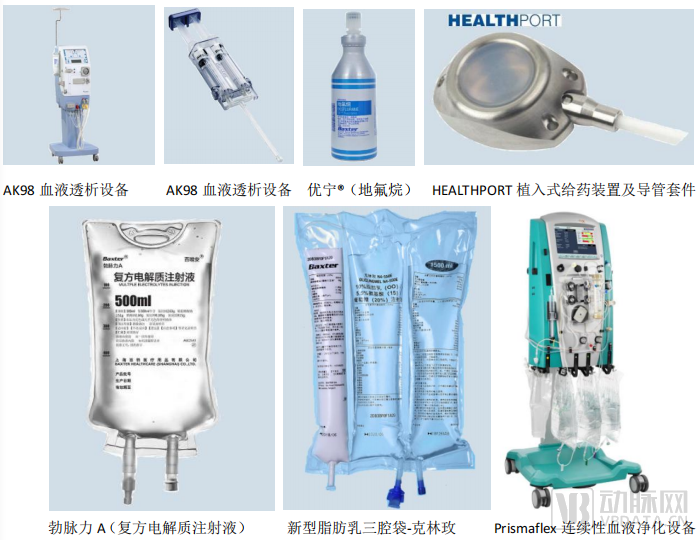
Featured Products Source: Baxter Official Website
3Innovation Equals Pioneering the Second Curve
From the perspective of Baxter’s development trajectory, its renal care business can be regarded as its first “second curve,” having consistently served as a core component of its overall operations since its initial inception. Currently, Baxter stands in the first tier of the dialysis industry and is one of the market leaders. A closer examination of its renal care business reveals that “innovation” has always been the key to its growth.
Source: Baxter Official Website
Since William B. Graham’s decision in the early 1950s to continue supporting Dr. Kolff in the development of the artificial kidney, Baxter has embarked on a journey of continuous innovation in renal dialysis. In the late 1970s and early 1980s, Baxter launched continuous ambulatory peritoneal dialysis (CAPD) along with its associated home-use devices, enabling the company to establish a competitive advantage in the home dialysis sector and seize first-mover market opportunities.
Since the turn of the new century, Baxter has continued to innovate in peritoneal dialysis products, launching the HOMECHOICE automated peritoneal dialysis system, Extraneal, a glucose-free peritoneal dialysis solution, and the Theranova dialyzer, which offers higher permeability and effective selectivity for larger proteins.
In 2013, the acquisition of Gambro, a Swedish innovator in global kidney care, further solidified its industry leadership in the field of dialysis.
Furthermore, under the influence of digital technology, Baxter’s dialysis equipment is also evolving from automation to intelligence.As in 2015, Baxter and SHARESOURCE jointly launched AMIA, this is the first automated peritoneal dialysis system with user-friendly features, which can help patients achieve more efficient home peritoneal dialysis treatment by staying connected with remote healthcare providers.
In 2020, the FDA approved Baxter’s HomeChoice Claria automated peritoneal dialysis system and its Sharesource connectivity platform for use in adult and pediatric populations.It is reported that ShareSource is the only bidirectional remote patient management platform in the United States designed for peritoneal dialysis patients.
The market size for dialysis services exceeds that of dialysis equipment. In the dialysis sector, industry giants are expanding across the upstream and downstream segments of the dialysis value chain, making the “equipment + services” model an inevitable choice. Around 2017, Baxter began gradually integrating its services with its products. For instance, in 2017, Baxter China established its first independent dialysis center in Xiamen, China; in 2018, Baxter started launching kidney care centers in the United States.
Thus,From the commercialization of dialyzers to continuous innovation in peritoneal dialysis technology, and from the development of home dialysis devices to integration with digital innovations,Baxter’s dialysis business alone exemplifies its willingness to embrace change and seize new opportunities. Through innovation, Baxter not only achieves new business growth but also continuously strives to build a “second curve.”
Baxter’s pace of innovation continues.In 2011, it established Baxter Ventures to lay the groundwork for corporate innovation through investment.Baxter Ventures invests in therapeutic areas that are complementary to Baxter’s focus on critical care, hospital solutions and therapies, nutrition, renal care, and surgical care, as well as in cutting-edge technologies and therapies beyond Baxter’s current product portfolio.
In addition, Baxter has established the Baxter Young Researcher Award and the Research and Continuing Education Grant.The former is an annual awards program open to graduate students and postdoctoral researchers, designed to incentivize and reward research applicable to the development of therapies and medical products that save and sustain patients’ lives; the latter is dedicated to supporting the pioneering efforts of clinicians and scientists focused on innovative research and continuing education for healthcare professionals.
Baxter in China
As time passed, in 1989, 58 years after Baxter’s founding,This company became one of the first multinational medical enterprises to enter the Chinese market and was the first to introduce hemodialysis, peritoneal dialysis, and continuous renal replacement therapy (CRRT) to China.
Currently, Baxter has established 11 institutions and offices, five manufacturing plants, one R&D center, and one technical service center in China, with Shanghai serving as its Asia-Pacific headquarters.
It is reported that by 2018, Baxter had cumulatively provided peritoneal dialysis treatment solutions to nearly 150,000 Chinese patients with end-stage renal disease (ESRD). In terms of sales revenue, China is Baxter’s second-largest market globally, after the United States, with its growth rate once reaching double digits. In 2019, within the domestic market, particularly in the hemodialysis machine segment, Baxter’s market share was second only to that of Fresenius.
As the policy environment and industry landscape evolve, the concept of localization for multinational corporations has gained increasing momentum in recent years. In 2015, while Baxter International implemented global reforms, Baxter China initiated its strategic transformation and localization process. In terms of product and business model innovation, Baxter China adopted a “dual-engine” approach: on one hand, it continued to introduce Baxter’s internationally leading products and therapies; on the other hand, it actively advanced its “In China, For China” strategy.
Taking renal dialysis as an example, in 2012, Baxter launched the “Research on Accessibility and Primary Care Management Models for Peritoneal Dialysis in Patients with End-Stage Renal Disease” project, targeting rural areas in China with limited medical resources, to provide home-based treatment for patients with end-stage renal disease.
In 2017, Baxter Shengkang, Baxter’s nephrology services brand, opened its first independent dialysis center in Xiamen. This initiative represents a collaboration between Baxter, authoritative public tertiary hospitals in Xiamen, and local communities to explore an innovative model within the medical consortium framework. Under this model, two-way referrals and information sharing for patients undergoing renal dialysis are implemented with hospitals, while disease education for patients with chronic kidney disease is supported at the community level. This approach aims to establish an innovative healthcare model that achieves mutual benefits for patients, hospitals, and the government.
At the 2021 China International Import Expo (CIIE), Baxter showcased its end-to-end healthcare solutions across four key areas: peritoneal dialysis, hemodialysis, acute and critical care, and perioperative care, highlighting its “In China, For China” practices and innovative achievements.
Ms. Xu Runhong, President of Baxter Greater China, stated, “We aim to comprehensively showcase Baxter’s global and local innovative practices at the 4th China International Import Expo. Meanwhile, we look forward to exchanging insights with stakeholders from all sectors to jointly drive a new wave of development in China’s healthcare industry, contribute to the ‘Healthy China 2030’ initiative, and ultimately benefit more patients.”
Sustained growth is one of the corporate objectives pursued by enterprises, and “saving and sustaining lives” is also Baxter’s commitment to its users. In October 2021, Baxter celebrated its 90th anniversary. For an ordinary person, this would mark the age of ninety; however, for a company committed to continuous innovation, this milestone serves more as a node, or evenEmbracing a New Beginning in a Brand-New World。
References:
[1] Baxter China. Baxter to Showcase Innovative Products at the 4th CIIE, Jointly Building a “Healthy China”
[2] Baxter China. Rockefeller not only founded Peking Union Medical College but also contributed to the establishment of Baxter.
[3] Siyu Medical Device Watch. $81.8 Billion! Healthcare Giant Baxter International Announces Completion of Hillrom Acquisition
[4] Siyu Medical Device Watch. How Did Baxter, After Stumbling, Rise from the Trough to Become the Dominant Player in Hospital Consumables?