

Lianou Health Leverages SaaS to Power DTC Digital Marketing in China's Pharmaceutical Sector
On January 12, the National Joint Drug Procurement Office issued a notice stating that the results of the sixth round of national centralized drug procurement would be implemented in May 2022.
To date, six rounds of national centralized volume-based drug procurement have been successfully implemented, with the average price reduction of winning bids reaching 53%, indicating that the reform is gradually entering a phase of deeper challenges.
On one hand, under the influence of national policies such as volume-based procurement, tiered diagnosis and treatment, and medical insurance cost containment, the era of "kickback-driven" sales by pharmaceutical companies is gradually coming to an end. Under pressure and driven by practical needs, a large number of pharmaceutical companies are turning to the out-of-hospital market to seek new growth opportunities.
On the other hand, traditional marketing models are plagued by low efficiency and high costs. Influenced by factors such as market penetration into lower-tier cities, pharmaceutical companies are actively seeking marketing transformation. Digital marketing has gradually become a core competency for branded pharmaceutical enterprises; it is no longer a question of whether to adopt it, but rather whether companies possess the capability to execute it effectively. Driven by the impact of the pandemic, the trend of pharmaceutical companies shifting towards online marketing has become even more pronounced.
Founded in 2018, Lotus Health has targeted the pain points of pharmaceutical companies by facilitating their marketing upgrades through DTC (Direct-to-Consumer) digital marketing solutions. How does DTC in the pharmaceutical industry differ? What exactly is Lotus Health’s approach? We interviewed Wang Yanxiong, founder of Lotus Health, to lift the veil on this “mysterious” company that VCBeat has been frequently asked about by external parties.
Since the beginning of his career, Wang Yanxiong has been inextricably linked to the pharmaceutical industry. He initially worked at the Health Bureau and the Drug Administration in his early years, later founding a pharmaceutical ERP software company and Zhenkang Pharmaceutical, which specializes in the marketing of anti-tumor drugs. However, it is Kangaiduo, founded by him in 2010, that is more widely known to the public. In 2018, when he embarked on a new journey by establishing Lianou Health, he immediately attracted significant attention.
Wang Yanxiong, who was among the first in the healthcare industry to recognize the opportunities in pharmaceutical e-commerce, has now set his sights on a new frontier: digital marketing for pharmaceuticals. In his view, digitalization is bound to reshape the entire pharmaceutical industry.
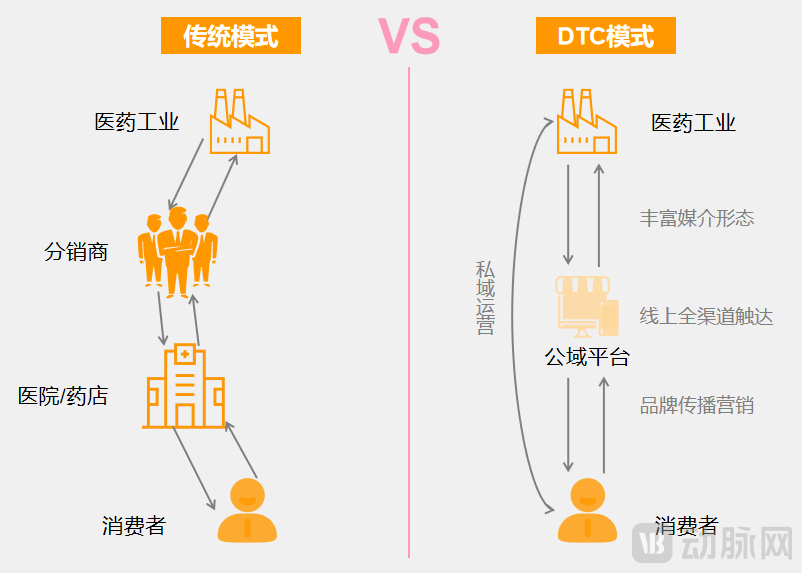
Unlike the common approach of influencing physicians’ decisions through academic conferences, Lianou Health has adopted a Direct-to-Consumer (DTC) model, whereby the pharmaceutical industry directly engages with and serves consumers. Wang Yanxiong explained, “Influencing consumer decision-making is a method of digital pharmaceutical marketing, but the ultimate goal is to address users’ health concerns. Many companies seek to influence prescribing behavior by targeting ‘the pen in the doctor’s hand.’ In contrast, we tackle problems by directly engaging with and serving patients.”
Compiled from Lotus Health Data
Lianou Health has positioned its service scenarios primarily on public-domain platforms, supplemented by private-domain channels. Its target clients include pharmaceutical manufacturers, public-domain platforms, and end consumers. Multiple stakeholders may serve as paying customers for Lianou Health.
For the pharmaceutical industry, Lianou Health leverages its professional medical service capabilities and brand marketing expertise within public-domain platforms to facilitate pharmaceutical companies’ marketing through resource integration, brand promotion, store operations, and refined user management.
For C-end users, Lianou Health provides product services along with corresponding specialist physicians and health management services, achieving user coverage through continuous content output and health management services.
Currently, Lianou Health covers mainstream e-commerce platforms (Tmall, JD.com, Pinduoduo, Meituan, Ele.me, JD Daojia, Baidu, Suning, etc.), content platforms (Xiaohongshu, Kuaishou, Douyin, Toutiao, WeChat Channels, etc.), community group-buying platforms (Duo Duo Maicai, Meituan Maicai, Meiyijia, Kuaituantuan, etc.), major internet healthcare platforms (Ping An, Haodaifu, Haoxinqing, etc.), leading SaaS service providers (Youzan, Weimob, Yaolian, etc.), as well as official accounts and mini-programs within the WeChat ecosystem (including those operated by medical institutions, pharmaceutical manufacturers, doctors, and pharmacies).
It is worth noting that Lianou Health has always played a “behind-the-scenes” role. Users have minimal awareness of “Lianou Health” when utilizing its services, as it typically operates under the guise of pharmaceutical brands. This aligns with what Lianou Health describes as DTC (Direct-to-Consumer in the pharmaceutical industry), empowering brand value enhancement for the pharmaceutical manufacturing sector.
In the “doctor-to-patient” digital pharmaceutical marketing model, companies typically leverage their own private-domain traffic pools (such as apps or official account platforms) to reach patients through a cascade of physician referrals, thereby influencing patient decision-making. In contrast, Lianou Health primarily relies on public-domain platform traffic, helping pharmaceutical companies conduct operations directly on these public platforms and engage target users face-to-face. After users make a payment, Lianou Health invites them to become members and continues to nurture user relationships through ongoing content delivery and health management services, ultimately influencing their decision-making behavior and guiding them back to complete transactions on public-domain platforms.
In this process, medical services serve as just one component, catering exclusively to its target user base rather than targeting a broad patient population like other internet hospitals. To ensure the accessibility of medical services, Lianou Health has established its own specialized medical team and formed multiple specialty physician teams organized by disease type. These teams operate under a “1+10+100” model: one department head at the associate chief physician level or above provides disciplinary leadership; ten internal full-time physicians establish standards and protocols and handle routine consultations; and one hundred external physicians are contracted to provide targeted services. Currently, Lianou Health offers specialized medical services through dedicated teams in various specialties, including maternal and child health, dermatology, andrology, cardiology and neurology, endocrinology, and gastroenterology.
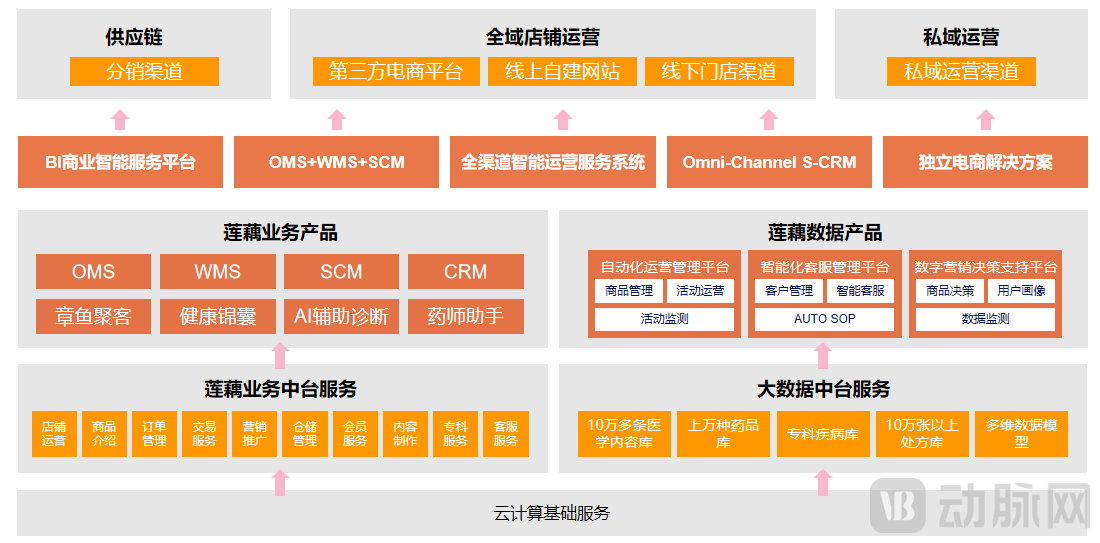
Beneath the surface lies Lianou Health’s deep professional expertise. In the realm of digitalization, the core often manifests in data and systems. Centered on its core solutions, Lianou Health has developed a suite of SaaS systems through a technical development team of nearly 100 professionals.
 Compiled from Lotus Health Data
For example, in its internet hospital solutions for delivering medical services, Lianou Health has developed the Lianou Doctor Internet Hospital System, a specialized pharmaceutical database, a rational drug use system, and an AI-assisted diagnosis and treatment system. Furthermore, it provides clients with private-domain operation solutions, out-of-hospital prescription solutions, specialty-specific intelligent pharmacist solutions, and a Business Intelligence (BI) analytics system.
Operations entail continuous iteration and optimization. By the end of 2021, Lianou Health was facilitating over 300,000 online follow-up consultations daily. Throughout this process, Lianou Health continuously enhanced system operational efficiency, initially by upgrading capabilities such as concurrent consultations and intelligent triage, and subsequently by institutionalizing these early achievements through systematic development. Tools like Lianou Shuxun serve to unlock the market value of its products. In 2022, Lianou Health will continue to explore market-oriented strategies in its SaaS services.
In fact, in 2021, at the upstream pharmaceutical manufacturing level, Lianou Health had established strategic partnerships with more than 50 pharmaceutical companies, including China Resources Sanjiu, Kelun Pharmaceutical, Jianmin Group, and Scrianen. It deeply operated over 600 products, and its SaaS and internet healthcare services effectively reached 130,000 pharmacies.
For Lianou Health, building a data- and algorithm-based precision medicine digital marketing platform is the company’s long-term goal, which in fact also reflects the development direction of pharmaceutical digital marketing.
In the era of Pharmaceutical Digital Marketing 1.0, the primary focus was on the digitization of information. During this phase, online digital platforms for offline physical entities emerged. In the era of Pharmaceutical Digital Marketing 2.0, greater emphasis was placed on scenario-based tooling, with one-stop end-to-end service platforms beginning to appear and experiencing rapid growth. In the 3.0 era, pharmaceutical digital marketing will increasingly trend toward building precision marketing platforms based on data and algorithms.
Wang Yanxiong stated, “In the long run, the development and application of various types of medical digital assets (encompassing data such as supply chains, transaction behaviors, disease maps, and patient-physician profiles) are expected to translate into greater new commercial value. This includes digital supply chain services, digital marketing services, digital therapeutics, digital R&D services, and cost-containment management for basic medical insurance and commercial health insurance. In the future, the capability to ‘accumulate and operate’ data assets may become a core competitive advantage.”
This will further promote the development of the digital pharmaceutical marketing industry.
Currently, Lianou Health has officially launched its fundraising round. The company also seeks like-minded partners to jointly usher in the era of Digital Marketing 3.0.