

Babylon Health Reports $80 Million Revenue in January Alone, Projects Up to $1 Billion for 2022

Babylon
Digital Health Service Provider
You may have seen profitable companies, but you have certainly never seen one this profitable—at the J.P. Morgan Healthcare Conference, Babylon Health (“Babylon”), a veteran UK-based digital health company that had only just listed on the NASDAQ in October 2021, announcedRobust Performance—Revenue for January 2022 Alone Is Projected to Reach $80 Million (Approximately RMB 500 Million), with the Upper Limit of the Full-Year Revenue Target Raised to a Staggering $1 Billion (Nearly RMB 6.4 Billion)!
Is Babylon’s audacious goal merely a case of “unwarranted confidence,” or is it the result of careful deliberation? What underpins this ambition? VCBeat (WeChat ID: Vcbeat) offers an analysis to provide insights for the industry.
Public information indicates that Babylon has just finalized a value-based care agreement in the United States. This will bring 88,000 new members to its platform and raise its projected revenue for January 2022 to $80 million. Following this signing, Babylon’s global membership under value-based care services has reached 440,000.
Meanwhile, Babylon also conducted a preliminary assessment of its 2021 annual revenue, projecting that full-year revenue would reach its previously set target of $321 million. Based on the optimistic indicators reflected in these figures, Babylon announced an upward revision of its 2022 revenue forecast to $900–$1 billion. This represents an increase from the previous $710 millionProjected revenue for 2022 is expected to surge by a substantial 40%, reaching approximately three times the projected revenue for fiscal year 2021.。
Such a substantial growth forecast even prompted Babylon’s founder and CEO, Ali Parsa, to offer a humblebrag—he noted that while Babylon’s sustained expansion in healthcare may appear exceptional, it is in fact no different from the rapid growth rates seen in the early stages of many well-known disruptive digital innovators such as Amazon, Netflix, Tesla, or Airbnb.
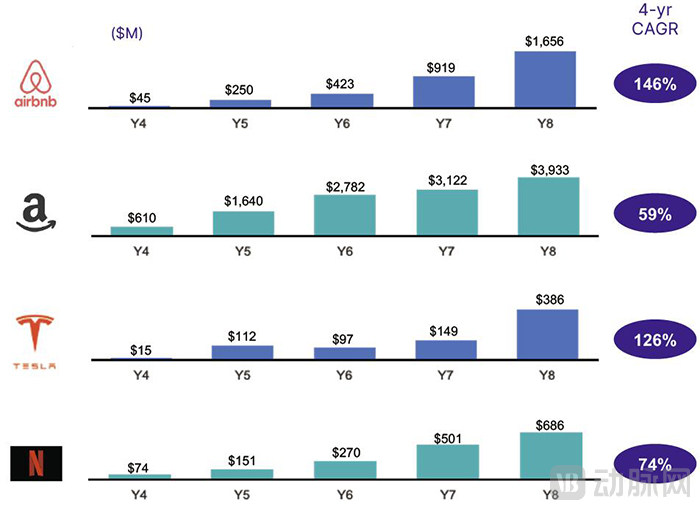
Revenue Growth Trends of Amazon, Netflix, Tesla, and Airbnb (Screenshot)From Babylon’s Public Documents)
Although this statement may appear modest, a comparison of data reveals that Amazon, Netflix, Tesla, and Airbnb achieved four-year compound annual growth rates (CAGR) in revenue of 59%, 74%, 126%, and 146%, respectively, during the four years following their initial revenue generation. How did Babylon, which began generating revenue in 2018, perform on this metric?
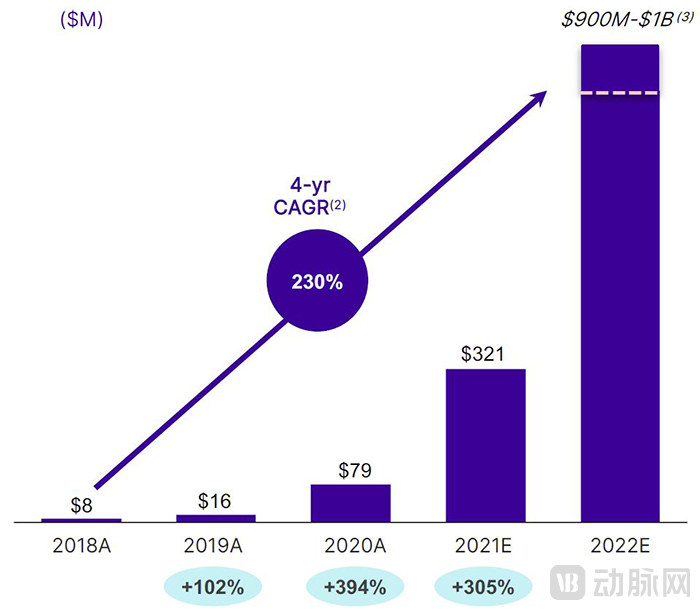
Babylon’s Revenue Growth Trend Far Outpaces That of Other Innovative Enterprises
In 2018, Babylon generated $8 million in revenue. A year later, in 2019, its annual revenue reached $16 million, representing a year-on-year growth of 102%. In the subsequent years of 2020 and 2021, its annual revenue growth rate more than tripled each year, resulting in a four-year compound annual growth rate (CAGR) of 230%.This metric is 3.9 times, 3.1 times, 1.8 times, and 1.6 times that of Amazon, Netflix, Tesla, and Airbnb, respectively.—Ali Parsa’s “humblebrag” is all too predictable.
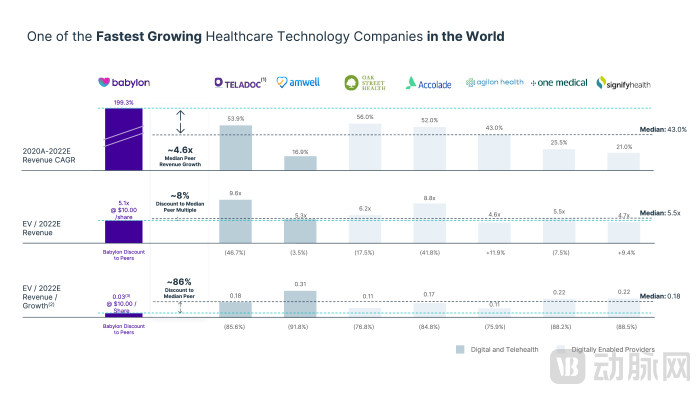
Babylon vs. Industry Average (Screenshot)From Babylon's Public Documents)
Compared with its peers, Babylon’s growth rate is even more astonishing. ItsThe compound annual growth rate (CAGR) of revenue from 2020 to 2022 reached as high as 199.3%, which is 4.6 times the median of 43% among major companies in the industry.. No wonder Babylon calls itself “The World's Fastest-Growing Digital Health Company”。
Why Is This Company So Profitable? Babylon’s Distinctive Service System May Be One of the Most Critical Factors. Babylon’s service architecture differs slightly from that of other telemedicine companies, with its overall service model forming a “pyramid” structure.
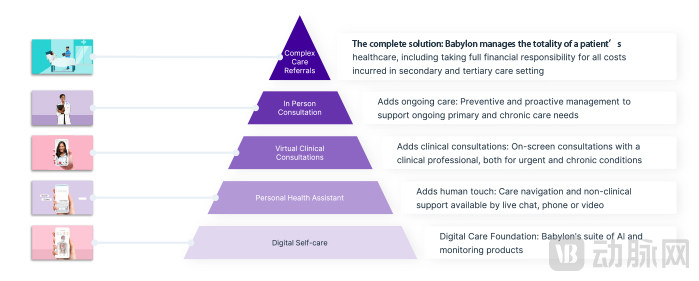
Babylon’s Digital “Pyramid” Service System
The base of the “Pyramid” is built on a mobile app to enable users’ self-management of their health. The mobile application can collect multi-dimensional health data from members, leverage artificial intelligence to create personalized health goals for them, and track their progress.
This level is critical for Babylon. Through digital tool assessments, Babylon helps members understand their current health metrics and trends; most importantly, it enables risk stratification of the served population. Subsequently, Babylon can provide early intervention alerts or establish health goals for members to maintain their well-being and prevent deterioration of their health status.
Babylon Personal Health Assistant constitutes the second tier, helping members meet their healthcare needs by providing non-clinician support through chatbots or human interaction.
Babylon’s personal health assistant includes a comprehensive symptom-checking feature. Members can answer questions about their symptoms and be guided toward potential matching conditions. This enables members to promptly access accurate information—such as medication and care guidance—when they are ill, thereby facilitating self-assessment and self-care.
If user needs remain unmet and require the involvement of professional healthcare providers, Babylon will introduce clinical services delivered by qualified medical professionals. Babylon first provides 24/7 remote clinical consultations, enabling members to communicate with healthcare professionals to address their urgent or chronic care needs.
Most members’ healthcare needs can be addressed through the aforementioned methods; however, when in-person medical services are genuinely required, Babylon also facilitates face-to-face consultations with healthcare professionals. If such in-person care still fails to resolve the member’s issue, Babylon will refer them to third-party partner medical institutions, which will provide comprehensive medical care.
Once users have fully recovered, Babylon leverages its digital service capabilities to provide extensive follow-up care, including medication management, nursing, and rehabilitation advice, thereby ensuring that members maintain their health in optimal condition—after all, as long as members remain healthy, their membership fees translate into profits for Babylon.

Babylon’s Recent Financial Data (Source: Babylon Prospectus; Chart by VCBeat)
Babylon generated $120 million in revenue in the first half of 2021, with an actual net loss of $75.7 million. As full-year revenue is projected to exceed $300 million, the loss is expected to narrow further.
Babylon’s prospectus also reveals the specific composition of its revenue. Currently, Babylon’s primary revenue streams consist of three components: value-based healthcare services, clinical services, and software licensing.

Babylon’s Overall Revenue Composition (Data sourced from Babylon’s prospectus; chart by VCBeat)
Value-based healthcare services have become Babylon’s primary source of revenue in recent years, with their share of total revenue rising from 32.9% to 51.6%. Under this model, Babylon partners with healthcare organizations to receive fixed capitation payments and provides corresponding medical services to members enrolled in the relevant health plans, achieving profitability by keeping costs below actual expenditures.
To achieve cost reduction, Babylon strengthens chronic disease management for its members through proactive and preventive care, keeping them healthy and thereby avoiding unnecessary emergency room visits and hospitalizations. Meanwhile, it leverages the continuous application of digital technologies to lower costs and improve member health management.
In most cases, these services can ensure Babylon’s profitability, although occasional unexpected scenarios cannot be ruled out. Therefore, Babylon also purchases “stop-loss” insurance for all value-based healthcare service contracts—this insurance kicks in when expenditures on any single patient exceed expectations by a certain threshold. The cost of such stop-loss insurance accounts for only a few percentage points of its revenue.
Currently, Babylon has built one of the largest value-based care networks in the United States, and its coverage is expanding rapidly, with clients including BNP Paribas, HSBC, Shell, and BuzzFeed. Its prospectus shows that as of September 30, 2021, its value-based care services had only about 100,000 members. ButBy January 2022, this service network had amassed as many as 440,000 members, representing a more than fourfold surge in just three months.。
These services have gained popularity partly because they can effectively reduce medical costs. Babylon published a peer-reviewed study in the Journal of Medical Internet Research. The study analyzed emergency care utilization in Northwest London from April 1, 2018, to March 31, 2019, and found that Babylon’s services saved its members up to 35% on emergency care costs.
Furthermore, the UK’s National Health Service (NHS) commissioned Ipsos MORI to conduct a study on Babylon’s services. The study analyzed emergency department (ED) visits over a two-year period—comprising the year before and the year after members enrolled in the service—and found that Babylon’s services reduced ED visits by 25%. Given the exorbitant cost of emergency care abroad, it is unsurprising that Babylon has gained significant popularity among both employers and employees.
Babylon’s clinical services are customized to meet client needs, yet all users have full access to its comprehensive suite of digital health solutions, including app-based tools and consultations with licensed healthcare professionals. This service model combines fee-for-service and capitation payment structures. For instance, in the UK, Babylon users can choose to pay £49 per consultation or opt for an annual subscription of £149 for unlimited consultations. If members require physiotherapy, Babylon charges £25 per session for members and £35 per session for non-members.
Returning to Babylon’s “pyramid” service system, value-based healthcare services constitute the base of the pyramid, while clinical services occupy the middle and upper tiers. Prior to 2021, clinical services were Babylon’s largest source of revenue. However, as Babylon has secured an increasing number of value-based healthcare contracts, the proportion of revenue derived from clinical services has declined significantly.
According to data disclosed in the prospectus, its clinical services generated revenue of US$28.631 million in 2020 and US$18.134 million in the first half of 2021. Given that its covered population grew fourfold within just six months, the growth rate of clinical service revenue was significantly lower, and its proportion of total revenue declined substantially. This likely indicates that value-based healthcare services are playing a “gatekeeper” role, enabling more conditions that might otherwise have progressed to require clinical intervention to be resolved at an early stage.
Software licensing primarily refers to the cloud platform licenses that Babylon provides to healthcare institutions and payers. For example, Babylon entered into a seven-year licensing agreement with Telus Health in Canada, allowing Telus to use Babylon’s platform while delivering services under the Telus brand.
While positioning itself as a premium provider, Babylon also draws comparisons with its peers to highlight its distinct advantages. Compared to common telehealth companies such as Teladoc and Amwell, Babylon’s services are more scalable, offering broader and more flexible medical care rather than being confined to specific specialties. This approach also enables Babylon to achieve higher revenue per customer.
Teladoc projected revenues of $2.03 billion for 2021 and planned to achieve $2.6 billion in revenue by 2022. By comparison, Babylon remains relatively small. However, Teladoc’s revenue is heavily dependent on its number of covered members, which has been the primary driver behind its aggressive acquisitions and expansion since its inception. In recent years, this growth rate has slowed significantly, with its domestic member count in 2021 increasing by only 2% compared to 2020. Therefore, Babylon’s claim of superior profitability is not without merit.
Although digitally enabled healthcare companies such as Livongo (acquired by Teladoc) and One Medical demonstrate strong profitability, they remain predominantly physical entities with certain limitations in digital capabilities. For these companies, digital technology serves at best as a technical support function rather than a top strategic priority. Due to the lack of end-to-end technological capabilities and their reliance on asset-heavy physical models, their business scalability is relatively limited and slow.
Babylon’s digital solutions are ubiquitous, enabling fully integrated, personalized healthcare and access across the entire care continuum. Members can obtain “24/7” on-demand care through its digital platform or receive local medical services via third-party contracted healthcare institutions, thereby demonstrating advantages in scalability and flexibility.
For example, when entering Missouri in the United States, Babylon partnered with Home State Health to rapidly achieve coverage. Leveraging its digital capabilities and existing local medical services, it served approximately 17,000 members with limited incremental investment.
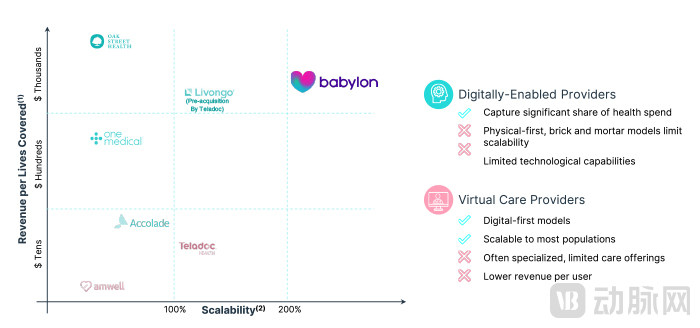
Compared with the industry, Babylon’s model is more distinctive (screenshot from Babylon’s official public documents)
Therefore, relatively speaking, Babylon combines the strengths of both types of enterprises, possessing both strong profitability and robust scalability. Ultimately, Babylon’s technological advantages are the key to integrating these strengths.
Babylon has accumulated extensive expertise in artificial intelligence over many years. In 2018, Tencent also collaborated with Babylon in the field of AI. Currently, Babylon employs a team of more than 750 AI researchers and developers across three global locations, and its cumulative investment in technology over the past three years has exceeded $300 million.
These investments have played a significant role. According to tests, Babylon’s artificial intelligence performs on par with mid-level general practitioners in diagnosing conditions, and 48% of Babylon’s current operations can be handled by AI assistants. In turn, these digital solutions generate substantial data for AI learning, further enhancing algorithmic accuracy. Additionally, 84% of medical services are delivered via virtual online channels. All of this enables strict and precise cost control.
Babylon has successfully translated these advantages into customer satisfaction—its user retention rate exceeds 95%, and approximately 90% of users have given its app a 5-star rating. In the first half of 2021, Babylon assisted one patient every five seconds, recording around 1.7 million AI interactions and 1.3 million consultations.
To pursue further growth, Babylon also initiated its public listing process in 2021. In June 2021, it announced that it would enter into a definitive business combination agreement with the special purpose acquisition company (SPAC) Alkuri Global Acquisition Corp. (“Alkuri”). In October, the two companies completed$4.2 Billion MergerThe merged new company operates under the entity Babylon and is listed on the Nasdaq stock market under the ticker symbol “BBLN”.
With this, the UK-based company founded in 2013 has completed the first phase of its lifecycle.
Compared with its peers, Babylon’s path to going public was nothing short of lightning-fast. Teladoc, the first publicly traded telemedicine company, took a full 13 years from its founding in 2002 to its IPO in 2015. Amwell, Teladoc’s main competitor, was founded in 2006 and finally went public in 2020, taking 14 years. By contrast,Babylon took only 8 years。
When considering the company’s location, such rapid progress becomes even more commendable. It is well known that the market and regulatory environments faced by European healthcare companies differ significantly from those in the United States. Although the European Union provides a unified framework, individual member states impose their own specific requirements. This fragmented multi-country landscape often subjects European startups to various constraints and challenges.
Taking online healthcare as an example, France did not pass legislation permitting the provision of medical diagnoses and treatments online until late 2018. It was not until August 2019 that Germany legalized the dispensing of medications without a prior physician consultation. In comparison, the United Kingdom has been more open and innovation-friendly among European countries; coupled with its strong position in global finance, this has facilitated robust growth for UK-based digital health enterprises.
Nevertheless, Babylon clearly recognized that its rapid growth required the boost of markets with more favorable regulatory environments. Therefore, from the outset, Babylon expanded its operations globally, leaving its mark in North America, Europe, Asia, and even Africa. This is one of the key factors distinguishing it from other European digital health companies.
This global perspective stems, to some extent, from its founder. Ali Parsa, the founder of Babylon, is an Iranian-born serial entrepreneur who began his entrepreneurial journey in 1990 to fund his academic research while studying in London, subsequently establishing multiple companies. In addition, he has experience in the financial sector, having worked for two years each at Credit Suisse and Goldman Sachs in the United States.
These factors have made Babylon a company of significant interest among European digital health enterprises. Some enthusiasts once conducted a rough overview of the top 14 digital health startups in Europe in 2019,Babylon raised $550 million in a single financing round in 2019, an amount that exceeded the total funding of all other companies on the list.。

Babylon’s Historical Financing and Investment Overview (Chart by VCBeat)
In addition to its status as a high-quality, scarce asset, another reason for Babylon’s rapid listing was the recent surge in popularity of SPACs. As capital market interest rates continued to decline, increasingly large pools of capital struggled to find sufficient high-quality assets, prompting the exploration of new instruments and driving both the number of SPAC IPOs and their financing volumes to record highs. Among these, specialized SPACs focused on the healthcare sector emerged slightly later but have since experienced rapid growth.
In 2021, a total of 613 SPACs were listed on Nasdaq, raising a staggering $145 billion, representing a 91% increase from 2020. In 2020, the number of SPAC listings on Nasdaq (248) surpassed that of traditional IPOs (223) for the first time; in 2021, SPACs further outpaced IPOs with 613 listings compared to 420—solidifying SPACs as the mainstream choice.
The public listing has laid a solid foundation for Babylon’s further expansion. In its strategic vision, the company plans to grow its business by expanding population coverage and service offerings in existing markets, as well as entering new markets through both new and existing customers. This growth will rely on two key approaches: strategic partnerships and acquisitions, and continued investment in technology.
In terms of strategic partnerships and acquisitions, Babylon has been quite active over the past two years, frequently engaging in collaborations and acquisitions. Judging from its acquisition activities, the primary objective remains expanding business coverage. For instance, the most recent acquisition took place on December 31, 2021, when Babylon acquired Higi. This company operates 10,000 FDA-approved Smart Health Kiosks within retail chains such as Sam’s Club, Kroger, Rite Aid, and Publix. Statistics indicate that approximately 73% of the U.S. population lives within five miles of a Higi kiosk, with more than 61 million individuals having completed over 372 million biometric tests at these kiosks to date. This acquisition will help Babylon expand its reach and provide members with more comprehensive solutions.

Babylon’s Historical Acquisitions and Investments (Chart by VCBeat)
In terms of technology, Babylon has been making continuous investments. Its R&D team of 750 people, distributed across the United Kingdom, the United States, and India, accounts for more than one-third of its total workforce of 2,200 employees. Over the past three years, Babylon has invested $300 million in research and development. As Babylon’s revenue grows, its investment in R&D is expected to expand further.
Compared with other telemedicine providers, Babylon is somewhat of an outlier. With a stronger focus on technology, it has been an early pioneer and benchmark for the application of artificial intelligence in healthcare. Building on this foundation, Babylon has gradually established a “pyramid”-shaped service system and attracted partnerships through value-based payment models, specifically capitation rates.
Leveraging this model and its technological advantages, Babylon has significantly accelerated its development in recent years. Although the COVID-19 pandemic did provide a boost, it is undeniable that Babylon has also addressed widespread pain points in its target market, such as the high cost of emergency care and the difficulty in scheduling medical appointments.
Babylon’s success has recently been emulated by China’s internet healthcare industry. Some internet healthcare companies are exploring the provision of end-to-end medical and health maintenance services to residents, while also piloting payment models such as disease-based and capitation-based bundled payments under global budgeting for medical insurance. Meanwhile, other internet healthcare firms are building digital capabilities—such as developing scalable, AI-driven digital therapeutics—to gain a competitive edge.
Of course, whether Babylon’s success can be sustained in the long term remains to be seen. At the very least, driven by its original aspiration to leverage digital technology to transform and improve healthcare, it has embarked on its own exploratory journey. As its founder, Dr. Ali Parsa, stated, “Our mission is to make high-quality healthcare accessible and affordable for everyone, regardless of their geographic location, economic status, or social class.”