

ALSOLIFE and Peking University Sixth Hospital Launch Joint Development of Autism Spectrum Disorder Screening and AI-Assisted Diagnostic System
On the morning of January 5, the launch meeting for the research and development of the “Autism Screening and Assistive Diagnosis System” was held at Peking University Sixth Hospital. This system is an independently developed tool in China that utilizes interactive videos of children to provide intelligent assistive diagnosis for individuals with autism spectrum disorder (ASD). It was jointly developed by Peking University Sixth Hospital and Beijing Alsolife Technology Co., Ltd. (ALSOLIFE).
Professor Liu Jing, Director of the Child Mental Health Center at Peking University Sixth Hospital; Associate Professor Guo Yanqing, Deputy Director of the Child Mental Health Center; Associate Professor Li Xue, Secretary-General of the Child Mental Health Center; Han Xue, Deputy Director of the Scientific Research Department; Zhang Zhiguang, CEO of ALSOLIFE; and Cheng Jianhong, R&D Director of ALSOLIFE, among others, participated in the launch meeting.
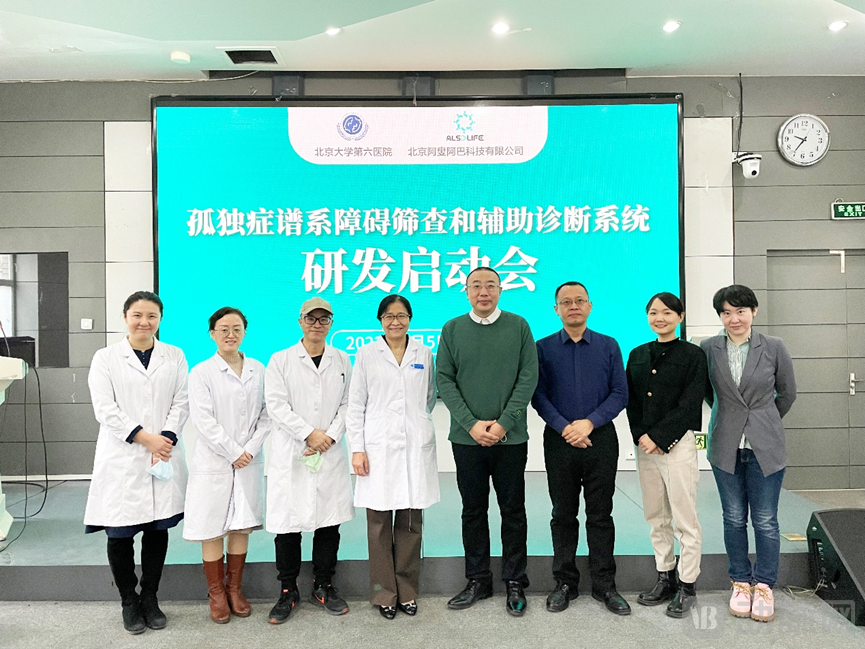
Group photo of the attendees, from left to right: Li Xue, Han Xue, Guo Yanqing, Liu Jing, Zhang Zhiguang, Cheng Jianhong, Ma Zenghui, and Xu Disha.
AI Technology Boosts the Efficiency of Autism Diagnosis
Autism is a neurodevelopmental disorder that originates in infancy and early childhood. Since it was first reported by American physician Leo Kanner in 1943, this disorder has garnered increasingly widespread attention from countries around the world and various sectors of society. It causes long-term and pervasive impairments to patients' psychological development, leading to deficits in social interaction, impairments in verbal and nonverbal communication, restricted interests, and stereotyped, repetitive behaviors. Its prevalence has been steadily increasing; studies from the 1950s and 1960s reported that only 2–4 out of every 10,000 children were affected by autism, whereas recent research indicates that the prevalence has gradually risen to nearly 1%.
Although the reasons for the rising prevalence of autism remain unclear, it is an undeniable fact that an increasing number of children are being diagnosed with this disorder. Numerous studies have explored the etiology and pathogenesis of autism from perspectives including genetics, immunology, maternal health during pregnancy, and even environmental pollution. Autism is widely recognized by the medical community as a condition closely linked to genetic factors, resulting from the interaction between genetic and environmental influences. However, the exact etiology and pathogenic mechanisms of this disorder remain elusive, and consequently, there is a lack of specific, highly effective treatments targeting its underlying causes.
Over the years, continuous exploration by various countries has led to the development of a series of rehabilitation training methods proven effective through research. These methods can promote the development of social interaction, language and communication, cognitive abilities, and other skills in affected children, thereby effectively alleviating their symptoms. Meanwhile, studies have shown that earlier intervention, even starting from infancy, is more likely to yield better therapeutic outcomes. Therefore, early identification and diagnosis are crucial for early intervention in autism and for improving the prognosis of children with autism.
Peking University Sixth Hospital, in collaboration with Beijing Alsolife Technology Co., Ltd. (ALSOLIFE), has jointly developed the “Autism Screening and Assistive Diagnostic System.” Addressing critical pain points in the autism care sector, this initiative leverages extensive diagnostic cases, clinical data, historical literature, and expert clinical experience. In accordance with the DSM-5 criteria for Autism Spectrum Disorder (ASD), it aims to establish an innovative, independently owned intellectual property framework for autism screening and diagnosis. By fully utilizing the latest advancements in artificial intelligence within the information technology sector, the system employs evidence-based approaches to refine the indicator system for autism screening and diagnosis. It utilizes modeling and training based on a machine learning algorithm framework featuring multi-modal fusion to develop AI-powered digital assistive diagnostic tools. These tools provide more convenient and reliable methods for early autism screening, offer auxiliary information to support clinicians’ diagnostic decisions, and thereby facilitate early screening and diagnosis, promote early rehabilitation for children with autism, and improve their long-term prognosis.
Dr. Guo, Chief Physician at Peking University Sixth Hospital, described the R&D collaboration between the hospital and ALSOLIFE as a “powerful alliance.” He stated, “Peking University Sixth Hospital has been dedicated to clinical practice and scientific research in autism spectrum disorder (ASD) for nearly four decades, accumulating extensive diagnostic data and resources for children with autism. ALSOLIFE, founded by parents of children with autism, emphasizes evidence-based interventions and rigorous scientific research. In the context of the broader digitalization trend, our joint development of this product aligns with the times. It is a mission of great significance with promising prospects, and I am deeply honored to be part of the R&D team. Meanwhile, how to provide the most appropriate support after earlier and more comprehensive identification of children with autism remains a significant challenge for us in the future.”
As the father of a child with autism, Zhang Zhiguang, CEO of ALSOLIFE, deeply understands the significance of early diagnosis and early intervention for children with autism and their families: “Due to its unique characteristics, autism cannot currently be diagnosed through biochemical indicators such as genetic testing, blood tests, or magnetic resonance imaging (MRI). Moreover, medical resources are extremely limited. Families often travel to multiple locations and spend years seeking a definitive diagnosis for their child, thereby delaying the critical window for early rehabilitation. We are honored to have collaborated with Peking University Sixth Hospital, a flagship institution in autism research in China, to jointly develop this product. By leveraging big data technology to quantify and visualize autism diagnostic data, we aim to provide an intelligent ‘stethoscope’ for autism diagnosis. Our goal is to further reduce the age at which children are diagnosed, enabling earlier detection, intervention, and treatment of autism, and ultimately improving prognostic outcomes for children with autism.”
Digital Health Holds Great Promise in Assisting the Diagnosis of Mental Disorders
This screening and computer-aided diagnosis system employs an action recognition algorithm based on multi-channel Long Short-Term Memory Recurrent Neural Networks (LSTM-RNN) to detect, recognize, compare, and analyze facial features and human behaviors in images, audio, and video data. It further performs modeling and training using a machine learning framework based on multimodal fusion, enabling two-level weighted classification and assessment to generate an auxiliary screening and diagnostic report for reference by diagnosing physicians.
The system fully integrates mobile technology and machine learning algorithms to reach a broader population of children with autism and their families, enabling access to screening and auxiliary diagnostic services via internet connectivity. This achievement holds significant importance for advancing autism diagnosis and establishing early screening systems for childhood developmental disorders, while also demonstrating the substantial potential of digital healthcare applications in the diagnosis of mental illnesses. To date, the project has filed nine invention patents in relevant technical fields, with three patents granted and eleven software copyrights registered.
Liu Jing, Chief Physician at Peking University Sixth Hospital, has dedicated many years to the field of childhood autism. She believes that the development of this system is highly significant for industry advancement: “In the realm of autism screening and diagnosis in China, Peking University Sixth Hospital has consistently remained at the technological forefront. In the 1990s, under the leadership of Professor Yang Xiaoling, our hospital was the first to introduce the internationally recognized Autism Behavior Checklist (ABC). Subsequently, we introduced the Modified Checklist for Autism in Toddlers (M-CHAT), the Autism Spectrum Screening Questionnaire (ASSQ), the Autism-Spectrum Quotient (AQ), the Aberrant Behavior Checklist, as well as a self-developed childhood autism screening scale. These efforts have contributed significantly to the screening, diagnosis, and treatment efficacy evaluation of children with autism in China. With advancing times, Peking University Sixth Hospital aims to leverage technologies such as big data and artificial intelligence through collaboration with ALSOLIFE, facilitating earlier diagnosis for more children with autism and better serving their families.”