

Telix Pharmaceuticals: A High-Growth Radiopharmaceutical Company with Over 1000% Stock Surge Since IPO, Focused on Innovative RDC Pipeline and Strategic Global Collaborations

Telix Pharmaceuticals
Radiopharmaceutical Developer
On the evening of December 21, 2021, Grand Pharma (0512.HK) announced that TLX591-CDx, a globally innovative radiopharmaceutical diagnostic compound (RDC) developed by Telix Pharmaceuticals Limited (“Telix”) for prostate cancer diagnostic imaging, had officially received marketing approval from the U.S. FDA.
Telix is a key strategic partner of Grand Pharma in the field of radionuclide drug conjugates (RDCs), with Grand Pharma holding approximately 7.35% equity stake.
One month ago.
On November 1, 2021, Grand Pharma announced the signing of a licensing agreement with Telix Pharmaceuticals, an Australian listed company. Under the agreement, Grand Pharma will pay upfront and milestone payments totaling up to USD 225 million to secure exclusive commercialization and manufacturing rights in Greater China for several innovative Radiopharmaceutical Diagnostic and Therapeutic (RDC) products—namely TLX591, TLX250, and TLX101—for the treatment of prostate cancer, clear cell renal cell carcinoma, and glioblastoma. Additionally, within a specified period, Grand Pharma will hold the right of first negotiation for the exclusive development, manufacturing, and commercialization rights in Greater China for other pipeline products from the Telix Group.
What makes this somewhat enigmatic Australian radiopharmaceutical company so compelling that Grand Pharma, a new giant in China’s radiopharmaceutical sector, has invested heavily in both product licensing and equity stakes? VCBeat attempts to provide a detailed analysis from four perspectives: the company’s profile, its flagship products, acquisitions and partnerships, and its leadership team.
Compared with nuclear medicine companies that boast R&D histories spanning decades or even a century, Telix is remarkably young.
In November 2015, Telix was founded in Melbourne, Australia, as aBiotechnology Company Focused on RDCs, focusing on novel radionuclide–targeted molecular drug conjugation technology, and leveraging this innovative technology platform to advance the development and application of RDCs in cancer diagnosis and treatment.
On November 15, 2017, the company was listed on the Australian Securities Exchange under the ticker symbol TLX, with a closing price of AUD 0.77 per share on its debut day. As of January 14, 2022, the closing price had surged more than tenfold to AUD 8.67 per share, making it one of the most outstanding performers in Australia’s healthcare sector in recent years.
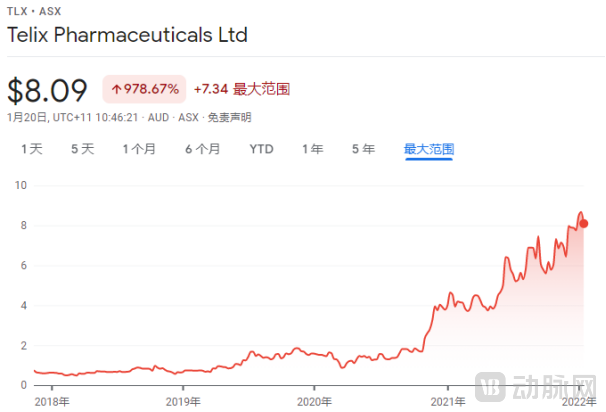
As of January 20, 2022, Telix’s share price has surged by over 1,000% since its listing. Image source: Google Finance
Telix's Pipeline CoverageVarious cancers with high incidence and mortality rates, such as prostate cancer, kidney cancer, glioblastoma (brain cancer), blood cancers, bone marrow transplantation, and other rare tumors, with over ten clinical trials currently underway globally. In the R&D pipelineThree products have been granted orphan drug designation, and one product has received breakthrough therapy designation.
According to the financial report,The company currently has 17 drugs in clinical trials.Its radiopharmaceutical pipeline mainly includes:
TLX591 (177Lu-DOTA-Rosopatamab), which has completed Phase II clinical trials for the treatment of prostate cancer;
TLX250 (177Lu-DOTA-Girentuximab), indicated for the treatment of clear cell renal cell carcinoma, with two Phase II clinical trials of combination immunotherapy regimens即将开展;
TLX101 (¹³¹I-IPA), indicated for the treatment of glioblastoma, has received FDA orphan drug designation and is currently in Phase I/II clinical trials.
Prostate cancer is the fourth most common cancer worldwide and the second most common cancer among men. According to GLOBOCAN 2020 data, there were over 1.4 million new cases and more than 370,000 deaths from prostate cancer globally in 2020. In China, there were over 110,000 new cases and more than 50,000 deaths, with an incidence rate of approximately 10.2 per 100,000 people, showing a year-on-year upward trend.
For this disease indication, Telix has launched a prostate cancer program, including aDiagnostic Imaging Product TLX591-CDx (Brand Name: Illuccix®)andA Therapeutic Candidate Drug (TLX591)。
the formerIlluccix® is Telix’s flagship product, approved by the FDA in December 2021.
Illuccix® (TLX591-CDx) is a kit for the preparation of gallium-68 gozetotide (also known as PSMA-11) injection. It is a radiodiagnostic agent that enables rapid radiolabeling at room temperature. Physicians administer the radionuclide68After injection of Ga-labeled radiopharmaceuticals into the patient, positron emission tomography (PET) is used to image the prostate and detect PSMA-positive lesions.
Illuccix testing is currently indicated for two scenarios: patients with suspected cancer cell metastasis during initial treatment, and patients with suspected prostate cancer recurrence based on elevated serum prostate-specific antigen (PSA) levels.
The targeting agent PSMA-11 in TLX591-CDx can specifically bind with high affinity to PSMA, which is highly expressed in prostate cancer, possessingCapable of cellular internalization, stable biological activity, short in vivo circulation half-life, and good penetration into tumor parenchymaandRapidly cleared by non-target tissuesFive Key Features.
According to FDA approval, the recommended dose of radioactive TLX591-Dx for adults is 111 MBq to 259 MBq (3–7 mCi), administered as an intravenous bolus. Imaging should be performed 50 to 100 minutes after administration, and patients should void immediately before imaging begins. Scanning should start from the caudal end and proceed toward the cranial end.
In terms of clinical research, the clinical study of TLX591-CDx conducted in Japan in June 2021 will accumulate safety data in Asian populations for the product’s registration in China.Currently, the registration work for this project in China is being steadily advanced by Grand Pharma, with the Investigational New Drug (IND) application expected to be submitted to the National Medical Products Administration (NMPA) of China in the first quarter of 2022.)。
The NCCN (National Comprehensive Cancer Network) Prostate Cancer Guidelines (2020 Edition) recommend TLX591-CDx as a novel positron emission tomography (PET) radiotracer, citing its superior detection of recurrence in patients with low PSA levels compared to other approved tracers. Clinical trials have demonstrated that TLX591-CDx is a novel PET radiopharmaceutical for prostate cancer diagnosis with high accuracy and sensitivity. In the preoperative assessment of patients at high risk for metastasis, it exhibits higher sensitivity and accuracy than conventional CT.
Meanwhile, TLX591-CDx demonstrated significantly superior detection rates for recurrent prostate cancer lesions compared to 18F-Fluciclovine PET-CT, a radioactive PET tracer used for prostate cancer recurrence. PSMA imaging has been incorporated into clinical practice guidelines in the United States and Europe, and the CSCO Guidelines for Diagnosis and Treatment of Prostate Cancer (2020) also recommend PSMA imaging for the diagnosis of recurrent prostate cancer, fully underscoring the superiority of PSMA imaging. This provides a solid foundation for the rapid market promotion of TLX591-CDx following its launch.
Telix stated that TLX591-CDx plus68Ga-68 radiolabeling confers a 4-hour shelf life, enabling broader adoption of PSMA-PET imaging across the United States. The distribution network comprises 140 nuclear pharmacies, ensuring TLX591-CDx availability at 85% of PET imaging sites.
Dr. Christian Behrenbruch, CEO of Telix Pharmaceuticals, stated: “The approval of TLX591-CDx signals to patients and physiciansEntering the new era of gallium-based PSMA-PET imaging marks a significant new phase as we bring our first commercial product to the U.S. market."Improved imaging technologies can provide physicians with insights to determine the most appropriate treatment pathways, offering U.S. patients a specialized and sensitive imaging tool for detecting prostate cancer and its metastases."
The latter, TLX591 (¹⁷⁷Lu-DOTA-rosopatamab), is an antibody-based therapeutic radiopharmaceutical targeting prostate-specific membrane antigen (PSMA). TLX591 (Therapy) is currently undergoing Phase III clinical trials in Australia.
In the pharmaceutical industry, there are two well-known expansion models. One is through independent research and development-driven innovation, while the other is through mergers and acquisitions (“buying spree”).
Mergers and acquisitions (M&A) for expansion require substantial capital outlays. For start-ups in particular, they consume significant resources, and acquisition targets may pose “black swan” risks; hence, Telix has been exceedingly cautious in this regard. According to publicly available information, Telix has completed three acquisitions to date, two of which occurred after its listing, primarily to expand its pipeline.
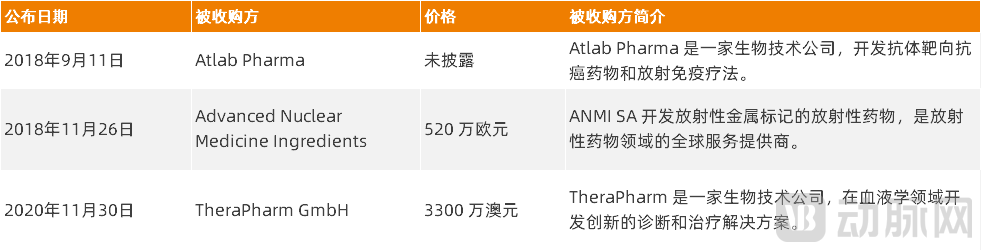
Telix Acquisition Details, Data Sourced from Crunchbase
In stark contrast to the low-frequency, steady acquisitions,Telix is highly proactive in external collaborations,Advancing with remarkable momentum, the enthusiasm for collaboration has been growing by the day in recent years.
According to public data, since its listing, Telix has13 Collaborations. Its partners, modes of cooperation, and areas of collaboration are also diverse.
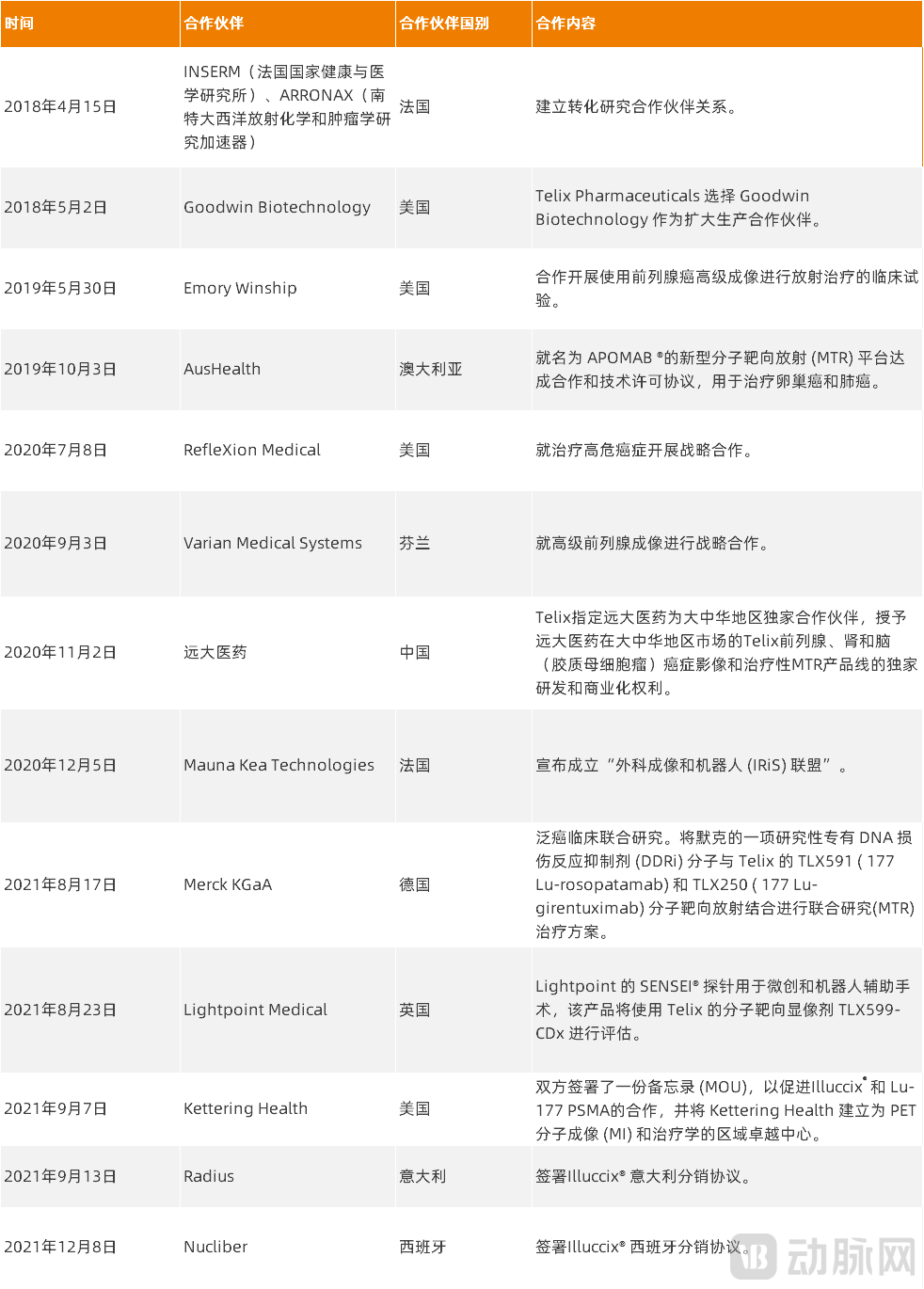
Telix’s Historical Partnerships. Data compiled from public sources; graphic by VCBeat
Telix’s collaborators include bothNational Medical Research Center, also haveAccelerator, andListed CompanyandEmerging Enterprises。
Cooperation models include not onlyJoint Research, also haveProduction Cooperation, and alsoClinical Trials, EstablishAlliance, Distributionetc., and so on.
"Diverse partners and varied collaboration models, like a diamond cutter, meticulously polish every facet of Telix, enabling it to shine with brilliance and stand head and shoulders above the competition in the industry."
Frequent and intensive collaborations have enabled Telix to achieve rapid growth over the past eight years, a success inseparable from the strategic acumen of its outstanding management team.

Dr. Christian Behrenbruch, CEO and Co-Founder
Telix CEO and Co-Founder Christian Behrenbruch,Possesses over 20 years of entrepreneurial and executive leadership experience in the healthcare sector. Their academic credentials and professional track record are nothing short of brilliant.
Christian is an exemplary scholar—he holds a DPhil in Biomedical Engineering from the University of Oxford, a joint EMBA degree from New York University, a Doctor of Laws (LLD) from the TRIUM Global Executive MBA program (a consortium of HEC Paris, the London School of Economics and Political Science, and New York University’s Stern School of Business), and a Juris Doctor from the University of Melbourne. He has served as a Fellow of Engineers Australia within both the Graduate School of Management and the Faculty of Biomedical Sciences, and is a Graduate of the Australian Institute of Company Directors.
With a high-profile background, his professional track record is even more impressive—he has served as CEO or Executive Director at Mirada Solutions, CTI Molecular Imaging (now acquired by Siemens Healthineers), Fibron Technologies, and ImaginAb, Inc. He is a former director of Momentum Biosciences LLC, Siemens Molecular Imaging Ltd., and Radius Health Ltd. (now Adaptix), and the former Chairman of Cell Therapies Pty Ltd (in collaboration with the Peter MacCallum Cancer Centre).
Christian currently serves as a director of the Australian-listed company Factor Therapeutics (ASX: FTT) and previously served as a director of Amplia Therapeutics Limited (ASX: ATX).

COO, Dr. Gabriel Liberatore
Dr. Gabriel, COO of the Company,He holds a Ph.D. in Neuroscience from the University of Melbourne, completed postdoctoral research at Columbia University, and earned an MBA from La Trobe University. He has over 20 years of experience in pharmaceutical and biotechnology development, as well as in operations and management functions.
Gabriel holds scientific qualifications and a robust R&D background, having previously worked at CSL Limited (ASX: CSL), Deloitte (Australia), Swisse Wellness (112.HK), and the PACT Group (ASX: PGH).
He is also a member of the Advisory Board at Swinburne University and the Australian Institute of Company Directors.

Chief Medical Officer Dr. Colin Hayward
Chief Medical Officer, Dr. Colin Hayward,With over 20 years of global experience in pharmaceuticals, biotechnology, and drug development, and leading Telix’s medical affairs, regulatory, clinical operations, and pharmacovigilance activities worldwide.
Prior to joining Telix, Hayward served as Chief Medical Officer at Premier Research, a globally leading CRO.
Dr. Hayward has held a range of senior medical, executive, and board positions at F. Hoffmann-La Roche, Myriad Genetics, Prism Ideas Ltd, and Symprove Ltd. Early in his career, he also worked for the UK National Health Service, focusing on clinical practice in critical care and anaesthesia. Dr. Hayward holds a medical degree from the University of London and is a Fellow of the Royal Pharmaceutical Society of Great Britain.
Overall, Telix’s executive team is composed of outstanding leaders with decades of management experience in the healthcare and life sciences sectors, laying a solid foundation for the company to overtake competitors and achieve rapid growth.
In just eight years, Telix has rapidly evolved from a nuclear medicine startup into a high-market-cap company, with its footprint and ambitions spanning the globe. The Telix story has only just begun… let us wait and see.