

POINT Biopharma Global Inc. IPO Prospectus: A Late-Stage Radiopharmaceutical Company Challenging Novartis in Phase III with Precision Oncology Pipeline

POINT Biopharma Global
Radiopharmaceuticals Developer
In July 2021, the massive industrial building along Georgetown Road was a hive of activity, with workers racing against time to install and operationalize all equipment before the end of August.
Just a year ago, this 77,000-square-foot building—roughly the size of a standard soccer field—served as a distribution center for an Italian food company. Now, the mission of this site has been redefined: it is being transformed into a manufacturing facility for POINT Biopharma, an Indianapolis-based publicly traded company, shifting its purpose from safeguarding human stomachs to protecting human health.
POINT Biopharma is a radiopharmaceutical company that has built a platform for the clinical development and commercialization of anticancer radioligands.
As forklifts sped across the floor, workers moved massive laboratory equipment into place. Nearby, a middle-aged man with short brown hair, a slightly receding hairline, and thin-rimmed glasses walked around the site. He was Todd Hockemeyer, Executive Vice President of Manufacturing at POINT Biopharma.
The man carefully examined the office, factory workshop, cleanroom, production room, laboratory, and command center, along with every detail within his view.

Executive Vice President of Manufacturing, Todd Hockemeyer
“The equipment in this small workstation is worth approximately $180,000; handle it with care during installation,” he said, pointing to a large piece of equipment in the quality control laboratory. “This facility will enable POINT Biopharma’s drug manufacturing operations to become operational rapidly, marking a significant milestone in our mission.”
The facility is designed to manufacture radioligand therapies, a technology that promises to deliver radiation to cancer cells with greater precision than chemotherapy.
Constrained by the short half-lives of radiopharmaceuticals, POINT Biopharma applied extremely stringent criteria in selecting its manufacturing site. The facility was ultimately located in Indiana, known as “the Crossroads of America.” With its extensive transportation network, drugs with ultra-short shelf lives can be delivered to destinations across the United States within hours and shipped via air freight to other parts of North America and Western Europe within 48 hours.
As efforts to conquer cancer intensify, the field of radiopharmaceuticals is poised for explosive growth. According to data from MEDraysintell, a European research firm specializing in nuclear medicine, the global nuclear medicine market is projected to grow fivefold over the next decade, reaching $30 billion by 2030.
Yet the current clamor and fervor, along with the explosive growth it is poised to bring and its role as the origin point that will rewrite the history of human cancer, actually stem from a doctor and his patient’s desperate inability to access medical care.
In early 2017, Dr. Neil Fleshner, a practicing urologist in Toronto, accompanied one of his prostate cancer patients to seek radioligand therapy, which was then a cutting-edge cancer treatment technology.
However, as this treatment was unavailable anywhere in North America at the time, Dr. Fleshner had to travel with his patients to Germany for therapy.
This tortuous experience prompted Dr. Fleshner to consider how to bring these innovative therapies to the United States, thereby benefiting more patients.

Neil Fleshner, Ph.D., Chief Medical Officer and Co-Founder of POINT Biopharma
Dr. Neil Fleshner graduated from the University of Toronto in 1988 with a medical degree and currently serves as a Professor of Surgery at the University of Toronto. He completed his specialty training in urology and oncology in 1996 and earned a Master of Public Health degree.
To date, Dr. Fleshner has published more than 400 papers on urologic oncology and is a recognized authority in urology and epidemiology. He previously served as Chief of Urology at the University Health Network, as Leader of the Genitourinary Cancer Site Group at Princess Margaret Hospital, and as the Chair in Prostate Cancer Prevention at Princess Margaret Hospital.
In early 2020, Dr. Fleshner co-founded POINT Biopharma with Dr. Joe McCann.

Joe McCann, Founder and CEO of POINT Biopharma
Joe holds a Ph.D. in Biochemistry from McMaster University. He previously held multiple roles at the Centre for Probe Development and Commercialization (CPDC), where he was responsible for leading the establishment and growth of the company’s contract development and manufacturing business, as well as expanding radiopharmaceutical manufacturing facilities. Prior to joining CPDC, Joe served as a Drug Development Scientist at GlaxoSmithKline, overseeing product development across all stages of clinical development. Currently, Joe oversees the daily operations at POINT Biopharma.
The rest of the management team all have experience working at well-known pharmaceutical companies such as GSK, Novartis, and AbbVie.
SPAC, also known as a blank-check company, is a shell company with no business operations and only cash assets. The sole purpose of such a company is to identify a suitable target, merge with it, and facilitate the target’s public listing. A SPAC’s prospectus typically does not include specific details such as market size or product potential; instead, investors place the greatest emphasis on the sponsors’ and management team’s proven track record in capital markets and their strong ability to integrate industrial resources.
Overall, healthcare companies going public via SPACs are predominantly those focused on frontier technological innovation applications, such as cell therapy, gene therapy, and AI-driven drug discovery, as well as digital business model innovations, including digital therapeutics and digitized clinical trials.
On March 15, 2021, POINT Biopharma announced a merger agreement with Research Alliance Corp. I (ticker symbol: RACA), a Nasdaq-listed special purpose acquisition company (SPAC) sponsored by RA Capital Management. The merger was completed on July 1, and RACA was renamed POINT Biopharma Global Inc. (ticker symbol: PNT).

POINT Biopharma’s NASDAQ Listing Chart, sourced from POINT Biopharma’s Facebook
POINT Biopharma will receive $286.7 million in proceeds from this business combination, including a fully subscribed $165 million PIPE investment led by RA Capital Management and other top-tier investors. The proceeds will be used to fund POINT Biopharma’s advancement of its Phase 3 prostate cancer and neuroendocrine cancer programs, early-stage pipeline, and the facility construction mentioned at the beginning of this article.
POINT Biopharma's current pipeline is primarily focused onProstate Cancer, Neuroendocrine Tumors, Solid TumorsThree Aspects.
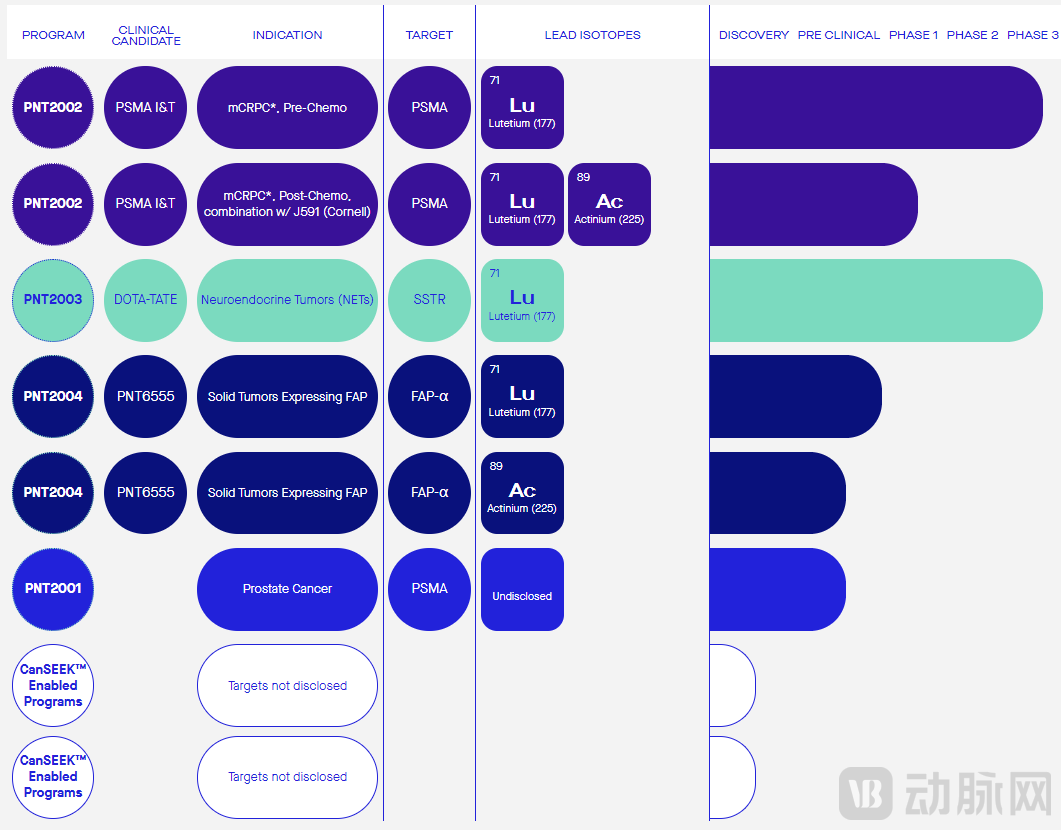
POINT Biopharma’s Pipeline Research and Progress
Before introducing the “Three Axes,” we need to first understand radioligand therapy. This modern class of radiopharmaceuticals is used for both diagnosing and treating cancer, acting like cancer-seeking missiles under a microscope. Its principle involves ligands binding to receptors on the cell surface within the tumor microenvironment (TME), thereby precisely activating radioactive elements at the target site to maximize therapeutic efficacy while minimizing toxicity from off-target delivery.
Compared with traditional chemotherapy, radioligand therapy (RLT) does not cause extensive damage to healthy tissues and organs; instead, it delivers radiation precisely to tumors, destroying cancer cells while sparing surrounding tissues.
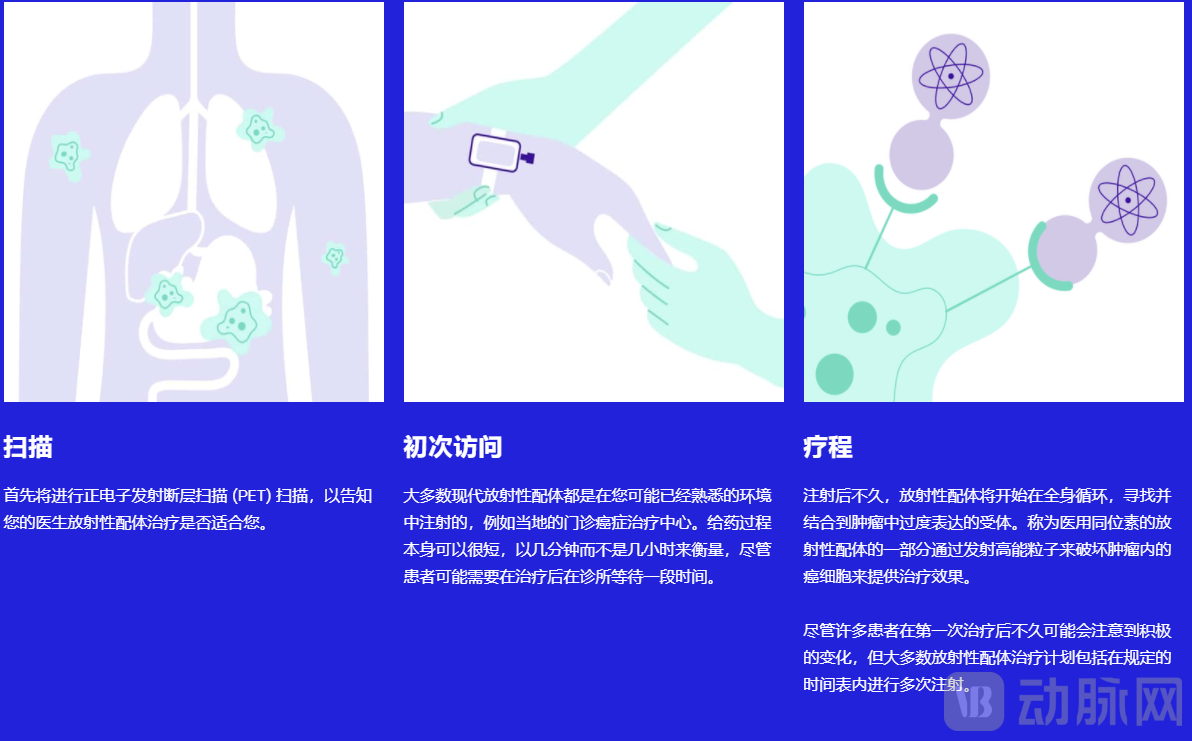
Radioligand Therapy Process Overview, Image Source: POINT Official Website
Prostate Cancer: PNT2002 and PNT2001
For prostate cancer, PSMA was selected as the target, with PSMA I&T used as the ligand.PSMA is highly expressed in the vast majority of prostate cancers (>85%), while its expression is low in normal tissues.
The resulting pipeline code is PNT2002,PSMA I&T and Radioisotopes177Lu or225Ac combined. Among them, the combination177Lu’s product has entered Phase III clinical trials and is currentlyResearch on Metastatic Castration-Resistant Prostate Cancer,is the world's most leading177One of the Lu-based therapeutic radiopharmaceuticals.
It is worth noting that its product is a targeted radioligand therapy for the treatment of prostate cancer, which Novartis recently announced had entered Phase III clinical trials.177Lu-PSMA-617 is facing direct competition. However, Novartis holds a slight lead, having completed its Phase III clinical trials and presented the data at the 2021 European Society for Medical Oncology (ESMO) Virtual Congress. The SPLASH Phase III clinical trial of PNT2002 was launched in September 2021, making it one of the strongest contenders in this field and poised to compete head-to-head with Novartis in the future.
PNT2001 is a next-generation PSMA-targeted radioligand.Existing PSMA-targeted radioligands are unlikely to be paired with more potent radioisotopes, such as Actinium-225, for therapeutic applications. PNT2001 aims to address this challenge through a unique linker technology. This approach enhances tumor targeting while reducing the required radioisotope dose, thereby minimizing off-target toxicity without compromising tumor-killing efficacy.
PNT2001 is currently in the preclinical development stage, with IND-enabling studies for this project expected to commence this year.
Neuroendocrine Tumors (NET): PNT2003
PNT2003, also known as lutetium-177 Octreotate (177Lu-DOTATATE) is a somatostatin receptor (SSTR)-targeted radioligand therapy for the treatment of patients with SSTR-positive neuroendocrine tumors.
SSTRs are regarded as ideal therapeutic targets for NETs. Somatostatin analogs (SSAs) have been developed for the treatment of NETs, exhibiting antisecretory and antiproliferative effects.
The SSTR-targeting ligand DOTA-TATE used in PNT2003 is sourced from CanProbe, and POINT has obtained the relevant clinical trial data and intellectual property licenses. The DOTA-TATE formulation utilizes no-carrier-added (n.c.a.) medical-grade isotopes.177Lu. No-carrier-added (n.c.a.)177Lu Products with Intermediate to Long Half-Life177mLu exhibits extremely low impurity levels, offering advantages such as reduced consumption of precursor compounds for labeling, extended shelf life of radiolabeled drugs, and easier disposal of radioactive waste, thereby presenting broad market prospects.
The PNT2003 trial has completed registration and is expected to be announced in 2022.
Solid Tumors: PNT2004
PNT2004 is an early-stage radioligand that targets fibroblast activation protein-α (FAP-α), which is highly expressed in a wide range of solid tumors but exhibits very low or absent expression in healthy tissues. FAP-α is present in over 90% of epithelial tumors, making it a promising target for pan-cancer imaging and therapy.
PNT2004 was co-developed by POINT and Dr. William Bachovchin, a pioneer in the design of inhibitors for the DASH family of proteases, including fibroblast activation protein (FAP). The CanSEEK™ technology employed in this development was created by Dr. William Bachovchin to address toxicity issues associated with off-target drug delivery. CanSEEK™ enables more precise therapy, thereby improving the therapeutic index.
PNT2004 targets FAP-α and features best-in-class tumor targeting and normal tissue sparing capabilities, demonstrating ideal radiopharmaceutical properties: it can deliver high-dose radiation directly to the tumor microenvironment while sparing healthy tissues.
POINT plans to initiate the Phase 1 trial of PNT2004 in 2022.
Reference: John Russell <Cancer-fighting nuclear medicine firms find home in central Indiana>