

Lantheus Holdings, Inc. Files Prospectus Highlighting Over $300 Million in Annual Revenue and Leadership in Radiopharmaceuticals

Lantheus
Developer of radiopharmaceuticals, diagnostic imaging agents, and precision medical technology
In recent years, R&D investment in radiopharmaceuticals has grown robustly, and the market size has gradually expanded. According to data from medraysintell, the global radiopharmaceutical market was valued at approximately USD 6 billion in 2019, with diagnostic agents accounting for the majority of the market. However, the launch of an increasing number of therapeutic agents is expected to drive the global radiopharmaceutical market to reach around USD 30 billion by 2030.
Radiopharmaceuticals are compounds or biological agents labeled with radioactive isotopes (radionuclides). Based on their applications, radiopharmaceuticals can be categorized into two major classes: diagnostic and therapeutic. Diagnostic radiopharmaceuticals are further divided into single-photon and positron-emitting agents, which can be used in conjunction with Single-Photon Emission Computed Tomography (SPECT) or Positron Emission Tomography (PET) scanners to study the function and metabolic processes of drugs in vivo at the molecular level. This enables rapid, non-invasive, and real-time imaging of physiological and pathological processes, representing a qualitative leap over conventional imaging-based medical diagnostics and providing the means for true early diagnosis and timely treatment.
Lantheus Holdings, Inc. (NASDAQ: LNTN, hereinafter referred to as “Lantheus”) was founded in 1956 and is headquartered in Massachusetts, United States. As a global leader in the research and development, manufacturing, sales, and distribution of diagnostic imaging agents, Lantheus is committed to providing medical imaging solutions for the treatment of human diseases.
This established medical diagnostic imaging company, with over 60 years of history, made early strategic moves into the radiopharmaceutical market. It boasts a robust portfolio of marketed diagnostic radiopharmaceuticals and a rich R&D pipeline, along with the capability to independently produce the radionuclide Tc-99m, thereby securing a significant position in the radiopharmaceutical sector. This article will examine the team’s key figures,Development History,Product Pipeline and Global Business Layout: Four Aspects to Introduce This Company.
The team has a solid foundation and years of accumulated professional experience.
Mary Anne Heino is the President and Chief Executive Officer of Lantheus, with 30 years of diverse experience in the pharmaceutical industry. Prior to joining Lantheus, Ms. Heino led the pharmaceutical joint venture Angelini Labopharm LLC and Labopharm US as President of Global Sales and Marketing and Senior Vice President. Previously, she held various positions at Johnson & Johnson, including Vice President of Strategic Planning and Competitive Intelligence and Vice President of Sales.
Heino holds an MBA from the NYU Stern School of Business, a Bachelor of Science in Nursing from the City University of New York, and a Bachelor of Science in Biology from Stony Brook University, State University of New York.
Heino currently serves as a board member of the Massachusetts Medical Device Industry Council (MassMEDIC) and on the Executive Committee of the Massachusetts Business Roundtable (MBR).

Mary Anne Heino: President and Chief Executive Officer
As Chief Financial Officer and Treasurer, Mr. Marshall brings to Lantheus more than 30 years of financial experience, including expertise in mergers and acquisitions, capital markets, and investor relations. Prior to joining Lantheus, Mr. Marshall spent 16 years at Zimmer Biomet Holdings, Inc. (NYSE: ZBH), a global medical device company.
Marshall holds a Master of Business Administration degree from Indiana University South Bend and a Bachelor of Business Administration in Finance from the University of Notre Dame.

Marshall: Chief Financial Officer and Treasurer
Six Decades of Dedication to Diagnostic Imaging, Becoming a Nuclear Medicine Tycoon
Lantheus was established through a series of acquisitions characterized by larger entities absorbing smaller ones. In 1956, Edward Shapiro and Seymour Rothschild co-founded New England Nuclear (NEN), which became the earliest predecessor of Lantheus. It was from this point that Lantheus began its research and accumulation of expertise in diagnostic imaging.
In 1981, NEN was acquired by DuPont to expand its drug research and healthcare sectors.
In 2001, DuPont and its diagnostic medical imaging business were acquired by BMS.
In 2008, BMS’s medical imaging business was acquired by the private equity firm Avista Capital Partners and was officially renamed Lantheus Medical Imaging.
In June 2015, its parent company, Lantheus Holdings (NASDAQ: LNTN), went public on the NASDAQ in the United States, raising $65 million through its initial public offering (IPO).
In 2020, Lantheus acquired the publicly listed pharmaceutical company Progenics Pharmaceuticals. Prior to this acquisition, Lantheus’s business was primarily focused on medical imaging diagnostics; however, through this transaction, it not only obtained several targeted PET imaging agents (such as 1404 and PyL) but also expanded into cancer therapeutic products (such as AZEDRA).®, 1095, and PSMA TTC).
Following an extended period of mergers and acquisitions, Lantheus has focused on diagnostic medical imaging while expanding its therapeutic agents business, establishing two highly complementary business segments—ultrasound and radiopharmaceuticals—and pioneering a portfolio of products for coronary artery disease, cancer, stroke, and other life-threatening conditions.
However, compared to its ultrasound business, Lantheus focuses more on the research and development and commercialization of radiopharmaceuticals. Among Lantheus’s current portfolio of 12 products, eight are nuclear medicine products (including radiopharmaceutical imaging agents and generators), accounting for approximately 67%. Of the 10 products currently in Lantheus’s pipeline, seven are radiopharmaceuticals, representing 70%.
Diagnostic-Focused, with Expansion into Therapeutic Radiopharmaceuticals
Lantheus boasts a robust portfolio of nuclear medicine products, currently comprising seven radiopharmaceutical imaging agents and one isotope generator.
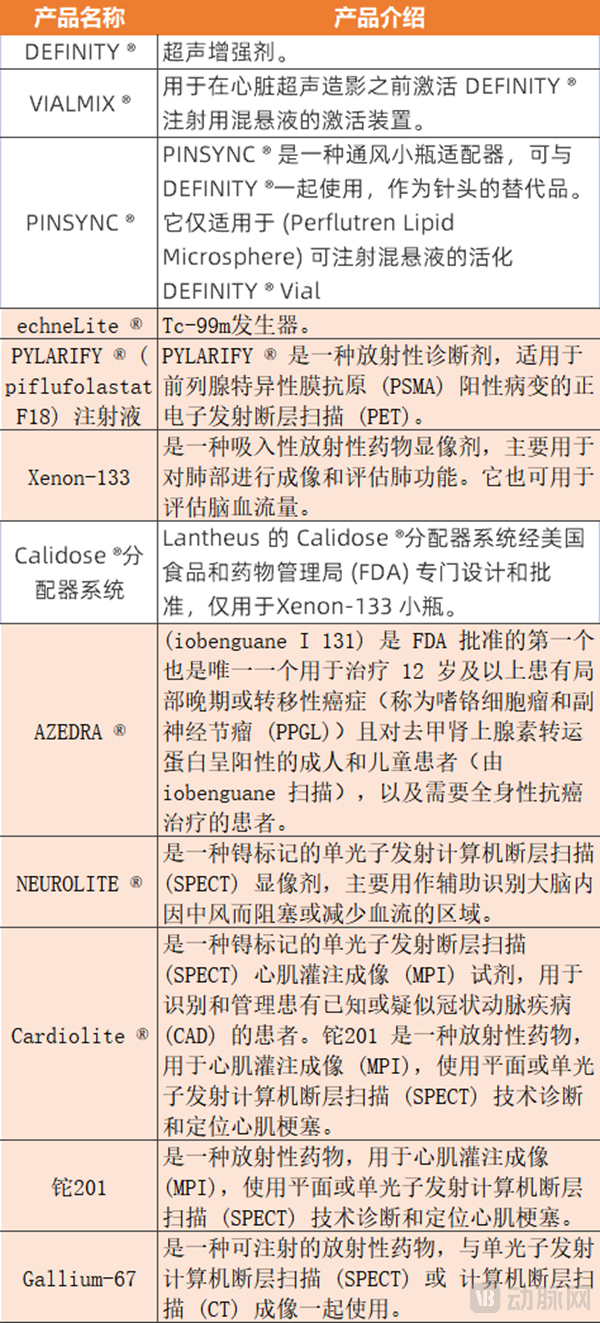
Lantheus Products, Source: Lantheus Official Website
The following section will focus on introducing several radiopharmaceutical products with outstanding performance.
PYLARIFY®: The only commercially available, FDA-approved PSMA-targeted PET imaging agent for prostate cancer
PYLARIFY®(piflufolastat F-18) Injection (also known as18F-DCFPyL (or PyL) is an F-18-labeled, PSMA-targeted PET imaging agent used to identify suspected metastasis or recurrence of prostate cancer. For men with prostate cancer, PYLARIFY PET combines the accuracy of PET imaging, the precision of PSMA targeting, and the clarity of the F-18 radioisotope, delivering superior diagnostic performance. This enables physicians to detect suspected metastatic or recurrent prostate cancer anywhere in the body earlier and more accurately, thereby facilitating optimized treatment plans that may significantly impact patients’ lives.
PYLARIFY received U.S. FDA marketing approval in May 2021. The approval of PYLARIFY was based on two pivotal studies (OSPREY and CONDOR), which were designed to evaluate the safety and diagnostic performance of PYLARIFY across the spectrum of prostate cancer disease progression. Results from OSPREY (Cohort A) demonstrated that, in men with metastatic prostate cancer at risk prior to initial treatment, PYLARIFY PET imaging exhibited superior specificity and positive predictive value (PPV) compared to conventional imaging. Results from CONDOR indicated that, in patients with biochemically recurrent prostate cancer and non-informative baseline imaging, PYLARIFY achieved high rates of correct localization and detection, including in patients with low prostate-specific antigen (PSA) levels (median PSA of 0.8 ng/mL).
PYLARIFY is the first and only commercially available, FDA-approved PSMA-targeted PET imaging agent for prostate cancer, and PET imaging with PYLARIFY has been included in the latest National Comprehensive Cancer Network (NCCN) guidelines in the United States for the treatment of prostate cancer.
Meanwhile, to enhance the effective integration of PSMA PET/CT into clinical practice and support the adoption of PYLARIFY, Lantheus has developed a medical device software, PYLARIFY AI.TM, now listed in the United States.
The PYLARIFY AI system software is designed for use with images acquired through nuclear medicine (NM) imaging using PSMA PET/CT. It provides general Picture Archiving and Communication System (PACS) tools and clinical oncology applications, including region-of-interest marking and quantitative analysis. Through rigorous analytical and clinical studies, PYLARIFY AI has demonstrated greater consistency, accuracy, and efficiency in the quantitative assessment of PSMA PET/CT.
As a diagnostic radiopharmaceutical, PYLARIFY facilitates early disease diagnosis, while subsequent timely treatment relies on therapeutic radiopharmaceuticals. Therapeutic radiopharmaceuticals can highly selectively accumulate in lesion tissues, generating local ionizing radiation-induced biological effects that inhibit or destroy the lesion tissues to exert therapeutic effects. Lantheus’s AZEDRA®It is a therapeutic radiopharmaceutical.
AZEDRA®: FDA-Approved Therapeutic Radiopharmaceutical for the Treatment of Rare Adrenal Tumors
AZEDRA®It is an I-131-labeled radiopharmaceutical indicated for the treatment of patients aged 12 years and older with rare adrenal tumors (pheochromocytoma or paraganglioma), particularly those with unresectable, metastatic disease requiring systemic anticancer therapy.
The efficacy of Azedra was demonstrated in a single-arm, open-label clinical trial involving 68 patients. The trial evaluated the number of patients who achieved a reduction of 50% or more in antihypertensive medication use sustained for at least six months. The secondary endpoint of the trial assessed overall tumor response in subjects using conventional imaging criteria. Results showed that 17 out of 68 evaluable patients (25%) achieved a reduction of 50% or more in antihypertensive medication use for at least six months. Among the studied patients, 15 (22%) achieved an overall tumor response, and the study met its primary endpoint.
The FDA previously granted AZEDRA Fast Track, Breakthrough Therapy, and Priority Review designations, as well as Orphan Drug designation, and formally approved AZEDRA in 2018.
LEU TechneLite®: Tc-99m Generator with Global Mo-99 Supply
LEU TechneLite®(Technetium Tc 99m Generator) is a generator capable of producing the radioactive isotope Tc-99m, meeting the needs of Lantheus radiopharmaceutical products (such as Cardiolite®、NEUROLITE®) demand for Tc-99m.
Lantheus received FDA approval for the commercial use of LEU TechneLite in 2010 and has used a mixture of highly enriched uranium (HEU) and low-enriched uranium (LEU) Mo-99 in its TechneLite generators in the U.S. market since 2011. In January 2013, LEU TechneLite became the first Tc-99m generator in the United States.
Lantheus has established a diversified and balanced global Mo-99 supply chain. Globally, there are four major Mo-99 processors and six associated production reactors; Lantheus sources Mo-99 from three of these processors and five reactors, thereby ensuring the supply for Tc-99m production.
Actively pursuing collaborations, with 10 novel radiopharmaceuticals under development
Like sailing against the current, failing to advance means falling behind. Despite having multiple marketed products, Lantheus has not halted its R&D efforts in novel radiopharmaceuticals. Through independent development and active collaborations, the company is gradually expanding its product pipeline and enhancing its market competitiveness. Currently, Lantheus has 10 products in development, including seven radiopharmaceuticals—two developed independently and five through collaborations—covering indications such as prostate cancer, neuroendocrine tumors, biomarkers, and cardiovascular diseases.
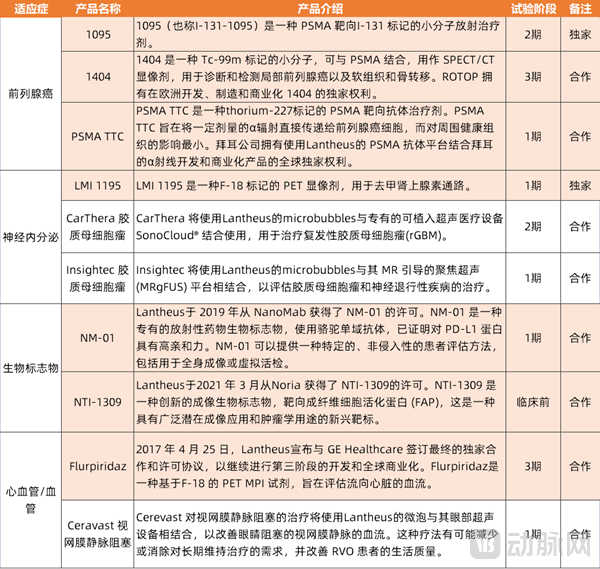
Lantheus’s Products in Development, Source: Lantheus Official Website
Below, we will highlight its two exclusively developed products.
I-131 1095
I-131 1095 is a small-molecule radiopharmaceutical that targets prostate-specific membrane antigen (PSMA). This antigen is highly expressed on prostate cancer cells; therefore, when I-131 1095 binds to these cells, the beta radiation it carries destroys the tumor cells.
Lantheus is conducting a Phase 2 clinical trial of I-131 1095 in 1,095 subjects with metastatic castration-resistant prostate cancer (mCRPC) in the United States and Canada, with completion expected in 2023. This trial evaluates the efficacy and safety of I-131 1095 in combination with enzalutamide in patients with mCRPC who have not received chemotherapy and have experienced disease progression on abiraterone (ARROW).
Official announcements indicate that the combination of I-131 1095 and enzalutamide is highly likely to provide an effective treatment option for patients resistant to novel androgen axis drugs (NAADs), thereby improving therapeutic outcomes.
LMI 1195
LMI 1195 is an F-18-labeled tracer used for cardiac positron emission tomography (PET) to assess presynaptic sympathetic function of the myocardium.
Phase 2 clinical trials of LMI 1195 have demonstrated that PET imaging with LMI 1195 provides measurements of cardiac sympathetic function comparable to those obtained with carbon-11 (C-11) hydroxyephedrine (HED), while offering more favorable kinetics for early cardiac imaging. C-11 HED has been used in cardiac PET imaging to characterize the integrity of the sympathetic nervous system (SNS) and to help assess the risk of requiring an implantable cardioverter-defibrillator (ICD) in patients with ischemic cardiomyopathy. However, its widespread clinical application is limited by the short half-life of C-11–labeled tracers, which necessitates the on-site availability of a cyclotron.
Currently, Lantheus has two Phase 3 clinical trials for LMI 1195 that have been designed but not yet initiated. The trials will use LMI 1195 to diagnose and manage neuroendocrine tumors in pediatric and adult populations.
Actively Pursue Global Collaboration and Expand Business Scope
On June 18, 2015, Lantheus was listed on the NASDAQ Stock Exchange with an initial public offering (IPO) price of $6 per share, raising $65 million. As of the market close on January 20, 2022, Lantheus’s closing stock price was $25.90, with a market capitalization of $1.753 billion.
According to Simply Wall St analysis, Lantheus shareholders have achieved a one-year return of approximately 67.9% and a five-year return of 197.2%, both exceeding the U.S. medical equipment industry averages. Over the long term, Lantheus has demonstrated strong profitability.
Lantheus is actively pursuing a global business strategy to expand its revenue streams. The company’s operations are primarily managed through its U.S. and International segments. In Canada and Puerto Rico, Lantheus maintains direct sales operations; in Europe, Australia, the Asia-Pacific region, and Latin America, it leverages third-party distribution channels. Its subsidiary, EXINI, oversees business operations in Sweden.
In the field of nuclear medicine, Lantheus actively pursues commercial collaborations. In 2019, it granted Curium an exclusive license to develop and commercialize PyL (a PSMA-targeted PET imaging agent for prostate cancer) in Europe, thereby earning royalties on net sales of PyL. In 2020, Lantheus entered into a stock purchase agreement with PharmaLogic, a radiopharmaceutical and mobile PET/CT operations company, to sell its radiopharmaceutical and PET production facility (PMF) in Puerto Rico and to supply radiopharmaceuticals to PharmaLogic on a long-term basis.
According to Lantheus’ financial reports, the company’s total revenue has remained largely stable over the past three years, with a slight decline. Incremental revenue from radiopharmaceutical oncology products (PYLARIFY and AZEDRA) showed significant growth, rising from $8.7 million in 2019 to $13.2 million in the first three quarters of 2021.
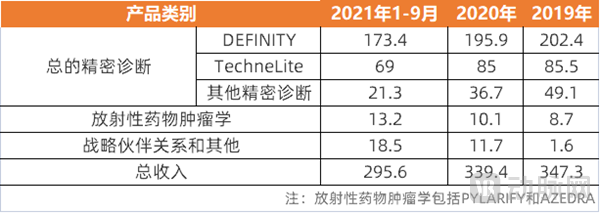
Net Revenue by Category, in Millions of U.S. Dollars
Furthermore, Lantheus is actively pursuing new drug development collaborations and has established cooperative R&D partnerships in radiopharmaceuticals with companies such as CarThera, ROTOP, and NanoMab, thereby further expanding its product pipeline.
Lantheus boasts a rich history and extensive product portfolio in the field of nuclear medicine diagnostics, while actively pursuing global business expansion. To achieve further growth in the future, the company may need to focus on enhancing product quality, accelerating the research and development of new drugs, and securing early market entry.