

C4 Therapeutics: Pioneering Targeted Protein Degradation with a Robust Pipeline and Strategic Pharma Collaborations
C4 Therapeutics
Targeted Protein Degradation Therapeutics Developer
In the field of innovative drugs, while small-molecule inhibitors are being vigorously developed, another novel therapy has emerged as a dark horse, attracting significant attention and strategic investment from numerous pharmaceutical companies: protein degraders.
Currently, in the field of protein degraders, Chinese biopharmaceutical companies such as BeiGene, Kintor Pharmaceutical, and Haisco Pharmaceutical are leading in clinical progress. International pharmaceutical giants like Pfizer, AstraZeneca, and Merck & Co. have taken the lead in establishing global layouts. Among emerging overseas pharmaceutical companies, biotech firms such as Arvinas, C4 Therapeutics, Nurix Therapeutics, and Kymera Therapeutics are engaged in fierce competition around protein degraders, with C4 Therapeutics attracting significant attention due to its robust pipeline of new drug candidates.

Protein degraders primarily leverage a natural cellular process known as ubiquitination. Ubiquitin, a biological tag found in nearly all eukaryotes, serves mainly to target proteins for degradation. Ubiquitination refers to the biochemical process by which proteins are marked with ubiquitin; through the catalytic action of a series of enzymes, ubiquitin is covalently attached to target proteins. This mechanism enables disease treatment by either destroying targeted pathogenic proteins or regulating their abundance. Ubiquitination participates in the regulation of many fundamental cellular physiological processes, including cell proliferation, apoptosis, autophagy, DNA repair, and immune responses. It plays a crucial role in maintaining protein homeostasis, primarily by facilitating the rapid removal of misfolded proteins.
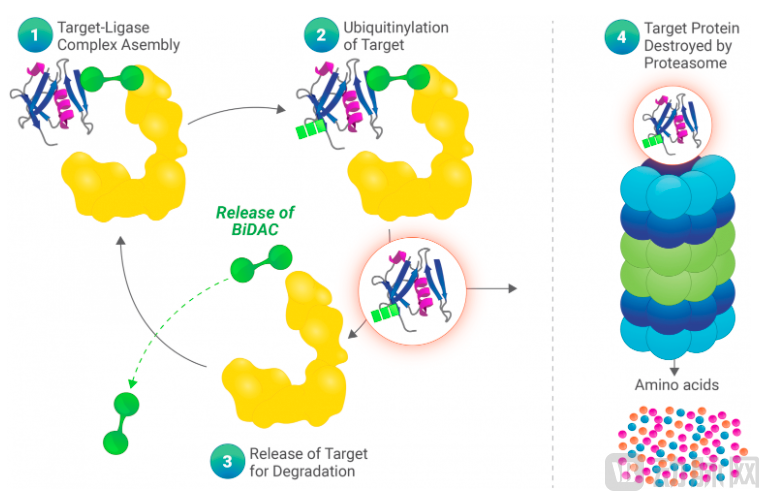
Mechanism of Protein Degraders (Source: C4 Therapeutics)
According to data provided by C4 Therapeutics, currently, less than 15% of proteins are considered druggable with traditional small-molecule inhibitors. Targeted protein degradation technology can fundamentally overcome this limitation, enabling the drug development potential for a large number of “undruggable” or “difficult-to-drug” targets.
1. C4 Therapeutics, Which Won Widespread Acclaim Since Its Inception
C4 Therapeutics, founded in 2015 and headquartered in Cambridge, Massachusetts, USA, focuses on the research and development of protein degraders. The company is dedicated to developing novel therapeutic candidates by leveraging the body’s natural regulatory mechanisms for protein levels, with applications in the treatment of cancer, neurodegenerative diseases, and other conditions. Currently, its drug discovery platform, TORPEDO ®It has demonstrated robust productivity, with multiple cancer-related protein degrader drugs developed on this platform having advanced to clinical trials.
Reviewing the development trajectory of C4 Therapeutics, the company underwent three rounds of financing from its inception to its initial public offering. The Series A financing completed on January 7, 2016, marked a highlight in its history. On that day, C4T not only secured $73 million in Series A funding but also obtained a collaboration order worth $750 million from the international pharmaceutical giant Roche. This demonstrates that PROTAC (Proteolysis-Targeting Chimera) targeted protein degradation technology was highly anticipated at the time, and C4T, akin to being born with a “silver spoon,” became a focal point of attention in the pharmaceutical industry.
Initially, C4 Therapeutics was co-founded by scientists from Harvard University and the Dana-Farber Cancer Institute. One of its co-founders, Jay Bradner, had in 2015ScienceThe journal published new research on PROTAC molecules. In this study, he and his team used the BRD4 protein as a model to co-design a chemical strategy that degrades target proteins via ligand binding, thereby delaying leukemia progression in mice during experimental trials. This research laid a theoretical foundation for the establishment of C4 Therapeutics. However, Jay Bradner left C4 Therapeutics the following year to join Novartis, and another co-founder, Marc Cohen, took over as the company’s interim CEO and Chairman.
Following its IPO on October 1, 2020, C4 Therapeutics welcomed Andrew Hirsch as its new CEO. Mr. Hirsch previously served as Chief Financial Officer and Head of Corporate Development at Agios Pharmaceuticals, a publicly traded company specializing in cancer metabolism. With over 20 years of strategic and operational experience in the biotechnology sector, complemented by his expertise in managing public companies, Mr. Hirsch has brought fresh operational perspectives to drive C4 Therapeutics’ growth.
II. Develop a Proprietary Intelligent Platform for Drug Design to Empower Innovation in the PROTAC Field Through an Open-Source Initiative
1TORPEDO ®Intelligent Platform
Leveraging the ubiquitination mechanism, C4 Therapeutics has built its core technology platform, TORPEDO. ®, TORPEDO discovers degraders that can target disease-causing proteins through a novel quantitative method. ®The full name is “Target ORiented ProtEin Degrader O“Optimizer,” the platform centers its research on the E3 ubiquitin ligase Cereblon, approaching efficient and precise development of degrader drugs from three aspects: design, analysis, and prediction, while screening for effective candidate drugs. With the support of this platform, C4 Therapeutics has synthesized multiple novel small-molecule drugs, achieving remarkable results in enhancing and optimizing the specificity and efficacy of protein degraders, thereby enabling TORPEDO ®demonstrates numerous advantages:
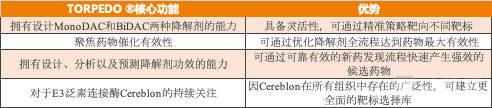
ApprovedTORPEDO ®C4 Therapeutics has primarily developed two types of protein degraders: MonoDACs and BiDACs, aiming to target and degrade different proteins through tailored approaches. Among them, MonoDACs are monovalent degradation-activating compounds that enhance the binding affinity between E3 ubiquitin ligases and target proteins by binding to the E3 ligase and acting as a "molecular glue." These compounds, also known as molecular glue degraders, are capable of degrading previously undruggable target proteins. In contrast, BiDACs are bivalent degradation-activating compounds designed with one end binding to the disease-causing target protein and the other end binding to the E3 ligase. BiDACs are also referred to as heterobifunctional degraders, commonly known as PROTACs. Compared to MonoDACs, BiDACs have a larger molecular weight due to their three-component structure. Both types of degraders possess distinct advantages and offer strong complementarity in their respective application scenarios.
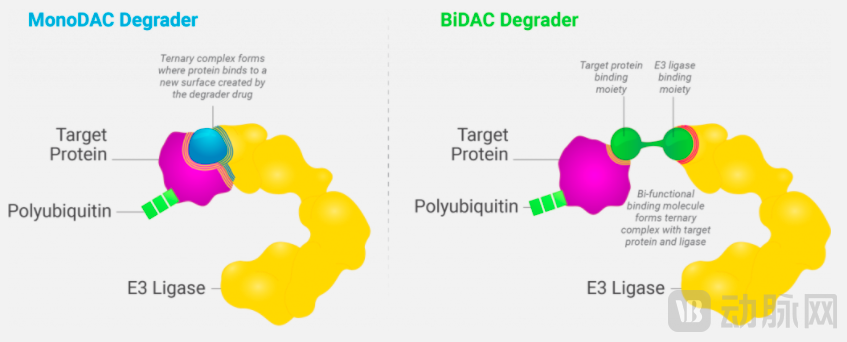
MonoDAC (left) and BiDAC (right) combination principle (Image source: C4 Therapeutics)
Currently, C4T has established the MonoDAC™ and BiDAC™ libraries, aiming not only to address efficacy challenges that remain inadequately resolved by existing therapies, but also to lay the foundation for drug design targeting undruggable or difficult-to-drug targets.
2aTAG Open Source Initiative
In addition to pioneering TORPEDO ®, C4 Therapeutics has also launched the aTAG open-source initiative for use by numerous researchers, encouraging technological innovation in the field of protein degraders. aTAG, which stands for Achille’s TAG, is a systematic tool capable of predicting target protein degradation outcomes, enabling the dissection of the biological mechanisms and phenotypic results of degraders on target proteins in both in vitro and in vivo environments.
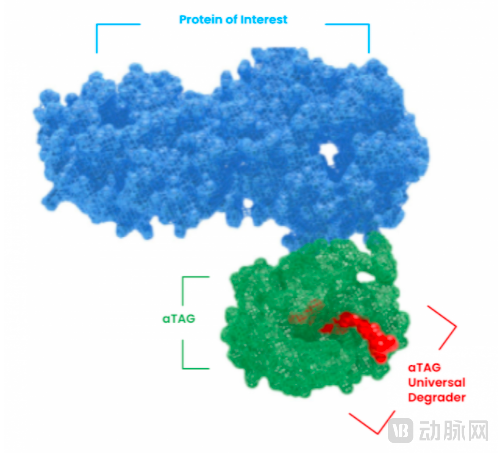
aTAG System Working Principle (Image source: C4 Therapeutics)
The aTAG system is primarily divided into two components. The first is a small protein domain that readily binds to target proteins; based on the MTH1 protein, it offers advantages such as a compact structure and ease of ligand conjugation. The second component consists of three meticulously screened BiDAC degraders, which exhibit excellent target-binding affinity and favorable pharmacokinetic properties, enabling selective targeting of the MTH1-based degradation tag. Leveraging this system, researchers can fuse proteins of interest with aTAG and induce their degradation using the corresponding degraders, thereby analyzing the impact of protein depletion on cellular physiology.
aTAG enables the rapid, tunable, and reversible validation and prediction of the mechanistic roles of specific proteins across diverse disease states and physiological systems. Furthermore, it can be integrated with other chemistry-based tools to investigate the complex mechanisms of action of multiple proteins of interest.
Previously, C4 Therapeutics validated the efficacy of the aTAG system through experiments controlling CAR-T cell protein activity, and in 2019, it entered into a collaboration with Bio-Techne Corporation. Under the agreement, Bio-Techne Corporation obtained an exclusive license to the aTAG system, marking the first commercialization of aTAG technology and aiming to provide specialized services to the scientific research community.
III. Four R&D pipelines advancing in parallel, with collaborations with Roche and Biogen just around the corner
Based on TORPEDO ®Leveraging its drug design platform, C4 Therapeutics has developed multiple protein degraders, primarily focusing on the oncology field:
CFT7455CFT7455 is an orally bioavailable MonoDAC degrader designed to target the degradation of IKZF1/3 proteins by binding to the E3 ubiquitin ligase Cereblon with higher affinity, for the treatment of multiple myeloma (MM) and non-Hodgkin lymphoma (NHL). Preclinical studies have demonstrated that CFT7455 exhibits high binding affinity and target selectivity for Cereblon, enabling rapid and profound degradation of IKZF1/3 proteins. C4 Therapeutics submitted an Investigational New Drug (IND) application for CFT7455 in December 2020 and received approval from the U.S. FDA in January 2021. Based on positive preclinical data, C4 Therapeutics initiated a Phase 1/2 clinical trial of CFT7455 in June 2021. The drug also received orphan drug designation from the U.S. FDA for the treatment of multiple myeloma in August 2021.
In addition to its current core product, CFT7455, C4 Therapeutics has three other protein degraders poised to enter clinical trials:
CFT8634It is an orally bioavailable BiDAC degrader that targets the BRD9 protein for the treatment of synovial sarcoma and SMARCB1-deficient solid tumors. The drug received approval from the U.S. FDA for its Investigational New Drug (IND) application in December 2021, and Phase 1 clinical trials were initiated in January 2022.
CFT1946It is a protein degrader targeting BRAF V600X mutations, primarily used for the treatment of solid tumors with V600X mutations. Currently, C4 Therapeutics is preparing to submit an Investigational New Drug (IND) application to the FDA and commenced Phase 1 clinical trials in February 2022 for BRAF V600X-driven cancers, including melanoma, colorectal cancer, and non-small cell lung cancer.
CFT8919It is a degrader targeting the EGFR L858R protein, primarily used for the treatment of non-small cell lung cancer (NSCLC). C4 Therapeutics plans to complete the Investigational New Drug (IND) application for this drug by the end of 2022.
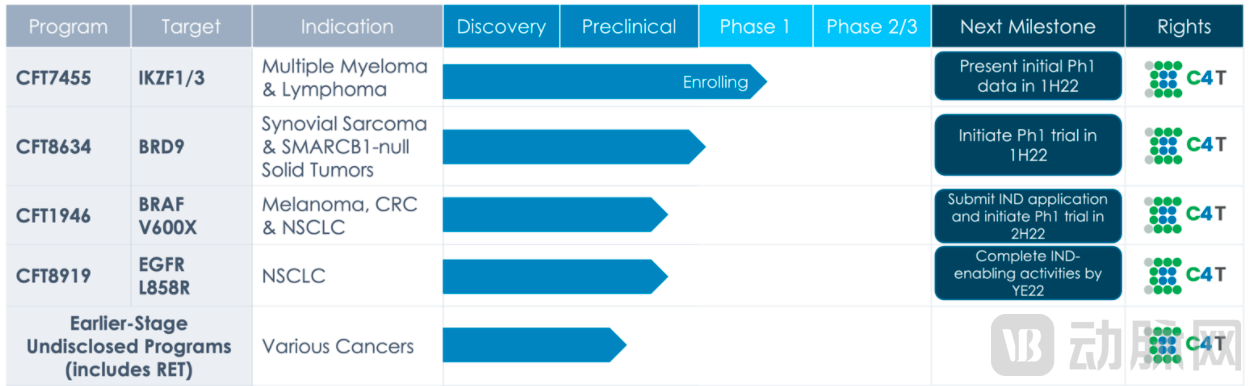
In addition to its pipeline products, C4 Therapeutics has also entered into R&D collaborations with multiple pharmaceutical companies. Among these:
Rocheis a partner that has provided substantial support to C4 Therapeutics since its early stages, having engaged in collaborations exceeding $900 million with C4 Therapeutics, with a primary focus on developing novel cancer therapies based on C4 Therapeutics’ targeted protein degradation technology;
In addition to oncology, C4 Therapeutics has also established a pipeline in neuroscience drug development. In 2019, it partnered withBiogenEstablish a strategic partnership to develop novel potential therapies for Alzheimer’s disease, Parkinson’s disease, and other debilitating neurological disorders, leveraging C4 Therapeutics’ protein degrader design platform;
In addition, C4 Therapeutics is also associated with the biopharmaceutical company under Alphabet, the parent company of Google.CalicoReach a partnership to jointly develop novel protein degrader drugs targeting aging and cancer.

Currently, C4 Therapeutics has announced its latest strategic layout and the key milestones to be achieved within 2022. In addition to vigorously advancing its protein degrader products into clinical trials, the company will continue to optimize its core technology platform, TORPEDO. ®, to drive innovation in targeted protein degradation technologies.
Currently, no protein degrader products have been launched on the market either domestically or internationally. Let us look forward to the latest clinical progress of C4 Therapeutics’ new drug, as well as the emergence of more innovative pharmaceutical companies in the field of protein degraders.