

A Glimmer of Hope for 25 Million Couples: Can Assisted Reproductive Technology Rescue China's Sub-1% Birth Rate?
The comprehensive relaxation of the three-child policy, the release of the “Plan for the Application of Human Assisted Reproductive Technologies (2021–2025),” and a population of over 50 million individuals affected by infertility have collectively ushered in a promising upturn for the assisted reproductive technology industry in 2021.
In the primary market, the assisted reproductive technology (ART) sector delivered impressive financing performance in 2021. WeTuo Bio completed a C-round financing of over RMB 100 million, while Nvwa Life secured two rounds of funding within five months of its establishment. In the secondary market, ART-related stocks such as Becare Medical and Jinxin Fertility Women’s Healthcare attracted significant investor attention following the rollout of major policy initiatives, including the three-child policy. It is fair to say that the ART industry reached unprecedented heights in 2021.
VCBeat believes that 2021 marked the peak of growth for the assisted reproductive technology (ART) industry, but by no means its zenith. With the completion of the transitional period for population policies, the rapid implementation of the “Plan for the Application of Human Assisted Reproductive Technology (2021–2025),” and the accelerated domestic substitution of upstream medical devices, the development of ART in 2022 deserves even greater attention.
Policy has always been one of the major factors influencing the development of the assisted reproductive technology (ART) industry. Compared with previous years, the positive impact of ART-related policies introduced in 2021 on industry development was unprecedented.
In January 2021, the “Plan for the Application of Human Assisted Reproductive Technologies (2021–2025)” was released, stipulating that during the period 2021–2025, the number of newly added assisted reproductive technology institutions providing “husband’s sperm artificial insemination, donor sperm artificial insemination, in vitro fertilization-embryo transfer, and intracytoplasmic sperm injection” shall not exceed 15% of the total number of such institutions as of the end of 2020. In principle, one assisted reproductive technology institution may be established for every 2.3 to 3 million residents based on the permanent population. Furthermore, in principle, no more than one human sperm bank shall be established per province (autonomous region or municipality).
This means that,China is set to have more than 600 assisted reproductive technology (ART) institutions in the next phase, driving the expansion of the overall ART market, meeting greater clinical demand for assisted reproduction, and generating incremental growth for the upstream medical device and pharmaceutical markets.
The comprehensive rollout of the “three-child” policy in late May 2021 further fueled the already booming assisted reproductive technology industry.
In May 2021, the data from the seventh national census was released, revealing a precipitous decline in the number of newborns in China in 2020. The figure dropped by 2.65 million year-on-year compared to 2019, with only 12 million newborns recorded. According to the latest data from the 2021 China Statistical Yearbook, China’s birth rate in 2020 was merely 0.852%, falling below 1% for the first time, while the natural population growth rate (birth rate minus death rate) also declined to 0.145%. On the other hand, the number of individuals affected by infertility in China has exceeded 50 million. Experts predict that the era of negative population growth in China may arrive sooner than expected.
Rising infertility rates and declining birthrates have intensified the severity of China’s demographic challenges. In response, the Central Committee of the Communist Party of China and the State Council issued the “Decision on Optimizing Fertility Policies to Promote Long-Term Balanced Population Development,” making the major strategic decision to implement a three-child policy along with supporting measures, aiming to reverse this trend. Consequently, the assisted reproductive technology (ART) industry has once again been thrust into the spotlight. Following the announcement of the “three-child” policy, stocks of ART companies surged, with Beikang Medical, which holds a 70% market share in the industry, jumping 15% in a single day to reach a market capitalization of HK$7.7 billion.
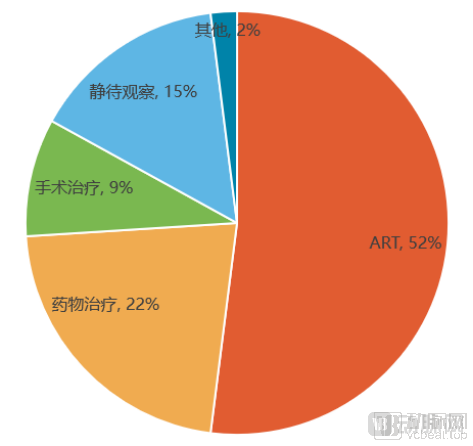
Assisted reproductive technology is the primary treatment modality for infertility among physicians in China.
(Source: "2021 Assisted Reproductive Technology Industry Research Report")
Encouraging childbirth has become a major long-term goal for China, and driven by policy support, the strong growth momentum of the assisted reproductive technology (ART) industry is expected to continue. According to forecasts from VCBeat’s “2021 Assisted Reproductive Technology Industry Research Report,” and as calculated in the “2021 Assisted Reproductive Technology Industry Research Report,”The market demand for in vitro fertilization (IVF) is valued at RMB 421.2 billion, while that for artificial insemination stands at RMB 12.9 billion, bringing the total market demand for assisted reproductive technologies to RMB 434.1 billion.
The “14th Five-Year Plan” for the Development of the Medical Equipment Industry, issued in late December 2021, focuses on seven key areas, including maternal and child health equipment. It emphasizes the need to attach great importance to the development of the medical equipment industry starting from 2021 and to accelerate efforts to address China’s shortcomings in high-end medical equipment.
The introduction of this policy has shifted greater attention from the downstream assisted reproductive technology sector to the upstream medical device segment, where there is an urgent demand for domestic substitution.Domestic upstream medical devices are also widely recognized as one of the new growth drivers in the field of assisted reproduction in 2022.
The “14th Five-Year Plan” for the Development of the Medical Equipment Industry proposes strengthening breakthroughs in original and leading-edge medical equipment, aiming to elevate the research and development, manufacturing, and application of medical equipment to an advanced global level by 2035, thereby positioning China among the forefront of innovative nations in medical equipment.
Furthermore, in 2021, the “Guiding Opinions on Promoting the Healthy Development of the Pharmaceutical Industry,” issued by the General Office of the State Council, explicitly stipulated that government procurement projects shall, in principle, procure domestically produced products if Chinese-made drugs and medical devices can meet the requirements, thereby gradually enhancing the configuration level of domestically produced equipment in public medical institutions. Dozens of provinces, municipalities, and autonomous regions, including Guangdong, Shaanxi, Shandong, Shanghai, Fujian, and Jiangsu, have explicitly stated in their published government procurement policies that imports of medical devices will be strictly restricted while domestic products are supported.
Thus, it can be seen thatAmid multiple pressures, including national volume-based procurement, the impact of the pandemic, and a downturn in the broader biopharmaceutical market, the domestic substitution of medical devices has emerged as a new breakthrough.
The upstream of the assisted reproductive technology (ART) industry chain comprises manufacturers of medical devices, pharmaceuticals, and R&D providers; the midstream consists of distributors of medical devices and pharmaceuticals, as well as marketing channel partners; and the downstream includes ART healthcare service providers.
In the upstream segment of assisted reproductive technology (ART), due to the industry’s late start, stringent approval and regulatory oversight, and limited technological accumulation, there is a heavy reliance on imported brands for high-value consumables used in IVF treatment—such as preimplantation genetic testing (PGT) reagents, embryo freezing/thawing solutions, and embryo culture media—as well as for medications including those for down-regulation, ovarian stimulation, ovulation induction, and luteal phase support. This dependence results in a significant proportion of the overall costs.In the assisted reproductive technology (ART) industry, 95% of high-value consumables and 80% of pharmaceuticals are monopolized by foreign brands, making it a key focus area for domestic substitution in the medical sector.
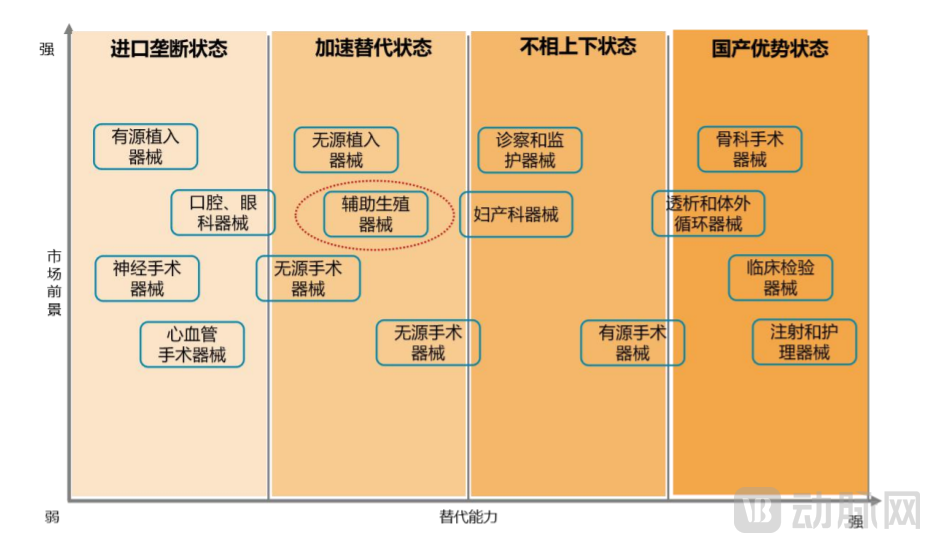
Schematic Diagram of the Status of Domestic Substitution for Medical Devices
(Source: "2021 Assisted Reproductive Technology Industry Research Report")
Rising downstream demand for assisted reproductive technology has made the domestic substitution of upstream medical devices and pharmaceuticals an urgent priority.
Encouragingly, the pace of domestic substitution for upstream medical devices in assisted reproductive technology (ART) accelerated significantly in 2021. According to statistics from VCBeat, there are currently more than 70 ART-related medical devices approved in China, with 27 products approved in 2021 alone, accounting for 40% of the total.
Among them,High-value consumables such as PGT reagents, cryopreservation/thawing solutions, and embryo culture media are at the core of domestic substitution for upstream medical devices in assisted reproductive technology.
Preimplantation Genetic Testing (PGT) is primarily used for embryo screening. It employs PGT reagents alongside sequencers to analyze DNA samples from preimplantation embryos for genetic disorders, thereby determining whether the embryos carry hereditary diseases and selecting healthy embryos for transfer. This includes reagents designed for Preimplantation Genetic Testing for Aneuploidies (PGT-A), Preimplantation Genetic Testing for Structural Rearrangements (PGT-SR), and Preimplantation Genetic Testing for Monogenic Disorders (PGT-M). In 2020, the domestic PGT market in China reached RMB 2.16 billion, with PGT-A accounting for 56% of the share. This dominance is mainly attributed to the broad applicability of PGT-A screening, as evidenced by over 500,000 IVF cycles utilizing PGT-A in 2020.
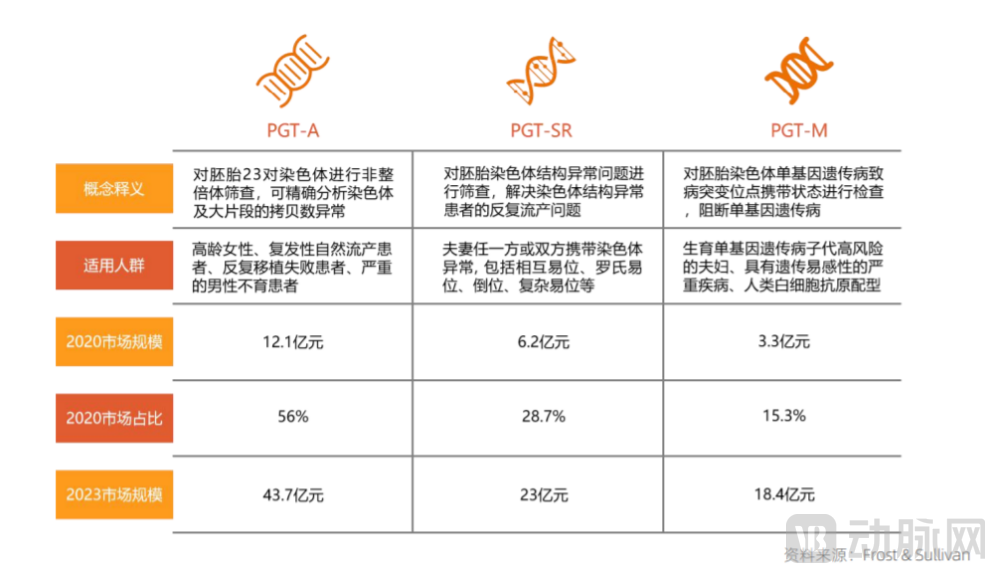
Comparison of the Three Major PGT Screening Types
(Source: 2021 Research Report on the Assisted Reproductive Technology Industry)
In 2020, the PGT-A kit under Beikang Medical was approved for market launch, marking it as theThe First Domestically Produced PGT-A Kit Approved for Market Launch in China, filling a domestic gap. In 2021, products such as freeze/thaw solutions and the second PGT-A kit were also approved successively.
Beikang Medical’s R&D progress in PGT-M and PGT-SR also leads the domestic market, with the PGT-M kit expected to be launched in 2022 and the PGT-SR kit in 2024, which will continuously consolidate Beikang Medical’s position in third-generation IVF testing. Meanwhile, innovative products such as ultra-low temperature storage units and intelligent non-invasive sperm quality analyzers are under development, poised to lead the wave of import substitution for upstream medical devices in assisted reproduction.
Over the past two years, the successive approvals of high-barrier products such as PGT-A kits, freeze/thaw media, and embryo culture media have demonstrated China’s capability for domestic substitution. A cohort of assisted reproductive technology (ART) device companies with independent R&D capabilities, including Bekang Medical, Weitu Biotechnology, and IVF Bioscience, will accelerate the upstream process of domestic substitution and further expand the market size of ART medical devices.
According to the “2021 Assisted Reproductive Technology Industry Research Report,”The market size of medical devices for in vitro fertilization (IVF) is projected to exceed RMB 24 billion in 2023, representing 1.5 times the market size in 2020.
Given the introduction of multiple policies encouraging childbirth, the advent of opportunities for domestic substitution, and data showing the birth rate falling below 1% and the number of people suffering from infertility exceeding 50 million, it is no surprise that the assisted reproductive technology sector experienced an explosion in 2021.
However, in VCBeat’s view,It is more accurate to regard 2021 as the beginning of the golden age of development for the assisted reproductive technology industry.
Data released by the National Bureau of Statistics on January 17 showed that China’s total population at the end of 2021 increased by 480,000 compared with the end of 2020. On January 20, 2022, the National Health Commission held a press conference to introduce progress and best practices in implementing the Decision on Optimizing Fertility Policies to Promote Long-Term Balanced Population Development.
As the birth rate continues to decline, the true boom in the assisted reproductive technology (ART) sector will only arrive once the transitional period of population policies concludes, their effects become evident, and multiple favorable policies are effectively implemented. Population dynamics have become a key national priority, and we believe that day is not far off.
In 2022, operational management, channel management, and service capability enhancement will be the top priorities for downstream assisted reproductive technology (ART) institutions, while domestic substitution will become the mainstream trend in the broader healthcare industry.Promoting “independent innovation” and “domestic production” will be the key for upstream medical device and pharmaceutical companies in the assisted reproductive technology sector to break through competitive barriers.In the future,The next wave of industry growth and the emergence of leading enterprises will inevitably be closely tied to the trend of domestic substitution.
As a key force driving the domestic substitution of upstream medical devices for assisted reproduction, Beikang Medical has established a comprehensive product portfolio spanning reproductive medicine, obstetrics and gynecology, and andrology, covering critical stages throughout the entire reproductive cycle.
Beikang Medical spent over four years clearing the high hurdle of clinical trials for PGT reagents, and its developed PGT-A kit was the first to receive NMPA approval in 2021.The product has increased the pregnancy rate to 72% and reduced the miscarriage rate to 6.9%, pioneering the niche market for third-generation IVF testing in China. The company has established molecular genetic testing laboratories in over 50 reproductive centers across China and partnered with more than 250 reproductive centers, capturing a 70% market share in the assisted reproductive technology sector.
It is foreseeable that, with leading enterprises continuously innovating, an increasing number of players entering the market, and the penetration rate of third-generation in vitro fertilization (IVF) technology rising, the industry will enter a period of rapid domestic substitution. The variety of approved products will continue to expand, the distribution of assisted reproductive medical resources will become increasingly balanced, and the development of the assisted reproduction industry will become more standardized and healthy, reaching new heights.