Exclusive: China's Ailux Appoints Ex-AstraZeneca Executive as CSO, Targets 2027 IND Filings

AstraZeneca
Pharmaceutical Technology Research and Development Provider
XtalPi
Computation-Driven Innovative Drug R&D Provider
Beijing time, April 9th evening, authoritative American biopharmaceutical media Endpoints News reported on XtalPi (2228.HK) Ailux, a biotechnology company wholly controlled by [entity], was exclusively reported.

(The following is the English translation)
Ailux Accelerates Talent Layout, AstraZeneca Veteran
Executive Appointed as Chief Scientific Officer, 2027 Clinical Trials on the Horizon
A former AstraZeneca scientist is about to join Ailux — the little-known Shanghai startup that has grown into a leader in China's AI biotech sector.
Endpoints News has exclusively learned that Ailux has appointed Maria Belvisi as the company's Chief Scientific Officer. Belvisi previously served as Senior Vice President of Respiratory and Immunology at AstraZeneca’s biopharmaceutical R&D division, leading approximately 500 scientists. After joining Ailux, she will oversee the overall direction of the company’s pipeline, with the company expecting to submit its first three IND applications by 2027.
Ailux was established in 2021 as an independent business unit of XtalPi. XtalPi is a Chinese AI-for-science technology company with a current valuation of $5.46 billion. Although Ailux's operations are currently fully funded by XtalPi, CEO Li Yi revealed that the company plans to initiate its first external funding round next month, aiming to complete it by the third quarter of this year. He did not disclose the specific target amount or valuation, only stating, "We are closely monitoring the financing activities of other companies in this space."
Ailux's core R&D focus is on using AI to design protein-based drugs, a field that is currently one of the hottest directions in the global AI biology sector, attracting numerous players. Leading companies include: Generate:Biomedicines, under Flagship Pioneering, which raised $400 million in an IPO in February this year; Isomorphic Labs, which secured $600 million in funding last year; and Xaira Therapeutics, which announced over $1 billion in committed capital upon its debut in 2024.
Belvisi is based in London and also serves as a professor at Imperial College London. She became Ailux's first employee in the UK and will continue to work from the UK. Of Ailux’s approximately 150 employees, over 130 are in Shanghai, but the company plans to establish another team of 10 to 20 people in the UK by the end of the year. Over the past two years, Ailux’s workforce has more than doubled. The company is currently seeking a Chief Medical Officer in the United States, with the goal of building a clinical development team before initiating Phase I clinical trials.
Li Yi said that he has always been pragmatic in recruitment and has kept a global perspective. Shanghai has a strong talent pool for early drug discovery, but he hopes to build Ailux into a global biopharmaceutical company, benchmarking against leading companies like Regeneron and BeiGene.
"The development model of BeiGene is the direction I have been benchmarking against," said Li Yi in an interview, referring to how BeiGene started in China and grew into an industry benchmark in the global oncology drug field. "Building a truly global and diverse team is my unwavering goal."

Shift Commercial Focus to Pipeline
In the first two years of its establishment, the Ailux team focused mainly on refining its AI platform, which is a product of deep collaboration between laboratory scientists and AI experts. Li Yi introduced that in the current R&D team, scientists with wet-lab backgrounds account for about two-thirds, while computational experts make up roughly one-third. The company’s AI models cover a wide range, capable of predicting drug properties from antibody-antigen complex structures, binding affinities, to thermal stability, polyreactivity, and more.
In 2023, Ailux began offering drug discovery services and has since collaborated extensively with dozens of pharmaceutical companies, accumulating a wealth of project experience. According to Li Yi, this move aimed to test the platform's practical effectiveness in real industrial scenarios. Over the past five years, Ailux has completed over a hundred projects related to the discovery and optimization of biologic macromolecule drugs. About a year ago, the company proactively scaled back its external collaborations to focus strategically on building its in-house pipeline. Li Yi admitted that he had always anticipated that the company would transition away from a pure research service model at the appropriate time.
"We have always been clear that this would not be the end for Ailux — our investment in innovation cannot be sustained solely by providing R&D services," said Li Yi. "But it is precisely this experience that has allowed us to refine our platform and fully validate its value through real projects."
Li Yi stated that Ailux still retains a few select cooperative projects, but the selection criteria have been significantly raised. The R&D collaboration with Eli Lilly announced in November last year is a typical case.
Belvisi's joining is a key step for Ailux to complete this transformation. She has the full experience of managing drug development projects from start to finish, including leading the development of AstraZeneca's tozorakimab — this IL-33 antibody recently succeeded in two Phase III COPD clinical trials.
Ailux hopes to leverage Belvisi's extensive experience to effectively advance the construction of the company’s self-developed pipeline. According to company data, its R&D pipeline includes: T-cell engagers targeting CD19 and BCMA (indication for immune and inflammatory diseases), a long-acting FcRn blocker for antibody-mediated diseases, and bispecific antibodies targeting TL1A and IL-23p19 (indication for inflammatory bowel disease).

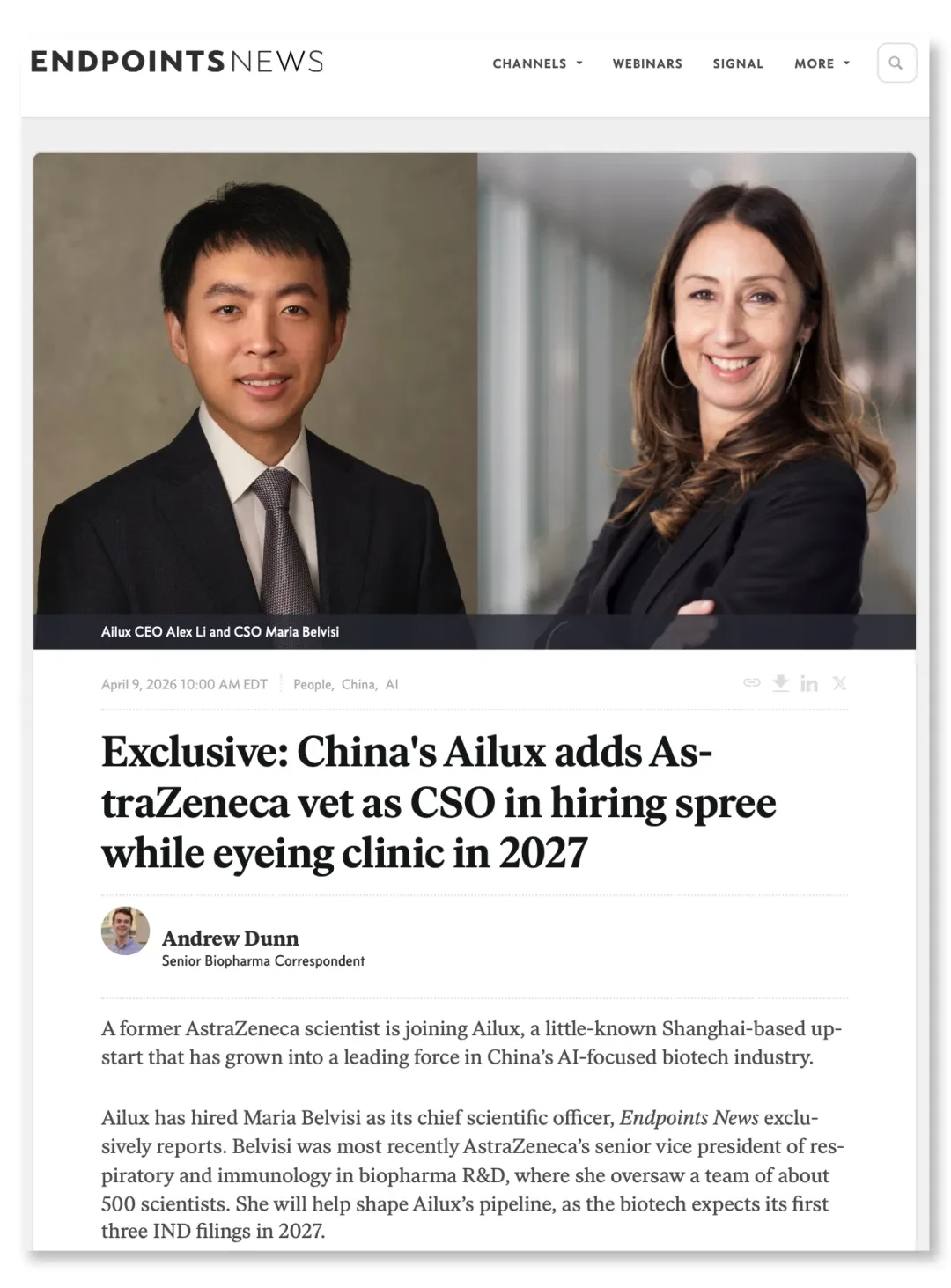
Exclusive: China's Ailux adds AstraZeneca vet as CSO
in hiring spree while eyeing clinic in 2027
By Andrew Dunn, Senior Biopharma Correspondent
A former AstraZeneca scientist is joining Ailux, a little-known Shanghai-based upstart that has grown into a leading force in China’s AI-focused biotech industry.
Ailux has hired Maria Belvisi as its chief scientific officer, Endpoints News exclusively reports. Belvisi was most recently AstraZeneca’s senior vice president of respiratory and immunology in biopharma R&D, where she oversaw a team of about 500 scientists. She will help shape Ailux’s pipeline, as the biotech expects its first three IND filings in 2027.
Ailux started in 2021 as a subsidiary of XtalPi, an AI-for-science company in China now valued at $5.46 billion. So far, XtalPi has single-handedly bankrolled the company, but Ailux CEO Alex Li said he plans to kick off its first external fundraise next month, aiming to finish the round by the end of the third quarter. He declined to disclose a target size or valuation for the raise, but said “we’re paying close attention to what other companies have raised in this space.”
Li didn’t name names, but Ailux has specialized in using AI for designing protein-based drugs, which has become one of the hottest and most competitive areas in the AI bio space. The biggest companies in the area include Flagship Pioneering’s Generate:Biomedicines, which raised $400 million in an IPO in February, Isomorphic Labs, which raised $600 million last year, and Xaira Therapeutics, which debuted in 2024 with over $1 billion in committed capital.
Belvisi, who is based in London and is also a professor at Imperial College London, is Ailux’s first hire in the UK, and will remain there. More than 130 of Ailux’s 150 employees are based in Shanghai, according to the company, but it plans to hire a UK-based team of 10 to 20 people by year’s end. Ailux, which has more than doubled its headcount over the past two years, is also looking to hire a chief medical officer, likely in the US, to build out its clinical development team before starting human trials.
Li said he has focused on thinking pragmatically and globally on hiring. Shanghai has a strong talent pool for early R&D work, but he envisions Ailux as a global biopharma, inspired by companies like Regeneron and BeOne Medicines (formerly BeiGene).
“The BeiGene model is what I strive for,” Li said in an interview, referring to the company’s growth into an industry leader in cancer drugs. “I’m very determined in building that global diversity.”
Shifting the business to focus on pipeline
For its first two years, Ailux built out an AI platform that resulted from close collaboration between laboratory scientists and AI experts. Today, Ailux’s R&D team is about two-thirds wet lab scientists and one-third computational experts, Li said. Its AI models help make a range of predictions on everything from antibody-antigen structures to binding affinity to drug properties like thermostability and polyreactivity.
In 2023, Ailux adopted a service business model, working with dozens of drugmakers on as many projects as possible. Li said the goal was to see how its models performed in the real world. All told, Ailux has run over 100 biologics projects over the past five years. About a year ago, Ailux’s leaders decided to sign fewer partnerships and focus on building its own pipeline. Li said he always anticipated the company would eventually move away from being a purely service business.
“We always knew that wouldn’t be the ultimate plan, because the scale we invest in innovation isn’t sustainable for just a service model,” Li said. “But it really helped hone and validate our platform.”
Ailux is still carrying on with a few partners, Li said, but it is far more selective, like an R&D deal announced in November with Eli Lilly.
Belvisi’s hiring will be a key addition in making that pivot. She has overseen drug programs from start to finish, including leading the development of AstraZeneca’s tozorakimab, an IL-33 antibody that recently succeeded in Phase 3 COPD trials.
Ailux is hoping Belvisi’s experience will boost its own pipeline, which includes a CD19xBCMA T cell engager in immunology and inflammation, a long-acting FcRn blocker for autoantibody-mediated diseases, and a TL1AxIL-23p19 bispecific antibody in inflammatory bowel disease, according to its corporate slides.
Original link:https://endpoints.news/china-based-ai-biotech-ailux-hires-cso-eyes-clinic-in-2027/