

Akili Interactive Files for IPO Amid FDA Approval of First Prescription Video Game Targeting a $70 Billion Market

Akili
Digital Medicine Therapy Developer
As 2022 began, the digital therapeutics sector witnessed major news: on January 26, 2022 (U.S. time), Akili Interactive (“Akili”), a prominent digital therapeutics company, announced that it had entered into a definitive business combination agreement with the SPAC Social Capital Suvretta Holdings Corp. I, with plans to list on Nasdaq by mid-2022 through this transaction.
The equity value of the merged company will reach approximately $1 billion, with total cash proceeds to the company expected to be as high as $412 million. The newly merged entity will operate under Akili, with the stock ticker symbol “AKLI.” VCBeat (WeChat ID: VCbeat) learned of this development at the earliest opportunity and has compiled and analyzed Akili’s current status and future trajectory based on publicly available information.
In recent years, significant breakthroughs have been achieved in the treatment of many diseases. Even cancer, once considered an “incurable disease,” has seen marked improvements in incidence and survival rates thanks to a variety of therapeutic approaches. In contrast, progress in treating cognitive impairments—characterized by symptoms such as inattention, memory loss, and difficulties with learning and decision-making—has been limited, making it one of the largest unmet medical needs worldwide today.
Attention-Deficit/Hyperactivity Disorder (ADHD) is a major category of cognitive impairments and one of the most common neurodevelopmental disorders in childhood. It is typically first diagnosed during childhood and often persists into adulthood.
Children with ADHD may struggle to concentrate, exhibit impulsivity and irritability, or display excessive hyperactivity. These symptoms are chronic and persistent, leading to physical development that lags behind age-appropriate norms and causing irreversible harm to children’s health.
According to the latest publicly available data from the U.S. Centers for Disease Control and Prevention (CDC), based on the 2016 National Survey of Children’s Health, approximately 6.1 million children in the United States have been diagnosed with ADHD, accounting for 9.4% of the U.S. child population. Among these, approximately 388,000 are aged 2–5 years, 2.4 million are aged 6–11 years, and 3.3 million are aged 12–17 years.
When stratified by sex, the prevalence of ADHD diagnosis was 12.9% in boys, significantly higher than the 5.6% observed in girls. Furthermore, approximately 60% of children with ADHD also had at least one other psychiatric, emotional, or behavioral disorder. For instance, about 50% of children with ADHD exhibited conduct disorder, and around 30% suffered from anxiety disorders.
It is evident that the number of children diagnosed with ADHD increases with age. This is because diagnosing ADHD is not straightforward; it requires comprehensive evaluation by healthcare professionals, and subtle signs may easily go unnoticed by parents. As children grow older, their symptoms become more pronounced, leading to higher diagnosis rates. Unfortunately, by this time, the optimal window for intervention has already passed. If this issue is prevalent even in the United States, where mental health receives relatively greater attention, the situation is undoubtedly more severe in other countries and regions.
For ADHD, advances in digital technology are a “double-edged sword.” On the one hand, the progress of mobile internet technology has rapidly fragmented our time, making it difficult to sustain concentration for extended periods. This is clearly unfavorable for individuals with ADHD, whose primary symptom is inattention. On the other hand, traditional ADHD therapies have focused on symptom management and coping strategies rather than directly targeting cognitive functions. Technological advancements have indeed opened up new possibilities for therapeutic innovation.
By leveraging advances in cognitive neuroscience and consumer technology, Akili has innovated ADHD treatment with the development of its digital therapeutic, EndeavorRX. This digital therapeutic product, designed for children aged 8–12 with ADHD, directly targets neurophysiology to better meet the needs of patients and their families, and is transforming the paradigm of neurological treatment.
Of course, EndeavorRX is not a standalone therapy and cannot completely replace medication. It is part of a comprehensive treatment plan for ADHD, requiring a physician’s prescription to be used in conjunction with clinician-guided therapy, pharmacotherapy, and educational programs over a three-month course to improve patients’ disease symptoms.
The only side effect of this therapy observed in clinical trials was frustration occasionally caused by high game difficulty. This is not a concern, as the therapy can adaptively adjust the corresponding game difficulty to alleviate patients’ frustration. Furthermore, no serious adverse events have been associated with its use.
At the core of EndeavorRX is the Selective Stimulus Management Engine (SSME), which also serves as Akili’s current core digital therapeutic platform. It is specifically designed to target and activate neural systems involved in attentional control. Developed through a collaboration between cognitive neuroscientists and mobile game developers, the platform employs personalized, closed-loop algorithms with multiple adaptive capabilities to stimulate key neural circuits underlying specific cognitive functions, demonstrating potential for application across various indications in psychiatry and neurology.
Akili’s digital therapeutic product has “broken through” largely due to its video game format. For a long time, video games were viewed merely as a form of entertainment; more often than not, they have been stigmatized as “mental opium” because of their inappropriate use.
As understanding of mental disorders deepens, scientists have gradually discovered that many such conditions have diverse neurobiological underpinnings. For instance, symptoms of inattention are associated with reduced activity in brain regions including the frontal lobe, frontoparietal cortex, and the ventral attention network.
Through thoughtful design, video games can deliver potent stimulation to the brain, thereby enhancing the structure and function of specific regions. Meanwhile, children are easily drawn to video games. Consequently, there has long been speculation about whether video games could be leveraged to treat certain medical conditions. Akili is the first company to turn this concept into reality.
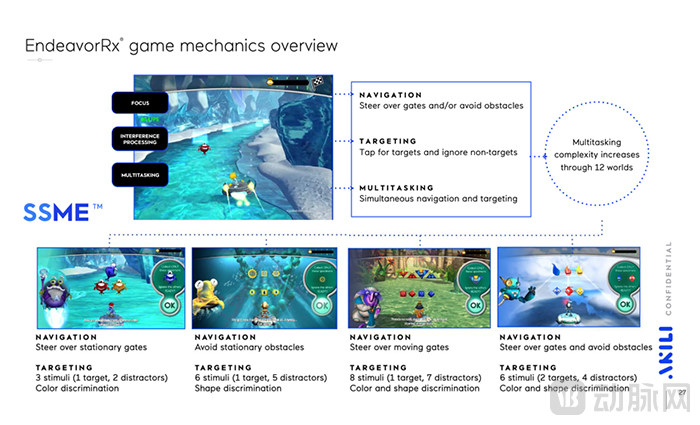
The Operation of EndeavorRX May Appear Simple, but It Is Designed with Medical Considerations in Mind (Image from Official Public Documents)
Of course, not every game can produce therapeutic effects. The design and mechanics of EndeavorRX appear relatively simple—players must steer a boat while battling monsters. However, these mechanics have been carefully designed and validated. During the development process, the team simultaneously scanned and monitored participants’ brain activity to observe which gameplay actions activated specific brain regions, thereby ensuring that the game delivers targeted stimulation to the prefrontal cortex in a specialized manner.
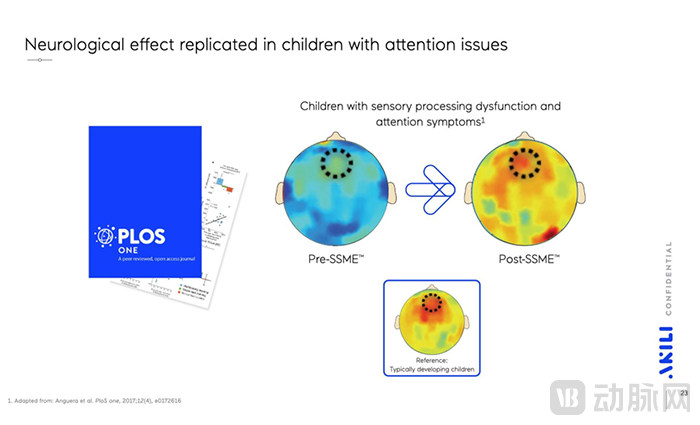
Brain imaging in pediatric patients validated the clinical efficacy of EndeavorRX (image from official public documents)
In 2017, Akili published a peer-reviewed academic paper demonstrating the effects of its game-based therapy on the prefrontal cortex in children with ADHD who exhibited sensory processing disorders and attention deficits. The results showed that brain activity in these children significantly improved after digital therapeutic intervention, approaching levels observed in typically developing children.
The concept of treating diseases with video games has garnered significant attention since its inception, while also facing considerable skepticism. In the past, Akili would likely have needed to undergo prolonged promotion and clinical trials before obtaining FDA medical device clearance. However, no one anticipated that the rampant spread of COVID-19 in the United States would dramatically accelerate this process.
Due to the impact of the pandemic, the FDA temporarily waived requirements for low-risk software tools for mental health in April 2020. By temporarily suspending approval and registration requirements for low-risk digital therapeutics during the pandemic, the agency aimed to rapidly expand access to these interventions, enabling patients to more conveniently obtain digital therapeutics for mental health and receive corresponding treatment or disease management at home.
The FDA believes that this will help reduce the burden on healthcare institutions, allowing them to focus their primary efforts on combating the epidemic; it will also reduce the risk of viral infection and help control the outbreak.
This presented a golden opportunity for Akili. Prior to the pandemic, Akili had already completed randomized clinical trials for its digital therapeutic targeting ADHD and was in the process of applying for medical device certification. The trials involved 348 children, and the data demonstrated that this video game-based digital therapy offered statistically significant benefits in improving pediatric ADHD symptoms.
In accordance with the FDA’s emergency guidance, EndeavorRx received emergency authorization and was made available to the public free of charge. At the time, it was widely believed within the industry that the performance of this digital therapeutic during the free-access period would significantly influence its path to formal clearance. As expected, EndeavorRx obtained De Novo medical device classification in June 2020. It became the first prescription video game ever approved by the FDA, as well as the first commercial product authorized by the agency for children aged 8–12 years with ADHD.
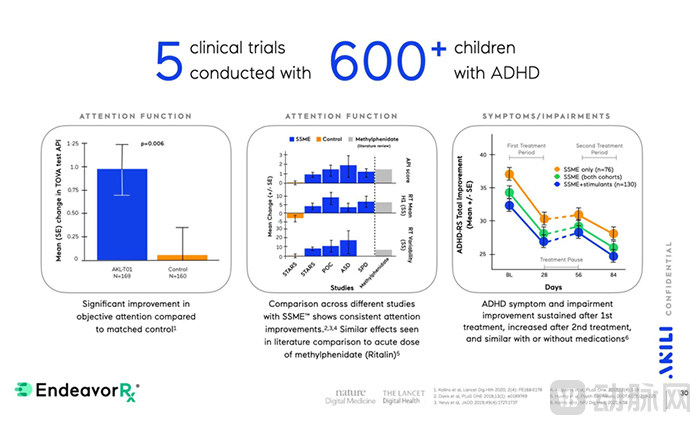
EndeavorRX’s Clinical Trial Data Showed Excellent Performance (Image from Official Public Documents)
To date, Akili’s EndeavorRX has completed five clinical trials involving more than 600 children with ADHD, all of which have confirmed the significant efficacy of this digital therapeutic in improving ADHD symptoms. Patients using EndeavorRX demonstrated improvements in the Test of Variables of Attention (TOVA), a digital assessment measure of sustained and selective attention. These findings have also been published in academic journals such as Nature: Digital Medicine.
Akili’s regulatory approval landed like a bombshell, sending shockwaves throughout the industry. After all, this marked the first time the FDA had approved a video game for use as a medical device. The move was welcomed not only by digital therapeutics companies but also by a large number of game developers.
In fact, the effects of video games on the human body have long been recognized, and the use of gaming for fitness purposes is well-established. For instance, edutainment-oriented motion-sensing games allow players to engage in physical exercise in a relaxed and enjoyable manner. Although gaming consoles equipped with motion-sensing kits are not classified as medical devices, their practical effects can, to a certain extent, be equivalent to those of medical devices.
Some high-difficulty games have even evolved into competitive sports and been included as events in the Asian Games. Their significant impact on human reaction time and psychological resilience is self-evident. The challenge lies in how to incorporate medical principles into game design to achieve therapeutic effects while avoiding side effects. Furthermore, it is necessary to scientifically and rigorously validate the clinical efficacy of these games. In this regard, the industry clearly has a long road ahead.
Another issue is that gaming companies are extremely profitable. According to media statistics, Sony ranked first in global gaming revenue in 2020, with gaming-related income reaching $25 billion. This figure would have placed it second on the 2021 global medical device ranking. Although it did not break into the top ten on the 2021 global pharmaceutical company ranking, it would still have ranked eleventh.
Entering the healthcare industry means that companies must contend with extensive regulations and conduct various costly, rigorous, and cumbersome clinical trials. A single misstep could lead to catastrophic failure and total loss of investment. Given that substantial profits can be made with minimal effort, the gaming industry, accustomed to lax regulatory oversight, clearly has little incentive to venture into the healthcare sector.
Of course, if Akili can blaze a trail in the medical application of games, the gaming industry will certainly not let such a prime opportunity slip by. After all, compared to the consumer entertainment sector, serious healthcare represents an essential need. The same software, when launched as a game, may sell for less than $100, with no guarantee of player interest; however, when marketed as a medical device, its price can easily double, and patients may even proactively repurchase it multiple times—provided it is genuinely effective.
Furthermore, if video games are viable, other diverse digital formats inevitably hold medical potential. A prime example is the currently booming metaverse, encompassing VR/AR/MR technologies. As expected, in November 2021, the FDA granted De Novo clearance to AppliedVR’s VR-based digital therapeutic, EaseVRx, for the treatment of chronic low back pain. In fact, the FDA’s approval timeline for VR-based therapies has been even slower than that of China’s National Medical Products Administration (NMPA). Notably, the NMPA had already approved a VR-based digital therapeutic for cognitive rehabilitation as early as 2020.
From this perspective, the future potential of digital therapeutics is indeed limitless.
Akili believes that with precise marketing, EndeavorRX will hold strong appeal for its target population. Statistics show that the average healthcare expenditure for children with ADHD is five times that of neurotypical children; 44% of these patients have conditions that are not effectively controlled, and another 55% of their families are seeking non-pharmacological treatment options.
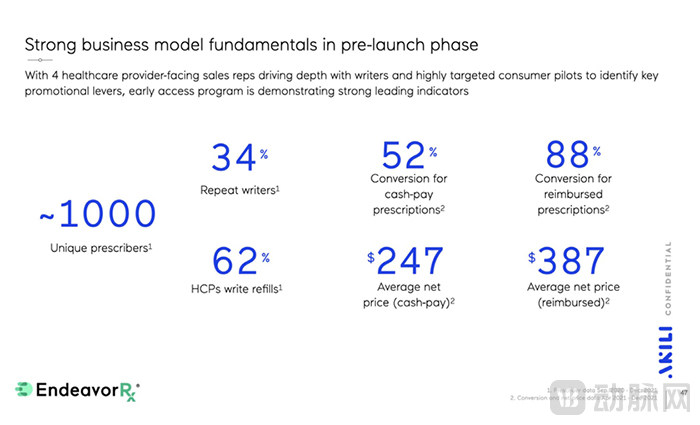
Akili’s Early Commercialization Efforts Yielded Favorable Results (Image Source: Official Public Documents)
Akili’s early commercialization efforts have confirmed this. Between September 2020 and December 2021, four partner healthcare institutions issued 1,000 prescriptions, with a prescription renewal rate of 62%. Meanwhile, from April 2021 to December 2021, the conversion rate for cash-pay prescriptions was 52%, with an average transaction value of $247; the conversion rate for insurance-reimbursed prescriptions reached 88%, with an average transaction value as high as $387.
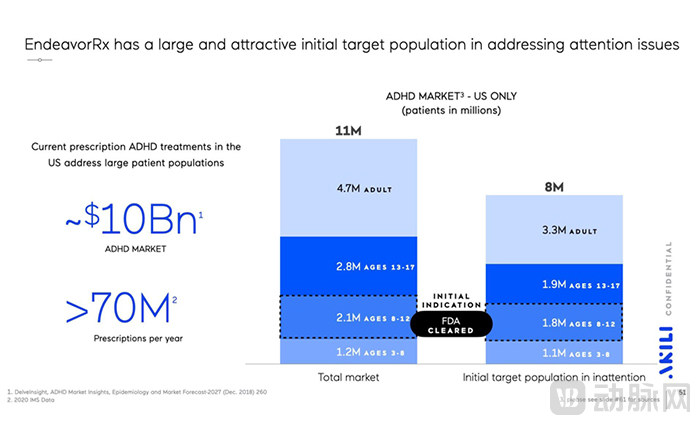
Akili’s initial target population will cover 8 million people (image from official public documents)
Including adults, the population affected by ADHD in the United States is approximately 11 million. These patients require around 70 million prescriptions annually, driving the total U.S. ADHD market size to $10 billion. Among them, approximately 8 million patients suffer primarily from attention deficits—this group constitutes Akili’s initial target population.
Akili’s plan is to reach the 8–12-year-old population with EndeavorRX in the second half of 2022, followed by the 3–7-year-old age group. Key data for the 13–17-year-old cohort and adults will not be available until the second half of 2023. Once full coverage is achieved, Akili projects potential annual revenues exceeding $500 million.
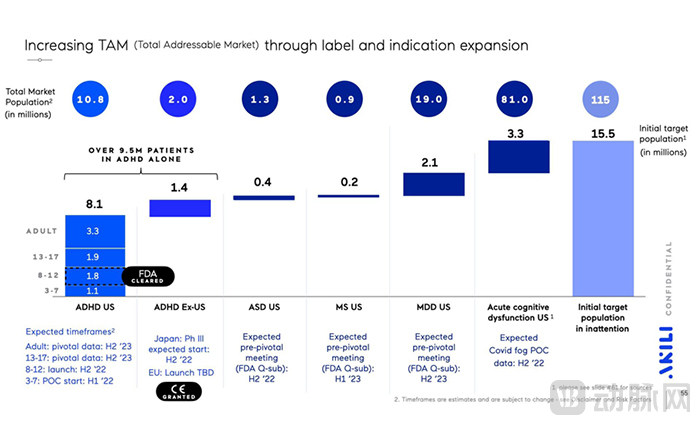
Akili Plans to Reach Approximately 15 Million People Within Two Years (Image from Official Public Documents)
Furthermore, by sequentially expanding coverage in the U.S., European, and Japanese markets to include conditions such as ADHD, ASD, MS, MDD, and acute cognitive dysfunction, Akili aims to increase its addressable population to approximately 15.5 million within two years.
To this end, Akili will invest $390 million in its product pipeline. Of this amount, $195 million—half of the total—will be allocated to the commercialization and expansion of its core product, EndeavorRX. The remaining half will be primarily directed toward research and development of the existing product pipeline ($150 million), with an additional $45 million dedicated to future new platform technologies.
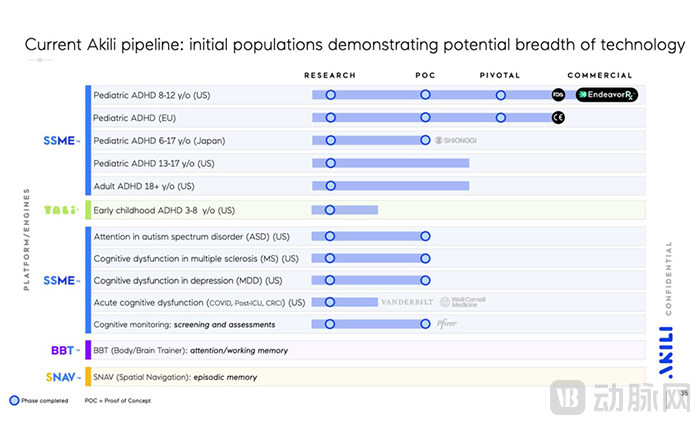
Akili’s Current Product Pipeline (Image from Official Public Documents)
As disclosed by Akili at its investor meeting, the company is also advancing other platform technologies to broaden the range of diseases it covers and address additional cognitive impairments. In addition to the Selective Stimulation Management Engine (SSME), which targets the prefrontal cortex to regulate attention control, inhibition, and multitasking, Akili is advancing the Tali platform for children aged 3–8 with ADHD; the Spatial Navigation Engine (SNAV), which targets the hippocampus to regulate spatial orientation, memory, and organizational planning; and the Body and Brain Training Engine (BBT), which targets the fronto-parietal-cerebellar regions to regulate attention, impulsivity, working memory, and goal management.
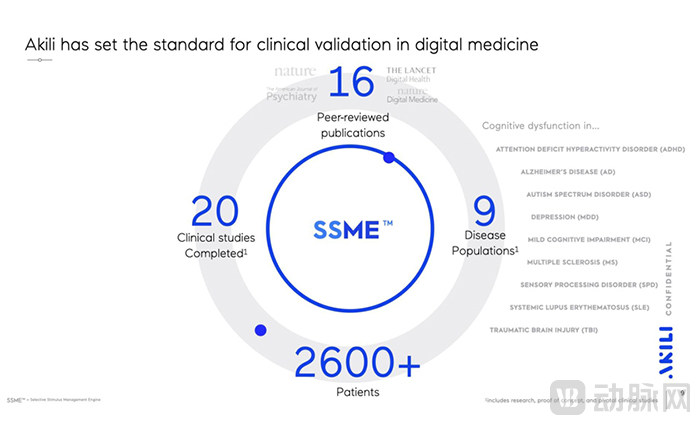
Akili has always prioritized clinical trials (image from official public documents)
To date, Akili has completed 20 clinical trials, enrolled more than 2,600 patients, and published 16 peer-reviewed papers. This sufficiently demonstrates the clinical efficacy of Akili’s digital therapeutics.
It is worth noting that these clinical trials are not limited to ADHD but also cover eight other conditions: Alzheimer’s disease (AD), autism spectrum disorder (ASD), major depressive disorder (MDD), mild cognitive impairment (MCI), multiple sclerosis (MS), sensory processing disorder (SPD), systemic lupus erythematosus (SLE), and traumatic brain injury (TBI).
These patients number in the hundreds of millions, and Akili aims to cover multiple indications that have already achieved proof of concept by creating a disease-agnostic technology platform. Clearly, Akili has more ambitious plans for the future.
Akili is pioneering game-changing technologies to usher in a new era of cognitive medicine. By integrating digital therapeutics with gaming, Akili combines scientific and clinical rigor with the innovation of the technology and entertainment industries, challenging the status quo in medicine. Thanks to Akili’s efforts, the adage that “good medicine tastes bitter” may well become a thing of the past—effective treatments can also be fun and engaging.
In June 2021, Pear had already gone public on the Nasdaq through a SPAC merger. Akili’s listing further fueled the recent surge of interest in digital therapeutics. Meanwhile, China’s digital therapeutics sector has also seen new developments: not long ago, Wangli Technology and Boston Scientific (Bossteng), representative companies in the domestic digital therapeutics field, successfully obtained Class II medical device approval from the National Medical Products Administration (NMPA). Whether digital therapeutics will continue to thrive in 2022 now seems to have an obvious answer.
As one of the earliest research institutions in China to focus on digital therapeutics, VCBeat will continue to closely monitor this sector, providing readers with the most up-to-date and in-depth reporting and analysis. We also welcome valuable insights from the industry.