

Internet Healthcare Giants Crowd into Specialty Segments: M&A and Integration Emerge as the New Normal?
In the Internet healthcare sector, major tech giants are stirring beneath the surface.
In August 2021, Alibaba Health announced its integration with Xiaolu TCM, expanding its strategic footprint into the online traditional Chinese medicine sector.
In September, ByteDance led a RMB 200 million Series C strategic financing round for “Hao Xinqing,” an internet healthcare company specializing in central nervous system (CNS) disorders and mental health. Given the positioning of Xiaohé Health, ByteDance’s subsidiary, as a “comprehensive internet healthcare platform,” the investment in Hao Xinqing yields clear strategic benefits by facilitating Xiaohé Health’s further exploration into the specialized field of mental health.
Major tech companies are further exploring the in-depth areas of medical services. What is presented to the outside world is that internet giants are increasingly emphasizing the development of specialized fields.
Why Specialized Care? What Is the Logic Behind Platform-Based Tech Giants’ Entry into Building Specialized Internet Healthcare Services? What Impact Will Their Explorations Have on Private Healthcare Service Providers Like “Haoxinqing,” Which Focus on Niche Specialties? For Internet Giants with Substantial Capital and Strength, Will “Acquisitions” Be Their Ultimate Strategy?
To delve deeper into these issues, VCBeat interviewed practitioners and investors in the internet healthcare sector, aiming to provide answers to the aforementioned questions.
Specialty Development Is in Full Swing
The unique characteristics of the healthcare industry make it more susceptible to the influence of policies, planning, and other factors.
In October 2021, the National Health Commission issued the “14th Five-Year Plan for the Development of National Clinical Specialty Capacity” (hereinafter referred to as the “Plan”), aiming to propel China’s clinical specialty capacity building onto a sustainable path of high-quality development and establish a long-term mechanism for such capacity building.
To ensure the effectiveness of implementation, the "Plan" states:
During the 14th Five-Year Plan period, the “Hundreds, Thousands, and Ten Thousands Project” for key clinical specialties will be implemented. At the national level, support will be provided for the construction of no fewer than 750 National Key Clinical Specialty projects across various provinces. At the provincial level, the 31 provinces will cumulatively support no fewer than 5,000 Provincial Key Clinical Specialty construction projects. At the municipal and county levels, the 31 provinces will cumulatively support at least 10,000 capacity-building projects for municipal- and county-level clinical specialties. Through these initiatives, a grid-based clinical specialty service system will be established, significantly enhancing the diagnosis and treatment capabilities for common diseases.
For provinces across the country, the development of clinical specialties will undoubtedly usher in an unprecedented opportunity for growth.
In terms of specialty capacity building, the plan also mentions “enhancing the application capabilities of medical technologies and promoting the translation of technological innovations,” “optimizing healthcare service models,” “improving the quality and safety of medical care,” and “strengthening the development of specialized talent teams.”
In fact, the fervor for specialty development in the past is evident both offline and online. The guiding direction of the “Plan” may further boost the development of specialty construction.
From an offline perspective, the development of specialized hospitals and specialized hospital alliances is thriving.To some extent, this is related to the high investment value of certain specialized hospital chains. For instance, Aier Eye Hospital, leveraging its comprehensive advantages in capital, management, and talent, has continued to extend its medical service network into lower-tier markets through its “three-tier chain model,” establishing new specialized ophthalmic hospitals at the prefecture-level city level. Furthermore, medical consortia, particularly specialized medical consortia, have developed rapidly in recent years, already covering nearly all conceivable fields, including pediatrics, otolaryngology, rheumatology, gynecology, maternal and child health, hepatology, orthopedics, respiratory medicine, and laboratory diagnostics. However, from a certain perspective, both the construction of offline specialized hospitals and the development of specialized medical consortia and alliances exhibit a degree of regional specificity.
The use of internet technology has enabled medical services to break free from the constraints of time, space, and geography to a certain extent. In the “Plan,” under the section on “optimizing healthcare service models” within specialty capability development, it is proposed to “actively promote the construction of smart healthcare systems, strengthen the exploration and application of artificial intelligence and sensing technologies in the healthcare industry, and promote new ‘Internet+’ healthcare service models, striving to make positive progress in areas such as surgical robots, 3D printing, the application of new medical materials, computer-aided intelligent diagnosis and treatment, and telemedicine.” This undoubtedly represents a solution aimed at addressing the geographical limitations of healthcare services.
From an online perspective, the development of “Internet+” specialty care is gaining increasing momentum.In May 2020, VCBeat conducted a statistical analysis of the then 497 internet hospitals (based on data as of April 30) and found that general hospitals and traditional Chinese medicine (TCM) hospitals dominated the landscape, while specialized hospitals were primarily focused on chronic diseases or specialties with strong consumer demand, such as dentistry and ophthalmology. Today, with thousands of internet hospitals in operation, their clinical coverage has long since extended to many more specialized subfields. For instance, in December 2021, Zhenru Network obtained the license for a breast specialty internet hospital. Furthermore, provincial-level professional alliances for internet healthcare are taking shape. For example, in September 2021, Guangdong Province established its first “Internet + Nursing” professional alliance. Major tech companies have also continued their exploration of specialized internet healthcare services (this point will be elaborated later).
The rapid development of offline and online specialty care is closely linked to the current imbalance between the accessibility and distribution of medical resources and regional healthcare demands. For relatively weaker specialties, it may be necessary to enhance clinical service capacity and the quality and safety of medical care by strengthening talent development, optimizing service models, increasing basic investment, and reinforcing quality and safety management, thereby ultimately ensuring that the public’s needs for medical consultation and treatment are met.
Meanwhile, internet healthcare companies are attempting to address these issues through innovations in medical service models and other areas.
Why Are Platform-Based Enterprises Eager to Enter the Specialty Care Sector?
It is worth noting that the platform-based enterprises referred to here tend to be those that leverage the substantial resources of major tech conglomerates from the outset and adopt a comprehensive, multi-specialty approach to building their services. Examples include JD Health, AliHealth, and Ping An Good Doctor.
The trend of platform-based enterprises expanding into specialized medical sectors is becoming increasingly evident.
Taking Ping An Health as an exampleIn January 2021, it entered into a strategic partnership with Jiangyin Tianjiang Pharmaceutical, a subsidiary of Sinopharm Group, to collaborate on engaging renowned TCM practitioners, developing specialized departments and disease-specific centers, enhancing diagnostic and treatment capabilities, and ensuring the supply of distinctive pharmaceutical products, thereby launching an online diagnosis and treatment model for specialized diseases and departments. In May of the same year, Ping An Health formed a strategic partnership with Shanghai Skin Disease Hospital to advance cooperation in areas such as the establishment of specialized disease and department centers. Beyond dermatology, Ping An Health is also accelerating the development of specialized departments and disease-specific centers in internal medicine, surgery, gynecology, pediatrics, and traditional Chinese medicine.
Alibaba Health, it strategically invested in LinkDoc Technology in March 2021 to jointly build a service platform covering the entire disease journey for cancer patients in China. The two parties are exploring innovative online service models for specialized oncology pharmaceuticals, establishing an integrated online-offline ecosystem for specialized oncology medical services, and providing cancer patients with high-quality healthcare services that span the entire disease continuum, from clinical care to medication. Furthermore, in August 2021, Alibaba Health merged with Xiaolu TCM to expand into the field of Traditional Chinese Medicine.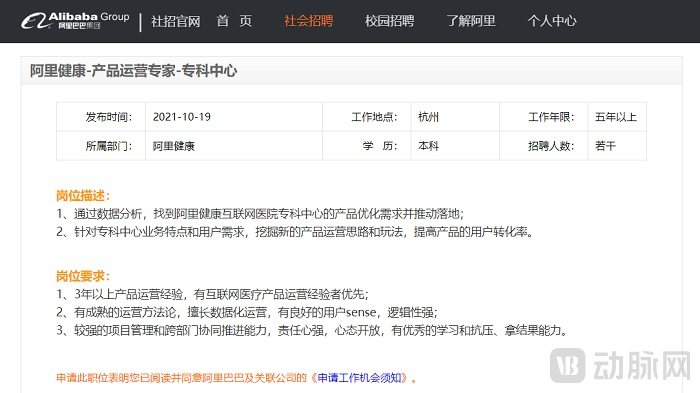
While searching for information on the Specialty Centers of Alibaba Health’s Internet Hospital, we unexpectedly discovered that Alibaba Health continues to invest in the operation of these centers. Screenshot from Alibaba’s social recruitment page.
JD HealthSince establishing the Heart Center in collaboration with Professor Hu Dayi and his team in 2019, JD Health has subsequently partnered with numerous top-tier experts, including academicians and committee chairs. To date, it has established 27 specialized centers covering multiple fields such as endocrinology, oncology, and mental health. Additionally, it has launched dedicated service zones in cooperation with physician groups and specialized institutions. Corresponding medical services can be accessed conveniently through the JD Health platform.
Why Are Platform-Based Internet Healthcare Companies Increasingly Focusing on Specialized Medical Fields?
First, from an industry perspective, the development of internet healthcare has entered a critical phase.The industry has gradually evolved from basic “connectivity” services, such as appointment scheduling and lightweight online consultations that link to existing resources, toward in-depth services like “online disease management.” In 2018, a series of policies favorable to the development of internet healthcare were successively introduced, creating opportunities for the industry’s profound growth. Meanwhile, the Chinese government has been increasing its investment in the construction of regional medical centers. Leveraging the internet to connect with national-level medical resources, delivering integrated online-and-offline diagnostic, treatment, and health management services, and establishing “large-scale internet medical centers” focused on specific diseases and specialties represent a viable and promising development trend. JD Health’s vigorous expansion of specialty center construction in 2019 likely reflected its strategic recognition of this trend and opportunity.
Secondly, from the perspective of corporate development, the construction and growth of online departments follow a logic similar to that of offline hospitals.Building clinical specialties is the core and foundation of hospital development, and strengthening such construction is an essential pathway to enhancing a hospital’s core competitiveness. For online internet healthcare companies to achieve growth, they must inevitably enhance their service capabilities and brand influence through specialty-focused development. Specialty-oriented operations facilitate the decentralization of high-quality medical resources, truly improving resource utilization efficiency and corporate operational efficiency.
Thirdly, from the perspective of user demands, online convenience and diverse healthcare-seeking needs are further driving internet medical platforms to deepen their specialization in specific medical fields.Following the widespread promotion and adoption of online medical platforms, an increasing number of users have begun to experience telemedicine services. The convenience of online healthcare has become more widely recognized by the general public. Furthermore, the disruptions in access to offline medical institutions during the pandemic have further intensified users’ demand for online disease diagnosis, treatment, and management. Diverse patient needs for medical care have, from the demand side, driven new changes on the supply side.
The ability of platform-based internet healthcare companies to deeply cultivate specialized fields is also related to the inherent advantages of the platforms themselves:
① Advantages of Resource Synergy.Taking JD Health as an example, its core strengths lie in its user base, supply chain, and technological capabilities. The specialized medical services offered by the JD Health Internet Hospital can synergize with various business segments and service products, including JD Health’s pharmaceuticals, medical devices, health supplements and tonics, consumer healthcare, and JD Family Doctor services, to provide users with comprehensive solutions for disease prevention, treatment, rehabilitation, and health management.
② Provide targeted services for physicians.By implementing targeted operational strategies for physicians in the “specialty services” sector, the platform offers tailored solutions for different types of doctors: For renowned experts, it helps build their online intellectual property (IP), facilitating the dissemination of academic ideas and the translation of research achievements, thereby further enhancing their influence within the medical community. For early- and mid-career physicians, the platform provides broad development opportunities through benefits such as traffic support, consultation subsidies, brand building, patient management, and professional training. For new or non-onboarded physicians, it promotes rapid professional growth through onboarding guidance, training on laws and regulations, and precise doctor-patient matching.
③ Professional departmental operational capabilities.Platform-based internet healthcare companies have accumulated extensive experience in departmental operations. By leveraging big data analytics in the early stages to evaluate departmental resources, physician availability, and the population applicability of diagnostic and treatment modalities, these companies have built a substantial knowledge base that accelerates the establishment of specialized departments focused on specific diseases.
By building specialized centers and departments, internet healthcare companies can export their advantageous service capabilities to the external market.
For example,The platform has established a comprehensive physician service system, providing users with full-cycle, multi-specialty care covering the entire lifespan of disease management.Ping An Health is committed to building a four-tier physician network: anchored by AI physician assistants, it employs over 2,000 in-house physicians to address common healthcare needs. More than 46,500 external physicians serve as the clinical backbone, addressing patients’ core medical concerns. Over 800 renowned specialist studios, composed of leading experts, focus on specific diseases and specialties to deliver rigorous, high-quality medical care. Meanwhile, the launch of family doctor membership products facilitates patient stratification and ensures seamless referral to specialists.
In addition,The platform has established “integrated” + “one-stop” medical service capabilities.Platform-based internet hospitals, such as JD Health and Ali Health, integrate with high-quality specialist and specialty resources from large tertiary Grade-A hospitals. Through the close integration of online and offline networks, both parties can jointly achieve refined, full-course management across multiple specialties for diverse patient groups, providing one-stop medical and health services that deliver a higher-quality and more convenient user experience. They are able to continuously provide closed-loop services covering the pre-consultation, during-consultation, and post-consultation phases of patient care.
Given that platform-based internet hospitals possess inherent advantages and continue to explore specialized department development, will specialized internet hospital enterprises, which are themselves committed to deepening their presence in niche segments, face relatively greater pressure? What trajectory will their development take?
Are Specialized Internet Healthcare Companies Under Pressure?
The “emergence” of specialized internet-based enterprises represents a new trend: increasing industry fragmentation.
Compared to generalist platforms,Companies focused on specialized fields may possess the following advantages:
① Capabilities are more focused, with a more pronounced trend toward specialization.Ye Dan, President of Shiqiang Health, which specializes in sexual health, stated in an interview, “General-practice internet hospitals may encompass physician resources across a wide range of medical conditions and achieve broader patient coverage. However, this also necessitates more comprehensive pharmaceutical formularies and greater regulatory investment. Consequently, the resources and capabilities allocated to the diagnosis and treatment of different conditions vary. In contrast, specialized internet hospitals concentrate all their institutional resources and capabilities exclusively on the diagnosis and treatment of conditions within a specific specialty. This approach enables the development of more targeted diagnostic and therapeutic systems and knowledge graphs, thereby enhancing diagnostic and treatment efficiency and fostering technological breakthroughs in the respective medical field. The entire organizational structure and personnel exhibit specialized characteristics, resulting in more efficient internal management.”
② More targeted, with more comprehensive supporting services.The traditional, fragmented, and decentralized healthcare model can no longer meet the demands for medical services. In contrast, specialized internet hospitals, leveraging their long-term accumulation of resources and patient bases within specific specialties, are able to provide more targeted diagnostic and treatment services. By focusing directly or supportively on one or a category of diseases, they offer greater disease-specific precision compared to generalist internet hospitals.
③ More convenient and more efficient.Ou Junlin, CEO of Youan Medical, who has accumulated substantial experience in urology, stated, “Each medical specialty has its own characteristics regarding disease onset and progression, diagnostic and treatment needs, as well as specific requirements for internet-based tools—far beyond simple doctor-patient communication platforms. The primary advantage of specialty-specific internet healthcare over general practice lies in the ability to conduct more in-depth exploration within a particular field, uncover application scenarios that better align with specialty-specific needs, and provide patients and physicians with more convenient and efficient medical services. Meanwhile, specialty internet hospitals can more readily earn positive reputations and establish brand advantages due to their specialized expertise.”
Currently, despite various challenges, internet healthcare platforms continue to emerge in large numbers.Which specialties in internet healthcare are more suitable for development?
Xu Feng, Vice President of HaoxinqingConsider“Chronic diseases are well-suited for entry due to their prolonged treatment cycles. Acute conditions can also be addressed, but this requires support from offline infrastructure.” Haoxinqing Internet Hospital currently provides online services through tens of thousands of registered psychiatrists and psychologists from public hospitals, while simultaneously creating a closed-loop pharmaceutical and medical service ecosystem via Haoxinqing Pharmacy to better serve patients.
The decision to focus on mental health and psychology stems from its suitability for online development. The diagnosis and treatment of psychiatric disorders do not rely on physical tests; instead, they primarily depend on doctor-patient communication, where physicians observe patients’ behaviors and verbal expressions, leveraging their robust theoretical knowledge and clinical experience to assess and determine the condition. Meanwhile, patients with mental health conditions often suffer from stigma, leading to low consultation rates under traditional healthcare models. Online screening and consultations via the internet can better protect patient privacy, alleviate psychological burdens, and effectively expand the service capacity of psychiatrists. Furthermore, many patients with mental health conditions require care and companionship when visiting hospitals for follow-up appointments, imposing significant financial burdens on families due to transportation, accommodation, and meal expenses. Internet-based healthcare perfectly circumvents these barriers and holds immense future potential.
Shiqiang Health has accumulated 26 years of development in the field of sexual health specialties, establishing collaborations with over 10,000 hospitals and more than 100,000 physicians across China, thereby commanding nearly 80% of the nation’s medical resources in this specialty. In terms of pharmaceuticals, it has established two physical hospitals in Tonglu and Hainan to create smart pharmacies. Beyond its self-operated drug offerings, Shiqiang Health has built an “online pharmacy” through a combination of drug agency agreements and third-party partnerships, achieving comprehensive coverage of common medication categories and nationwide distribution to support physician prescribing. It is for these reasons that Shiqiang Health chose to “start with andrology to build an internet hospital focused on sexual health specialties.”
Ye Dan, President of Shiqiang Health, also mentioned“, on the one hand, chronic diseases require long-term treatment courses; on the other hand, patients demonstrate high adherence and strong engagement,” which may represent a promising direction for the future development of specialized medical services. Specifically, this may apply to departments such as “andrology, gynecology, diabetes, hypertension, ophthalmology, and dentistry—specialized fields primarily focused on chronic disease management.”
Youan Medical CEO Ou Junlin pointed out that“First, there must be a sufficiently large patient volume; second, there must be a need for disease management; and third, there must be available tools for testing, monitoring, and intervention, along with high patient compliance, as seen in specialties such as dermatology, gynecology, rehabilitation, cardiology, and endocrinology.”
Jiang Xiaodong, Managing Partner of Changling Capital, pointed out, companies currently focusing on specialized medical fields can be divided into two categories: one type focuses on a specific niche specialty, while the other exerts efforts across multiple disease-specific specialties. These specialized departments share certain commonalities in terms of service model design, supply chain development, and core capability building. Changling Capital, which is bullish on the development of the specialized care sector, successively completed investments in December 2021 in Jiandan Xinli (Simple Psychology), a company dedicated to mental health and psychological well-being, and Yunkai Yamei, a multi-specialty internet healthcare enterprise operating in disease areas such as rheumatology and orthopedics, central nervous system disorders, and oncology.
Jianke Fangzhou, Medlinker, etc.The development of multi-specialty internet healthcare platforms further promotes the online management of diseases and home-based disease care., which itself is also validating the trend toward building multi-specialty disease platforms.
Although specialized internet hospitals have certain advantages, we must also point out thatIt is not that there are no difficulties in the process of building a specialized internet hospital.Xu Feng, Vice President of Haoxinqing, stated, “The biggest challenge in building and operating specialized internet hospitals remains professionalism."A 1% increase in professionalism requires 100% or more effort."Shiqiang Health specifically highlighted regulatory issues.“, 'Policy regulation, including oversight of medical service quality, doctor-patient relationships, and physicians' professional competence,' is considered a key pain point and challenge."
YouAn Medical’s CEO, Ou Junlin, also pointed out that talent and funding issues are among the challenges faced by specialized internet healthcare companies.“There is a shortage of professionals who possess both a deep understanding of specialty diseases and medical care, as well as a certain level of familiarity with the internet.” Furthermore, “medical services themselves are long-cycle investments, and specialty internet-based medical services are even more difficult for capital to comprehend.”
As noted by Feizhen Wang, a platform dedicated to pulmonary health, in an interview, “Not all medical specialties are suitable for migration to online platforms. Feizhen Wang’s decision to focus on pulmonary nodules and lung cancer was largely driven by the fact that this field lends itself well to rapid digitalization and internet-based integration.”The successful implementation of online medical consultation services also involves numerous issues, such as the exploration of service scenarios.
Perhaps by examining industry practitioners who provide support for the construction and operation of internet hospitals, we can gain some insights that directly address the actual operational challenges faced by enterprises.
Naitrui CEO Qu Yi stated in an interview“For private enterprises, patients have diverse personalized demands. Due to the constraints of the public hospital system and insufficient medical resources, these needs have not been adequately met, creating significant opportunities in various healthcare sectors, such as andrology, sports rehabilitation, nutrition, and mental health. Conditions associated with strong social stigma are also well-suited for online follow-up consultations, particularly in the field of psychiatry and psychology. In Traditional Chinese Medicine (TCM), prescriptions often need to be adjusted after medication intake, and the treatment course is relatively prolonged. The holistic management process requires continuous guidance on follow-up examinations, interventions, conditioning, medication, exercise, and diet, making this sector highly suitable for online business operations.”
Qu Yi mentioned,Specialized Internet hospitals may encounter some common challenges during their construction and operation.For instance, “First, the expansion of physician resources. Second, the operational management of physicians in internet hospitals. Merely enabling physicians to practice at multiple locations and prescribe medications for pharmaceutical services does not fully realize the maximum value of internet hospitals; platform providers need to offer learning channels to enhance physicians’ professional capabilities and provide rich learning tools, thereby helping physicians deliver more efficient, scientific, and patient-centered care. Third, the scarcity of medical resources. This is particularly challenging for smaller enterprises entering the internet healthcare sector.” In light of these challenges, Natrai has chosen to deepen its expertise in the construction and operation of internet hospitals and in assisting enterprises with digital transformation, providing comprehensive services—including greater access to medical resources, industry chain resources, and a diverse portfolio of IT products and technologies—to enterprises building internet hospitals.
Most specialized internet hospital operating platforms are relatively more optimistic. When discussing how specialized internet healthcare service providers can respond to competition from platform-based internet healthcare enterprises, a more common view is, ““If platform-based internet healthcare companies devote 200% of their efforts to building specialized departments, it will pose a brand-new challenge for specialized internet healthcare platforms. However, at that point, such platforms might perhaps be better termed ‘specialized platforms.’”
So, what kind of relationship will exist between general-practice-oriented medical service platforms and specialty-focused medical service providers?
Benign Competition and Cooperation: Jointly Promoting the In-Depth Development of the Internet Healthcare Industry
In fact, many enterprises dedicated to building specialized medical services have undoubtedly also recognized the potential challenges posed by large platforms after they delve deeply into specialized medical services.Some platforms are also mitigating competition from comprehensive platform enterprises by adopting measures such as “building specialty-specific brands to achieve brand premium” and “establishing specialized pharmaceutical supply chains to reduce drug distribution costs.” Some companies have also pointed out that, in response to competition, they may not rule out the possibility of specialty platforms expanding into more specialty areas in the future, thereby creating a multi-specialty landscape.
Regarding competition, Ou Junlin, CEO of Youan Medical, stated, “The essence of internet healthcare is medical care, with physicians at its core. Physician resources are limited, specialist resources are even more scarce, and the time available from physicians and specialists is also finite. Large platforms and specialized disciplines should leverage their respective strengths and collaborate to improve resource utilization, thereby avoiding redundant infrastructure development and competition for limited resources.”For instance, large-scale platforms can leverage their advantages in capital, traffic, technology, and supply chain management by integrating with specialized disciplines that possess profound insights into the field and service models that better align with the needs of both physicians and patients. This approach enhances physician service efficiency, reduces patient burden, and achieves a win-win outcome for all stakeholders. Specialized platforms should focus more on deeply exploring disease characteristics within their specific domains and internet-based application scenarios, thereby strengthening their core competencies.to deliver genuine internet-based medical services and products, rather than simply acting as 'drug peddlers'."
In fact, Jiang Xiaodong of Changling Capital, a long-term investor in the healthcare services sector, also stated that the two parties may not necessarily face a competitive landscape in the future. “It really depends on what each party is doing. Even within the same sector, the depth of service and the types of services offered are multifaceted,” he added. “For large platforms, the greatest advantage and the most promising direction for their business model should be to provide users with as many relatively standardized products and services as possible.The provision of healthcare services inherently involves many elements that are difficult to standardize; substantial effort is required to develop standardized products and services. Startups may hold a comparative advantage in this regard.A more favorable ecosystem in the future may involve high-quality specialized healthcare providers partnering with large platforms to serve as their service suppliers.“The two parties may develop a benign relationship of co-opetition, with cooperation even outweighing competition.”
For companies currently deeply engaged in specialized medical services, he also pointed out a cautionary note from an investor’s perspective: “Startups inherently lack traffic advantages. If they allocate substantial funds to acquiring traffic, their business models may need to be reevaluated. However, if limited resources are invested in building a deep, relatively standardized service system, there will be significant opportunities for future collaboration with large platform-based enterprises. AndCompetition may arise from suppliers competing with companies in other specialty areas.”
Will acquisitions and integration become the norm alongside collaboration? Jiang Xiaodong stated that platform acquisitions and integration are merely normal business activities.“"Large platforms need to adopt a more open mindset and approach to jointly cultivate and build an ecosystem, providing internet-based healthcare services through positive interactions and commercial cooperation, thereby creating value for patients."
Under this landscape, what trends may emerge in the field of internet-based healthcare services in the future?
From the perspective of patient demands, with the “Healthy China” initiative proposing a shift in the focus of healthcare from “disease treatment” to “health,”Future public demand will become increasingly precise., once patients have identified the appropriate department for their condition, the clinical capability of that department will become the primary criterion in selecting a hospital, and departmental structures will shift toward a “specialty-focused, generalist-supported” model. Internet-based healthcare will expand the reach of specialized diagnosis and treatment, broaden the scope of medical services, and enhance public satisfaction with healthcare delivery.
From an industrial development perspective, there may emerge a small number of large-scale, comprehensive internet healthcare platforms offering general practitioner services, alongside a greater proliferation of highly specialized internet hospitals with distinct characteristics.The latter will become one of the key tools supporting the diagnosis and treatment of specialized diseases, while also providing a new platform for basic medical research. Medical resources will be redistributed online, further advancing the management of complex and rare cases in digital healthcare settings.
From an industry-wide perspective, disease prevention, screening, diagnosis, treatment, rehabilitation, and recurrence monitoring require full-process management that integrates online and offline services. In the future, internet-based medical services will further establish a comprehensive disease management framework spanning pre-consultation, during-consultation, and post-consultation phases; integrating online and offline channels; and covering both general practice and specialized care., to realize truly patient-centered medical services, improve the efficiency of healthcare and health insurance, alleviate the time and financial burdens on patients, and achieve a win-win outcome for the government, institutions, enterprises, doctors, and patients.