

Will Medical and Health Industry Investment Continue to Shift to Non-Tier-1 Cities in 2022 Amid 13.2% Funding Growth?
In early 2022, 30 big data projects in health and medicine, with a total investment of approximately RMB 12.5 billion, were signed in a concentrated ceremony at the Hefei High-Tech Industrial Development Zone. This move marked Hefei’s significant push into the medical and broader health sector in 2022, following its rise to prominence in the venture capital scene in 2020 when it was hailed as the “boldest venture capital firm.”
In addition to Hefei, cities such as Nanjing, Suzhou, and Chengdu have continued to exert strong efforts in the medical and health sector in recent years. Investment and financing in medical and healthcare are increasingly shifting toward non-tier-1 cities, represented by Suzhou, Nanjing, Chengdu, and Hefei. This analysis references the “2021 National City Comprehensive Strength Ranking” and the “2021 City Business Charm Ranking,” which define tier-1 cities primarily as Beijing, Shanghai, Guangzhou, and Shenzhen.
Several industry insiders revealed to VCBeat that while a trend of investment shifting toward lower-tier markets has emerged within the sector, this phenomenon is not yet pronounced. There is still a long way to go before investment truly trickles down to non-first-tier cities.
Based on data from VBInsight, VCBeat compiled statistics on the number of financing and investment events in 2020 and 2021, categorized by investment institutions and regions.
Among them, 30 non-tier-1 cities were randomly selected for statistical analysis by region. The data show that the total number of investment and financing events in the selected regions was 159 in 2020 and 180 in 2021, representing a 13.2% increase.Five cities—Changzhou, Nantong, Hefei, Nanchang, and Fuzhou—each recorded an increase of more than five financing events.Increased by 6, 10, 7, 6, and 5 cases, respectively; nine cities reported an increase of no more than 5 cases.
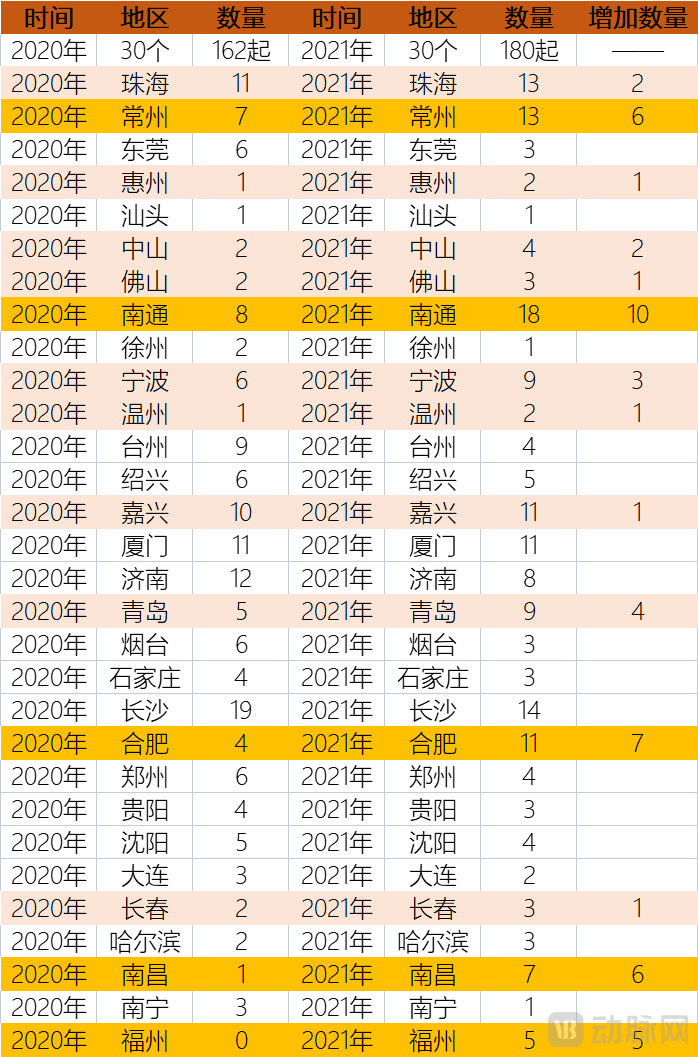
Changes in the Number of Investments and Financings by Region (Data Source: VBInsight)
A random sample of 25 investment institutions was selected from the investor dimension. Statistical results show that the total number of financing and investment events was 348 in 2020 and 515 in 2021, representing a 48% increase.Among them, the number of investment and financing events in five cities—Suzhou, Hangzhou, Nanjing, Tianjin, and Chengdu—increased by more than five., with 34, 23, 12, 10, and 5 cases, respectively; there were 7 cities with an increase of fewer than 5 cases.
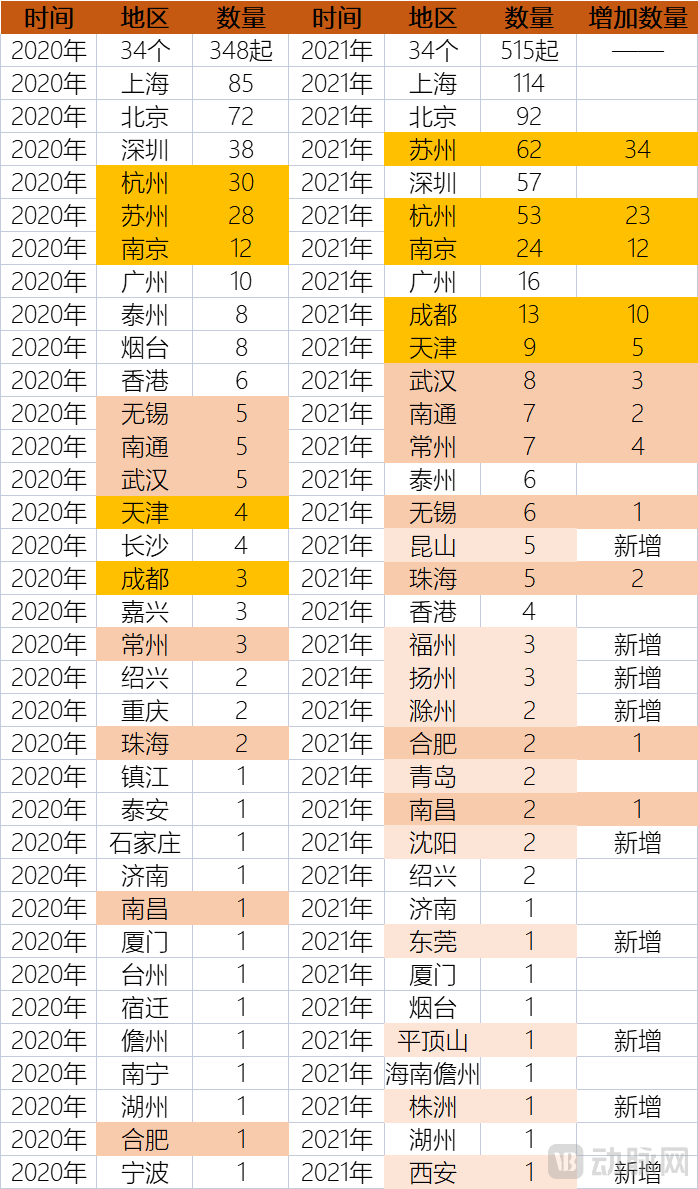
Changes in the Number of Investments and Financings by Investment Institutions (Source: VBInsight)
From two statistical perspectives, the number of investment and financing deals has seen significant growth in the following 10 cities: Changzhou, Nantong, Hefei, Nanchang, Fuzhou, Suzhou, Hangzhou, Nanjing, Tianjin, and Chengdu.
Although some investors have stated,Such growth is merely an isolated case; investment in lower-tier markets will not become a trend. The core of investment projects and resources will continue to be concentrated in cities such as Beijing, Shanghai, and Shenzhen.. However, some investors have pointed out to VCBeat that such growth is actually a manifestation of investment moving down-market, although it is difficult to say whether this downward shift in investment will become a trend,However, it is undeniable that non-tier-1 cities—primarily new tier-1 and tier-2 cities such as Suzhou, Nanjing, Chengdu, and Hefei—are experiencing rapid development and emergence in the healthcare and wellness sector.
The investor noted that industrial clusters in some new first-tier and second-tier cities are gradually emerging, supported by complementary policies, while the scientific research capabilities of local universities are also on the rise.As a result, the number of startups in these cities is increasing, and investment is flowing into these regions; however, this phenomenon is not yet pronounced, and it will take considerable time before it evolves into a definitive trend.
This view was also shared by an investor with VCBeat, who presented her due diligence findings from projects in Chengdu, Hefei, Nanjing, and other cities. The investor noted that Chengdu has achieved solid development in the semiconductor sector, driven by its university resources, while some enterprises in Hefei have primarily capitalized on emerging market trends. She stated that although the trend of investment moving to lower-tier cities is not yet pronounced, given the intense competition in first-tier cities and the current development status of new first-tier and certain second-tier cities, research institutions and enterprises are increasingly relocating to these areas, and investment capital will follow suit.Investment in lower-tier markets is beginning to take root and, in the long run, will become a trend.
The growth in investment and financing data in these cities is actually traceable.
Take Hefei, for example. In 2020, Hefei successfully built its reputation in venture capital and private equity across China under the title of “the boldest venture capital firm.” A series of moves—such as investing RMB 3 billion in BOE, committing RMB 10 billion to ChangXin Memory Technologies (CXMT), and stepping in with a RMB 7 billion rescue investment in NIO—propelled Hefei into the spotlight.
Hefei has also made significant moves in the healthcare and wellness sector.In 2021, a total of 11 investment deals were completed in the medical and healthcare sector in Hefei City. The funded companies included Lianchuang Biotech, Guoyi Technology, Guoyi Quantum, Huaheng Biotechnology, Linyi Kuaiyao, and Huibang Biotechnology, among others.
Among them, Lianchuang Bio, a portfolio company founded in 2009, is an innovative technology enterprise that provides products and technical services to global medical and chemical manufacturers. It specializes in the research, production, and sales of advanced pharmaceutical intermediates, as well as CDMO services, and is one of the earliest companies in China to engage in the business of SGLT-2 inhibitor intermediates and JAK inhibitor intermediates.On October 27, 2021, Addor Capital completed a nearly RMB 100 million Series A investment in Lianchuang Biotechnology.
On June 12, 2021, Guoyi Technology completed a RMB 120 million Series B+ financing round, exclusively invested by the Anhui Railway Development Fund.Public records indicate that this marks the first time the Anhui Railway Development Fund has invested in a primary-market company. The investee, Guoyi Technology, was founded in 2016 and specializes in the development and operation of hospital supply management platforms.
Portfolio company CIQTEK also completed a C-round financing of hundreds of millions of yuan on December 24, 2021. Investors in this round included China National Cultural Industry Investment Fund, CAS Capital, IDG Capital, Hefei Industrial Investment Holding Group, Sinovest Capital, and Qianhai Fund of Funds., in addition, existing shareholders including iFlytek Venture Capital, USTC Guochuang, Hillhouse Ventures, China Everbright Limited (CEL) Partners, Bosera Innovation, and Spark Capital also participated in this round of financing.
In fact, Hefei began exploring the development of its life and health industry as early as 2010. The Hefei High-Tech Industrial Development Zone has consistently prioritized the healthcare and medical industry as a key focus of its growth, leveraging the foundational strengths of the provincial-level strategic emerging biomedical industry base.The park has gathered more than 400 health and medical enterprises, forming a relatively complete health and medical industry chain covering biological drugs, chemical drugs, high-end medical devices, and precision medicine. In 2018, the output value of the health and medical industry in this district exceeded RMB 12 billion. In 2019, the biopharmaceutical industry in Hefei High-tech Zone negotiated and introduced more than 50 projects, with a total investment of nearly RMB 20 billion.
Furthermore, Hefei has witnessed rapid development and achieved notable success nationwide in several key sectors: the big health data industry, anchored by enterprises such as the Hefei Big Gene Center; precision medicine, led by institutions including the Ion Medical Center and CAS Hefei Stem Cell and Regenerative Medicine; the medical high-field magnet industry, supported by entities like the China-Canada Health Engineering Research Institute; and the biopharmaceutical sector, featuring core products such as recombinant human interferon α2b, the flagship product of Anke Biotechnology.
In 2020, the Work Plan for Accelerating the Development of the Big Health Industry, reviewed and approved at the 56th Executive Meeting of the Hefei Municipal People’s Government, outlined a “construction blueprint” for the development of the city’s big health industry—Hefei to Strive for National Strategic Emerging Industry Cluster in Biopharmaceuticals
In January 2022, 30 big data projects in health and medicine, with a total investment of approximately RMB 12.5 billion, were signed in a concentrated ceremony at the Hefei High-Tech Industrial Development Zone.Of these 30 projects, categorized by sector, there are 10 in biopharmaceuticals, 6 in high-end chemical drugs, 4 in digital health, 3 in genetic testing, 2 in technology platforms, 2 in medical devices, 2 in headquarters bases, and 1 in modern traditional Chinese medicine. In terms of investment, 28 projects have investments exceeding RMB 100 million, including 11 projects with investments over RMB 500 million and 4 projects with investments over RMB 1 billion. The projects include the China Regenerative Cancer Primary Cell Biobank project, which addresses key common technologies in biological evaluation in China, and the Beijing Sitosen Stem Cell Storage and Clinical Translation project, which pioneers new models for cell applications.
Hefei's Government Venture Capital Model Also Draws Significant AttentionAccording to relevant reports, the investment process of the Hefei Municipal Government involves first establishing industrially focused investment funds operated on a market-oriented basis to support the attraction of strategic industries. The city excels in leveraging capital for investment promotion by making substantial initial investments to attract enterprises to establish local operations, later divesting its equity stakes at doubled profits, and reinvesting the proceeds to expand the investment funds, thereby exchanging single investments for entire industrial sectors. This venture capital approach can generate industrial agglomeration effects.
More importantly,The Hefei municipal government has a thorough understanding of local resource endowments and clearly identifies its needs, determining which industrial chains align with national strategic development directions while maximizing the boost to local GDP and employment.
Hefei's scientific research resources and transportation infrastructure are also a major advantage.Hefei is home to the world-renowned University of Science and Technology of China, a leading institution in science and engineering, as well as other prominent universities such as Hefei University of Technology and Anhui University. The Chinese Academy of Sciences has established numerous research institutes in Hefei, including the Tokamak laboratory for artificial controlled nuclear fusion reactions and China Sound Valley. In terms of transportation and regional development, with the westward expansion of the Yangtze River Delta, Hefei has emerged as a regional hub city within this expanded area. Furthermore, amid the rise of Central China, Hefei has rightfully become a key city in the region’s economic development, leveraging its advanced technological capabilities and comprehensive transportation network.As the economic center of Anhui Province, Hefei leverages its superior geographic location to serve as a vital link connecting eastern and western China., which also provides significant transportation convenience for settled enterprises and research institutions.
On January 18, 2022, on the eve of Sichuan Province’s “Two Sessions,” Zhang Hu, a member of the Sichuan Provincial Committee of the Chinese People’s Political Consultative Conference (CPPCC) and Deputy Director of the Inflammatory Bowel Disease Center at West China Hospital, stated in an interview that to promote the development of Sichuan’s big health industry, it is essential to first establish an ecosystem for the sector and build a supportive guarantee system. This involves formulating high-standard policy plans and action schemes for the ecosystem, accurately assessing and optimizing the entire industrial chain—from factor support and innovation R&D to commercialization—thereby safeguarding and accelerating the upgrading and growth of the big health industry.
By 2025, the industry’s operating revenue will reach RMB 1 trillion; by 2030, it will reach RMB 2 trillion... This is the roadmap for the development of Chengdu’s pharmaceutical and health industry.
In line with Chengdu’s future development plan, the city will accelerate the enhancement of its core competitiveness in biopharmaceuticals, traditional Chinese medicine (TCM) and natural medicines, and high-performance medical devices. It will also actively foster emerging sectors such as gene and cell therapy, medical artificial intelligence, and novel antibody drugs.
In 2021, there were a total of 41 investment and financing events in Chengdu’s healthcare sector. The funded companies included Hanchen Guangyi, Anaerobic Biology, Kelun-Biotech, Meiyida Medical, Haoyisheng Cloud Healthcare, and Clover Biopharmaceuticals, among others.
Among them,On September 2, 2021, Hanchen Guangyi completed a RMB 200 million Series B financing round.This funding round introduced new shareholders, including Legend Capital, LYFE Capital, and Sinovation Ventures, while existing shareholders Boyu Capital, Northern Light Venture Capital, and Yunzhi Capital continued to increase their investments. Currently, Hanchen Guangyi has successfully developed multiple intelligent life science technology platforms, with a product pipeline covering application areas such as in vitro diagnostics, modern agriculture, and scientific research.
In July 2021, Anaerobe Bio completed a Pre-A financing round of tens of millions of yuan, exclusively invested by Daoyuan Capital.Anaerobic Biologics is an innovative drug developer specializing in the human microbiome. It possesses core technologies covering the entire R&D chain for anaerobic bacterial therapeutics, including high-throughput screening of anaerobic microorganisms, efficient evaluation of microbial drugs, and storage and transportation of live bacteria. Additionally, it has established the largest human anaerobic microbiome resource bank in Southwest China.
Furthermore,, Kelun-Biotech also completed an investment of over RMB 500 million in March 2021, with participation from institutions including IDG Capital, SDIC Innovation Investment Corporation, LAV, Suzhou Likang, and Hillhouse Capital.Public information shows that Kelun-Biotech is a holding subsidiary of Kelun Pharmaceutical, dedicated to the research and development, commercialization, and international cooperation of biologic macromolecule drugs and innovative small-molecule drugs.
Chengdu’s development in the healthcare and life sciences sector dates back to 2012, when GE established its first Innovation Center in China in the city. By 2017, a large number of multinational corporations had successively set up operations in Chengdu, including Siemens, Sanofi, Medtronic, AstraZeneca, and Allergan. Among them, Siemens invested RMB 1 billion to build a digital factory; Sanofi located its “Sanofi Western China Operations and Innovation Center” and “Sanofi Global R&D Operations Center” in Chengdu; Medtronic established its second innovation center in the city; and AstraZeneca set up its Western China headquarters in Chengdu.
In 2018, Allergan established its China Innovation Center in Chengdu, which directly spurred the city’s proposal to build itself into the “Capital of Medical Aesthetics.”
In recent years, Chengdu has gradually tilted its policies and resources toward the pharmaceutical sector.2In 2019, the Chengdu Municipal Government released two documents: “Implementation Opinions on Promoting High-Quality Development of Chengdu’s Pharmaceutical and Health Industry” and “Several Policies to Promote High-Quality Development of Chengdu’s Biopharmaceutical Industry.” These documents outlined the development path for Chengdu’s pharmaceutical and health industry from three aspects: development goals, key priorities, and policy measures.
Among them,Biopharmaceuticals, healthcare, and pharmaceutical commerce are the three key focus areas for the development of Chengdu’s pharmaceutical and health industry.In these three areas, Chengdu will respectively build a globally renowned center for biopharmaceutical innovation and creation, a preferred destination for healthcare services under the Belt and Road Initiative, and an international pharmaceutical supply chain hub city.
Notably, these two documents have strengthened support for pharmaceutical innovation.More detailed policies have also been formulated to attract pharmaceutical and medical talent and deliver high-quality services.Chengdu itself is home to a cluster of higher education institutions, including Sichuan University and Chengdu University of Traditional Chinese Medicine, and boasts advanced medical service resources in western China, such as provincial- and ministerial-level medical institutions including West China Hospital of Sichuan University, Sichuan Provincial People’s Hospital, and the Affiliated Hospital of Chengdu University of Traditional Chinese Medicine.
Supported by these policies and resources, Chengdu has gathered a cluster of key institutions and enterprises focused on the development of the pharmaceuticals, medical devices, and healthcare services sectors. In the pharmaceutical sector, notable companies include Better Pharmaceutical, Kelun Pharmaceutical, Kanghong Pharmaceutical, Di’ao Group, and HitGen. Among them, Kelun Pharmaceutical, Better Pharmaceutical, and Kanghong Pharmaceutical have ranked among China’s Top 100 Pharmaceutical Industry Enterprises, with 75 product varieties achieving annual sales revenues exceeding RMB 100 million. In the medical devices sector, key players include Maccura Biotechnology, AutoBio Medical, Bonss Surgical Robot, and Blu-Ingno. In the healthcare services sector, prominent enterprises include Xichan Plastic Surgery & Aesthetics and KingMed Diagnostics. Additionally, emerging health economy companies such as 23Mofang, New Life Stem Cell, and Medlinker are also part of this ecosystem.
Currently, Chengdu’s pharmaceutical and health industries are primarily distributed across the High-Tech Zone, Wenjiang District, Shuangliu District, Wuhou District, Pengzhou City, and other areas. With industrial carriers such as the Tianfu International Bio-town, Chengdu Medical City, and Tianfu Traditional Chinese Medicine City, these sectors have gradually formed industrial clusters.
In 2021, there were a total of 44 investment and financing events in the healthcare sector in Nanjing. The funded companies included Triastek, Newborn Biotech, Dingtai Pharmaceutical Research, Legend Biotech, Simcere Diagnostics, Suikun Intelligence, and Nuoling Biotechnology.。
Among them, Triastek completed a RMB 330 million Series B financing round in June 2021; Dingtai Pharmaceutical Research completed nearly RMB 1 billion in financing; Legend Biotech secured USD 500 million in financing; and Simcere Diagnostics completed a Series B financing round of nearly RMB 600 million.
According to incomplete statistics,Since 2010, Nanjing’s biopharmaceutical industry has attracted over RMB 20 billion in external investment., many domestic pharmaceutical giants and related industrial investment institutions have already identified Nanjing as a key city for establishing operations. Through years of quiet dedication in recent years, Nanjing has emerged as a major hub for biomedical industry investment in China.
In terms of hard power,Nanjing has established a life and health industry landscape characterized by “One Valley, One Town, and Three Parks,” with the main business revenue of its five major clusters accounting for 75.4% of the city’s total.
In fact, Nanjing’s biopharmaceutical enterprises currently rank among the largest in Jiangsu Province. According to statistics, by the end of 2020, there were 14 listed companies in Nanjing within the new pharmaceuticals and life health industry sector. In 2021, four companies were proposed for inclusion on Nanjing’s Unicorn Enterprise list, 44 were proposed for inclusion on the Nanjing Cultivated Unicorn Enterprise list, and 20 were proposed for inclusion on the Nanjing Gazelle Enterprise list.
Furthermore, according to statistics based on publicly disclosed information,Since 2010, nearly 100 enterprises and investment institutions have invested in Nanjing’s biopharmaceutical companies, with total investments exceeding RMB 20 billion. Notably, the investment volume from 2021 through the end of September alone reached nearly RMB 5 billion, marking a historic high. This trend underscores how Nanjing’s industrial policies and development are now reaping the benefits of long-term accumulation.
The booming industrial scale has also made Nanjing more ambitious. In August 2020, the Nanjing Municipal People’s Government released the Action Plan for Building Nanjing into a Landmark Hub for New Pharmaceuticals and the Life Health Industry, proposing that by 2025, the city’s new pharmaceuticals and life health industry would exceed RMB 540 billion in scale, and its comprehensive ranking in biomedical innovation would enter the top three nationwide.
In March 2021, the Nanjing Municipal Science and Technology Bureau, the Municipal Health Commission, and two other departments jointly formulated and issued the “Action Plan for Scientific and Technological Innovation in Life and Health,” proposing to strengthen support for scientific and technological innovation in life and health and to build a globally influential highland for such innovation.
In September 2021, the Nanjing Municipal Government issued the "Three-Year Action Plan for the Development of Bioeconomy in Nanjing (2021-2023)," striving to achieve a bioeconomy output value of RMB 400 billion by 2023, thereby doubling the previous figure.
Furthermore, to better serve healthcare enterprises in Nanjing and enhance the R&D and innovation capabilities of local companies, Nanjing has established 158 innovation platforms related to biomedicine. These include 7 national key laboratories, 2 national-level public science and technology service platforms, 1 national engineering technology research center, 84 provincial-level platforms, and 64 municipal-level platforms. Among more than 200 newly established R&D institutions that have completed filing procedures, 35 are specialized in biomedicine.
Relevant investors disclosed to VCBeat,Nanjing holds significant investment potential. First, it boasts a robust talent pool, drawing from prestigious institutions such as Nanjing University and China Pharmaceutical University. Second, its effective promotion of the “Pharma Valley” has enhanced its competitiveness in attracting enterprises.
Another investor expressed a similar view and stated,Talent shortage is a significant factor limiting the downward penetration of investment into new first-tier and second-tier cities, and it also serves as a major constraint on the development of the healthcare industry in these cities.The development of urban healthcare must make substantial efforts in talent acquisition, particularly for inland cities, as medical professionals are currently concentrated mainly in regions such as the Yangtze River Delta and the Pearl River Delta. This is also a key reason why the downward shift of investment into lower-tier markets is unlikely to become a trend in the short term.
In addition to the healthcare industries in Hefei, Chengdu, and Nanjing, which merit attention, those in Nantong (Jiangsu) and Nanchang (Jiangxi) are also developing rapidly.
In 2021, there were a total of 18 investment and financing events in the healthcare sector in Nantong City. The funded companies included Lianya Pharmaceutical, Ludede Medical, Yiyi Medical, Auscan Biologics, Jiunuo Medical, Kekai Life Sciences, and Sino-American Ruikang, among others. In Nanchang City, there were a total of 7 investment and financing events in the healthcare sector. The funded enterprises and institutions included Bornier, Double Angel Biotechnology, Tengwangge Pharmaceutical, Zhonghong Boyuan, Jiangxi Fukang, and Nanchang Mingzhou Rehabilitation Hospital, among others.
In 2021, the Nantong Economic and Technological Development Area announced the issuance of the “Several Opinions on Accelerating the Development of the Pharmaceutical and Health Industry in the Nantong Economic and Technological Development Area.” In terms of encouraging R&D and innovation,Subsidies of RMB 7.5 million to RMB 8.7 million are provided for new drugs entering clinical trials, with additional subsidies of RMB 10 million to RMB 12 million granted upon obtaining the Drug Registration Certificate, among other supportive policies.In promoting large-scale production,New drug projects are subsidized at 20% of equipment investment, while generic drugs and me-too drugs are subsidized at 15% of equipment investment.In terms of attracting high-end talent,Launch startup grants of up to RMB 50 million, along with supportive policies such as salary subsidies, housing purchase subsidies, and living allowances.。
In recent years, Nantong Development Zone has leveraged its existing foundation to accelerate development, setting a goal to cultivate more than 10 listed biopharmaceutical companies across the district by 2025; attract over 50 industrialization bases for high-quality pharmaceutical enterprises; and achieve a scale of RMB 50 billion for the pharmaceutical and health industry, with the combined scale of drugs and medical devices striving to exceed RMB 30 billion.
Currently, there are 31 pharmaceutical and health enterprises above the designated size in Nantong Development Zone.In 2020, sales revenue reached RMB 18.5 billion, representing a 20% increase; from January to July 2021, taxable sales revenue amounted to RMB 10.6 billion, up by 9.3%, with industry giants such as Merck Pharmaceuticals, Promiscience Innovative Drugs, and Siforui Pharmaceuticals establishing their presence in the area.Meanwhile, a biopharmaceutical industrial park with a total planned area of 4,100 mu is being developed in the central zone to provide strong support for the establishment of biopharmaceutical projects.
In early 2022, Nanchang, Jiangxi Province, issued the "Several Policy Measures (Trial) of the Jiangxi Provincial Medical Products Administration to Support the High-Quality and Leapfrog Development of Nanchang’s Biopharmaceutical Industry." The document outlines 18 specific measures across four areas to fully support the development of Nanchang’s biopharmaceutical industry.
This includes establishing a new drug application service platform for clinically urgent medicines, such as innovative drugs, rare disease treatments, and pediatric-specific drugs developed by pharmaceutical companies, to fully support their registration applications in entering the National Medical Products Administration’s priority review and approval pathway as quickly as possible; for key enterprises, projects, and products that meet the criteria, as well as “two products and one device” companies located in key industrial parks such as the Traditional Chinese Medicine Science and Technology Innovation City, prioritize verification and review, and complete the review, verification, and on-site inspections in the shortest possible time;Support the inheritance, innovation, and development of traditional Chinese medicine (TCM), and encourage pharmaceutical manufacturers in the Nanchang area to participate in the research, development, and production of TCM formula granules.
According to publicly available data, Nanchang City currently has more than 300 pharmaceutical manufacturing enterprises and over 16,000 operating entities, employing more than 80,000 people. Among these, pharmaceutical production accounts for 17.6% of the province's total output, while medical device production accounts for 47.5% of the province's total.The production scale of proprietary Chinese medicines ranks among the top in cities across China, and the manufacturing scale of single-use medical devices is the largest in the country.
Among them,As a distinctive industry of Nanchang, the traditional Chinese medicine (TCM) sector has also become a key pillar supporting the development of Nanchang’s biopharmaceutical industry.Public data shows that in 2017, the city had 19 large-scale enterprises engaged in traditional Chinese medicine (TCM) and proprietary Chinese medicines, including two TCM decoction piece manufacturers and 17 proprietary Chinese medicine manufacturers. In 2017, these enterprises achieved a total main business revenue of RMB 10.25 billion, accounting for 32% of the city’s total biomedical industry output. Of this amount, RMB 92.27 million came from TCM decoction pieces, and RMB 10.16 billion from proprietary Chinese medicines. The city has a total of 17,960 mu of TCM cultivation bases, with companies such as Jiangzhong and Huiren also operating additional cultivation bases both within and outside the province.
In recent years, non-tier-1 cities have gradually risen in prominence. Amid the widespread perception of intense “involution” in tier-1 cities, talent and scientific research resources have, to some extent, flowed toward non-tier-1 cities. The decentralization of research institutions and enterprises has also spurred a corresponding shift in investment toward these regions. Furthermore, local governments in non-tier-1 cities are vigorously developing the healthcare industry based on their unique urban conditions, with certain sectors in specific cities already attracting investor attention. Whether viewed as isolated cases, accidental phenomena, or an inevitable trend, investment targets in some non-tier-1 cities are gaining visibility at a time when the vast majority of capital remains concentrated in tier-1 hubs such as Beijing and Shanghai—and they are likely to receive even greater attention in the future.