

Plexium Therapeutics Announces IPO Filing to Advance Its Novel Monovalent Protein Degraders and Proprietary DELPhe Discovery Platform

Plexium
Targeted Protein Degradation Technology Developer
Recently, global pharmaceutical giant Amgen announced a strategic collaboration with biotech startup Plexium to develop small-molecule degraders. By leveraging Plexium’s proprietary DELPhe drug discovery platform and Amgen’s expertise in developing multispecific molecules, the two companies will jointly research and develop novel molecular glue drugs. Molecular glues are a class of small-molecule degraders that primarily function by modifying the surface of E3 ubiquitin ligases, thereby enabling the recognition and degradation of novel substrates; they are classified as monofunctional small-molecule compounds.
Under the terms of the agreement, the collaboration between the two parties will focus on two initial projects, with Amgen holding an option to add additional projects. Plexium is eligible to receive milestone payments totaling more than $500 million, based on achievements in research and development, regulatory approvals, and commercial progress. Meanwhile, Amgen holds exclusive commercialization rights for each project advanced to predefined preclinical development stages and will be responsible for global development and commercialization.
Currently, the targeted drugs most extensively developed by scientists for disease targets are small-molecule inhibitors, antagonists, blockers, and agonists. These agents work through distinct mechanisms: inhibiting ligand–receptor binding by altering ligand structure; antagonizing ligands by competing with them for receptor binding sites; blocking the interaction between endogenous ligands and their receptors by binding to the receptors; and binding to receptors to activate them and elicit a response. In theory, these targeted therapies can address diseases at their root cause.
However, the binding of these small-molecule targeted drugs to their targets depends on mutual affinity. Targets with low binding affinity have become “forbidden zones” that are difficult to drug in the pharmaceutical field. In recent years, small-molecule degraders that bypass affinity limitations have come into view, offering a potential pathway for developing new drugs in these previously inaccessible areas.
The discovery of small-molecule degraders relies on research into the ubiquitin-proteasome system (UPS). By mediating the recognition between ubiquitin ligases and target proteins, these agents facilitate the degradation of the target proteins. This degradation is essentially a catalytic process that leverages the body’s endogenous proteasomes to directionally decompose target proteins tagged with ubiquitin “labels.” This mechanism bypasses the need for drug-affinity bridges, allowing direct interaction with the target protein to drive UPS-mediated degradation.
It is reported that fewer than 20 companies worldwide have small-molecule degraders in clinical development, and no small-molecule degrader drugs have yet received regulatory approval. In this emerging field, what has attracted the interest of pharmaceutical giant Amgen in Plexium, a second-tier player whose pipeline has not yet entered clinical trials? VCBeat New Medicine has compiled information from public sources on Plexium’s innovations in small-molecule degraders and its corporate development history for our readers.
Founded by Three Co-Founders, with R&D Led by the President of Japan’s Third-Largest Pharmaceutical Company
Plexium, founded in 2017, is a biopharmaceutical company dedicated to the research and development of next-generation targeted protein degradation (TPD) therapeutics, with expertise in the discovery and design of various monovalent protein degraders. The company’s innovatively developed small-molecule degraders transcend the limited applications of traditional proteolysis-targeting chimeras (PROTACs) and cereblon IMiDs (a class of molecular glues). Spanning from molecular glues to monovalent degraders, these agents hold promise for treating diseases across multiple therapeutic areas, showcasing the vast potential of protein degradation technologies.
The company was co-founded by three scientists—Andrew MacConnell, Joe Rokicki, and Kandaswamy Vijayan—though none of the three co-founders currently serve at Plexium.
Among them, Kandaswamy Vijayan holds a Ph.D. in Physics from the University of Pennsylvania in the United States. He served as Chief Executive Officer of Plexium from its founding until April 2021 and is currently the CEO of Zafrens, a U.S.-based technology company. Andrew MacConnell holds a Ph.D. in Chemistry from The Scripps Research Institute in the United States. After co-founding Plexium, he established the biotechnology company 1859 in 2019, which focuses on building data science tools for new drug discovery to empower pharmaceutical companies; he currently serves as its Chief Technology Officer. Joe Rokicki holds a Ph.D. in Molecular, Cellular, and Developmental Biology from the University of Colorado in the United States. After co-founding Plexium, he founded Enveda Biosciences, a biotechnology company that leverages plants to develop new drugs, where he serves as Chief Technology Officer.
In November 2021, Plexium announced on its official website that Percival Barretto-Ko would be appointed as President and Chief Executive Officer. Mr. Barretto-Ko holds an honors bachelor’s degree in biological sciences and chemistry from Cornell University, an MBA from Yale University, and a Master of Science in Management from the MIT Sloan School of Management, where he also served as a Fellow in Innovation and Global Leadership.

Plexium’s New CEO: Percival Barretto-Ko
Prior to joining Plexium, Percival Barretto-Ko spent 16 years at the globally renowned pharmaceutical company Astellas Pharma, where he held several key positions. He served as President of Astellas Pharma US, overseeing annual revenues exceeding $4.5 billion during his tenure and leading the execution of Astellas’ corporate strategic plans. Astellas Pharma is Japan’s third-largest pharmaceutical company, with revenue trailing only Takeda Pharmaceutical and Otsuka Pharmaceutical. Before joining Astellas, Percival Barretto-Ko held various senior commercial roles at Roche Group in the United States and the United Kingdom, covering multiple therapeutic areas including oncology, hematology, virology, immunology, and infectious diseases.
As Plexium’s newest Head of Drug Development, Percival Barretto-Ko stated, “I am delighted to join Plexium at this exciting juncture and help realize its vision of becoming a leading next-generation targeted protein degradation (TPD) company. With its specialized R&D platform, innovative technologies, top-tier investors, and world-class team, Plexium is well-positioned for success in developing TPD therapies that address the limitations of PROTACs and cereblon modulators. I look forward to advancing our important and innovative work to establish protein degraders as a new class of therapeutics with the potential to treat a wide range of diseases.”
DELPhe Platform Facilitates the Discovery of Small Molecules and Novel E3 Ligases, with a Differentiated Strategy for Monovalent Degraders
Traditional PROTAC small-molecule degraders are, strictly speaking, bivalent molecules, with one end binding to the target protein and the other to an E3 ligase. However, Plexium is focused on developing monovalent degraders that can bind independently to either the target protein or the E3 ligase, inducing conformational changes that ultimately lead to degradation of the target protein.
Plexium’s proprietary DELPhe drug discovery platform, leveraging ultra-high-throughput screening (uHTS) technology, enables the differentiated development of targeted protein degradation (TPD) therapies, expanding the breadth and depth of traditional small-molecule degraders.
The DELPhe drug discovery platform is essentially a DNA-Encoded Library (DEL). Plexium has developed the DELPhe drug discovery engine by strategically designing its DEL to enable the targeted screening of novel small molecules that bind to E3 ligases. Leveraging a professionally designed “on-bead” DNA-encoded library (as shown in the figure below), Plexium can perform analytical assays in miniaturized cellular formats at ultra-high throughput, quantifying the degradation of one or more candidate proteins within disease-relevant cellular environments.
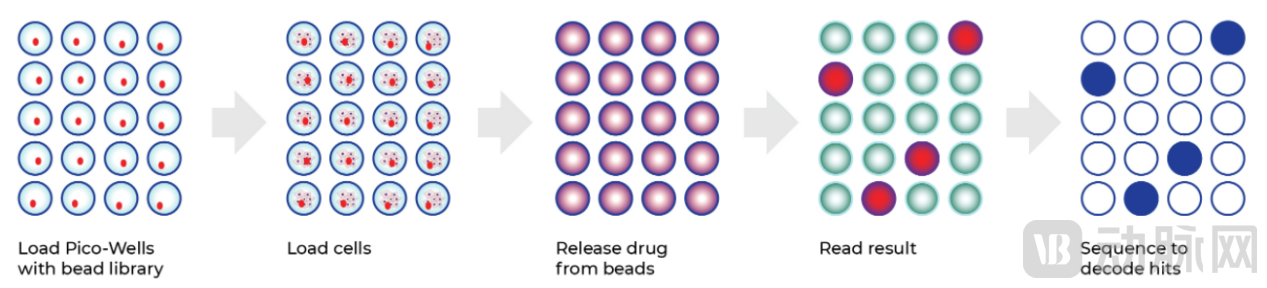 DELPhe Platform DEL Screening Process
Leveraging the advantages of DNA-Encoded Library (DEL) technology, Plexium can rapidly identify high-potential small-molecule compounds that modulate E3 ligase activity. Furthermore, the DEL platform enables multiple parallel screens against the same E3 ligase, addressing the challenge of potential conformational heterogeneity. The company is utilizing this approach to discover best-in-class monovalent degraders or molecular glue degraders targeting disease-causing proteins.
Development of small-molecule degraders via this technical approach offers four key advantages:
1. DEL combinatorial libraries can contain hundreds of billions of molecules, and this vast molecular library ensures the diversity and novelty of small-molecule structures;
2. The DELPhe drug discovery engine enables intuitive visualization of the degradation efficacy of target compounds in disease-relevant typical cellular environments;
3. DELPhe can be used to identify novel small molecules that bind to E3 ligases and optimize these small molecules for specific activity profiles; 4. It has the potential to access all intracellular E3 ligases.
Leveraging this technological advantage, the DELPhe platform is well-suited for studying E3 ligases and assessing how modulating their activity affects cellular phenotypes. Consequently, within Plexium’s clinical pipeline, we observe that in addition to its research on monovalent small-molecule degraders targeting undruggable targets, the company has also invested in the development of novel E3 ligase modulators.
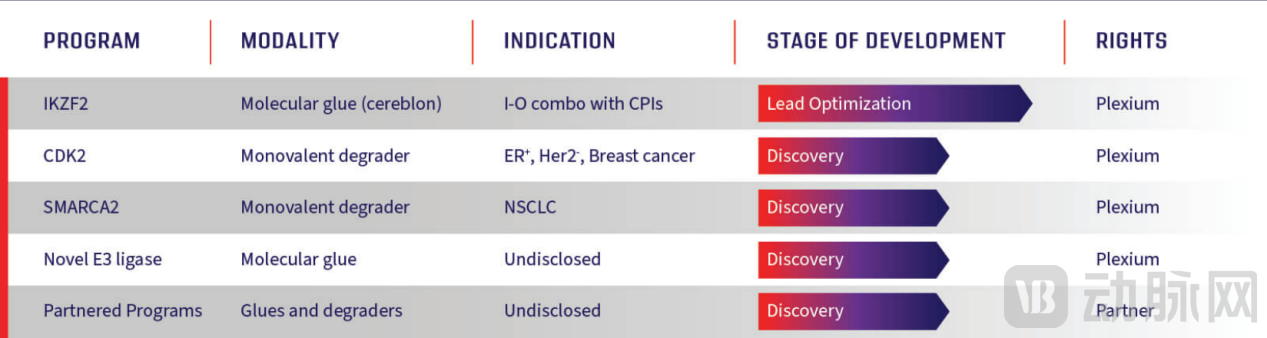
Plexium's Clinical Pipeline Portfolio
An examination of Plexium’s clinical pipeline reveals that its projects primarily include molecular glues targeting the IKZF2 transcription factor, monovalent degraders targeting CDK2 and SMARCA2, respectively, as well as novel E3 ligases and other degraders. Among these, the IKZF2 transcription factor plays a role in immuno-oncology signaling and represents a highly promising cancer target. In China, biopharmaceutical companies such as Biaoxin Biologics are also developing molecular glue degraders targeting IKZF2, which are currently still in the preclinical research stage.
The other two targets, CDK2 and SMARCA2, are a key regulator of the cell cycle and a global transcriptional activator, respectively. Their degraders are being developed for the treatment of HER2-/ER+ breast cancer and small cell lung cancer (SCLC), respectively. Currently, in China, Haisco Pharmaceutical Group Co., Ltd. is conducting research on small-molecule degraders targeting SMARCA2. According to publicly available information, teams researching CDK2 degraders include Professor Rao Yu’s team from the School of Pharmaceutical Sciences at Tsinghua University and Professor Ying Meidan’s team from the College of Pharmaceutical Sciences at Zhejiang University.
In the field of small-molecule degrader development, the screening of E3 ubiquitin ligase binders represents a significant technical barrier. Although there are over 600 E3 ubiquitin ligases in the human body, each with distinct tissue distribution patterns and specific substrates, our understanding of their druggability remains limited. Currently, most targeted protein degraders rely on only five to six E3 ligases, predominantly CRBN or VHL.
Plexium’s proprietary DELPhe platform has the potential to address this challenge by enabling comprehensive screening of all E3 ligases through DNA-encoded library (DEL) technology, thereby facilitating the discovery of novel E3 ligase-modulating therapies. It leverages target-specific degradation assays and phenotypic screening to identify small molecules that can reduce target protein levels in cells.
$63 Million Series A Financing, $500 Million R&D Collaboration: Emerging Small-Molecule Degrader Company Plexium Shows Great Potential
Since its establishment in 2017, Plexium has completed five rounds of financing and is currently at the Series A stage.
The seed-round investors primarily include the U.S. venture capital fund DCVC Bio and CRV, a U.S. venture capital firm focused on early-stage investments.
Plexium’s Series A1 round in October 2019, led by DCVC Bio and The Column Group with participation from M Ventures, CRV, and Neotribe Ventures, raised $28 million. Its Series A2 round in January 2021, led by Lux Capital and Pivotal BioVentures with participation from The Column Group, DCVC Bio, and other existing investors, raised $35 million. Combined, Plexium’s total Series A funding has reached $63 million.
In addition to investor support, Plexium’s unique monovalent degraders have also attracted the interest of Amgen, a major pharmaceutical company. The two parties are collaborating to develop novel molecular glue therapies for targeted protein degradation, focusing on expanding opportunities in this field by discovering previously unknown molecular glues or monovalent degraders.
Dr. Ray Deshaies, Senior Vice President of Global Research at Amgen, expressed high praise for Plexium in a joint statement: “Collaborating with Plexium and leveraging their innovative technology to discover molecular glue degraders can help tackle some of the most challenging protein targets to address serious diseases. We are ushering in a new era of drug discovery, where the mechanisms of action of innovative therapies may differ fundamentally from those of traditional drugs.”