

Will Domestic Bioreactors See a Breakthrough After WuXi Biologics Plunges 30% and Halts Trading? [Upstream Tools Special Report]
On February 7, the U.S. Department of Commerce added WuXi Biologics and 32 other Chinese entities to the “Unverified List” (UVL). On February 8, trading in WuXi Biologics’ shares (HKEX: 02269) was suspended after a 30% plunge, while a host of other listed CXO companies—including WuXi AppTec, Tigermed, Pharmaron, Jiuzhou Pharmaceutical, and Asymchem—also suffered collective setbacks due to the fallout.
Regarding its inclusion on the list, Chen Zhisheng, CEO of WuXi Biologics, stated that the Unverified List involves import controls on two consumables—single-use bioreactor controllers and hollow fiber filters—primarily affecting its major facilities in Wuxi and Shanghai. In terms of hardware, these two plants have reached a relatively mature stage of development. Moreover, WuXi Biologics currently has four to five suppliers for both single-use bioreactor controllers and hollow fiber filters across Europe, the United States, and Japan. Therefore, the company is not materially impacted; it merely needs to switch suppliers.
How Did Bioreactors Cause WuXi Biologics’ Stock to Plunge and Trigger a Trading Halt? What Are Their Critical Roles in the Biopharmaceutical Industry? Why Does This Vital Biopharmaceutical Equipment Remain Heavily Dependent on Imports? What Are the Key “Chokepoint” Challenges Facing the Localization of Bioreactors?
This article primarily introduces the development and market of bioreactors, the current status and industry pain points of bioreactors and their associated consumables in China, and strategies for achieving breakthroughs in localization, with the aim of providing reference and insights for industry development.
Domestic stainless steel reactors have reached a mature stage of development,
Single-Use Bioreactors Are Just Getting Started
In the ancient Middle East, local Arabs used sheep stomachs to store sheep's milk. Although this practice was largely accidental, the natural rennet present in the sheep stomach catalyzed the limited hydrolysis of proteins in the milk, inadvertently transforming it into cheese. Thus, the sheep stomach that facilitated this conversion functioned as a bioreactor.
During the Shang and Zhou dynasties, more than 3,000 years ago, drinking culture was prevalent. Oracle bone inscriptions contain records of wine-related terms such as “Li” (sweet fermented beverage) and “Nie” (malt). Among these, the Nie method for brewing Li refers to a process conducted in a sealed environment, where enzymes produced during grain germination saccharify the raw materials into sugars, which are then converted into alcohol by yeast. The sealed vessels used in this winemaking process represent an early form of bioreactor.
Although reactors have a long history, the term “bioreactor” did not begin to appear in professional journals and books until the 1980s. In bioengineering, a bioreactor refers to a device used for the in vitro culture of microorganisms and cells, enabling the production of various target products and drugs through biochemical reactions or the organisms’ own metabolic processes. To date, in the biomedical and pharmaceutical fields, nearly all processes involving cellular metabolism and cell culture require the use of bioreactors. Bioreactors have provided the foundational platform for the development and industrialization of genetic engineering, fermentation engineering, cell engineering, enzyme engineering, and protein engineering.
Bioreactors are generally classified by material into stainless steel bioreactors and single-use bioreactors, both of which have their respective markets in the biopharmaceutical industry.
The application of stainless steel bioreactors leans toward engineering-oriented projects, with production scales often reaching tens of thousands of liters. China has a long history in the development of stainless steel bioreactors, and industry leaders such as Tofflon and Truking Technology have successfully completed their initial public offerings (IPOs). In fields that are more engineering-focused, China’s rapidly growing capabilities should not be underestimated.
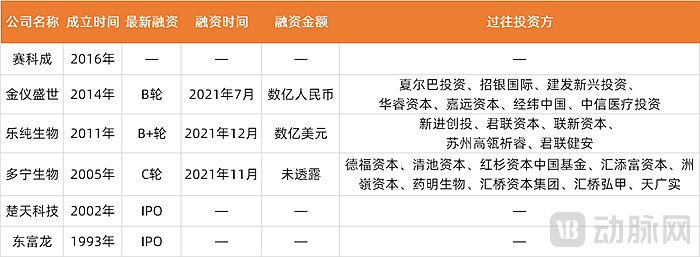
According to incomplete statistics, some domestic bioreactor companies (excluding those in the CGT equipment sector)
Furthermore, although there is an order-of-magnitude difference in yield between stainless steel bioreactors and single-use bioreactors (for example, cultivating 1,000 liters of cells versus 10,000 liters may require a tenfold difference in materials, the cost increase does not follow a linear tenfold relationship), the resulting differences in production scale will impact product costs. However, based on comprehensive factors such as the product’s market and the extent to which costs influence the selling price,Choosing between large-scale stainless steel bioreactors and single-use bioreactors is a non-standard question.
With the rise of single-use technology in the pharmaceutical sector, single-use bioreactors and their associated consumables have also advanced. Compared with stainless-steel bioreactors, single-use bioreactors eliminate the need for cleaning in place (CIP) and sterilization in place (SIP), thereby enhancing sterility assurance and shortening production cycles.Given the well-established history of stainless steel bioreactors in China, this article will not elaborate on them further; instead, it will primarily discuss single-use bioreactors.
Disposable Bioreactor (Disposable Bioreactor or Single-Use Bioreactor, SUB) is a ready-to-use, non-reusable culture vessel made from plastic materials (such as polyethylene, ethylene vinyl acetate, polycarbonate, and polystyrene) certified by the U.S. Food and Drug Administration (FDA).
As early as 1953, Fenwal Laboratories developed the earliest plastic plasma bags, marking the first use of single-use products in the biotechnology field. With the rise of modern biotechnologies such as monoclonal antibody technology and recombinant DNA technology, the development and optimization of bioreactors were rapidly prioritized.
In 1995, pharmaceutical companies began utilizing miniPERM and CeLLine single-use bioreactors for in vitro antibody production. The CeLLine single-use bioreactor has gained widespread popularity in the pharmaceutical industry due to its suitability for long-term cell culture, screening assays, and the preparation of laboratory-scale preclinical samples.
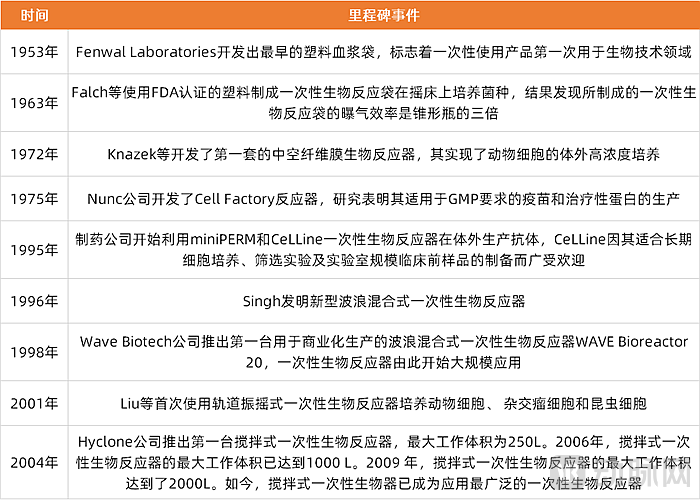
Key Historical Milestones in the Development of Single-Use Bioreactors (Compiled from Public Sources)
To date, single-use bioreactors widely used in cell culture and fermentation within the pharmaceutical industry are primarily categorized into stirred-tank single-use bioreactors, wave-mixed single-use bioreactors, and orbital shaking single-use bioreactors.
Stirred Disposable Bioreactor: Primarily used for mammalian cell culture, it is also applicable to plant and insect cell cultures, as well as human stem cell culture.
Stirred-tank bioreactors rely on impellers to provide agitation power for the liquid phase. Due to their wide operating range, excellent mixing performance, and uniform concentration distribution, they are widely used in bioprocessing. However, animal cells lack the protection of a cell wall and are highly sensitive to shear stress generated by impellers; direct mechanical agitation can easily cause cellular damage. Therefore, stirred single-use bioreactors are generally employed for culturing robust and stable cell lines.
Although stirred-tank single-use bioreactors emerged later than other types of single-use bioreactors, their development has surged ahead for two reasons.
First, the design principle of stirred single-use bioreactors is identical to that of traditional stainless steel stirred bioreactors; the only difference is that the culture vessel of stirred single-use bioreactors is made of plastic.In terms of working principle, single-use stirred-tank bioreactors are identical to traditional stirred-tank bioreactors. Therefore, built upon the extensive operational experience and robust theoretical foundation accumulated from traditional stirred-tank reactors, the development of single-use stirred-tank bioreactors is more streamlined and progresses more rapidly.
Secondly, the stirred-tank bioreactor corresponding to the single-use stirred bioreactor is the most widely used type of traditional bioreactor in biotechnology production processes, with culture conditions that are relatively easy to optimize.Consequently, companies with experience in using traditional stirred-tank bioreactors are more inclined to adopt corresponding single-use stirred-tank bioreactors for equipment upgrades, resulting in relatively greater market demand for single-use stirred-tank bioreactors. Furthermore, single-use stirred-tank bioreactors offer cultivation conditions similar to those of traditional stirred-tank bioreactors and provide the advantage of ease of scale-up, leading to broader commercial application.
Wave-mixed disposable bioreactor, suitable for various types of cell culture, including CHO, NSO, hybridoma, HEK293, insect cells/baculovirus, adenovirus, T cells, plant cells, and primary human cell lines.
Cells and culture media cultured in wave-mixed single-use bioreactors are placed in a pre-sterilized, sterile plastic bag. These bags are for single-use only and arrive in individual sterile packaging, thereby eliminating common issues associated with traditional tanks, such as contamination and cross-contamination.
Since the culture medium and inoculated cells are contained within a sealed, sterile, and airtight bag, the introduction of air through a sterilizing filter creates a culture vessel with a defined headspace. The bag is placed on an oscillating platform. As the platform shakes back and forth, the culture medium forms wave-like motions within the bag, thereby achieving mixing.
This mode of motion generates lower shear forces, which are significantly less than those produced by stirring or air-lift methods in traditional bioreactors. Furthermore, wave-mixed single-use bioreactors do not require sparging, thereby eliminating the need for antifoaming agents. Consequently, wave-mixed single-use bioreactors are more suitable for culturing cells that are sensitive to shear stress or prone to foaming during the culture process.
This gentle wave-like motion effectively facilitates oxygenation and mixing. The undulating surface of the culture medium continuously interacts and mixes with the air introduced into the bag, thereby providing sufficient dissolved oxygen for cell growth. Higher levels of dissolved oxygen can be achieved by adjusting the shaking frequency and angle of the rocking platform, as well as by supplying a controlled mixture of air and oxygen into the bag.
Using wave-mixed single-use bioreactors for cell culture, once one cultivation cycle is completed, a new bag can be immediately placed on the shaking platform to start a new round of cultivation, greatly saving preparation time between batch fermentations.
Orbital Shaken Disposable BioreactorThe orbital shaken disposable bioreactor is distinguished from wave-mixed and stirred disposable bioreactors by its well-defined fluid dynamics, which confer excellent parallelizability. Consequently, orbital shaken disposable bioreactors are widely used for large-scale strain screening and optimization of culture conditions, with their application gradually expanding to production scales. These bioreactors are primarily employed for the cultivation of animal and plant cells with low oxygen demands.
Although there are limited types of orbitally shaking disposable bioreactors on the market and their commercial applications are relatively few, their characteristics of low shear stress and simple, convenient operation have led to their widespread use in laboratories., commonly used for the culture of animal cells, microalgae, insect cells, plant cells, and microorganisms.
Furthermore, since the aeration system of orbital shaking single-use bioreactors does not cause airflow turbulence, it prevents foam formation and eliminates the need for antifoaming agents. The culture medium in orbital shaking single-use bioreactors flows under laminar conditions, resulting in low tangential shear stress on the culture medium. Additionally, orbital shaking single-use bioreactors do not require expensive, complex moving parts, offering advantages such as ease of operation and high cost-effectiveness.
During the culture of animal cells, cell culture bioreactors serve as key equipment throughout the entire process, providing a suitable growth environment for cells and determining the quality and yield of cell culture. Currently, bioreactors are widely used in the production of monoclonal antibodies, vaccines, recombinant proteins, and other products.
However, no single cell culture system is universally applicable to all cell culture technology applications. In the selection of single-use bioreactors, the appropriate cell culture system must be determined based on product type, cell line, and various other factors.
Multilayer co-extruded film is a critical barrier,
What Are the Secrets to Overtaking on a Bend?
Bioreactors serve as the cradle for biopharmaceutical products, nurturing cell growth. However, during this developmental process, the localization of bioreactors in China still faces numerous unresolved pain points that domestic enterprises must collectively address.
First, the most formidable core barrier to overcome for single-use bioreactors lies not in the design and manufacturing of hardware or software, but in the research and development of consumables used in conjunction with them—namely, single-use bioreactor bags.
Single-use bioreactor bags are primarily composed of multi-layer co-extruded films, making the selection of film materials particularly critical. When multi-layer co-extruded films used for cell culture come into contact with cultures, they may release leachables. Once these leachables enter the culture medium, they can potentially affect cell growth. Currently, FDA-approved film materials include PE, PC, PVC, PP, EVOH, EVA, PS, and PA, among others. All components of the co-extruded films must utilize FDA-approved materials.
The structural composition of multilayer co-extruded films can be broadly divided into three layers:
The outermost layer is typically made of PA, LLDPE, polyether, or nylon. These robust and abrasion-resistant materials provide mechanical support for the entire bag and reduce wear. The middle layer is generally composed of EVOH, PVC, or PVA, providing barrier properties; for instance, the middle layer in Sartorius products is made of EVOH. Finally, the innermost layer, which is the most critical contact layer, is usually made of PE, PP, or EVA. This layer must provide a biocompatible environment suitable for cell culture. Both Cytiva and Sartorius use PE as the material for their innermost layer.
While the structure of multilayer co-extruded films may appear unremarkable when examined in isolation, the reality is that their formulations are exceedingly sophisticated. The formulations require precise compatibility between adjacent layers and across the entire multilayer structure, with stringent requirements for the resulting physicochemical properties. Once the film formulation is finalized, production processes are subject to rigorous control to ensure both high product quality and batch-to-batch consistency.
How Can Domestic Enterprises “Strike Back from Behind” and Achieve Overtaking on a Bend in the Face of the Co-extruded Film Barrier?
LePure Biotech, a leading domestic provider of biopharmaceutical consumables, told VCBeat New Medicine: “LePure has been dedicated to the field of single-use systems for over a decade. Recently, we successfully launched our independently developed LePhinix™ single-use bioreactor and LeKrius™ biopharmaceutical process films. In addressing the technical barriers encountered during previous R&D phases, we have no shortcuts to share; only through relentless innovation and experimentation can we ultimately deliver high-quality products. Furthermore, we actively engage in in-depth communication and collaborative development with domestic pharmaceutical companies. Without the involvement of client-side talent or individuals well-versed in client processes, we might only be able to produce ‘functional’ products, rather than ‘high-quality’ products that truly meet the specific needs of pharmaceutical enterprises.”
Growth rate exceeding 20%, Tofflon, Truking,
Donning, LePure, and Jinyi Shengshi have all made strategic moves in this area.
In addition to the technological gap with global giants, Chinese enterprises also face a significant disparity in brand influence.
According to estimates by Research and Markets, MarketsandMarkets, and other institutions, the global market size for biopharmaceutical equipment and consumables was approximately USD 20 billion in 2020, with a growth rate exceeding 10%. Equipment accounted for about 46% of the market, while consumables accounted for about 54%. Among these, the global market size for single-use bioreactors was approximately USD 1.2 billion in 2020 and is projected to reach USD 3.5 billion by 2027, growing at a compound annual growth rate (CAGR) of 16.6%.
According to estimates by the consulting firm Research and Markets, China’s single-use bioreactor market is projected to reach $790 million in 2027, with a compound annual growth rate (CAGR) of 21.1%. Based on this projection, the total market size in China in 2020 was $210 million, equivalent to approximately RMB 1.47 billion.
In the face of a market growing at over 20%, the domestic landscape in China has long been dominated by giants such as Cytiva, ABEC, Sartorius, Thermo Fisher Scientific, and Merck. Meanwhile, Chinese companies like Tofflon, Truking Technology, Duoning Biology, LePure Biotech, and Jinyi Shengshi are actively expanding their presence and experiencing rapid growth.
In fact, China’s biopharmaceutical industry has undergone a period of development. Particularly under the influence of U.S.-China trade tensions and the COVID-19 pandemic, many pharmaceutical companies no longer select raw materials, consumables, or equipment solely based on brand reputation. Instead, domestic pharmaceutical firms typically conduct comprehensive evaluations before choosing their suppliers.
In the long term, domestic enterprises can maintain long-lasting and stable services under various circumstances, demonstrating prominent advantages in after-sales maintenance, cargo transportation timeliness, supply stability, and customized services.
Of course, the products of industry giants have withstood decades of market testing, giving them distinct advantages in product maturity and service comprehensiveness; it is difficult for domestic companies to achieve this overnight. However, Chinese startups can accelerate their development through multi-party collaboration, drawing fully on the lessons learned from successful international cases to compress a 20-year trajectory into five years or even less. We also look forward to the introduction of increasingly relevant policies in the near future that will both encourage high-quality enterprises and weed out underperforming ones.
In addition, some domestic companies, such as Shenzhen Shenyan Biological Technology Co., Ltd. and Saiqiao Bio, have also entered this niche and emerging sector, which includes the research, development, and manufacturing of equipment and consumables for cell and gene therapy (CGT).
Although the CGT-related bioreactor market is not subject to monopolistic pressure from international giants and remains in its early stages globally, the innovation and technical barriers it faces offer no prior experience for reference. This imposes stricter professional and engineering requirements on enterprises across multiple interdisciplinary fields, including computer science, electronic engineering, nanomaterials, and chemical engineering.
“Localization” has long been advocated, with the industry coordinating across various sectors to strive to break the monopoly of giants. In the wake of the “WuXi Biologics incident,” the pace of localization should be accelerated not only in the field of single-use bioreactors but also across the broader biopharmaceutical sector and the wider healthcare industry.
Only by achieving domestic substitution across the entire industry chain can we gain autonomy in key areas such as R&D, manufacturing, cost, and pricing, thereby avoiding being held hostage by external constraints. The localization of bioreactors is merely the tip of the iceberg in the broader effort to domesticate the entire supply chain. The speed and wisdom of the Chinese people have never disappointed. Let us hope that all segments of the industry chain will exercise greater patience, and that all parties will work collaboratively to advance this process!
We thank LePure Introduction and Shenzhen Shenyan Biological Technology Co. LTD for their support in the preparation of this article.
References:
1. Zhou Yi, Yang Mei, Wang Bolin, He Ling, Wen Ming, Wen Guilan, Zhou Bijun, Cheng Zhentao, Wang Kaigong. Research Progress on Bioreactors for Animal Cell Culture. *Guizhou Animal Husbandry and Veterinary Medicine*, 2019, Vol. 43, No. 4.
2. Zhang Xiaoyang, Research and Development and Application Study of Stirred Single-Use Bioreactor Systems.
3. Wang Yuanshan, Zhu Xu, Niu Kun, Xu Jianmiao, Research Progress on Single-Use Bioreactors, "Fermentation Science & Technology Newsletter", July 2015, Vol. 44, No. 3.
4. Tian Hongmin, Xie Hongde. Progress in the Application of Single-Use Technology in the Biopharmaceutical Field. Chinese Journal of Biologicals, July 2017, Vol. 30, No. 7.