

How the University of Tokyo Hospital Achieved Financial Independence Through Innovation and Translation in Asia's Premier Medical Research Institution
In Japan, being a doctor is undoubtedly a high-income, high-reward profession, but securing this “golden rice bowl” is by no means easy.The annual pass rate for the Japanese National Medical Practitioners Qualifying Examination is only 5%.This has, to some extent, resulted in a severe shortage of physicians in Japan and an increasingly heavy burden on the healthcare system.
However, Japan has not lowered the entry barriers for physicians as a result, especially for those ranked first in Japan.The University of Tokyo Hospital(hereinafter referred to as “Dongda Hospital”), its entry requirements for physicians are quite stringent.
In fact, the University of Tokyo Hospital also has such “confidence,” as it has long been regarded as a mythical institution in the hearts of the Japanese public. First, in terms of performance, the hospital serves 580,000 outpatients annually (An average of 2,374 people per day) and 320,000 inpatients (Average of 880 people per day), performing approximately 10,000 surgeries annually, figures that rank first among national university hospitals.
Secondly, in terms of award recipients, Dongda Hospital is even more“Winning awards left and right”Due to its advanced medical services and high-quality clinical research, The University of Tokyo Hospital has been designated in Japan as a “Specific Function Hospital” (similar to China’s Grade 3A hospitals), a “Core Clinical Research Hospital,” and a “Core Hospital for Cancer Genomic Medicine.” On the global stage, The University of Tokyo Hospital has also received widespread recognition.Consistently Ranked Among the Top 10 Healthcare Organizations Globally, and was named the best hospital in Japan by U.S. Newsweek.
Finally, from a research perspective, Dongda Hospital has witnessed historic moments in global medicine, including the world’s first discovery of efflux transporters responsible for intracellular-to-extracellular transport and the successful establishment of large-scale production methods for functional granulocytes derived from human induced pluripotent stem (iPS) cells, andAchieved over $35 million in research funding in 2020, achieving "financial independence" in medical innovation and translation.
To unlock the “wealth code” of innovation and translation at Dongda Hospital,VCBeat Orange BureauA deep analysis was conducted on this.
A Research System Aligned with the Three Core Missions
As the premier medical center in Japan and the brightest jewel in the nation’s healthcare system, The University of Tokyo Hospital has upheld three core missions since its inception:Clinical, Education, and Research, which ranks first globallyMayo ClinicShare a similar ingenuity.
Yet what coincidentally aligns between these two medical “powerhouses” is not only their missions but also their logos. Just as the Mayo Clinic fully embodies its mission in its logo, Dongda Hospital has likewise seamlessly integrated its own mission into its logo.
The logo of Dongda Hospital features two “h” letters in a mirror-image configuration, which respectively represent““Person”and“Hospital”, which reflects Dongda Hospital's patient-centered commitment to sparing no effort in providing patients with superior medical services. This is manifested not only in its humanized medical care but also in Dongda Hospital's dedicationCure patients' conditions with cutting-edge medical technology.
This is precisely the foundational motivation behind Dongda Hospital’s enduring focus on scientific research. To conduct high-quality clinical studies essential for advancing the development of innovative drugs and medical devices, Dongda Hospital hasCenter for Clinical Research PromotionandDepartment of Clinical Research and GovernanceConduct scientific research centered on two organizations.
Center for Clinical Research PromotionIt is an organization that supports clinical research, including clinical trials at Tokyo University Hospital and multi-center collaborative studies conducted by the hospital. Its core mission is to seamlessly promote “investigator-initiated trials” and “industry-sponsored efficacy studies,” spanning from the development of cutting-edge medical technologies to the provision of optimal patient care.
AdditionalDepartment of Clinical Research and GovernanceIt is the administrative department of Dongda Hospital that proactively manages and promotes clinical research, primarily establishing the Office of Strategic Planning and Promotion, the Office for the Promotion of Equity in Clinical Research, and the Audit Office, so as to strengthen the academic research management structure, ethics education system, and quality assurance system for clinical research.
In addition to clinical care and scientific research, education is also a key pillar. As a training ground for physicians within Japan’s healthcare system, the University of Tokyo Hospital leverages the university’s educational and research resources to cultivate outstanding medical professionals and researchers capable of leading the future of healthcare. This approach not only addresses the hospital’s own shortage of medical talent but also continuously injects fresh energy into medical innovation, enabling it to maintain a globally top-tier position in scientific research.
Achieving “Financial Independence” in Innovation and Translation from Shallow to Deep
According to the latest data, in 2020, the total revenue of Dongda HospitalOver $500 millionwith research-related income accounting for approximately 7% of the total, making it the second-largest revenue source. Dongda Hospital achieved “financial independence” in medical innovation and translation within just four years.
This is, in fact, not easy. For many healthcare institutions around the world today, their investment in scientific research is far less than the eventual “return” they receive. This"Yield Gap"This largely depends on the research system of the medical institution itself. Therefore, for any medical institution, identifying a research path suited to its own circumstances and generating the expected innovative value along this path remains a continuous endeavor.
In fact, Dongda Hospital has been on this path for a long time. To truly achieve original innovation, Dongda Hospital has formed an integrated"Advanced Medical Technology Development and Research Cluster", with the aim of bringing together top talent within the hospital, targeting global innovation trends, and deepening research efforts.
To achieve differentiated innovation, Dongda Hospital divides scientific research into three levels.The first is basic research., this is the driving force behind the entire research and innovation process; to advance innovative projects, this is the first critical step.
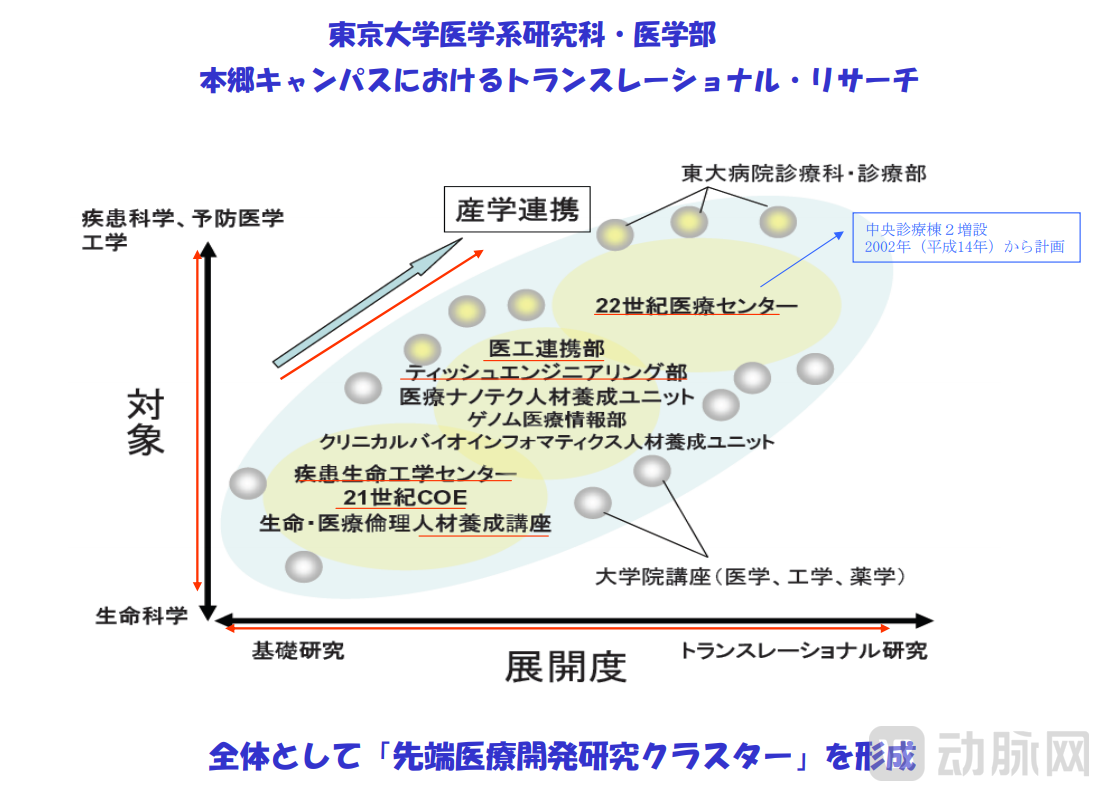
Specifically, the basic research at Dongda Hospital is divided into three steps: the first step is to transform an idea into a project, where researchers need to bring their research into the Disease and Life Sciences Research Center for systematic study.
Step 2: Assessment, namely, by employing a third-party evaluation system to conduct comprehensive assessments of outstanding research projects and provide them with priority funding. It is reported that in 2002, the government approved 21 research bases in the field of life sciences, with total funding exceeding US$30 million.
Step 3: Ethical Review, a comprehensive review is required of the ethical issues arising from the application of the latest biological and medical research findings to clinical practice and healthcare. All researchers at the University of Tokyo must attend training lectures on bioethics and medical ethics, and their research outcomes are subject to oversight by the Medical Ethics Department.
The second is interdisciplinary research.. Currently, interdisciplinary integration represents a major trend in scientific research development; however, effectively promoting interdisciplinary research poses significant difficulties and challenges for medical institutions. On this critical issue, Dongda Hospital has developed its own unique approach.
To build a bridge between medicine and engineering, Dongda Hospital has establishedDepartment of Medical-Engineering Collaboration, with its core focus on promoting the clinical translation of scientific research achievements to effectively address clinical challenges. Furthermore, Todai Hospital has established close collaborations with key disciplines such as pharmacy, informatics, and chemistry, jointly founding research institutions including the Center for Training Medical Nanotechnology Professionals, the Department of Genomic Medical Information, and the Center for Training Bioinformatics Professionals. The hospital also frequently organizes multidisciplinary lectures at the University of Tokyo, covering fields such as medicine, engineering, and pharmacy.
The third is translational research. The ultimate goal of scientific research is to better apply innovative technologies in clinical practice; therefore, it is essential to advance research projects toward commercialization. It was with this rationale that the University of Tokyo Hospital established in 2002“22nd Century Medical Center”, and assume the responsibility of promoting research and development in clinical medicine and healthcare services.
Currently,“22nd Century Medical Center”The center’s sponsoring organizations consist of the Donations and Social Cooperation Department; in addition, projects supported by competitive funds have joined the center. To date, the center has developed11 donor departments, 3 social collaboration departments。
Among these initiatives, the donation-driven department primarily facilitates the commercialization of scientific research outcomes by securing corporate sponsorships. It is reported that in April 2021, Hong Kong Weijia Pharmaceutical Group joined forces with Dongda Hospital to launch a regenerative medicine and cell data research program (under the donation-driven department), aiming to establish a robust product pipeline encompassing both clinical development and commercialization stages.
The Social Collaboration Department primarily facilitates partnerships between innovators and clinical professionals to jointly conduct research and medical evaluations, assists in the development and operation of clinical databases, and performs systematic analyses to support the commercialization of scientific research. Furthermore, leveraging the integration of Information and Communication Technology (ICT) and the Internet of Things (IoT), Peking University First Hospital is developing new comprehensive service programs aimed at delivering better clinical outcomes for innovators.
In addition, in terms of building a research talent pool, the Bio-Design Division of the Translational Research Center has established six venture companies and continues to supply leading human resources to industry, government, and academia. Since 2020, Tohoku University Hospital has been commissioned by AMED to support young medical device researchers across Japan in developing their R&D concepts and commercialization strategies.
It is evident that Dongda Hospital has made robust and steady progress in every step from basic research to interdisciplinary research, and then to translational research, all grounded in innovation and translation.
First, by grounding its efforts in basic research, Dongda Hospital selected the most cutting-edge areas of innovation, thereby enhancing the research value and market competitiveness of its innovative projects from the outset. Second, through interdisciplinary research, the hospital broke down barriers between disciplines, fostering deep integration that sparked numerous innovative breakthroughs. Finally, focusing on translational research, Dongda Hospital deeply engaged in every stage of the scientific translation process—from medical evaluation and funding support to the establishment of talent teams—ensuring continuous progress in translating research into practical applications.