

Tsinghua-Founded Startups Dominate China's $4.2 Billion Ultrasonic Surgical Device Market
Are You Your Alma Mater’s Pride After Graduation?
For Tsinghua University graduates, some have excelled in industries such as finance and the internet, others have contributed to fields like aerospace and robotics, while still others have launched startups in the ultrasonic scalpel sector.
Currently, domestically produced ultrasonic scalpels are caught in a whirlwind of independent innovation, import substitution, and centralized procurement. VCBeat has reviewed the entrepreneurs in the domestic ultrasonic scalpel sector and found that the founders and senior executives of companies such as Sumai Medical, Houkai Medical, Shuimu Tianpeng, Sainowave Medical, and Segesys all hail from Tsinghua University.
Why did these individuals choose the field of ultrasonic scalpels? Why do they predominantly hail from Tsinghua University? To answer these questions, VCBeat interviewed some of the entrepreneurs and pieced together their stories based on available information.
In 1990, the Tsinghua Ultrasound Research Center was established and began developing ultrasound medical instruments. From 1990 to 2006, the center successively developed innovative products such as ultrasound orthopedic surgical systems, ultrasonic aspirators, and ultrasonic hemostatic scalpels, and published numerous high-impact papers.
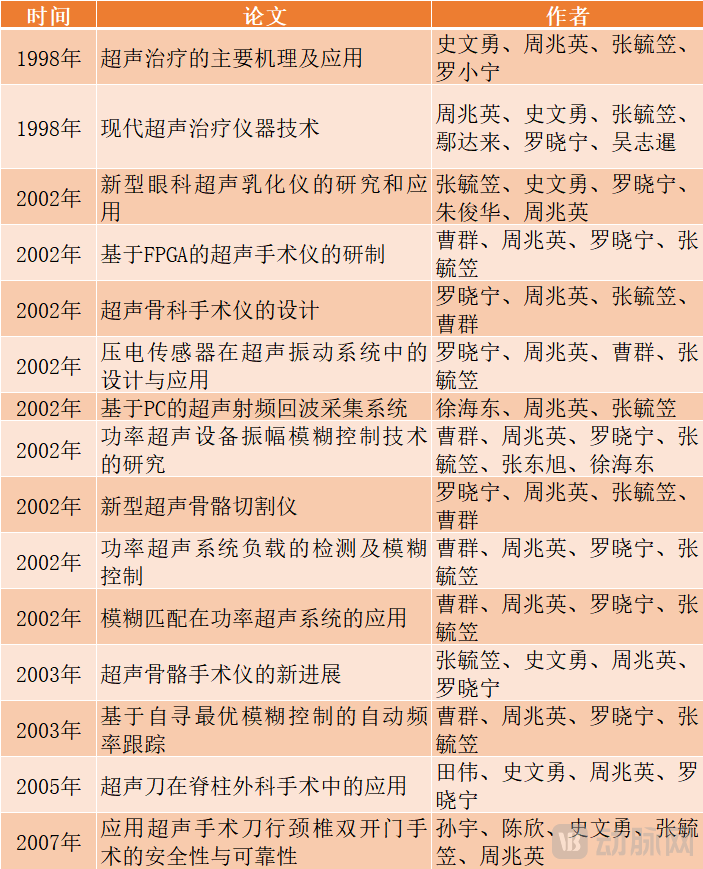
(Compiled by VCBeat from public sources)
According to statistics, Zhou Zhaoying, Zhang Yuzhu, Luo Xiaoning, Cao Qun, and Shi Wenyong are the most frequently mentioned individuals. Among them, Zhou Zhaoying graduated from the Department of Precision Instruments at Tsinghua University in the 1960s. He is a professor and doctoral supervisor at the Department of Precision Instruments and Mechanology, Tsinghua University, as well as the Director of the Academic Committee of the Tsinghua University Center for Micro/Nano Technology.
In 2007, Zhang Yuzhu, as Chairman, established Sumai Medical. According to reports,Suimai Medical was formerly known as the Ultrasound Research Center of Tsinghua University, its R&D and management team members are all from Tsinghua University, bringing extensive industry experience and a track record of scientific innovation. For instance, Zhou Zhaoying and Luo Xiaoning, experts at the Tsinghua Ultrasound Research Center, joined Suimai Medical after the center began commercialization, helping to drive the development and promotion of domestically produced ultrasonic scalpels.
To date, leveraging Tsinghua University’s academic environment, over two decades of technological accumulation, and high-quality talent resources, Somic Medical has developed multiple high-tech achievements with independent intellectual property rights. Most of these achievements have been progressively commercialized into ultrasonic medical instrument products, such as ultrasonic scalpels for hemostasis, ultrasonic bone scalpels, ultrasonic aspiration dissectors, and ultrasonic debridement devices.
andDr. Qun CaoFounded in 2010, Shuimu Tianpeng specializes in the research and development, manufacturing, and sales of ultrasonic surgical equipment and consumables. As Chairman and Chief Scientist of Shuimu Tianpeng, Dr. Cao Qun leads the team in developing products such as ultrasonic bone scalpels, ultrasonic aspiration systems, and ultrasonic hemostatic scalpels, which are applied across multiple medical specialties including orthopedics, spinal surgery, neurosurgery, plastic surgery, hand and foot surgery, and hepatobiliary surgery.
Shi WenyongIn 2014, he began operating Houkai Medical. Data shows that Houkai Medical is a leading domestic brand in minimally invasive surgery, with complete capabilities in product development, iteration, and manufacturing in the field of energy-based surgical products. Currently, Houkai Medical offers products such as ultrasonic scalpels for hemostasis and cutting, as well as ultrasonic transducers, tailored to various departments and indications. Its products have been sold to thousands of hospitals across China and hundreds of overseas hospitals in Europe, North America, and other regions.
Notably, Houkai Medical has partnered with domestic surgical robot companies to provide complementary energy-based surgical instruments and integrated surgical energy platforms for surgical robots, thereby promoting precision and intelligence in surgical procedures.
Although the founders of Sumai Medical, Shuimu Tianpeng, and Houkai Medical all hail from the Tsinghua Ultrasound Research Center, their technical details differ, and each company has differentiated advantages in its product portfolio and strategy.。
Backed by Tsinghua University, Sumai Medical boasts a robust technical foundation and a strong academic atmosphere. Benefiting from a favorable environment for innovation and entrepreneurship, the company has continuously innovated and iterated its ultrasound products. In 2008, it invented an ultrasonic bone surgery instrument featuring composite vibration, earning the Second Prize for Beijing Invention Patents and the First Prize of the Beijing Science and Technology Award. In 2009, it developed detachable multi-purpose surgical scissors for cutting. In 2012, it introduced an integrated ultrasonic surgical system...
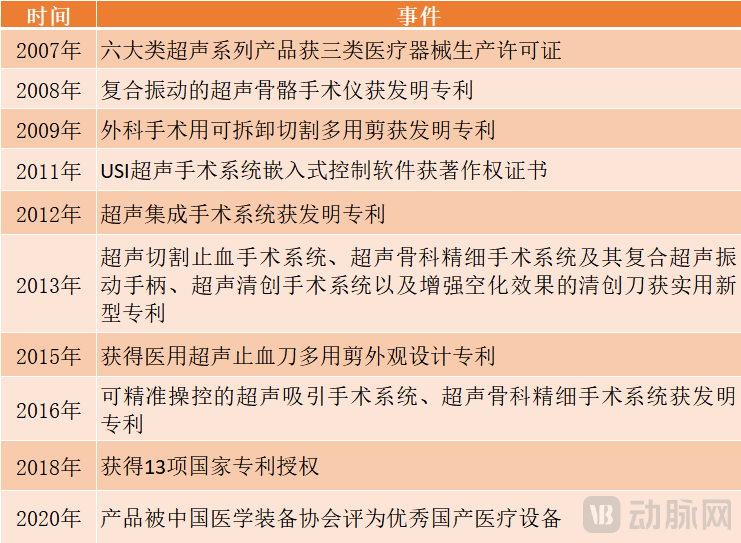
(Compiled by VCBeat based on public information)
According to data from Qichacha, Sumai Medical has filed for and obtained authorization for 70 patents to date, demonstrating robust technical capabilities. Meanwhile, Sumai Medical has jointly established academic centers with multiple hospitals. These centers serve a dual purpose: training physicians in the use of ultrasonic energy platforms, and engaging in in-depth exchanges with clinicians to refine surgical techniques and improve operative outcomes.
Perhaps it is precisely on this basis that Somic Medical can efficiently and rapidly update and iterate its products, making them better aligned with clinical needs.
Public information indicates that Somic Medical’s ultrasonic surgical system integrates four modules: an ultrasonic hemostatic scalpel, an ultrasonic bone scalpel, an ultrasonic aspirator, and an ultrasonic debridement scalpel. These modules can be configured according to the requirements of different surgical procedures, meeting the needs of departments including general surgery, spinal surgery, neurosurgery, oral and maxillofacial surgery, surgical oncology, urology, and cardiothoracic surgery.
In addition, Suimai Medical’s ultrasonic scalpel features a reusable tip, which offers lower surgical costs and reduces the financial burden on patients and medical insurance compared to disposable tips from multinational brands such as Johnson & Johnson. To mitigate the risk of cross-infection associated with reusable tips, Suimai Medical has developed a detachable instrument design that allows the scissors and shaft to be sterilized separately, ensuring more thorough disinfection and enhancing surgical safety.
Shuimu Tianpeng also places significant emphasis on R&D and innovation. According to data from Qichacha, the company has filed for and been granted 64 patents, including 16 international patents. Currently, Shuimu Tianpeng’s core products include ultrasonic bone scalpels and ultrasonic hemostatic scalpels. Notably, the technical specifications of its ultrasonic bone scalpel series are at a globally leading level.
Leveraging Shuimu Tianpeng’s leading position, in June 2021, Sanyou Medical acquired a 49.88% equity stake in Shuimu Tianpeng for RMB 343 million, implying a 7.5x premium and a valuation of RMB 687 million. Combined with its existing 1.94% stake, Sanyou Medical became the controlling shareholder of Shuimu Tianpeng.
According to Sanyou Medical, Shuimu Tianpeng’s ultrasonic bone scalpel is suitable for cutting, grinding, and drilling of bone tissues throughout the body. It is widely used in many departments, including spinal surgery, neurosurgery, and plastic surgery. The ultrasonic bone scalpel can precisely cut bone tissue while effectively avoiding damage to adjacent soft tissues such as the dura mater, blood vessels, and nerves, thereby significantly enhancing surgical safety.
Owing to its advantages in safety and convenience during surgical procedures, the ultrasonic bone scalpel is being increasingly accepted and adopted by clinicians. It has already been introduced into Grade A tertiary hospitals across more than 20 provinces and municipalities, including Beijing, Shanghai, and Guangdong. Over the past year, Shuimu Tianpeng has captured a 52.5% market share in the tendering market for ultrasonic bone scalpels, securing a leading position.
In the field of ultrasonic hemostatic scalpels, Shuimu Tianpeng’s independently developed device employs a technology that combines torsional and longitudinal vibrations, significantly enhancing tissue cutting efficiency. The product received approval from the National Medical Products Administration (NMPA) in 2021.
In terms of commercialization, Shuimu Tianpeng has entered the market by adopting an ambitious, high-profile strategy. For instance, the company has bolstered its brand image by participating in the formulation of industry standards; it has continuously developed clinical research and training systems while establishing medical-engineering collaborations with numerous renowned hospitals and clinical experts. Ultimately, leveraging the superior quality of its ultrasonic bone scalpel, Shuimu Tianpeng has captured market share, established a premium brand image, and laid the foundation for the promotion of subsequent innovative products.
Unlike other companies, Houkai Medical is not solely focused on the ultrasonic scalpel sector; instead, it is committed to becoming a platform enterprise for minimally invasive surgical instruments.
Minimally invasive surgical instruments include staplers, ultrasonic scalpels, endoscopes, and trocars. Among these, ultrasonic scalpels account for a significant proportion and represent a larger market size; therefore, Houkai Medical currently focuses primarily on the ultrasonic scalpel sector.
Entering the medical market with ultrasonic surgical devices, Houkai Medical has launched a series of ultrasonic hemostatic scalpels, transducers, and handpieces to meet the needs of various clinical departments.
In terms of commercialization, leveraging the high-quality advantages of its ultrasonic surgical scalpel, Houkai Medical entered more than 300 Grade A tertiary hospitals in China within just 10 months in 2021, achieving sales revenue exceeding RMB 100 million. Meanwhile, Houkai Medical has exported its products to over 30 countries worldwide, maintaining a 70% continuous growth in overseas sales despite the global pandemic.
In its strategic layout of the minimally invasive surgical instrument platform, Houkai Medical has partnered with leading domestic surgical robot companies to provide complementary energy-based surgical instruments and integrated surgical energy platform products. Moving forward, Houkai Medical will launch a broader range of minimally invasive surgical instruments.
Perhaps it was precisely based on Houkai Medical’s technological and commercialization capabilities that the company completed three rounds of financing cumulatively between 2019 and 2020, with investors including prominent institutions such as Hillhouse Capital, New Jun Capital, DT Capital Partners, and FenXiang Investment.
In addition to Suimai Medical, Shuimu Tianpeng, and Houkai Medical, Zhang Jindi, who holds a master’s degree in Biomedical Engineering from Tsinghua University, has also entered the ultrasonic scalpel field. In 2015, Zhang Jindi founded SinoMicroMed, focusing on minimally invasive surgery and tumor interventional therapy. According to the official website of SinoMicroMed, the company has established three major technology platforms: surgical vision, surgical energy, and tumor ablation, providing endoscopes in the field of minimally invasive surgery,Ultrasonic Hemostatic Scalpel, Integrated Ultrasonic and High-Frequency Surgical System, staplers, and many other products.
Unlike Zhang Yuzhu, Cao Qun, Shi Wenyong, and others, who naturally chose the field of ultrasonic scalpels due to their backgrounds in ultrasound research, Zhang Jindi, with a major in biomedical engineering, opted for minimally invasive surgery and tumor interventional therapy based on his years of professional experience.
According to available information, after obtaining his master’s degree from Tsinghua University, Zhang Jindi joined multinational medical device companies such as GE Healthcare and Medtronic, where he engaged in technical research and development. Prior to founding his own company, Zhang served as Senior Technical Director of the Global Emerging Markets R&D Department at Medtronic, leading the Chinese R&D team to develop multiple innovative products that gained recognition from both physicians and patients.
Drawing on years of experience in medical device R&D and deep industry insights, Zhang Jindi resolved to focus on the fields of minimally invasive surgery and tumor ablation. Unlike companies such as Sumai Medical and Shuimu Tianpeng, Sinowave Medical entered the healthcare sector through minimally invasive surgical instruments.
In the field of minimally invasive surgical instruments, products such as ultrasonic scalpels, staplers, and endoscopes constitute a significant share of the core market. Therefore, SinoMicroMed initiated projects including the ultrasonic scalpel at its inception, obtaining CE certification for its ultrasonic hemostatic scalpel in 2018 and approval from the National Medical Products Administration (NMPA) in 2020.
It is evident that Synow Medical has built a minimally invasive surgical device platform through a multi-pronged approach, underpinned by an R&D center comprising more than 10 laboratories and nearly 100 R&D engineers. To date, Synow Medical has filed approximately 40 national invention patents and around 10 PCT international invention patents.
Furthermore, leveraging the deep innovation of its R&D team, SinoMicro MedTech has developed multiple high-end domestic medical devices that break overseas technological monopolies, such asDomestically Produced Ultrasonic Scalpel Capable of Sealing 7mm Blood Vessels。
Internationally, SinoMicroMed’s innovative capabilities have also gained recognition. Renowned medical institutions such as the Gustave Roussy Cancer Campus in France, Baptist Health South Florida in Miami, USA, and Heidelberg University Hospital in Germany have established long-term partnerships with SinoMicroMed. Furthermore, leading companies including Verily, Stryker, and United Imaging Healthcare have entered into strategic technical collaborations with SinoMicroMed.
If SinoMicro Medical is representative of companies that entered the ultrasonic scalpel market from the perspective of minimally invasive surgery, then Surgical Science stands out as an excellent example of a company that expanded into minimally invasive surgery from the ultrasonic scalpel sector.
According to reports, Lv Dawei, founder of Shige Saisi; Dr. Zhou, head of ceramic materials technology; and Dr. Wang, head of titanium alloy materials technology, are all alumni of Tsinghua University.
Lu Dawei stated, “My father worked in the management and distribution of medical devices. Having been exposed to this field from a young age, I developed a strong interest in medical devices. Therefore, after graduating from Tsinghua University, I entered the medical device industry, engaging in agency sales for products such as ultrasonic scalpels.”
This endeavor has spanned 25 years. During this period, Lu Dawei observed that the domestic ultrasonic scalpel market was predominantly monopolized by multinational medical device companies such as Johnson & Johnson. Leveraging their monopoly status, these international brands set exorbitant product prices. In response to this situation, Lu Dawei aimed to develop high-quality, high-efficiency ultrasonic scalpels to reduce production costs and better serve domestic hospitals and patients.
Based on this, Lu Dawei and co-founder Mr. Feng reached out to Dr. Wang, who specializes in titanium alloy materials, and invited Dr. Zhou, who is responsible for ceramic material R&D, through the Tsinghua University Chengdu Alumni Association. The four of them formed the core team of Shige Saizi.
From its establishment in 2017, to the initiation of the ultrasonic scalpel project in 2018, and finally to the regulatory approval and market launch of its first-generation ultrasonic scalpel in 2021, Segesys has demonstrated formidable competitive strength. Behind the rapid advancement of its ultrasonic scalpel products lies a dedicated R&D team of over 50 professionals, along with sustained, in-depth collaborative research efforts with multiple domestic scientific research institutes.
To date, Segasec has independently developed the core material for ultrasonic scalpel tips—titanium alloy—and the core material for transducers—high-performance piezoelectric ceramics. This breakthrough not only breaks the overseas technological monopoly on foundational materials but also significantly reduces the overall production cost of ultrasonic scalpels. Meanwhile, Segasec has successfully secured funding for two major research projects and holds more than 20 domestic and international patents.
Segaseed stated that it will enter the minimally invasive surgery field through ultrasonic scalpels, driven by innovative R&D in foundational materials, intelligent algorithms, and core manufacturing processes. On one hand, leveraging its ultrasonic energy technology platform, the company is developing ultrasonic energy therapeutic devices, such as ultrasonic scalpels for pediatric surgery, neurosurgery, and surgical robots. On the other hand, relying on its intelligent minimally invasive surgery platform, it is developing intelligent surgical tools, including intelligent ultrasonic scalpels, staplers, suturing devices, clip appliers, and intelligent electrosurgical units. By pursuing these two strategies simultaneously, Segaseed aims to ultimately become a leading enterprise in the platform for intelligent minimally invasive surgical instruments.
In addition to the aforementioned innovative enterprises, Shenzhen Qingding Equipment Co., Ltd., established in 2019, also has ties to Tsinghua University. Its shareholders include Feng Pingfa, Wu Zhijun, Yu Dingwen, Zhang Jianfu, Huakong Technology Transfer Co., Ltd., and Shenzhen Yinbaoshanxin Equity Investment Fund Management Co., Ltd., among others.
Among them, Feng Pingfa and Wu Zhijun are professors in the Department of Mechanical Engineering at Tsinghua University; Yu Dingwen is a professor at the Institute of Manufacturing Engineering, Department of Precision Instruments and Mechanology, Tsinghua University; and Zhang Jianfu is an associate professor in the Department of Mechanical Engineering at Tsinghua University. Huakong Technology Transfer Co., Ltd. is a technology transfer company wholly owned by Tsinghua Holdings.
It is evident that, in addition to the Ultrasound Research Center, other departments at Tsinghua University—such as the Department of Mechanical Engineering, the Department of Physics, and the Department of Aerospace Engineering—are also engaged in ultrasound research. Meanwhile, Tsinghua University established the Institute for Technology Transfer in 2014, which is responsible for the commercialization of scientific and technological achievements and the management of related intellectual property rights, including patents, copyrights, and technical secrets.Following the establishment of the Institute for Technology Transfer, Tsinghua University achieved remarkable results from 2016 to 2020, commercializing 497 scientific and technological achievements with a total contract value of RMB 2.9 billion, involving 2,642 intellectual property rights such as patents.。
In addition, Tsinghua University has established investment institutions such as Hetang Venture Capital, which focus on incubating and investing in the commercialization of Tsinghua University’s scientific and technological achievements, covering fields such as information technology, life sciences, and clean technology. Tsinghua University has also set up science parks to incubate innovative projects, including the Tsinghua Science Park and the Tsinghua Overseas Scholars Pioneer Park.
Overall, Tsinghua University is intensifying its efforts in technological innovation while focusing on the commercialization of research outcomes.
In terms of technological innovation, Tsinghua University boasts numerous research laboratories and undertakes a significant number of key national projects, driving social development through technology by fostering foundational technological innovations.
For example, in 2021, Professor Feng Xue’s research group at the School of Aerospace Engineering and the Research Center for Flexible Electronics Technology of Tsinghua University achieved a breakthrough in flexible ultrasonic energy transmission and communication technology. They developed a flexible, stretchable ultrasonic array and system that combines miniaturized transducer dimensions with high-efficiency energy transmission performance, enabling wireless physiological telemetry.
In terms of technology transfer, Tsinghua University provides end-to-end services—from intellectual property protection and incubation parks to investment institutions—to facilitate the smooth commercialization of scientific research achievements.
Thanks to Tsinghua University’s efforts, many of its alumni have made significant contributions to the field of ultrasonic scalpels after graduation. For example, in December 2021, innovative companies such as Houkai Medical, SinoMicro Medical, and Segesys successfully won bids in the centralized procurement of ultrasonic scalpel blades organized by a 16-province alliance led by Guangdong Province.
It is reported that the volume-based procurement this time involved approximately 440,000 units, with its scale and outcomes covering more than 50% of the Chinese market and population. According to the procurement results, the average price reduction for ultrasonic scalpel tips was 70.11%, with a maximum reduction of 93%, and it is estimated that costs will be reduced by approximately RMB 2 billion in the first year.
Previously, China’s ultrasonic scalpel market was monopolized by companies such as Johnson & Johnson, Olympus, and Medtronic. This volume-based procurement not only reduced the financial burden on patients and the medical insurance system but also promoted the development of domestically produced ultrasonic scalpels.
The winning domestic manufacturers of ultrasonic scalpels have not only driven technological innovation, broken overseas monopolies, and resolved critical “chokehold” challenges, but also bolstered the development of China’s domestic technology sector and reduced production costs for innovative products, thereby making high-quality ultrasonic scalpels more accessible and affordable for the Chinese population.