

Commercial Insurance Benefits Surge: Digital Employee Health Solutions Reshape Corporate 'Health Power'
In the post-pandemic era, companies have placed greater emphasis on cost control and maximizing efficiency at all times; however, investment in commercial health insurance for employees has shown a trend of "counter-cyclical growth." The surge in commercial insurance benefits undoubtedly reflects enterprises' deep understanding of the significant pressure employees face regarding health risks, providing them with a sense of security and protection through the most direct and effective means.
The challenge is that, over time, traditional employer-sponsored commercial insurance plans struggle to meet the triple mandate of being “cost-controllable, personalized, and scalable”: they must keep welfare budgets within manageable limits, satisfy employees’ individualized needs, and leave room for future enhancements to coverage.
It was previously believed that employee experience and benefit costs were irreconcilable, with cost reductions inevitably compromising the employee experience. However, a high-standard, end-to-end digitalized commercial insurance solution can effectively balance this relationship. By implementing measures such as tiered deductibles, shared premium contributions between employers and employees, and corporate health dashboards, organizations can achieve cost reduction and efficiency gains, thereby reshaping their corporate “health resilience.”
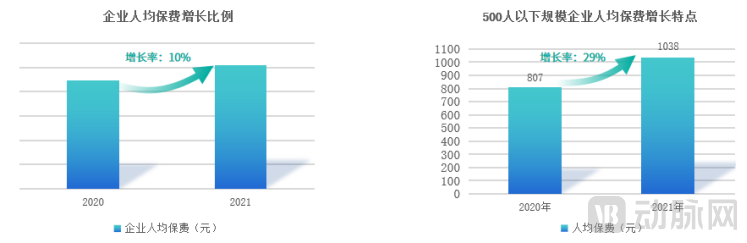
According to the "2021 Workplace Health Power Report" (hereinafter referred to as the "Report") released by insgeek, there was a significant upward trend in per capita insurance premiums for enterprises in 2021, representing a 10% increase compared to 2020. The most pronounced growth was observed in high-growth enterprises with fewer than 500 employees, where per capita insurance premiums rose by 29% year-on-year to reach RMB 1,038.
Source: insgeek, "2021 Report on the Health Resilience of Workplace Professionals"
Clearly, companies’ emphasis on employee commercial health insurance reflects a deep understanding of employees’ health needs. By leveraging commercial insurance benefits to play a unique role in retaining and attracting talent, and serving as an entry point for family coverage, this approach also serves as a key means of enhancing employees’ perception of their overall benefits package.
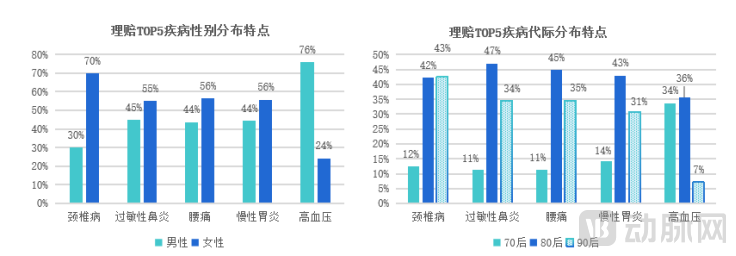
Behind the explosive growth of commercial insurance benefits lies the precarious reality of office workers, whose health status is a cause for concern. High-pressure, fast-paced work environments, coupled with unhealthy habits such as prolonged sedentary behavior, lack of exercise, and irregular eating patterns, have triggered a range of occupational health issues. Data from the Report indicates that cervical spondylosis, lower back pain, chronic gastritis, hypertension, and allergic rhinitis have become the five major health challenges plaguing office workers. In terms of healthcare utilization for prevalent conditions across different generational cohorts, those born in the 1980s visit hospitals most frequently, highlighting their particularly prominent health problems. The self-deprecating remark often made by today’s office workers—“young in age, but riddled with ailments”—accurately reflects the true state of their health.
Source: InsGeek, "2021 Report on Workplace Health Resilience"
According to data from the Report, the top five critical illnesses among working professionals in 2021 were acute myocardial infarction, lung cancer, thyroid cancer, cervical cancer, and breast cancer, with claim amounts ranging from RMB 110,000 to RMB 300,000. As stated in the 2021 National Health Education Reader on Critical Illness Prevention, the well-known cost of cancer treatment is approximately RMB 220,000 to RMB 800,000. Despite continuous advancements in medical techniques, accessing advanced treatments requires a certain level of financial capacity.
Under the pressure of health needs and medical costs, insurance products have become a standard workplace benefit. Most companies and employees alleviate the significant burden of health risks through self-payment or cost-sharing arrangements.
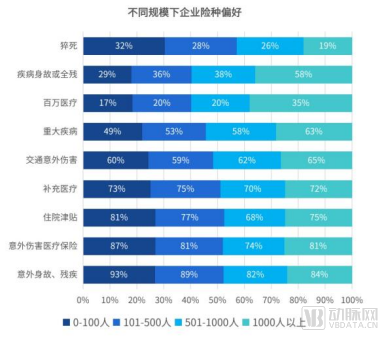
According to data from the Report, accidental death coverage, supplementary medical insurance, accident and medical insurance, hospitalization allowances, traffic accident injury insurance, and critical illness insurance have essentially become standard offerings for enterprises. Small and medium-sized enterprises (SMEs) tend to prefer basic commercial insurance configurations. In contrast, large enterprises, due to their larger scale and higher probability of employees developing critical illnesses, purchase more personal insurance and high-limit medical insurance (such as “million-yuan” medical coverage). This validates their assessment of operational risks and their reliance on core talent during periods of rapid growth. Commercial insurance helps both enterprises and employees mitigate a broader range of “unexpected” risks.
Source: insgeek, "2021 Workplace Health Power Report"
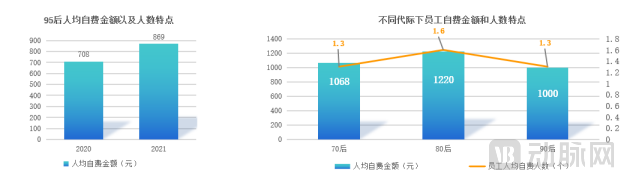
In addition, professionals demonstrate a strong willingness to purchase self-paid insurance, seeking “self-rescue” by enhancing their personal coverage. According to data from the Report, the average self-paid premium for individuals born after 1995 stands at RMB 869, indicating that insurance demand is accelerating rapidly. Those born in the 1980s have largely assumed managerial roles; despite experiencing rapid income growth, they face substantial family financial burdens and declining health conditions with age. Consequently, they exhibit strong insurance needs and remain the “core force” in self-paid insurance purchases, with an average self-paid premium of RMB 1,220.
Source: insgeek, "2021 Report on the Health Resilience of Workplace Professionals"
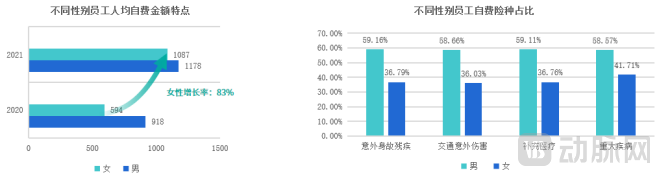
Compared with 2020, working women have become more concerned about the health of themselves and their families. In 2021, the average out-of-pocket expenditure per woman reached RMB 1,087, representing an 83% year-on-year increase. This significant rise reflects working women’s heightened awareness of risk mitigation for their households. In terms of insurance purchasing preferences, working men tend to favor personal accident insurance covering accidental death and disability, whereas women are more inclined toward critical illness insurance.
Source: insgeek, “2021 Workplace Health Power Report”
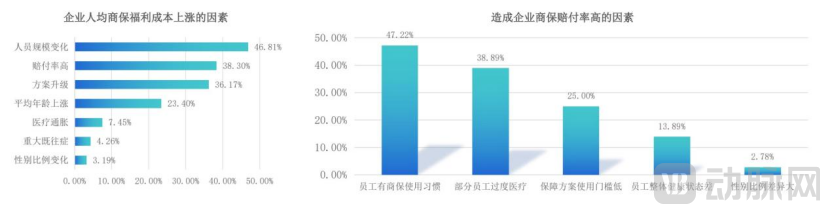
Sustainability is a major challenge for corporate commercial health insurance benefits. Factors such as high claim ratios driven by overutilization of medical services by some employees, objective medical inflation, and strong employee demand for enhanced coverage have led to distorted growth in commercial insurance costs, posing budgetary challenges for enterprises.
In implementing employee commercial insurance benefit programs, effective “tools” are crucial to curb resource waste, maximize benefit outcomes, and adapt to the evolving needs of both enterprises and employees.
For instance, a high claims ratio is a key factor driving up the cost of corporate commercial health insurance benefits. Under normal circumstances, a high claims ratio indicates elevated overall risk among employees; however, this is not always the case. When companies have offered commercial insurance for an extended period and maintain low thresholds for accessing coverage, many employees tend to utilize these benefits routinely. This habitual usage, coupled with unreasonable practices such as over-treatment, inflates the overall claims ratio. Importantly, this portion of the claims ratio is entirely controllable.
Source: insgeek, “2021 Workplace Health Power Report”
Historically, employee experience and benefit costs were viewed as an irreconcilable trade-off, with cost reductions inevitably compromising employee experience. However, by addressing the key drivers of rising commercial insurance costs—namely, high claims ratios and the demand for enhanced coverage—InsGeek has developed viable solutions through its digital employee commercial insurance offerings: the “Tiered Deductible Plan” and the “Geek+ Flexible Co-payment Model.”
The digital employee supplementary medical insurance plan adopts a "per-claim deductible" model to control costs. By flexibly combining the number of claims, deductibles, and reimbursement ratios, it covers the reasonable medical needs of the majority of employees while eliminating resource waste caused by a minority’s unreasonable medical utilization, thereby ensuring a smooth transition of corporate budgets. Rational intervention in employees’ medical-seeking behavior can also reduce frequent absenteeism and enhance benefit equity.
Leveraging the flexible, self-selectable "Geek+" platform, employees can upgrade their coverage based on individual needs and arrange insurance for family members such as parents, children, and spouses. By participating in co-payment models to customize their own protection plans, employees can meet personalized needs, achieving a "one-size-fits-one" approach to corporate commercial insurance while alleviating budgetary pressures.
Furthermore, by digitizing employee commercial insurance and accommodating benefit differentiation, InsGeek’s representative enterprise inclusive high-coverage life insurance product, “Double Monthly Salary,” features coverage amounts that fluctuate with monthly salaries, reaching a maximum of RMB 12 million. This meets the strong demand from both enterprises and employees for high-coverage protection, thereby realizing the value of digital employee commercial insurance in attracting, recruiting, and incentivizing talent.
To enhance the efficiency of commercial insurance decision-making, a robust data foundation is essential. Insgeek also provides enterprises with corporate health reports, analyzing the overall health status of the organization from multiple data dimensions, including “insured employee analysis, commercial insurance coverage levels, employee health, medical visit calendars, rankings of prevalent diseases, rankings of frequently visited hospitals, major and chronic diseases, and employee care.” These insights assist HR professionals in making informed management decisions and ensuring the long-term, sustainable development of commercial insurance benefits.
Currently, insgeek’s comprehensive digital solution for employee commercial insurance serves nearly 10,000 enterprises and over 1.2 million employees. By leveraging accumulated data and analyzing businesses and populations across diverse industries, scales, and regions, the company ensures that coverage plans are tailored to each enterprise based on its budget, insurance preferences, and historical claims data. This digital-first approach helps build a competitive employee benefits system.