

Avilar Therapeutics Files for IPO Following $60M Seed Round to Advance ATAC Platform for Extracellular Protein Degradation

Avilar Therapeutics
Developer of Extracellular Protein Degraders
On November 18, 2021, Avilar Therapeutics (“Avilar”), a biopharmaceutical company focused on extracellular protein degradation, secured $60 million in seed funding from its founding investor, RA Capital Management.The proceeds from this financing round have been utilized by Avilar to develop its ATAC degrader platform and to establish its ATAC therapeutic pipeline.。
Avilar Therapeutics is headquartered in Waltham, Massachusetts, USA, and is dedicated to the discovery and development of extracellular protein degraders, an emerging frontier in targeted protein degradation.
What is novel about Avilar Therapeutics’ targeted protein degradation therapy, and why did the emerging company secure as much as $60 million in its first round of financing?
Backed by an investment management firm, it brings together top-tier talent in biopharmaceuticals.
Avilar is a company founded and funded by RA Capital Management.
RA Capital Management is a multi-stage investment management firm dedicated to evidence-based investing in public and private healthcare and life sciences companies developing drugs, medical devices, and diagnostic technologies. The flexibility of RA Capital’s strategy enables it to provide seed funding to startups and assist its portfolio companies with private financings, initial public offerings (IPOs), and follow-on offerings, thereby empowering management teams to better drive commercialization and value creation.
Josh Resnick, M.D., Managing Director at RA Capital Management and a member of Avilar’s Board of Directors, stated: “RA Capital has extensive experience in the field of protein degradation. Building on our investments to date in intracellular degradation companies such as Arvinas, C4 Therapeutics, Frontier Medicines, and Vividion, we are pleased to now launch Avilar,”To surpass intracellular degradation and establish a leading position in the field of extracellular protein degradation.”
Today, Avilar has assembled a team of biopharmaceutical executives and scientific leaders with the skills and extensive experience to build an ATAC degrader pipeline. The team is led by CEO and President Daniel Grau.
Grau is a seasoned biotechnology entrepreneur and operations executive. Since 2016, he has co-founded and served as CEO and Director of the biopharmaceutical company Sojournix. Previously, he was President of Heptares Therapeutics, a drug discovery company (acquired in 2015); CEO of Cortria, a pharmaceutical company focused on cardiovascular disease treatments (acquired in 2010); and COO of CombinatoRx, a biotechnology company (which had its initial public offering in 2005).
Grau currently serves as an advisor to HotSpot Therapeutics, a developer of therapeutic platforms. He previously served on the Product Advisory Committee of Concert Pharmaceuticals and as an advisor to Nimbus Therapeutics, both biotechnology companies. Grau holds a Master of Arts in Philosophy and a Master of Arts in Religion from Yale University, where he was awarded the Mellon Fellowship, the Day Graduate Prize, and the Bass Scholarship.

CEO and President: Daniel Grau
Novel ASGPR-LYTAC Technology Enables Targeting of Extracellular Proteins
The onset and progression of most diseases are associated with abnormal protein expression or aggregation. In response to this pathological mechanism, traditional drug development strategies have focused on creating various small-molecule or protein-based inhibitors that suppress protein functional activity by occupying and blocking the active sites of target proteins. This approach requires target proteins to possess well-defined “druggable” active pockets or binding sites; however, approximately 80% of proteins lack such active binding regions and are therefore considered “undruggable.”
In recent years, protein degraders, represented by proteolysis-targeting chimeras (PROTACs), have created new opportunities for targeting proteins traditionally considered undruggable. A PROTAC molecule primarily consists of three components: an E3 ubiquitin ligase ligand, a target protein ligand, and a linker. PROTAC molecules recruit E3 ubiquitin ligases to the vicinity of the target protein, tagging it with ubiquitin. The ubiquitinated protein is then directed to the cell’s “waste disposal center” (the proteasome) for degradation. In this way, PROTAC molecules can specifically promote the degradation of disease-causing proteins.
Since this ubiquitin-mediated degradation pathway occurs intracellularly, PROTAC-based protein degraders currently primarily target intracellular proteins. However, in addition to intracellular proteins, many therapeutic targets—such as growth factors, disease-associated receptors, and cytokines—are actually secreted (extracellular) or membrane-associated proteins, which together constitute 40% of the human proteome.
The recently developed LYTAC (Lysosome-Targeting Chimera) technology effectively enables the degradation of extracellular and membrane proteins by leveraging the endocytic-lysosomal pathway, thereby overcoming the limitation of PROTAC technology, which targets only intracellular proteins.
LYTACs primarily consist of two binding domains: one is an oligosaccharide structure that targets lysosome-targeting receptors (LTRs) on the cell surface, and the other is an antibody, peptide, or small molecule that targets the protein of interest. These two domains are linked together by a chemical linker. First, the target protein ligand portion of the LYTAC molecule binds to the extracellular domain of the target protein, while the oligosaccharide structure binds to LTRs on the cell surface, forming a ternary complex of LTR–LYTAC–target protein. Subsequently, the complex undergoes clathrin-mediated endocytosis into the cell and is transported via vesicles to early endosomes. As the endosomes acidify, the LTR dissociates from the complex and recycles back to the cell membrane or Golgi apparatus, while the LYTAC–target protein complex is further transported to the lysosome for degradation.
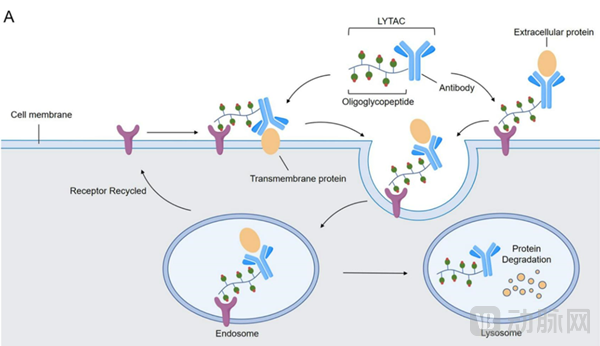
Mechanism of Action of LYTACs
Currently, two major types of lysosome-targeting receptors have been reported., namely the cation-independent mannose-6-phosphate receptor (cation-independent mannose-6-phosphate receptor,CI-M6PR) and asialoglycoprotein receptor (asialoglycoprotein receptor,ASGPR); their corresponding ligands are mannose-6-phosphate (M6P) and N-acetylgalactosamine (GalNAc), respectively.
Avilar Therapeutics’ proprietary extracellular protein degradation platform, named ATAC (ASGPR Targeting Chimeras), is an ASGPR-targeted LYTAC technology.
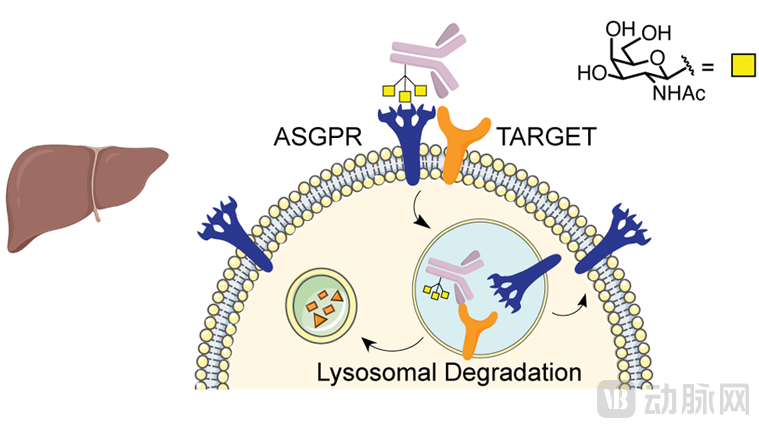
ASGPR-LYTAC (Image source: Nature Chemical Biology)
Leverage Proprietary Platform to Create ATAC Pipeline
Avilar’s proprietary ATAC platform features novel, high-affinity small-molecule ASGPR ligands; ATAC-mediated endocytosis; and advanced modeling of the biophysics, pharmacokinetics, and pharmacodynamics of the degradation process. Key components of the ATAC technology platform include:
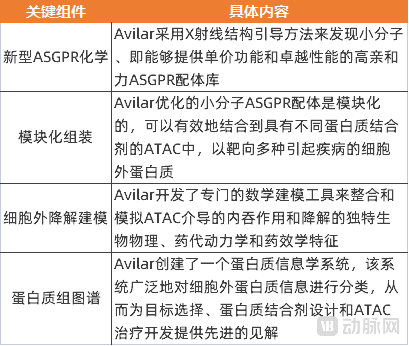
Key Components of the ATAC Technology Platform (Data Source: Avilar Official Website)
ATAC is a bifunctional molecule comprising a ligand that binds to ASGPR conjugated to a second ligand that binds to disease-causing extracellular proteins.
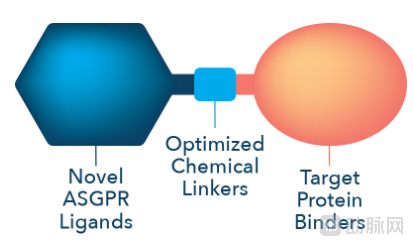
ATAC Structure (Image source: Avilar official website)
ASGPR is an endocytic cell-surface receptor that plays a key role in the natural process by which endogenous proteins are internalized into hepatocytes and degraded. ATAC works by leveraging the native degradation pathway of ASGPR to transport disease-causing proteins from the body’s circulatory system into lysosomes within hepatocytes, where these pathogenic proteins are degraded.
This platform enables the modular design and synthesis of ATACs to target a variety of extracellular proteins. By leveraging this discovery platform, Avilar is building a broad and diverse ATAC pipeline as best-in-class therapeutics for serious diseases.
The concept of LYTAC was first proposed by Bertozzi’s research group in July 2020. Currently, few companies are advancing LYTAC technology, and no related candidate drugs have been disclosed.
Lycia Therapeutics is the first company to drive the clinical translation of LYTAC technology and has entered into a multi-year research collaboration and licensing agreement with pharmaceutical giant Eli Lilly. The two parties will leverage Lycia’s proprietary LYTAC technology to develop and commercialize novel degraders targeting up to five targets.
Lycia is undoubtedly Avilar’s biggest competitor in this field to date. As an early researcher of LYTAC technology, what kind of LYTAC product pipeline will Avilar develop? Can it withstand competitive pressure and establish a leading position in the field of extracellular protein degradation? Let us wait and see.
References
[1] Liu Jinghong, Chen Yimin, Cai Xiaoqing. Emerging Technologies for Targeted Protein Degradation and Their Research Progress[J]. Acta Pharmaceutica Sinica,,:1-17.
[2] Huachuang Research: “PROTACs Poised for Takeoff, Protein Degradation Blooms”
[3] 《LYTACs that engage the asialoglycoprotein receptor for targeted protein degradation》https://pubmed.ncbi.nlm.nih.gov/33767387/