

Top 10 Strategies for Public Hospitals to Drive Online Consultation Volume in the Era of Internet Hospitals as a Standard
Recently, the National Health Commission pointed out in the "Guiding Principles for the Planning of Medical Institution Setup (2021-2025)": Vigorously develop internet diagnosis and treatment services, incorporate internet hospitals into the planning of medical institution setup, form an integrated online and offline service model, and improve the overall efficiency of the medical service system.
In fact, the trend of internet hospitals becoming a standard feature of public hospitals began to emerge in 2020; the policy document merely reaffirmed this direction. However, constrained by various factors, although publicly operated internet hospitals far outnumber those established by enterprises, their overall operational performance has been less than satisfactory.
How Can Consultation Volume Be Increased? This Is a Question Many Managers of Public Internet Hospitals Have Discussed with VCBeat, Hoping to Find an Answer.
Recently, some public hospitals released their 2021 annual operational summaries for internet hospitals. To better address the aforementioned questions, VCBeat collected and compiled data from ten public internet hospitals with high operational metrics or notable highlights, aiming to uncover the “secret to traffic growth.”
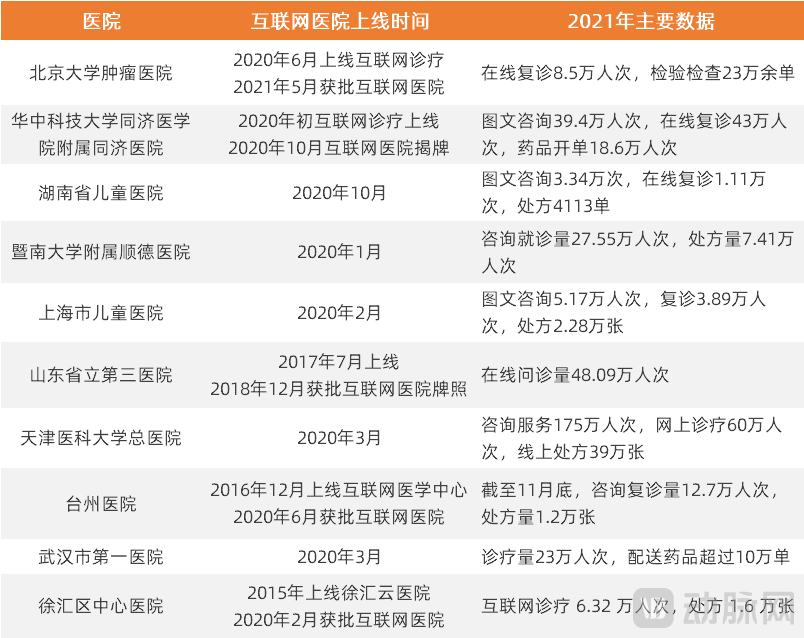
Key Operational Data of 10 Public Internet Hospitals; Data Source: Annual Reports of Each Internet Hospital or Provided by the Hospitals
As shown in the figure above, among the 10 hospitals, there are top-tier institutions ranked within the top 100 nationally, such as Tongji Hospital Affiliated to Tongji Medical College of Huazhong University of Science and Technology (hereinafter referred to as “Tongji Hospital”), Tianjin Medical University General Hospital, and Peking University Cancer Hospital; there are also regional hospitals such as Xuhui District Central Hospital and Taizhou Hospital. The group includes both general hospitals and specialized hospitals focusing on oncology and pediatrics.
In terms of operational data, Tongji Hospital served over one million patients through its online services in 2021, while Tianjin Medical University General Hospital recorded 1.75 million online consultations in the same year. Both hospitals also handled hundreds of thousands of online follow-up visits. Among regional hospitals, Wuhan No. 1 Hospital conducted 230,000 internet-based medical consultations. In the specialized hospital sector, Peking University Cancer Hospital achieved 85,000 online follow-up visits in 2021, accounting for more than 11% of its total annual outpatient volume offline.
Given the varying internal and external conditions faced by each hospital, direct data comparisons are not feasible, nor can operational models be directly replicated. Nevertheless, we aim to identify certain relative commonalities to provide reference for the industry.
Based on the operational measures visibly implemented by various hospitals and combined with interviews with administrators, we have summarized 10 secrets to achieving “high patient volume,” covering aspects ranging from infrastructure development to operations, from physicians to patients, and from within the hospital to outside services.
1. Equip with Necessary Human Resources
Among the hospitals included in this study, some have established separate departments to carry out their work, based on actual operational needs.
Li Gang, Director of the Outpatient Department Office and Director of the Internet Hospital Management Office at Tongji Hospital, told VCBeat that the Internet Hospital Management Office was established in July 2020. It falls under the jurisdiction of the Outpatient Department Office, is overseen by the Vice President in charge of medical affairs, and operates with the Hospital President serving as the legal representative of the Internet Hospital. The office comprises one director, one deputy director, and several full-time operational management staff. The main functions of the Internet Hospital Management Office include system process design, policy development, platform operation management, standardization of diagnostic and treatment practices, and medical quality management. Additionally, it oversees physician credential approval, digital signature certification, integration with provincial-level Internet hospital regulatory systems, and the rational drug use system, ensuring “pre-event checks, in-process tracking, and post-event traceability” to provide patients with sound, comprehensive, and reliable services.
Taizhou Hospital established its Internet Medical Center as early as 2016, which has been in operation ever since. Shandong Provincial Third Hospital set up a Smart Healthcare Department, with two deputy directors overseeing medical services and information technology respectively, thereby achieving the integration of medical management and technical management.
Internet hospitals require coordination across multiple departments within the hospital, and even collaboration with third-party partners. If existing departments are unable to assume these additional responsibilities, establishing a dedicated department to handle daily operations can enhance overall operational efficiency.
II. Clearly Define the Construction and Operation Model
Whether to co-establish and jointly operate an internet hospital with enterprises should be considered during the early planning stage.
Among the hospitals included in this survey, Xuhui District Central Hospital, Taizhou Hospital, Shandong Provincial Third Hospital, and Shunde Hospital Affiliated to Jinan University all selected internet healthcare companies as their partners, namely Guanzhong Health, Weimai, WeDoctor, and Ping An Good Doctor, respectively. In these hospital-enterprise collaborations, the hospitals are responsible for coordinating internal affairs, providing physical medical resources, and investing in certain premises or facilities and equipment; whereas the enterprises provide technical support, manage out-of-hospital and online resources, and assist medical staff in handling non-clinical tasks.
Peking University Cancer Hospital has adopted an independent operational model, with the daily coordination of its internet hospital jointly carried out by multiple departments, including the Hospital Information Department and the Outpatient Department.
Both models have demonstrated favorable outcomes. The primary reason is that the patient populations served by several general hospitals are more complex; while these hospitals excel in delivering medical care, they lack the capacity to provide services that are more closely aligned with patient needs—a gap that third-party operational expertise can effectively fill. In contrast, Peking University Cancer Hospital has high rates of follow-up visits and strong patient adherence to follow-up schedules, with a significant proportion of patients coming from outside Beijing. For this hospital, internet-based follow-up consultations are not merely an “added bonus” but a “critical necessity,” having become an essential requirement for many patients. Consequently, extensive “operational efforts” targeting patients are unnecessary.
Therefore, public internet hospitals need to choose their operational models based on their own circumstances.
III. Promoting Online-Offline Integration Through Laboratory and Diagnostic Testing
Online consultations, prescription renewals, and medication delivery were among the basic functions established at the inception of internet hospitals. VCBeat has found that self-service ordering for laboratory and imaging tests has also become nearly standard, with high utilization rates reported across various hospitals.
In 2021, Tongji Hospital launched an online self-service ordering system for ten types of laboratory and imaging tests, allowing patients to generate test requisitions in just three simple steps. The annual volume of self-ordered tests reached 567,000, with 479,000 patients completing the corresponding offline tests and treatments. In the same year, Hunan Children’s Hospital recorded 11,000 online follow-up visits, while pre-consultation self-ordered laboratory tests totaled 176,000. Peking University Cancer Hospital also facilitated over 230,000 online test orders and appointments through its internet hospital platform in 2021.
Why Is Online Ordering for Laboratory and Imaging Tests So Popular? This is primarily due to the cumbersome nature of offline testing processes. In recent years, online report retrieval has become increasingly widespread; however, patients still inevitably need to visit clinics in person to obtain test requisitions from physicians and wait in line. With the implementation of online ordering and appointment scheduling for laboratory and imaging tests, patients only need to come to the hospital when it is time to undergo the tests, significantly simplifying the traditional workflow. This service is particularly popular at high-volume tertiary hospitals.
Meanwhile, whether for online follow-up visits or offline initial consultations, appropriate laboratory and diagnostic tests are essential. Efficient testing enables a smoother patient experience and provides physicians with more comprehensive patient data, thereby becoming a key component in the integration of online and offline services in internet hospitals.
IV. Establishing Proactive and Continuous Services
Public hospitals typically adopt a “passive” approach to patient care, whereas internet hospitals provide them with more opportunities for proactive patient intervention.
“We are committed to building a comprehensive disease management system for patients, providing proactive and continuous services,” said Yao Gang, Deputy Director of the Internet Hospital Management Office at Tongji Hospital. The internet hospital offers full-course disease management for patients with chronic conditions, covering screening, diagnosis, treatment, rehabilitation follow-up, and health promotion. To date, it has launched services for 10 conditions, including COVID-19 follow-up visits and rheumatoid arthritis, serving 12,000 patient visits.
Taizhou Hospital has launched continuous care service packages, including post-consultation management for thyroid and breast conditions, abortion care support, and end-to-end management of day surgeries. In 2021, the volume of online consultations in the Department of Breast and Thyroid Surgery and the Department of Obstetrics ranked among the top three hospital-wide.
“The internet has extended the scope of hospital services to pre- and post-consultation stages, accelerating the transition toward providing comprehensive health services, rather than focusing solely on traditional acute medical care,” said Xie Bojian, Director of the Internet Medical Center at Taizhou Hospital.
Continuous service offerings can enhance the utilization rate of internet hospital services, foster patient habit formation, and, more importantly, facilitate better therapeutic outcomes through proactive hospital interventions. For hospitals and physicians, continuous and convenient patient monitoring also serves as a foundation for the efficient accumulation of research data.
V. Channeling Resources Toward Advantageous Specialties
Return visit rates vary across hospital departments and disease categories, as do the clinical capabilities of different specialties. Consequently, identical inputs may not yield commensurate returns, making rational resource allocation particularly important.
Wuhan No. 1 Hospital serves as a typical case in point. Dermatology is the hospital’s specialty department, one that is highly suitable for online diagnosis and treatment while also possessing consumer-oriented attributes. Wuhan No. 1 Hospital has fully leveraged these characteristics by prioritizing the development of its dermatology department within its internet hospital platform. For instance, it has conducted free online dermatology consultations during major shopping events such as “Double 11” to attract greater patient attention, vigorously promoted its proprietary dermatological preparations, and delivered flexible public education on dermatological health. In 2021, dermatology became the department with the highest volume of online consultations.
The Department of Rehabilitation Medicine is one of the specialty disciplines at Shunde Hospital Affiliated to Jinan University and serves as a promotional unit for projects under the National Key R&D Program. In 2021, the department launched a home-based tele-rehabilitation system on its internet hospital platform, enabling rehabilitation therapists to provide online services such as video assessments, personalized home rehabilitation plans, video-guided rehabilitation therapy, and text-and-image consultations.
For top-tier Grade 3A hospitals, the abundance of high-level specialties provides sufficient appeal to patients. Regional hospitals, however, differ; they can leverage the characteristics of the internet, combined with their own strengths or unique features, to achieve breakthroughs in selected specialties and disease categories.
VI. Enhancing Physician Motivation Through Multiple Approaches
Low physician enthusiasm for online consultations is a problem cited by many hospitals. According to regulations from the medical insurance authorities, online follow-up visits are charged at the standard outpatient rate, regardless of the physician’s seniority. VCBeat has conducted statistics showing that internet follow-up consultation fees vary significantly across provinces in China, ranging from a few yuan to several dozen yuan.
Currently, some hospitals allocate most or all of the online consultation fees to physicians to boost their motivation. Given that the overall volume of internet-based medical consultations remains low, the individual caseload for physicians is also limited; thus, even with income derived from consultation fees, the amount is not substantial. Therefore, the incentive value of consultation fee subsidies outweighs their actual significance in terms of “income growth.”
Some hospitals have also established role models and conferred awards through initiatives such as designating benchmark physicians and departments, thereby encouraging greater participation among doctors. For example, Tianjin Medical University General Hospital has introduced a monthly ranking for internet-based diagnosis and treatment services, publicly announcing the “Front-Runner Award” and “Progress Award” for departments and individuals each month to incentivize both departments and physicians.
Furthermore, administrators have proposed enhancing physician motivation by increasing the allocation of performance-based bonuses in annual assessments, calculating continuing education hours, incorporating these metrics into professional title evaluations, and strengthening physician insurance mechanisms.
7. Conduct High-Frequency Promotional Campaigns
As internet hospitals represent a new model, continuous promotion and outreach to patients are essential.
A clinician from a third-tier, Grade A tertiary hospital in Southwest China once told VCBeat that although the hospital had launched an internet hospital, few patients used it, as they still preferred face-to-face consultations. Indeed, usage habits are not formed overnight, but another fact is that many hospitals have not widely promoted the online consultation process and its convenience.
Among the 10 hospitals included in this survey, nearly all have frequently introduced and promoted internet hospital services to patients through their official websites, official WeChat accounts, and in-hospital display boards. This is a fundamental prerequisite for raising patient awareness of internet hospitals and, consequently, encouraging their use. For example, the General Hospital of Tianjin Medical University has conducted continuous promotion of its internet hospital via its official WeChat account. In 2021, the hospital’s WeChat public account published 94 news articles, produced 167 short videos, and posted 270 updates on its website, accumulating over 5 million views.
Shanghai Children’s Hospital has launched a dedicated WeChat Official Account for its Internet Hospital, which not only provides broader space for online health education, information dissemination, and feature showcases, but also helps establish a more distinct brand image for the Internet Hospital, enabling patients to gain a clearer understanding of its services.
Furthermore, mobilizing physicians to promote the product is also an effective strategy.
8. Node-based online free clinics to improve penetration rates
During the pandemic, internet hospitals provided large-scale free consultations, playing a positive role in popularizing online medical services. In the post-pandemic era, while free consultations are unlikely to become the norm, some hospitals continue to conduct periodic online free clinic events.
In 2021, Tianjin Medical University General Hospital organized multiple online free clinics by doctors from relevant departments on occasions such as National Ear Care Day, World Inflammatory Bowel Disease Day, and National Skincare Day. Shanghai Children’s Hospital also held online free clinics on events including National Dental Care Day, International Volunteer Day, and World Asthma Day, serving up to 652 patients in a single day.
Free clinics are an important form of public welfare value offered by public hospitals and have become a common practice offline. Extending free clinics to online platforms can significantly improve the efficiency of patient consultations and physician responses, while also helping to continuously expand the penetration rate of internet-based healthcare.
9. Enhancing the Convenience of Health Insurance Payments
In January 2022, Tongji Hospital published an article titled “Exploration and Reflections on the Construction of Internet Hospital Service Systems in Public Hospitals” in Chinese Hospitals. The article pointed out that an analysis of prescription fulfillment data from internet hospitals revealed an online prescription order execution rate of approximately 50%, with a substantial proportion of prescriptions being filled externally. The execution rate for online laboratory and imaging test requests reached a maximum of only 80%, primarily due to the need for further improvement in the convenience of online medical insurance payment services within internet hospitals.
In its research for the “2021 Internet Hospital Report,” VCBeat also found that internet hospitals offering medical insurance payment options generally had higher consultation volumes than those that did not. Therefore, there is a direct correlation between the extent of medical insurance reimbursement coverage and patient utilization rates. Nearly all hospitals included in this statistics have enabled online medical insurance payments, which has helped promote patient usage. However, the range of conditions covered by insurance payments and the convenience of the payment process vary across hospitals, indicating substantial room for improvement compared to offline services.
10. Explore B2B Business Opportunities
Public internet hospitals not only serve individuals but also explore B2B services. For example, Shandong Provincial Third Hospital, in partnership with WeDoctor, has delivered internet hospital services to enterprises such as Shandong Hi-Speed Group, China Construction Eighth Engineering Division, and the Shandong Branch of China Construction Bank, providing online consultations, health management, and health education for their employees or users. Xuhui District Central Hospital, together with Guanzhong Health and human resources firms, has launched corporate health benefit products, establishing “cloud clinics” within companies to provide internet-based medical services to employees.
In this model, public internet hospitals, third-party online healthcare companies, and B-side enterprises collaborate to precisely develop products and services for targeted user groups, thereby amplifying the operational efficiency of public hospital resources.
Overall, the ten high-traffic strategies are merely relatively common approaches and are not universally applicable to all hospitals; they should be combined according to actual circumstances. It is worth noting that renowned tertiary Grade A hospitals focus on enhancing the accessibility of high-quality resources through internet hospitals, while regional hospitals emphasize exploring more possibilities within a defined service radius. Their offline positioning varies, and online services must align with, rather than contradict, these respective positions.
In addition to the primary consultation data mentioned at the beginning of this article, internet hospitals can deliver multifaceted benefits.
First, internet hospitals have demonstrated significant effectiveness in improving efficiency and reducing costs for all stakeholders.Yao Gang, Deputy Director of the Internet Hospital Management Office at Tongji Hospital, believes that diverting a portion of follow-up patients to online platforms has alleviated difficulties in accessing medical care. Furthermore, follow-up patients can save considerable time by placing orders in advance through online channels.
Heng Fanxiu, Director of the Information Department at Peking University Cancer Hospital, stated that by factoring in the average per-patient economic cost of travel to and from the hospital and combining this with the number of online follow-up visits, it was estimated that in 2021, the hospital’s internet hospital saved patients more than RMB 400 million in non-medical expenses such as transportation and accommodation.
Internet hospitals drive cost reduction and efficiency improvement, a benefit that is particularly evident in large tertiary Grade A hospitals with high patient volumes and extensive service scopes. By moving routine follow-up visits and the ordering and scheduling of laboratory tests and examinations online, these hospitals can dedicate more resources to offline initial consultations and patients with complex or critical conditions, thereby fully unleashing the potential of high-quality medical resources.
Second, the scaling of online revenue.In 2021, the online follow-up consultation revenue of Peking University Cancer Hospital exceeded RMB 100 million, primarily derived from prescriptions, laboratory and imaging tests, and other diagnostic and treatment services. According to data released by Tianjin Medical University General Hospital, its internet hospital generated RMB 27.12 million in online revenue within nine months of launch in 2020, offsetting the shortfall in offline income.
Although public hospitals must uphold their public-welfare nature, revenue remains an unavoidable practical concern, particularly in the wake of the pandemic’s impact.
Finally, it helps hospitals enhance their comprehensive influence.Shandong Provincial Third Hospital and Xuhui District Central Hospital began exploring internet hospitals at an early stage. After several years of accumulation, their internet hospital initiatives have helped these institutions gain broader recognition, enhancing their influence among patients and within the industry. Although Wuhan No. 1 Hospital faced significant challenges during the pandemic, it seized this opportunity to rapidly establish its internet hospital as an industry benchmark; according to information released by the hospital, it has attracted visits and exchanges from more than 30 peer institutions across China. By reinforcing innovative service models, these hospitals have strengthened their competitiveness.
The construction and operation of internet hospitals have not been smooth sailing. The aforementioned data and achievements are the result of the concerted efforts of countless operational staff, who had to overcome various challenges along the way.
Li Gang, Director of the Outpatient Department Office and Director of the Internet Hospital Management Office at Tongji Hospital, noted that internet hospitals facilitate the decentralization of high-quality medical resources and support tiered diagnosis and treatment. However, limited interoperability of information systems remains a challenge, necessitating further exploration to achieve regional coordination. “Artificial intelligence can empower internet hospitals to effectively advance precision medicine by enabling precise patient services through intelligent prediction and monitoring. Yet, there is a lack of policy guidance on collaborating with third-party companies to leverage AI and other emerging technologies in internet hospital applications, which also warrants further exploration.”
Xie Bojian, Director of the Internet Medical Center at Taizhou Hospital, stated that in collaborations between hospitals and third-party entities, the former must uphold public welfare objectives while the latter pursues profit, emphasizing the importance of balancing the needs of both parties.
How Can Internet Hospitals Take a Further Step Forward in 2022? Enriching Service Offerings, Optimizing the Doctor-Patient Experience, and Promoting Regional Collaboration Are Key Priorities.
Li Gang, Director of the Outpatient Department Office and Director of the Internet Hospital Management Office at Tongji Hospital, stated that in 2022, the hospital planned to improve the pricing, service items, and operational models of internet-based diagnosis and treatment services, while expanding more new online service models. Measures such as forming physician working groups, screening and categorizing patients, and setting up patient-physician reminder functions would be implemented to enhance the efficiency of physicians’ online diagnostic and therapeutic services. The hospital would vigorously promote the “Internet +” full-course management model for chronic diseases and strengthen publicity and promotion among both physicians and patients. “We strive to achieve a 20% share of online diagnosis and treatment services in 2022.”
To address the issue of insufficient information connectivity within the region, Tongji Hospital will build a regional internet healthcare ecosystem. Based on the medical consortium, it will jointly establish a regional pool of medical resources and innovate service and operational models. By establishing a qualification authorization mechanism for member institutions of the medical consortium, the hospital will attract individual physicians, departments, and hospitals within the consortium to join the Tongji Internet Hospital. This will enable the sharing and interoperability of resources such as outpatient appointment slots, hospital beds, laboratory tests, diagnostic imaging, pathology services, and telemedicine across the region.
Peking University Cancer Hospital plans to establish a visit schedule. Heng Fanxiu, Director of the Information Department, introduced that after this feature goes live, the internet hospital will be able to synchronize in-hospital diagnosis and treatment plans and processes with patients in the form of a timeline. Patients can not only check their past medical records but also know their future diagnosis and treatment plans in advance. “This allows patients to fully understand their diagnosis and treatment plans and feel informed.”
Xie Bojian, Director of the Internet Medical Center at Taizhou Hospital, also stated that more exploration would be conducted in service models and patient management in the new year.
It is evident that public hospitals are continuing to refine the various functions of their internet-based medical services, constantly exploring approaches suited to their specific contexts. The healthy development of public internet hospitals will play a pivotal role in ensuring service quality within the industry and fostering patients’ adoption of these digital health practices. Meanwhile, third-party companies can complement public hospitals through synergistic partnerships. Notably, many public hospitals have already initiated such collaborations, actively addressing associated challenges and devising solutions—a trend that represents a significant direction for industry advancement.