

Monte Rosa Therapeutics Files for IPO to Advance Molecular Glue Degraders, Having Raised Over $400 Million in Two Years

Monte Rosa Therapeutics
Small Molecule Degrader Developer
In June 2021, biotechnology company Monte Rosa Therapeutics (hereinafter referred to as “Monte Rosa,” NASDAQ: GLUE) completed approximately $222 million in financing and listed on the NASDAQ.The prospectus disclosed that the proceeds from the IPO will be used to advance two molecular glue therapies into clinical development, as well as to support the preclinical pipeline.
In multiple Myc-driven preclinical models, Monte Rosa Therapeutics demonstrated that the GSPT1-directed molecular glue degrader (MGD) MRT-2359 is selective and well-tolerated, inducing tumor regression upon oral administration. At the latest AACR-NCI-EORTC International Conference on Molecular Targets and Cancer Therapeutics, Monte Rosa Therapeutics presented preclinical data highlighting the potential of the molecular glue degrader MRT-2359 to differentially induce cell death in Myc-addicted tumors.
The progress achieved in Monte Rosa’s preclinical studies demonstrates the potential of its molecular glue degrader platform. What unique technologies underpin Monte Rosa’s strong investor appeal and R&D momentum? What distinguishes its development pipeline? This article provides an overview.
Monte Rosa, founded in 2018 and headquartered in Basel, Switzerland, is a biotechnology company dedicated to the discovery and development of a pipeline of precision medicines based on novel molecular glue degraders. The company has developed its proprietary protein degradation platform, QuEEN, which enables the rapid identification of protein targets and molecular glue degraders.
Many human diseases are associated with abnormal intracellular protein function. Currently, the primary pharmacological approach to treating these diseases is the use of small-molecule inhibitors. However, the number of druggable protein targets available for inhibition is limited, restricted to those proteins with well-defined binding pockets (accounting for approximately 20%). The remaining proteins, lacking such binding pockets, are considered undruggable by traditional small molecules.
Targeted Protein Degradation (TPD) therapies can function without requiring tight binding to sites that modulate protein activity, thereby enabling previously “undruggable” proteins to become novel drug targets. Meanwhile, TPD therapies can continuously induce the rapid and efficient degradation of disease-causing proteins, significantly suppressing the development of resistance to target proteins.
Currently, the two most prominent targeted protein degradation therapies are Proteolysis-Targeting Chimeras (PROTACs) and Molecular Glue Degraders (MGDs). Both mediate the degradation of target proteins via the ubiquitin-proteasome pathway; however, they differ significantly in their molecular design and mechanisms of action.
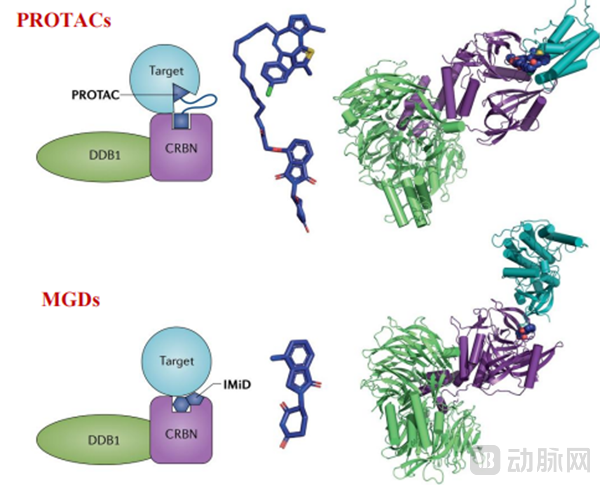
Comparison of PROTAC and MGD Structures and Binding Modes (Image Source: Huachuang Securities)
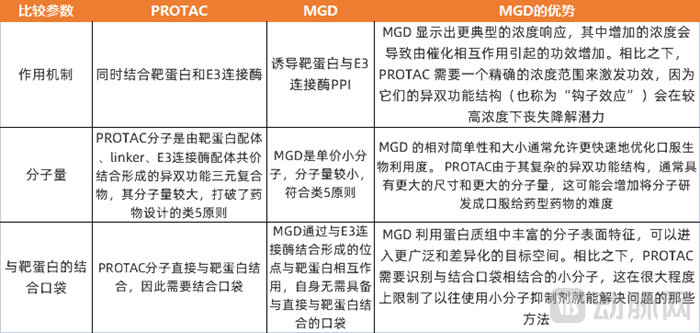
Differences Between PROTACs and MGDs (Data Source: Monte Rosa Therapeutics Website and Huachuang Securities)
Monte Rosa Therapeutics believes that molecular glue degraders offer greater advantages over PROTACs, and thus focuses on the research and development of molecular glue degraders, dedicated to treating immunological, inflammatory, neurological, and genetic diseases.
Monte Rosa was founded by Professor Raj Chopra and Professor Ian Collins of the Institute of Cancer Research, UK, together with Versant Ventures, a healthcare venture capital firm. The academic co-founders, Rajesh Chopra and Ian Collins, are pioneers in the field of molecular glue degraders (MGD).
Today, Monte Rosa is led by a seasoned team of experts in drug discovery and development, with decades of experience in targeted protein degradation, molecular glues, chemistry, structural biology, data science, disease biology, translational medicine, and clinical development.
Dr. Markus Warmuth, Chief Executive Officer, brings over 20 years of experience in data-driven drug discovery and precision medicine. He previously served as an Entrepreneur-in-Residence at the healthcare venture capital firm Third Rock Ventures and as Chief Executive Officer of the biopharmaceutical company H3 Biomedicine. Additionally, he held various positions at the Novartis Institutes for BioMedical Research (NIBR) and the Genomics Institute of the Novartis Research Foundation (GNF), including Director of Kinase Biology and Head of Oncology Pharmacology. During his tenure at Novartis, he contributed to the development of ceritinib and ribociclib, as well as the discovery of allosteric inhibitors targeting SHP2 and ABL.
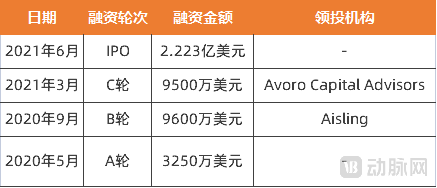
Through the collective efforts of the team, the company secured a total of approximately $450 million in financing within just two years via three rounds of pre-IPO funding and an initial public offering (IPO).
Monte Rosa’s unique protein degradation platform, QuEEN (Quantitative and Engineered Elimination of Neosubstrates), is the cornerstone of molecular glue degrader development.This involves three key components: the Degron Encyclopedia, the Proprietary MGD Library, and the Glueomics Toolbox.
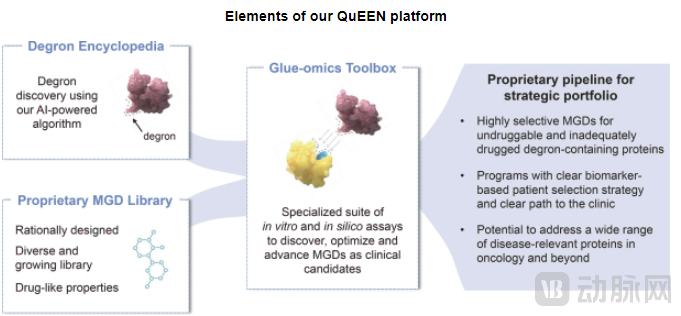
Three Elements of the QuEEN Platform (Image Source: MonteRosa Prospectus)
1Degron encyclopedia
The Degron Encyclopedia identifies target proteins and their surface structural features through Monte Rosa’s AI technology.
For proteins targeted by MGD, their surface must expose a structural feature that enables recruitment and degradation mediated by the E3 ligase complex. This structural feature is known as a degron, and proteins containing such degrons are referred to as neosubstrates. Neosubstrates are proteins degraded only in the presence of MGD, rather than being physiological substrates of the E3 ligase.
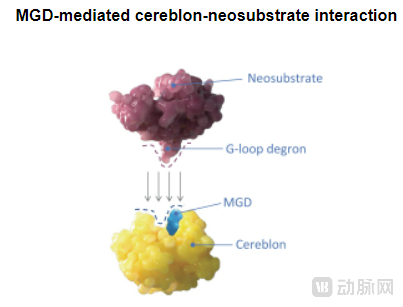
MGD-Mediated Cereblon–Novel Substrate Interactions (Image source: Monte Rosa Therapeutics Prospectus)
Monte Rosa has developed algorithms that leverage artificial intelligence to mine protein structure databases and model proteins in the absence of three-dimensional structures. Currently, Monte Rosa has identified more than 1,500 proteins representing potential new substrates targetable by Molecular Glue Degradation (MGD), over 95% of which possess unique degron sequences. Since the recruitment of E3 ligase complexes and subsequent degradation are mediated by degron structure and sequence, the uniqueness of these degron sequences suggests the potential for selective degradation of each new substrate. Due to the lack of suitable drug-binding pockets, more than three-quarters of the candidate targets identified by Monte Rosa are typically considered undruggable. Furthermore, these degron-containing proteins are associated with a broad range of diseases, indicating that MGD may offer therapeutic benefits for patients suffering from various conditions.
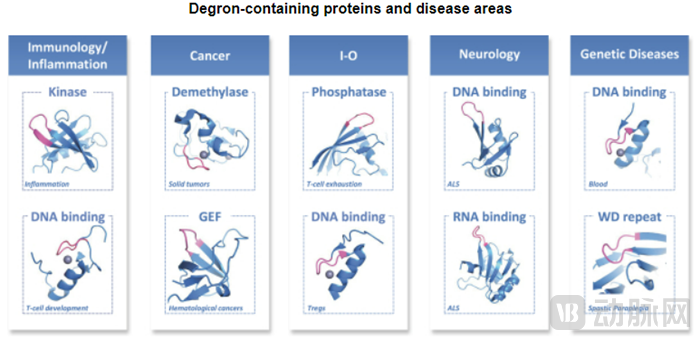
Degron-Containing Proteins and Disease Areas (Source: Monte Rosa Prospectus)
Monte Rosa prioritizes target proteins based on their robust association with disease biology and advances the most promising candidates into the drug discovery process.
2Proprietary MGD library:
Monte Rosa’s proprietary MGD chemical molecular library currently comprises more than 200 unique drug-eluting stents and over 7,000 unique molecular compounds, a figure that grew to approximately 20,000 by 2021.
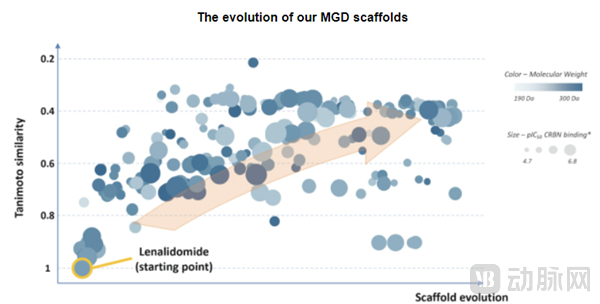
Changes in MGD Stents (Source: Monte Rosa Prospectus)
Preclinical studies by Monte Rosa have demonstrated that increasing the diversity of molecular glue degraders (MGDs), while maintaining cereblon binding and ideal drug-like properties for each molecule, enables these molecules to engage with distinct degrons. The proprietary MGD library is designed to focus on molecules with characteristics similar to those of approved drugs, including molecular weight, solubility predicted by the partition coefficient (clogP), and polar surface area. These molecular properties influence factors such as oral bioavailability, drug exposure, and metabolism. Leveraging its proprietary MGD library, Monte Rosa has identified multiple potential targets among proteins not previously reported as degradable by molecular glues.
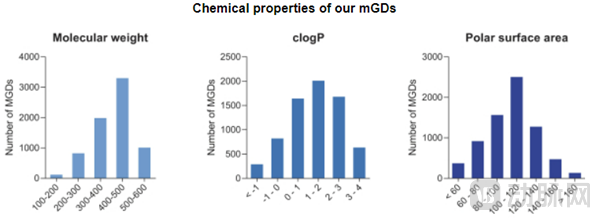
Chemical Properties of Monte Rosa’s MGDs (Source: Monte Rosa Prospectus)
3Glueomics toolbox
The Glueomics toolbox is a customized suite of biochemical, structural biology, cellular, proteomic, and computational screening tools designed to extensively screen molecular glue degraders (MGDs) against target proteins containing degrons, validate proteins as novel substrates, and optimize the potency of MGDs.
Overall, Monte Rosa expands the scope of new substrates by continuously identifying degrons and recruiting these substrates to additional E3 ligases, aiming to discover more therapeutically relevant proteins and bring them into the realm of druggable targets, thereby providing treatment options for targets previously considered undruggable or lacking available drugs.
Based on the QuEEN platform, Monte Rosa currently has five products in its public pipeline. Among them, one product has entered the IND-enabling stage, while the remaining four are still in the discovery phase.
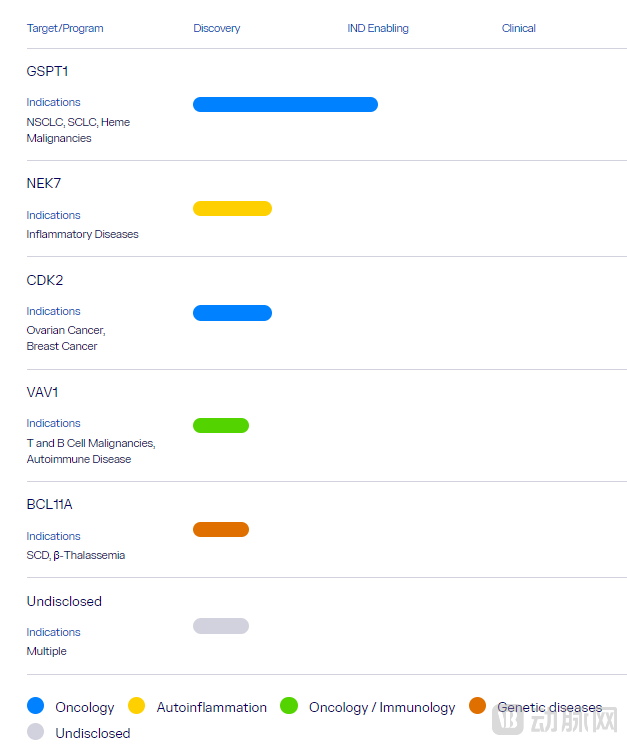
Monte Rosa’s R&D Pipeline (Image source: Monte Rosa official website)
MRT-2359 Targeting GSPT1
MRT-2359 is an oral molecular glue degrader (MGD) under development by Monte Rosa Therapeutics that targets GSPT1, a translation termination factor and a novel substrate containing a G-loop degron, which has been identified as a potential target in oncology. It is being developed for the treatment of cancers overexpressing Myc family genes (c-Myc, N-Myc, and L-Myc), such as non-small cell lung cancer, small cell lung cancer, and hematologic malignancies.
Myc is one of the oncogenes most frequently mutated, translocated, and overexpressed in human cancers. For example, approximately 10% of non-small cell lung cancer (NSCLC) cases exhibit N-Myc overexpression, while more than 50% of small cell lung cancer (SCLC) cases show L-Myc overexpression. Myc-driven cancer cells are highly dependent on protein translation. Given the critical role of GSPT1 in protein synthesis, Monte Rosa’s molecular glue degrader (MGD) therapy selectively degrades GSPT1 in these cells, leading to cell death.
At the latest AACR-NCI-EORTC International Conference on Molecular Targets and Cancer Therapeutics, Monte Rosa presented preclinical data highlighting the potential of the molecular glue degrader MRT-2359 to differentially induce cell death in Myc-addicted tumors. Monte Rosa has initiated Investigational New Drug (IND)-enabling activities and expects to submit an IND application to the U.S. Food and Drug Administration (FDA) in mid-2022.
The other four MGD candidates in development are a CDK2-targeted MGD molecule (for the treatment of ovarian and breast cancer), a NEK7 degrader (for inflammatory diseases), a VAV1-targeted MGD molecule (for hematologic cancers and autoimmune diseases), and a BCL11A-targeted MGD molecule (for the treatment of sickle cell disease and β-thalassemia).
Currently, most MGD drug candidates with advanced R&D progress are in Phase I or Phase II clinical trials.
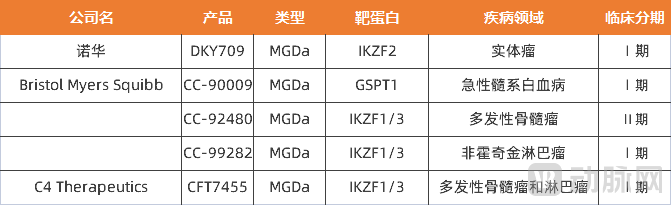
Monte Rosa is also actively accelerating its product development pipeline to keep pace with the market through strategic collaborations and increased capital investment.
On January 25, 2022, Monte Rosa Therapeutics and Yeda, the commercial arm of the Weizmann Institute of Science, announced a licensing and research collaboration to leverage CoLDR (Covalent Ligand-Directed Release) technology to accelerate the discovery of novel covalent molecular glue degraders.
On the same day, Monte Rosa Therapeutics announced a collaboration with Applied BioMath, a leader in applying systems pharmacology and mechanistic modeling, simulation, and analysis to reduce drug development risks, to develop a cellular systems pharmacology model targeting GSPT1 for cereblon-based molecular glue degraders. This model will be used to predict and analyze the degradation of GSPT1 by cereblon-based agents across various cellular disease contexts and to address mechanistic questions.
While actively pursuing collaborations, Monte Rosa has also increased its R&D investment. In the first nine months of 2021, the company invested a total of $39.02 million, representing a year-on-year increase of 176%.
The development of molecular glue degraders is still in its early stages, with no products currently on the market; indeed, there are yet no approved products across the entire field of targeted protein degradation therapy. If Monte Rosa Therapeutics can accelerate its R&D pace, it may be able to secure a first-mover advantage and capture a share of the market.