

The Hidden Track Favored by Eileen Gu and Elite Athletes: A $10B+ Market Attracting Over 20 Investment Firms
Yesterday, the 2022 Beijing Winter Olympics officially concluded, with the Chinese delegation finishing with 9 gold, 4 silver, and 2 bronze medals, setting new historical highs in both gold medal and total medal counts.
It is worth noting that in addition to the outstanding achievements of Olympic athletes in competition, the enthusiasm for ice and snow sports among people outside the arena has also been ignited. According to statistical survey data from the Winter Sports Management Center of the General Administration of Sport of China, driven by the Winter Olympics, China has now achieved the goal of “engaging 300 million people in ice and snow sports.”
Due toIce and snow sports are high-risk activities, with participants facing a higher probability of injury.Thus, orthopedic surgeon Mao Rui’s remark, “The end of the ski trail leads to the orthopedics department,” trended on Weibo during the Winter Olympics. The reason was that he performed nine surgeries on February 9, seven of which were for injuries caused by skiing falls.
Additionally, data compiled by experts from Peking University Third Hospital show that during two winter sports seasons, a total of 753 patients sought treatment for skiing-related injuries at a major ski resort in Chongli District, Zhangjiakou City, Hebei Province, with falls accounting for as high as 76.6% of these cases.
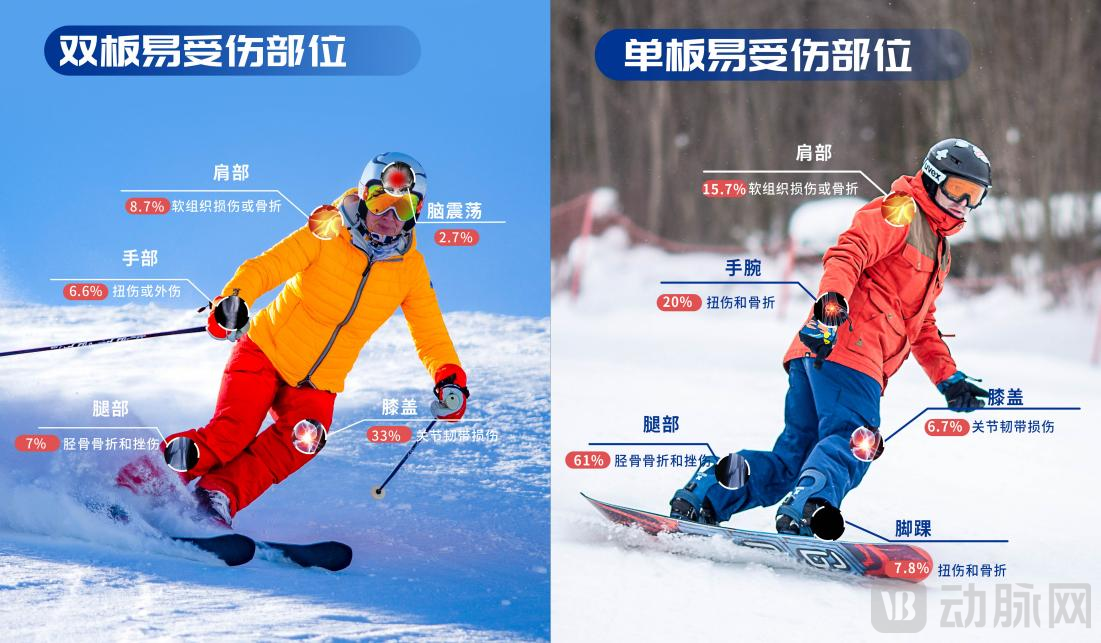 (Image of Common Injury Sites in Winter Sports. Image source: Youfu Medical)
Faced with such a high injury rate, how do professional athletes and sports enthusiasts strive to prevent injuries and facilitate recovery? The answer lies in sports rehabilitation, which can be simply understood as a method that promotes physical recovery by restoring injured areas through various medical interventions or training exercises.
For example, at the Beijing Winter Olympics, multiple sport teams within China’s delegation were equipped with rehabilitation therapists, including the figure skating team, curling team, women’s ice hockey team, freestyle skiing halfpipe team, biathlon team, and skeleton team.
Following the path of professional athletes, a growing number of people are beginning to understand and try sports rehabilitation.This has brought the once-niche market, popular among professional athletes and sports enthusiasts, into the public spotlight, where it has gained significant traction.
As one of the most heavily favored gold-medal contenders at this Winter Olympics, Eileen Gu’s dynamic jumps on the ski slopes were widely reposted by major media outlets.
Yet Behind the Glory, Peril Lurks: The high-speed and high-resistance characteristics inherent in ice and snow sports make athletes and sports enthusiasts highly susceptible to severe sports injuries, which directly impact their athletic performance and quality of life. ThereforeNo athlete dares to take their rehabilitation therapy lightly.
For example, in the men’s snowboard halfpipe qualification at this Winter Olympics, 21-year-old Chinese athlete Gao Hongbo suffered an unfortunate fall during pre-competition training, resulting in a fractured ankle, which led to him scoring only 15 points in the first run and finishing in last place.
For another example, snowboarder Liu Jiayu frequently sustained injuries during halfpipe training, suffering recurrent dislocations of her left shoulder that required surgical fixation with steel pins. To ensure her participation in the Winter Olympics, she underwent extensive sports rehabilitation training before the competition, training six days a week.
It is precisely the significant hidden risks that lead athletes to place great emphasis on sports rehabilitation.For example, during the preparations for the Winter Olympics, Eileen Gu’s team repeatedly sought medical rehabilitation treatment at the national training team’s base after training sessions and competitions. This approach helped reduce injuries during overseas training and competitions, laying a solid foundation for Eileen Gu to compete in optimal condition.
In sports rehabilitation training,Athletes prefer specialized sports rehabilitation institutions and authoritative rehabilitation therapists.“Because sports rehabilitation and general rehabilitation have different goals, sports rehabilitation falls under the category of sports physical therapy. It aims to help patients restore their normal active lifestyles, thus imposing higher demands on rehabilitation outcomes. In contrast, general rehabilitation focuses on helping individuals return to their daily living activities, which entails relatively lower requirements and is easier to achieve. ‘Sports rehabilitation must be guided by professional physicians and therapists to achieve optimal results, particularly requiring professionals with a medical background,’ said Sun Xiaoyi, founder of URehab Medical, in an interview with VCBeat.”
It is precisely in response to this demand that the sports rehabilitation market has gradually developed, with its momentum continuing to intensify.According to survey statistics from the Sports Rehabilitation Industry Alliance, the number of institutions and stores involved in the field of sports rehabilitation exceeded 100 in 2018 and approached 400 by the end of 2020, with a compound annual growth rate (CAGR) of over 40% during this three-year period.
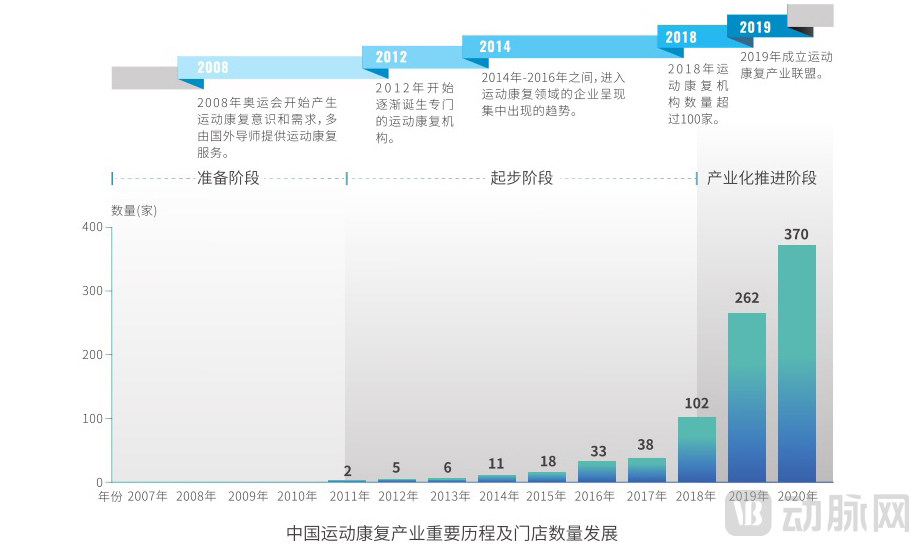 (Image source: White Paper on China's Sports Rehabilitation Industry)
On the other hand, with the rise of sports events and public awareness, the demand for sports rehabilitation has shown a continuous growth trend: In 2020, the number of people participating in physical exercise in China reached 430 million. Based on an estimated sports injury rate of 10%-20%, the number of individuals suffering from sports injuries is projected to reach 100 million.
Rising demand and increased supply are driving continuous growth in the market size of the rehabilitation medical industry.According to the "China Health and Health Statistical Yearbook," China's rehabilitation medical service market is estimated to have entered the RMB 100 billion scale in 2021.
“Sports rehabilitation was originally a niche sector, primarily serving professional athletes and sports enthusiasts with considerable financial means. The industry began to take root and develop in China following the 2008 Beijing Olympic Games,” said Han Feng, an investor in the rehabilitation sector. “The hosting of major sporting events, such as the Winter Olympics, boosts interest in the industry and provides a significant opportunity for it to break into the mainstream.”
Capitalizing on the momentum of the Winter Olympics, many sports rehabilitation brands have intensified their marketing efforts. For instance, Therabody, a developer of percussion massagers that secured an early advantage by signing Eileen Gu as its global brand ambassador last October, has recently launched extensive online and offline advertising campaigns. Meanwhile, offline service providers have also embarked on a new wave of store expansions.
From a Niche Track Serving Primarily Professional Athletes to Gradually Breaking into the Mainstream: Where Does the Sports Rehabilitation Industry Stand Today?
“Orthopedic surgeons contribute 51% to the outcome, while rehabilitation accounts for 49%. However, rehabilitation should be integrated throughout the entire treatment process, rather than being limited to the postoperative period. Moreover, a standardized rehabilitation protocol can enhance surgical outcomes. If scientific rehabilitation training is not conducted after surgery, there is a high likelihood of sequelae.” stated Professor Ma Xin, Vice President of Huashan Hospital and former rehabilitation physician for Wang Meng, a former member of the Chinese National Speed Skating and Short Track Speed Skating Teams, in a previous media interview.
It is precisely under this overall shift in mindset,People’s understanding of rehabilitation is no longer limited to orthopedics but now encompasses the entire field of sports rehabilitation, including sports medicine.Companies that have sensed the opportunity are beginning to make their moves.According to Qichacha data, there are more than 4,000 sports rehabilitation-related companies that have been established for one to five years.
The surge in market demand has also attracted significant capital investment into the sports rehabilitation industry. “Companies specializing in sports medicine consumables and devices, along with sports rehabilitation institutions, have become key focuses for investors; over the past two years, a number of outstanding enterprises have emerged,” said Han Feng.
According to the VBInsight database,Since 2020, there have been 13 financing events in the sports rehabilitation sector, with total funding exceeding RMB 1 billion and more than 20 investment institutions participating.
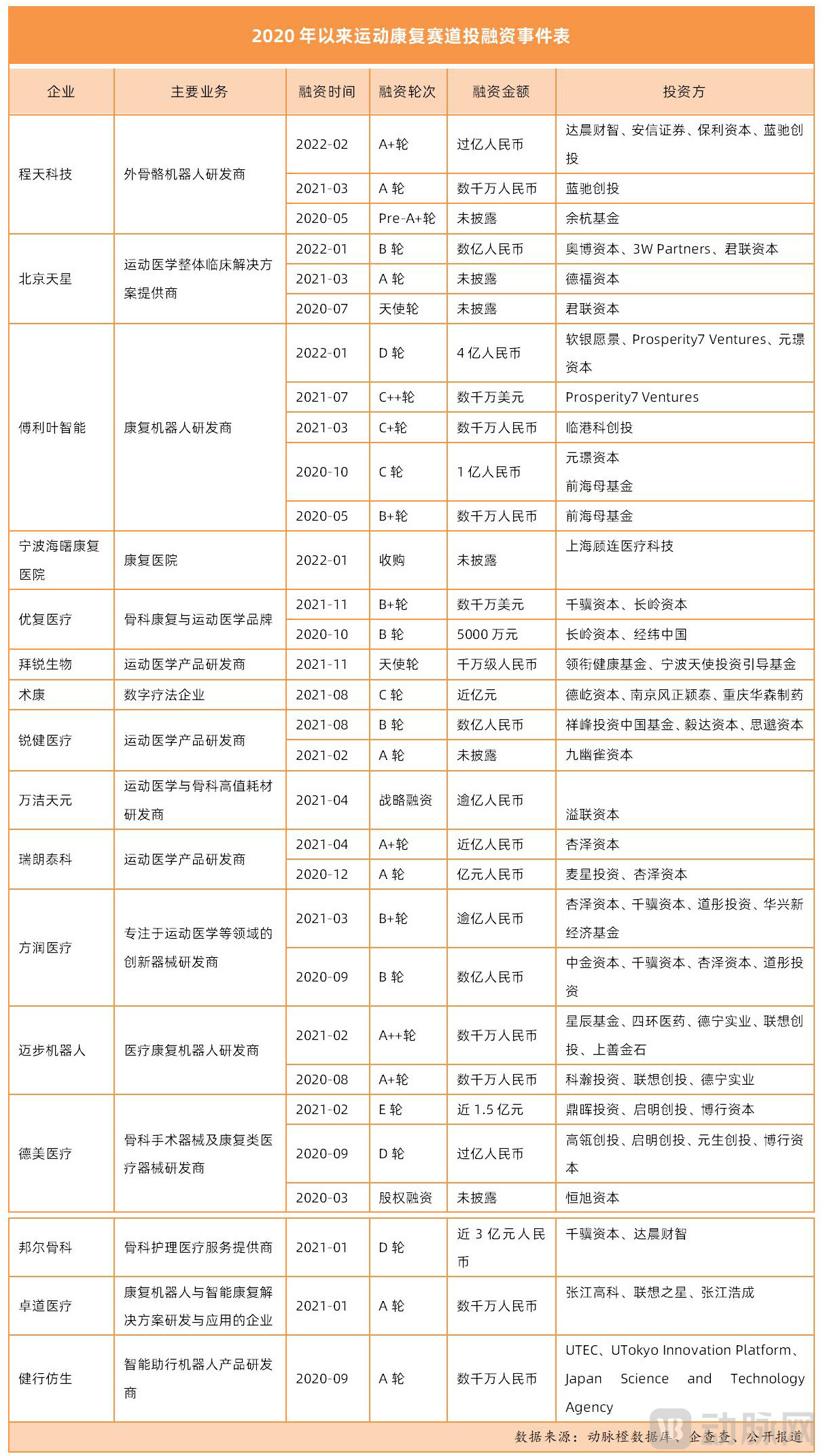
As can be seen, companies that secured more than two rounds of financing within approximately one year include Beijing Tianxing, Youfu Medical, Fangrun Medical, Ruijian Medical, and Ruilang Taike. In terms of financing frequency, the number of companies at Series B and Series C stages is gradually increasing, indicating that sports rehabilitation enterprises have begun to enter a phase of rapid development.
In terms of industry chain segmentation, the sports rehabilitation industry can be divided into the downstream service sector and the upstream sector for sports medicine consumables and equipment.
On the service provider side, the current landscape is characterized by strengthened responsibilities of rehabilitation departments in public hospitals, while private rehabilitation institutions are exhibiting diversified development.
“Although rehabilitation is not as urgent as acute-phase treatment, it should equally be regarded as an essential medical necessity. Acute-phase treatment addresses patients’ survival, whereas rehabilitation aims to improve their quality of life. Only by integrating treatment with rehabilitation can health be truly sustained in the long term,” Han Feng told VCBeat. “The level of rehabilitation development in a country generally reflects its degree of advancement, which is a key reason why China has placed significant emphasis on sports rehabilitation in recent years.”
Policy-level support for the development of the sports rehabilitation industry is being frequently articulated through official documents. For instance, in December 2021, the Hangzhou Municipal Health Commission and the Hangzhou Municipal Development and Reform Commission issued the “Notice on the 14th Five-Year Plan for Hangzhou’s Medical and Health Service System and the Configuration of Medical Institutions (Hangzhou Municipal Regional Health 14th Five-Year Plan),” which calls for prioritized support in constructing city- and district-level rehabilitation hospitals, promoting the transformation of select primary and secondary hospitals into rehabilitation hospitals, and requiring that each county (or county-level city) have at least one public county-level hospital equipped with a department of rehabilitation medicine.
In 2014, the State Council issued the “Several Opinions on Accelerating the Development of the Sports Industry and Promoting Sports Consumption,” which encouraged social capital to establish various institutions such as fitness and wellness centers, physical fitness assessment facilities, and sports rehabilitation clinics. This policy sparked a surge of professionals entering the field of establishing rehabilitation institutions.
“Under policy guidance, public hospitals are placing greater emphasis on their rehabilitation departments, while private-sector involvement has spurred the establishment of more institutions and provided users with a diverse array of rehabilitation service options,” said Han Feng. “This has afforded capital more choices among high-quality investment targets.”
In Han Feng's view,Investment in private specialized rehabilitation institutions primarily focuses on three key dimensions: the single-site profitability model, scalability for chain replication, and the construction of a closed-loop business model.“Standardization and chain operations can unlock greater commercial potential.”
Currently, 52% of sports rehabilitation clinics in China operate as independent single-store entities, with the remainder adopting a chain-store model. As of now, no large-scale national chain brands have emerged; the market is primarily dominated by regional enterprises focused on first- and second-tier cities, which are experiencing robust growth momentum.
For instance, U-Rehab Medical, which secured funding twice in a single year, has expanded from the trial operation of its first chain rehabilitation outpatient clinic in July 2018 to five clinics currently. It has also established Shanghai’s first rehabilitation medical center, with two additional centers under preparation. In terms of business layout, U-Rehab Medical launched its sub-brand, U-Rehab Stretching, last year and opened eight stretching studios within the first half-year, primarily located in core commercial districts of Shanghai.
Hongdao Sports Rehabilitation Clinic currently operates four clinics and Hongdao Rehabilitation Studios across multiple cities in China, primarily providing outpatient services, consultations, surgical procedures, and platelet-rich plasma (PRP) injections in the fields of orthopedics, sports medicine, and rehabilitation medicine.
Ranran Sports Rehabilitation has established seven sports rehabilitation centers and jointly founded a sports rehabilitation department in collaboration with Yiwu Puji Orthopedic Hospital. Its core services focus on sports injuries, knee pain, neck, shoulder and lower back pain, postural correction, post-orthopedic surgery rehabilitation, and physical conditioning.
“However, it is important to note that for sports rehabilitation companies, cross-regional expansion imposes high demands on talent acquisition and management. Therefore, a prudent, step-by-step approach is essential, with adequate preparation for long-term development."Han Feng stated that this process would subject enterprises to significant uncertainty, thus necessitating two measures to ensure their stable development."
First, adopt a differentiated positioning strategy to avoid involution and homogenization, strengthen the development of your talent pipeline, and maintain a strong brand image. Second, refrain from opening stores indiscriminately; ensure sufficient cash reserves to handle emergencies, improve capital efficiency, and maintain good relationships with potential institutional investors.
In the consumables and medical devices segment, the entire niche market remains dominated by imports due to high technological barriers and patent restrictions.
“International giants such as Smith & Nephew, Arthrex, Johnson & Johnson, and Stryker have long accounted for more than 90% of the domestic sports medicine market share,” said Han Feng. “Core medical device components related to sports medicine, along with original products in tissue engineering and regenerative medicine, are key areas of investor interest.”
For example, Ruilang Taike, which secured financing twice in a single year, focuses on the field of sports medicine. The company has completed its product portfolio in two key areas—shaver blades and low-temperature plasma radiofrequency—thereby achieving comprehensive coverage of consumables for sports medicine debridement procedures. Notably, several of its products, including the “Plasma Radiofrequency Electrode,” have obtained registration certificates from the National Medical Products Administration (NMPA).
Another example is Ruijian Medical, which has secured hundreds of millions in financing. Focusing on sports medicine products, the company has built an ecosystem encompassing independent R&D of base materials, product development, and industrialized production. It has currently obtained six Class III registration certificates and five Class II registration certificates from the National Medical Products Administration (NMPA), with 18 products certified under CE marking.
“The investment thesis for upstream sports medicine products focuses on three key indicators: first, the validation of clinical value; second, the progress of product approval; and third, the team’s sales and promotional capabilities."Han Feng stated, 'The subsequent sales of products will be a crucial factor determining whether such enterprises can rapidly break through.'"
As can be seen, an increasing number of industry participants are entering a period of rapid development, driven by supportive policies and capital infusion.
Following the Beijing Winter Olympics, the hosting of major events such as the Hangzhou Asian Games and the Chengdu Universiade will continue to drive the industry’s breakthrough into the mainstream, thereby accelerating its development. However, the industry still faces “three major obstacles” that must be overcome in this process.
The first major hurdle is the shortage of professional rehabilitation personnel.Since 2008, although many universities and sports colleges have successively established majors in sports rehabilitation, the number of professionals still fails to meet the rapidly growing market demand.
According to relevant statistical data, there are currently only 128 undergraduate programs in Rehabilitation Therapy and Sports Rehabilitation at Chinese universities. In comparison with the 219 programs in the United States and the 249 programs in Japan, China lags significantly behind.
Furthermore, master’s and doctoral education in this field is even more scarce in China. According to publicly available data, there are currently approximately 36,000 rehabilitation therapists with technical qualifications in China, resulting in a therapist density of only 0.026 per thousand population—a figure that lags significantly behind international standards. Therefore, the shortage of qualified professionals will be a major factor constraining the development of sports rehabilitation in China.
The Second Major Challenge: The Payer’s DilemmaCurrently, China's basic medical insurance has limited coverage in the rehabilitation sector, encompassing only more than 20 items. Among these, assessment-related items account for 40%, while therapeutic items account for 60%. Moreover, overall investment remains low and incentives are weak, resulting in substantially low reimbursement rates for rehabilitation services under the medical insurance system.
Specifically, China’s social health insurance covers only inpatient rehabilitation services, excluding outpatient care, and operates on a fee-for-service payment model. In the commercial insurance sector, although high-premium comprehensive medical insurance plans are available that cover rehabilitation costs at premium healthcare institutions such as United Family Healthcare, these products serve only a small segment of the population and lack broad applicability.
The third major challenge is that user awareness still needs to be continuously improved.The public’s lack of clear understanding of sports rehabilitation is the primary reason why such services have yet to gain widespread acceptance. In China, sports-related injuries are still not generally perceived as medical conditions, and the profession of certified sports rehabilitation therapist remains relatively obscure. When faced with the choice between “seeking medical treatment for an illness” and “restoring physical function,” most people still opt for the former.
“Many people believe that sports rehabilitation is only necessary for athletes or professional athletes, but this is a misconception,” Sun Xiaoyi, founder of Youfu Medical, told VCBeat.
For most people, the prevailing approach to injury management is “rest when injured; stopping will lead to recovery.” When individuals sustain sports-related injuries or experience discomfort, they typically do not seek treatment at professional rehabilitation facilities immediately. Instead, they either withdraw from activity altogether or wait until their condition improves before resuming participation, which often results in more severe consequences. “The root cause lies in the limited public understanding of the concepts and principles of sports rehabilitation. Greater efforts are needed to promote market awareness, so that the general population recognizes and acknowledges the existence and necessity of rehabilitative medical care,” stated Han Feng.
ThereforeFor domestic sports rehabilitation companies in China, there is still a long road ahead.. In this process, by staying true to our original aspirations and continuously accumulating expertise and deepening our engagement, we will ultimately reach the other shore as validated by time.
As stated in Xunzi, “The path is obstructed and long, yet those who press on will arrive; those who persevere without ceasing can look forward to a promising future.”