

Tailan Bio Completes Over 100,000 Pan-Cancer Screenings in Three Years with Proprietary Metabolomics Platform Validated in Nature Communications

TaiLai Biosciences
A New Generation Provider of Liquid Biopsy Products and Services
Among the many innovative companies offering early cancer screening products, TaiLai Biosciences stands out as a rather unique presence.
Pan-cancer, metabolomics, and mass screening: a strategy most companies would avoid due to its technical challenges, high barriers to entry, and lack of established models for reference. However, in the view of Liu Yaokun, Founder and CEO of TaiLai Biosciences, providing accessible pan-cancer early screening for the general public is an inherent imperative of tumor early detection.
Founded in 2018, this cancer screening and diagnostics company leveraged innovative laboratory technologies to achieve commercialization the following year. To date, it has completed pan-cancer screenings for over 100,000 individuals, becoming a vital tool for grassroots cancer prevention and control in Sichuan, Guangdong, Henan, and other provinces.
In early February, research findings based on TaiLai Biosciences’ technological platform were published in the prestigious international journal Nature Communications. This nearly three-year study, conducted collaboratively by researchers from TaiLai Biosciences, the National Engineering Research Center for Biomaterials at Sichuan University, Zhongshan Hospital affiliated with Fudan University, Wuhan University, and other institutions, validated the clinical value of TaiLai Biosciences’ Multi-Nanomaterial-Assisted Laser Desorption/Ionization (MNALDI) technology in the early diagnosis and classification of pan-cancer types.
Mass spectrometry, now gradually emerging as a cutting-edge technology, faces numerous challenges in its journey into clinical practice.
For instance, mass spectrometry is subject to significant matrix effects; if the matrix does not match the physicochemical properties of the analytes, such as molecular weight and spatial structure, the accuracy of test results can be severely compromised. “However, the clinical advantages of mass spectrometry are also evident,” pointed out Dr. Zhong Sheng, one of the authors of this article and head of product development at TaiLai Biosciences. “Taking the time-of-flight mass spectrometry we have selected as an example, it does not require complex sample pretreatment. The biomarkers detected are most directly correlated with human health status, and the technology offers higher throughput and lower costs, thereby meeting the requirements for rapid and accurate large-scale population-based cancer screening.”
After the technical platform was selected, the research team narrowed down the choice of mass spectrometry matrices to nanomaterials. Dr. Zhong Sheng told VCBeat that, compared with other types of matrices, nanomaterials exhibit strong signal capture capabilities in the detection of small-molecule metabolites, thereby yielding a higher detection signal-to-noise ratio.
“In this study, we employed two relatively feasible nanomechanistic materials,” Dr. Zhong Sheng recalled to VCBeat, reflecting on the extensive preparation involved in the research. He stated that the entire research team had previously devoted considerable effort to comprehensively analyzing the underlying technical principles, spatial structures, physical dimensions, and other multifaceted characteristics of a vast array of nanomaterials. By comparing these with the unique physicochemical properties of small-molecule metabolites, they ultimately selected two matrix materials capable of maximizing the enrichment and amplification of small-molecule metabolic signals in time-of-flight mass spectrometry.
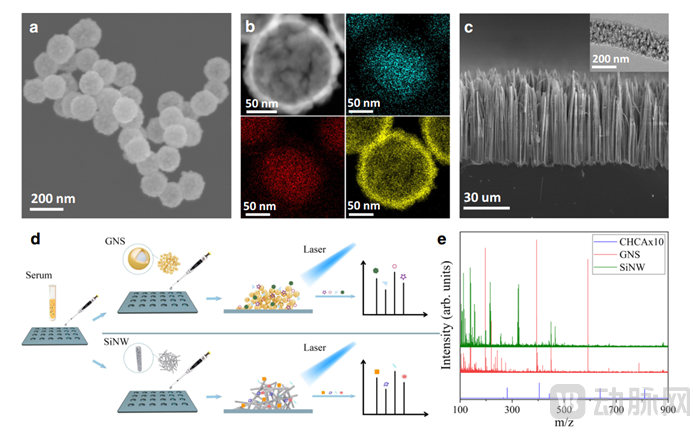
Two types of nanomatrix materials (Image source: Figure from the paper)
Prior to formally initiating the study for this paper, the research team had already collaborated with Zhongshan Hospital, Fudan University, to conduct a series of experiments over a six-month period. According to Dr. Zheng Jie, another author of this article, the team sought to combine untargeted mass spectrometry with machine learning to increase the probability of identifying biomarkers across multiple cancer types. By repeatedly optimizing the synergy among nano-matrix materials, sample pre-processing protocols, mass spectrometry instrument parameters, and machine learning algorithms, they ultimately obtained ideal data. Following the launch of this larger-scale study, they rapidly garnered support from experts at more than ten research institutions, including Fudan University, Sichuan University, and Wuhan University.
According to Dr. Zhong Sheng, the study was ultimately initiated by Professor Li Xiaoying of Zhongshan Hospital, Fudan University, and included serum samples from over a thousand patients with pathologically confirmed malignant tumors and healthy controls recruited from Zhongshan Hospital and the Affiliated Hospital of Anhui Medical University.
In the study, two types of customized nanomaterials with distinct morphologies, structures, and properties were applied to high-throughput time-of-flight mass spectrometry to capture and analyze signals from small-molecule metabolites. Combined with artificial intelligence and machine learning algorithms, this approach was used to detect malignant tumors in serum samples from patients and healthy individuals. The data indicate that this unique technique holds significant potential for the diagnosis and classification of six of the most common cancers: lung cancer, liver cancer, thyroid cancer, colorectal cancer, gastric cancer, and pancreatic cancer.
Specifically, at 93% specificity, the fusion model achieved an overall accuracy of 91% across various cancer classifications. Among different cancer types and control groups, hepatocellular carcinoma and pancreatic ductal adenocarcinoma showed the highest individual accuracies of 98%, while lung adenocarcinoma (non-small cell lung cancer) had the lowest individual accuracy of 83%.
In fact, validating the technical prototype is merely the first step in product development. For TaiLai Biosciences, significant challenges remain in scaling its multi-cancer early detection (MCED) screening product from the MNALCI stage to widespread adoption among over 100,000 individuals.
“First, the clinical application of mass spectrometry is not as mature as next-generation sequencing (NGS), and the corresponding metabolomics databases lag behind genomics databases by at least a decade in terms of maturity. Overall, there is a scarcity of metabolomics data in internationally authoritative databases,” said Dr. Zhong Sheng. “This necessitates that we establish our own metabolomics database tailored to Chinese cancer patients.” In clinical practice, the progression and development of tumors in each patient are highly complex and heterogeneous. Only by relying on real-world population-based databases can accurate assessments be made using precision technology platforms.
“Therefore, since its inception, TaiLai Biosciences has been committed to building a metabolomics clinical database covering a broad population and has introduced a professional data technology analysis team to implement refined management of collected sample resources. ‘On one hand, we continue to collect cancer patient samples adjudicated by clinical gold standards through multi-center collaborations across China; on the other hand, we increasingly gather real-world testing samples from various regions via our commercialized pan-cancer screening products, thereby enriching the database and iteratively optimizing our algorithmic models,’ stated Dr. Zhong Sheng.”
It is reported that since the formal launch of clinical research in 2017, TaiLai Biosciences has collected over 20,000 cases from multi-center clinical cohorts across top-tier Grade A tertiary hospitals nationwide, including Zhongshan Hospital Fudan University, Ruijin Hospital Shanghai Jiao Tong University School of Medicine, National Cancer Center/Cancer Hospital Chinese Academy of Medical Sciences, West China Hospital Sichuan University, Zhongnan Hospital Wuhan University, Union Hospital Tongji Medical College Huazhong University of Science and Technology, Harbin Medical University Cancer Hospital, and Sun Yat-sen University Cancer Center, thereby establishing the earliest retrospective study database.
With the commercialization and promotion of its pan-cancer screening products, TaiLai Biosciences’ database has been undergoing continuous and rapid updates. According to Dr. Zheng Jie, who is primarily responsible for data science, the company’s database currently contains more than 100,000 samples as of press time, including nearly 40,000 research samples and over 60,000 real-world commercial testing samples. “As our sample size continues to grow, we have also conducted in-depth mining of these massive metabolomics datasets, establishing the largest tumor metabolomics database for the Chinese population in China to date,” said Dr. Zheng.
According to Dr. Zhong Sheng, although research on tumors has been conducted for decades, increasing studies have further revealed the complexity of tumor mechanisms. “There is hardly any method that can achieve multidimensional management of tumor screening, diagnosis, and monitoring.” Therefore, at the pan-cancer level, TaiLai Biosciences is committed to optimizing universal cancer screening to provide accessible and reliable evidence for precise cancer prevention and control in a broad population.
As pan-cancer screening products and metabolomics databases continue to be iterated, TaiLai Biosciences is attempting to integrate additional omics data to enhance diagnostic accuracy. “We are conducting multi-omics cancer screening research, combining metabolomics with epigenomics, radiomics, and other fields to achieve complementary capture of multi-omics signals,” Dr. Zheng Jie told VCBeat. “Currently, our preliminary studies on the differential diagnosis of benign and malignant pulmonary nodules have also yielded promising model performance.”
In mid-2021, the time-of-flight mass spectrometer jointly developed by TaiLai Biosciences and Professor He Jian of Xiamen University obtained certification for instrument registration testing. Six months later, TaiLai Biosciences completed the clinical registration application for the mass spectrometer; once approved, it will be deployed in broader pan-cancer screening applications. In their progression from 1 to N, they also chose to move upstream.
When asked why they independently developed the mass spectrometer, Dr. Zhong Sheng candidly stated that it was primarily driven by demand.
"As a mature application tool in fields such as scientific research, industry, and agriculture, its design typically covers a very wide range of detectable substances. 'General-purpose instruments span from biochemical small molecules with molecular weights in the tens to peptides, proteins, and nucleic acids with molecular weights in the thousands. However, what we truly need is enhanced detection capability specifically focused on the vertical dimension of small molecules,' stated Dr. Zhong Sheng. 'With the rapid surge in sample volumes for pan-cancer universal screening, it is necessary to upgrade and iterate existing market products to specifically address the needs of tumor screening.'"
After repeated communications with global leading mass spectrometry brands such as Bruker and Shimadzu, TaiLai Biosciences chose the path of independent research and development with localized production. “On one hand, overseas manufacturers are imposing increasingly strict restrictions on technology transfer, making subsequent performance upgrades more cumbersome,” said Dr. Zhong Sheng. “On the other hand, non-localization leads to high communication and maintenance costs, as well as prolonged cycles. We believe that to truly achieve pan-cancer universal screening, we must resolve the ‘chokehold’ issue concerning upstream instruments.”
Under the guidance of Professor He Jian from Xiamen University, TaiLai Biosciences developed China’s first domestically produced biochemical small-molecule mass spectrometer by refining customization requirements for multiple core internal components based on practical needs. Consequently, the sample model for pan-cancer universal screening was transitioned from overseas technical platforms to an independent domestic platform. During this process, TaiLai Biosciences conducted head-to-head comparative trials on thousands of samples across different instrument platforms to ensure consistency in data and reporting results.
At this point, starting from a series of innovative technologies born in the laboratory, TaiLai Biosciences has completed the construction of a commercialization system for pan-cancer universal screening, covering instruments, reagents (IVD), and testing services (LDT). “We have basically achieved the goal of turning more precise early pan-cancer screening into a widespread service similar to routine health checkups,” said Liu Yaokun. “In the future, we will continue to improve our product pipeline for cancer prevention and control.” It is understood that TaiLai Biosciences’ diagnostic product for differentiating between benign and malignant pulmonary nodules is also undergoing extensive clinical research and has completed the development of commercial applications for LDT testing services.
Admittedly, understanding tumors remains a highly complex proposition. However, driven by rapid technological advancements and the growing efforts of specialized teams, we are confident that they are gradually becoming preventable and controllable.