

How Haomeng Tech Is Transforming Mental Health Services Through Technology: From Screening to Scalable Solutions
Over the past year, China’s mental health industry has shone brightly, with an increasing number of innovative mental health service models gradually entering the market. Among these, technology-enabled mental health services have gained significant market recognition.
Behind this lies the ever-rising demand for mental health services, driving the rapid development of the mental health industry. Taking depression as an example, data from the World Health Organization shows that more than 350 million people worldwide suffer from depression, with the number of patients increasing by approximately 18% over the past decade. Currently, China has a population of 180 million individuals with depressive symptoms, among whom 95 million have been diagnosed with depression.
Meanwhile, guided by policy, public awareness and acceptance of mental health have been steadily increasing, ushering the industry into a new phase of development. For the numerous innovative companies in the sector, this presents both opportunities and challenges.
It remains a challenge because China’s mental health industry is still in its early stages of development, with numerous dilemmas urgently requiring resolution.
According to Song Jinliang, founder of Zhejiang Haomeng Technology Co., Ltd. (hereinafter referred to as “Haomeng Technology”), the mental health industry faces three major challenges: first, the difficulty in identifying high-quality service providers; second, the scarcity of standardized services; and third, the challenge of achieving dynamic monitoring of patients’ conditions. Technological approaches offer an effective solution to these difficulties.

Song Jinliang, Founder of Haomeng Technology
Transformation, Tech-Enabled
Song Jinliang, who began his career in television media, has a decade of experience in the communications industry. It was during this ten-year period that he repeatedly encountered social cases involving adolescent misconduct, gradually recognizing the core issues of family education and adolescent mental health in youth development.
Affected by this, in 2013, Song Jinliang left the media industry, where he had been deeply rooted for many years, and began to offer lectures and popular science content related to psychology. Considering the public’s insufficient understanding and misconceptions about psychological issues at that time, Song Jinliang and his team initially focused on reaching users by integrating mental health services and content with offline activities such as parent-child events and summer camps, thereby enhancing public acceptance of mental health services.
By 2018, over the preceding five years, Song Jinliang and his team had continuously expanded their offline reach and coverage, signing up nearly 3,000 psychological counselors and directly serving approximately 30,000 end users.
Although the business had achieved notable results, Song Jinliang believed at the time that despite possessing large-scale service resources, the offline one-on-one service model yielded unsatisfactory efficiency, and there was significant room for improvement in resource implementation. Furthermore, the difficulty in ensuring standardization and service quality during the delivery process—indicating a need to strengthen service standardization—placed certain constraints on the scalable expansion of the business.
Driven by a confluence of factors, Song Jinliang and his team decided to pursue the technological transformation of mental health services through technology-enabled solutions, officially establishing Haomeng Technology in 2018. To safeguard the research and development of related technologies and products, Haomeng Technology has built dedicated teams specializing in artificial intelligence, big data, and communication engineering. Additionally, it has formed an expert advisory board in collaboration with specialists from the Chinese Academy of Sciences and multiple universities, thereby facilitating the efficient integration of technology and mental health services.
Deepening Expertise, Entering the Front End, Serving Multiple Stakeholders
With sound ideas and the accumulation of service experience over the past few years, integrating technology with services has become a top priority.
To ensure the smooth implementation of technology-driven initiatives, Haomeng Technology has addressed industry challenges such as difficulties in service supply, low levels of standardization, and the complexity of dynamic monitoring for mental health issues. The company has chosen to first leverage technological solutions to tackle the challenges of monitoring and matching at the front end of mental health services. To this end, it has independently developed a suite of assessment applications, including multiple psychological application system platforms such as the Family Education and Psychological Observation Assessment Application System and the Intelligent Psychological Sensing and Early Warning System. Underpinning these efforts is Haomeng Technology’s core psychological analysis technology.
Specifically, leveraging sample data accumulated over several years of service delivery and integrating tens of thousands of medical records from hospitals for algorithm design and technical development, Haomeng Technology has established two core technologies: contact-based psychological intelligent analysis and non-contact psychological intelligent analysis. These technologies enable the quantitative assessment of psychological states by analyzing contact-collected physiological signals, such as heart rate variability (HRV), and non-contact-collected data, including microexpressions and body language.
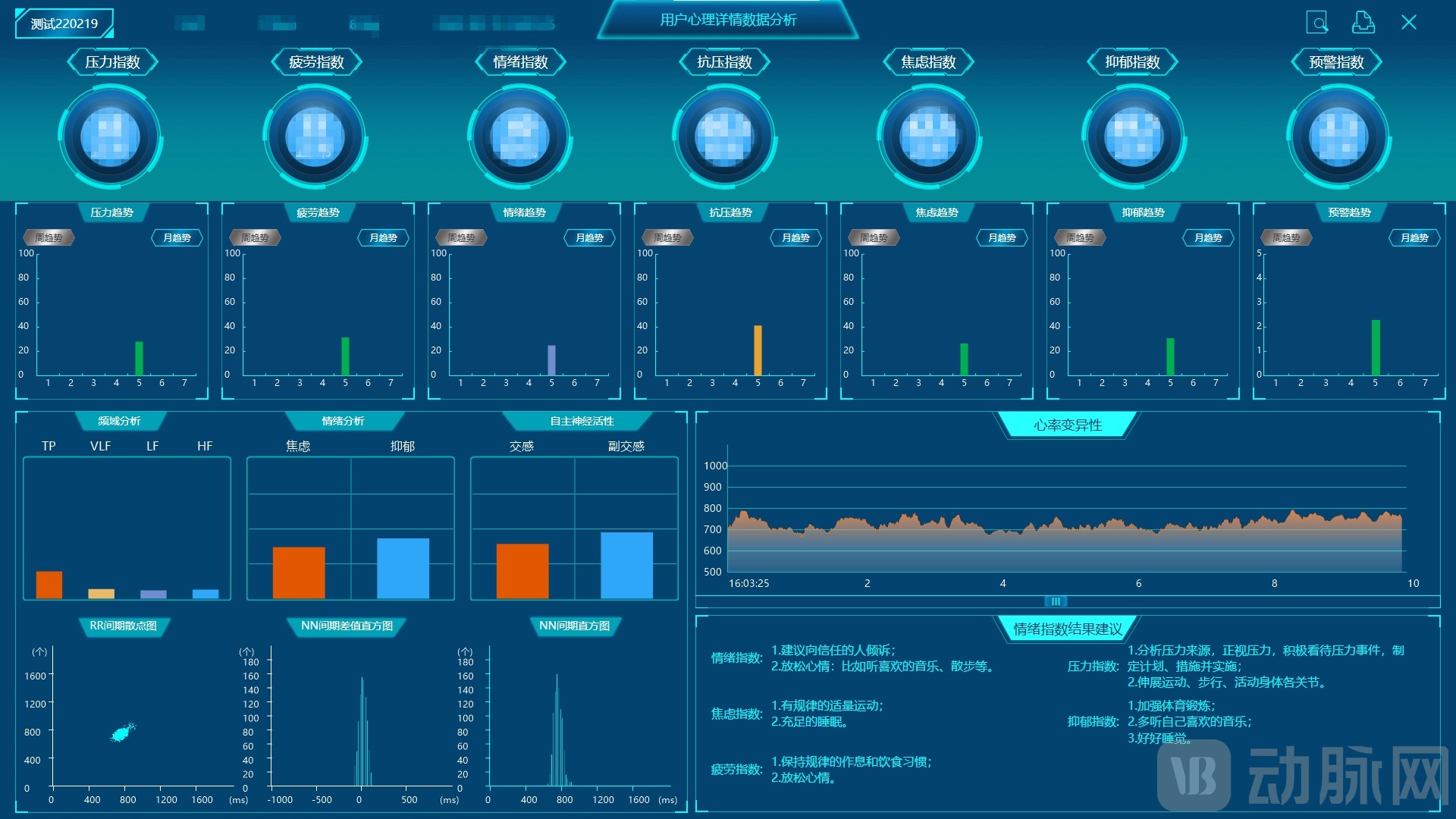
User Psychological Details Data Analysis Interface
It is reported that, leveraging these two core technologies, Haomeng Technology has generated revenue from its tech products since their official market launch in May last year that is several times higher than the revenue previously generated by its offline psychological services, all within less than a year. The products have also been widely acclaimed by customers.
In terms of specific applications, Haomeng Technology fully demonstrates its diversified characteristics, with its service scope covering multiple scenarios including government, enterprise, and individual consumer sectors.
For government clients, Haomeng Technology provides mental health check-ups and screening services to systems including the military, judiciary, public security, and education sectors, thereby fully safeguarding the mental well-being of diverse stakeholders within these systems.
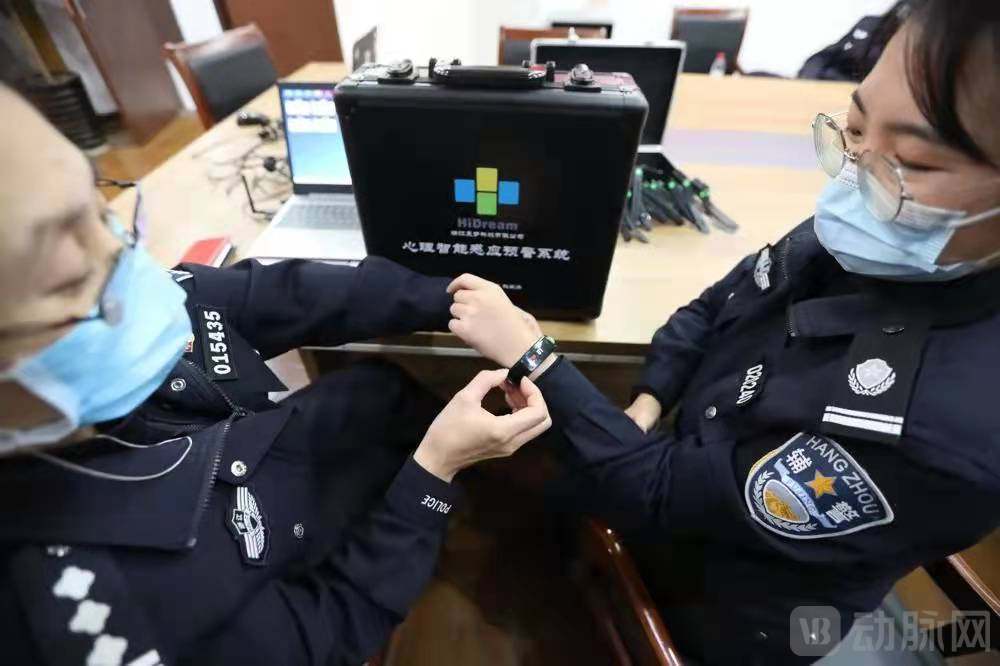
For the enterprise segment, Haomeng Technology places greater emphasis on its enablement capabilities, providing mental health value-added services to corporate clients such as health management companies, physical examination institutions, and human resources firms.
Taking enterprise clients in the mental health industry as an example, and considering the substantial demand among most psychological service institutions and practitioners for auxiliary tools, Haomeng Technology has developed a SaaS tool designed for industry professionals. This tool assists in screening and detecting clients’ psychological states and evaluating the effectiveness of psychological services. Through this approach, service providers can significantly improve operational efficiency, reduce costs, address the issue of inaccurate client assessments to a certain extent, and achieve dynamic monitoring of clients’ status throughout the service process.
Finally, for individual consumers, Haomeng Technology offers a range of services, including self-directed learning through psychology courses, self-assessment of psychological status, and precisely matched psychological support services, helping users access scientifically grounded mental health resources while minimizing trial-and-error costs.
Overall, empowered by technological advancements, Haomeng Technology places greater emphasis on its role in enabling various stakeholders within the industry. Frequent and extensive industry collaborations also constitute a key strategic focus in Haomeng Technology’s development.
Steady Progress: Lowering the Barrier to Accessing Services
Currently, China’s mental health industry has undoubtedly entered a phase of rapid development, with public awareness, investor confidence, and policy attention all reaching a new peak.
However, in Song Jinliang’s view, the industry still has significant room for improvement, such as the slow development of theoretical foundations and the lack of industry standards. Therefore, given the current trajectory of industry development, Haomeng Technology, as a participant in the sector, will maintain a clear understanding of its position within the entire industrial chain, steadily strengthen its core competencies, and proactively engage with professional research institutions in the field to jointly advance the development of industry standards.
In this process, Haomeng Technology will remain closely aligned with market demands, continuously expanding and implementing its technologies and product features. Meanwhile, it will enhance the inclusivity of its services by lowering barriers to access, thereby extending high-quality mental health services to a broader population.
To achieve the aforementioned objectives, Haomeng Technology will strengthen the recruitment and development of interdisciplinary talent teams with expertise in both technology and psychology. Meanwhile, the company seeks to collaborate with like-minded investors to jointly drive industry growth.