

Six Digital Health Companies Secure Two Rounds of Funding Within a Year: Is the Industry Breaking Through?
Internet healthcare has traversed a decade, giving rise to a cohort of leading enterprises and witnessing extensive innovative initiatives and explorations of business models. Although these endeavors have yet to yield large-scale profitability, they have not deterred new entrants, particularly as capital from various sources continues to flow into the sector.
Among comprehensive internet healthcare platforms, after experiencing their peak during the pandemic, Yuanxin Technology, WeDoctor, and Dingdang Kuaiyao secured financing in 2021, with Yuanxin Technology completing two rounds of funding.Of course, comprehensive platforms typically have a “starting price” of RMB 500 million or USD 100 million per financing round, with some reaching tens of billions, overall characterized by high amounts and low frequency. In contrast, niche or small- and medium-sized platforms are more active in financing, but due to their smaller business scale, the amount per financing round is lower.
Previously, we have continuously tracked and analyzed several large comprehensive platforms. To gain a more comprehensive understanding of the industry landscape, we have identified and analyzed a cohort of small and medium-sized platforms, using a single financing round of less than RMB 500 million as the criterion.
Since 2021, there have been a total of 26 small- and medium-sized financing rounds, involving 21 companies and 49 investment institutions. Among them, five companies secured two rounds of financing within a single year;Among the investment firms, there are still many star institutions such as Northern Light Venture Capital, Qiming Venture Partners, and Matrix Partners China.
Most of these companies secured individual funding rounds in the range of tens to hundreds of millions of yuan, with the total amount for the 26 deals reaching RMB 1.95 billion—equivalent only to a single fundraising round for some major platforms. In terms of financing activity and scale, internet healthcare appears to be crafting a “small but beautiful” narrative.
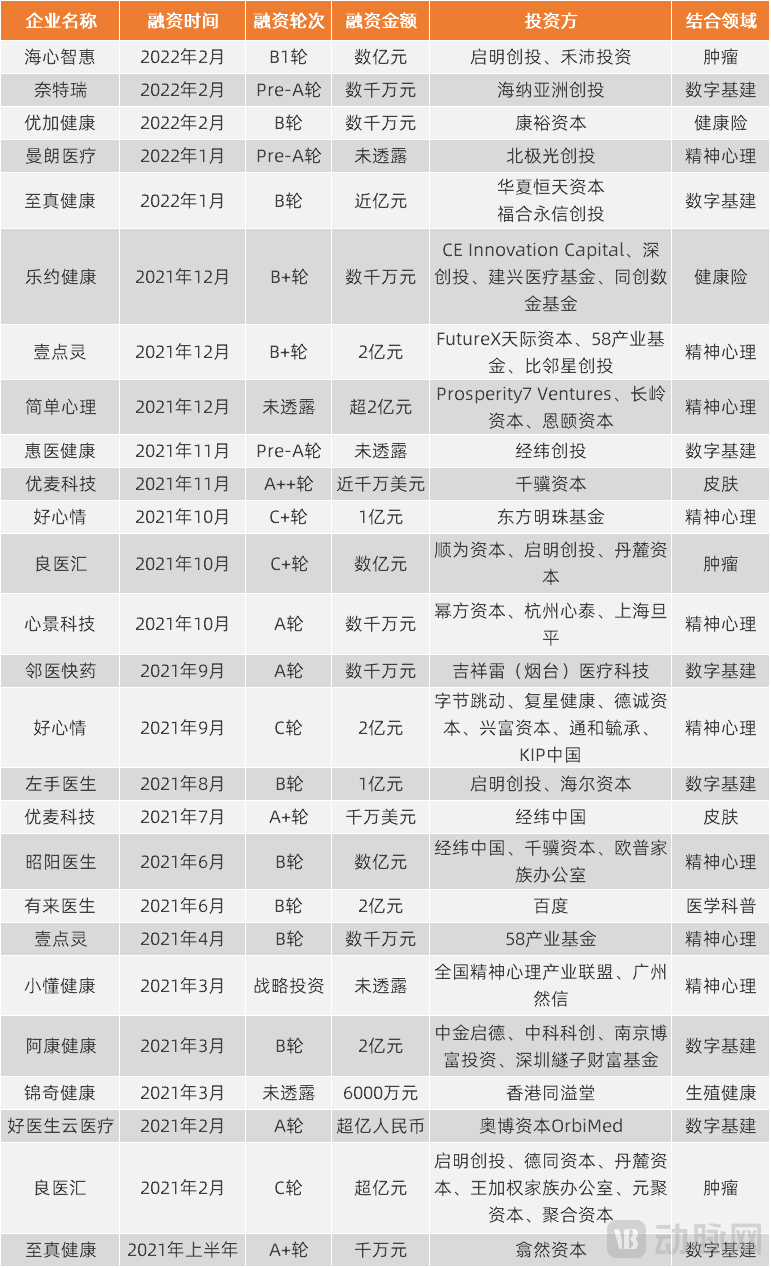
“Small- and Medium-Sized” Financing Rounds in the Internet Healthcare Sector Since 2021 (Statistics Based on Technology Companies Deploying in Internet Healthcare), Source: Arterial Orange, Chart by VCBeat
Most leading internet healthcare companies have established comprehensive layouts across medical care, pharmaceuticals, insurance services, and technical services. Covering a wide range of specialties and disease types, these platforms are predominantly comprehensive in nature.
Small and medium-sized platforms that secured financing in the past year have primarily focused on niche market segmentation, either concentrating on specific segments within healthcare, pharmaceuticals, insurance, or technical services, or building integrated medical-to-pharmaceutical service ecosystems within particular specialty areas. Overall, the 21 companies can be categorized into four groups: specialty care services, digital infrastructure, health insurance, and medical science popularization; among these, specialty care services and digital infrastructure account for the largest number of companies.
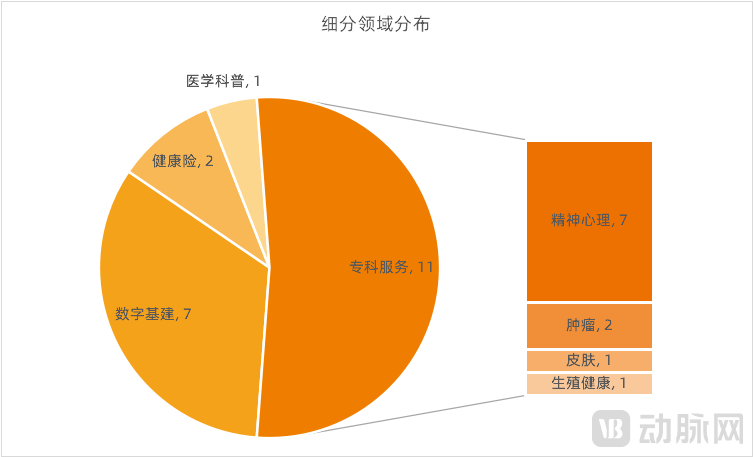
Sub-sectors of the 21 companies that secured financing. Source: Public reports; graphic by VCBeat
In terms of specialized services, the focus is primarily on specialties with long disease courses or those well-suited for online follow-up consultations, such as psychiatry and psychology, and oncology.
In the mental health sector, Haixinqing and Yidianling each secured two rounds of financing in 2021. Haixinqing’s Series C and Series C+ rounds were completed just one month apart, bringing its total funding to RMB 300 million. Currently, Haixinqing has established a service network comprising an online diagnosis and treatment platform, offline psychiatric hospitals, and psychological clinics. The company plans to increase investment in business expansion, intelligent supply chain development, the rollout of a chain of offline psychological clinics, AI product R&D, and public education on psychiatric and psychological medicine. Yidianling has expanded from its previous focus on mental wellness services into comprehensive mental health medical services, entering the internet healthcare space in 2021.
In addition, several companies active in the internet healthcare sector—Manlang Medical, Jiandan Xinli (Simple Psychology), Xinjing Technology, Zhaoyang Doctor, and Xiaodong Health—have also completed new rounds of financing. The surge in funding underscores investors’ positive outlook on the mental health and psychological care sector.
In the oncology sector, Liangyi Hui completed its Series C and Series C+ financing rounds within a single year. Haixin Zhihui’s Series B1 round in 2022 came just over a year after its previous funding round, with the two rounds raising a combined total of RMB 400 million. Seizing the abundant innovation opportunities in oncology and addressing the pain point of inefficient, fragmented care for cancer patients, both companies are exploring digitally enabled models for diagnosis, treatment, and disease management, while also providing services to physicians and pharmaceutical companies.
In terms of digital infrastructure, this article primarily refers to the provision of technology and related resource services centered around internet-based healthcare, which also exhibits significant segmentation characteristics.
Left Hand Doctor has been continuously developing and validating the application of AI across various stages of the clinical workflow, offering a range of solutions including speech-to-text translation robots, intelligent online consultations, intelligent post-consultation management, intelligent pharmaceutical care management, and AI-powered internet hospitals.
Haoyisheng Cloud Healthcare is positioned in primary care, establishing an internet-based diagnosis and treatment service platform that integrates IT technology development, cloud-based laboratory testing, training and deployment of medical and nursing assistants, specialized therapies, pharmaceutical e-commerce, online consultations, and medical education.
Zhizhen Health specializes in eye health. Its in-hospital clinical medical product line includes integrated in-hospital diagnostic and referral services, as well as a Medical Consortium Health Service Platform, which respectively integrate resources from internal hospital departments and external healthcare service providers. Its out-of-hospital health management product line offers one-stop health assessment solutions to empower users with self-testing capabilities.
In the health insurance sector, Leyue Health and Youjia Health both leverage health insurance as their entry point, integrating with internet healthcare to establish a streamlined service workflow from medical care to direct billing. This approach breaks down information silos between healthcare providers and commercial insurers, delivers a superior patient experience for hospitals, and creates value for all stakeholders.
Clearly, among the 21 companies, there are hardly any “all-rounders” left; instead, “specialists with multiple capabilities” are more favored. Segmentation, and even further sub-segmentation, is the model preferred by capital.
A review of the latest developments at 21 companies reveals that most have either already obtained medical device registration certificates or licenses to operate internet hospitals, or are in the process of securing these credentials, making regulatory approval a key focus.
Entering the Digital Therapeutics Threshold with a Medical Device Registration Certificate
Over the past year, the fervor surrounding digital therapeutics has fueled companies’ enthusiasm for obtaining regulatory approvals.
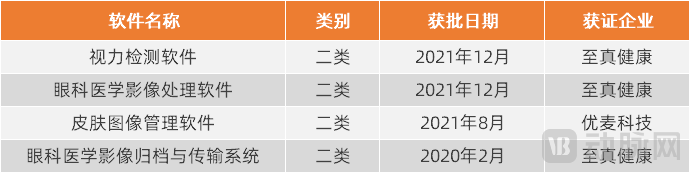
Medical Device Registration Certificates Obtained by Internet Healthcare Companies. Source: NMPA Medical Device Database; Graphic by VCBeat
Between the two financing rounds completed in 2021, Umai Technology’s skin image management software (USKIN-001), jointly developed with the CSID expert team, obtained a Class II Medical Device Certificate. In the field of dermatology, Umai Technology strives to establish an end-to-end pathway encompassing clinical data collection, patient–physician education, market promotion, diagnosis and treatment services, and disease-specific course management. The skin image management software is built upon the Chinese Population Skin Imaging Resource Library and leverages internet technologies to facilitate the flow of imaging data, bridge “information silos,” and maximize the efficiency of medical resource utilization.
Zhizhen Health has obtained three Class II medical device certifications. The company will continue to intensify its R&D efforts in intelligent products, optimize and upgrade the core capabilities of its AI algorithms, expand the clinical application of its integrated AI hardware-software solutions in tertiary hospitals and primary healthcare institutions, and accelerate deployment in scenarios such as education, insurance, elderly care, and chronic disease management.
Xinjing Technology has leveraged its 22 virtual reality clinical application R&D centers to apply VR/AR, AI, and other technologies in the fields of psychological rehabilitation, cognitive rehabilitation, attention training for children, and substance dependence withdrawal, thereby exploring VR-based digital therapeutics. In 2021, alongside securing tens of millions of yuan in Series A financing, Xinjing Technology also received strategic support from Tigermed and Sunyard, which will accelerate the clinical registration of its digital therapeutic products.
According to the Medical Device Catalog Classification, medical software is categorized into treatment planning software, data processing software, decision support software, in vitro diagnostic (IVD) software, and other software including rehabilitation training software. Digital therapeutics (DTx) products are classified accordingly and apply for registration certificates with reference to international development pathways. Approval by the National Medical Products Administration (NMPA) signifies that a product has been recognized for its safety and efficacy at the application level. Compared with mere business model innovations whose effects are difficult to demonstrate directly, this regulatory endorsement is more tangible and visible, thereby becoming one of the benchmarks for assessing a company’s strength.
Securing an Internet Hospital License to Fully Connect Doctors and Patients
Doctors, hospitals, patients, pharmaceuticals, and medical devices have always been the key elements constituting internet healthcare. The entity that fully connects these elements is the internet hospital. Therefore, obtaining the “license” for an internet hospital has also encouraged enterprises to actively invest in this sector.
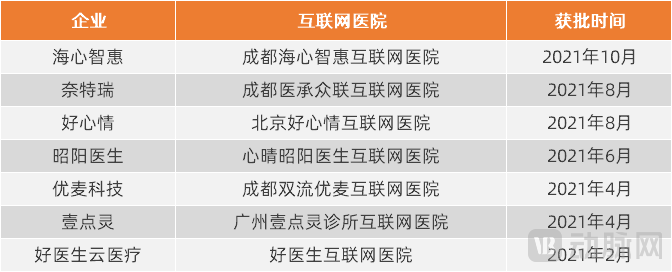
Companies Approved for Internet Hospital Licenses in 2021. Source: Official Website of the National Health Commission; Chart by VCBeat.
Among the 21 companies, in addition to those already holding internet hospital licenses, seven companies—including Haoyisheng Cloud Healthcare, Yidianling, and Umai Technology—obtained practice permits for internet hospitals in 2021. Xinjing Technology and Jiandan Xinli both plan to advance the establishment of their internet hospitals after completing financing rounds. Data from Qichacha shows that Xinjing Technology established Chengdu Shuangliu Xinjing Internet Hospital Co., Ltd. in December 2021, indicating that its construction efforts are being accelerated.
For companies, when business involves direct doctor-patient interactions, internet hospitals can supplement the diagnosis and treatment process, provide compliant prescription channels, and avoid issues arising from incomplete qualifications that make it difficult to distinguish between medical and non-medical activities.
Jiandan Xinli and Yidianling initially started with online psychological counseling. After several years of development, they gradually expanded from online to offline services, extending from psychological counseling to psychiatric diagnosis and treatment. The establishment of internet hospitals is a strategic move to complement their online diagnostic and treatment capabilities.
UMed Technology and Xinjing Technology focus on the research and development of digital therapeutics, with the future goal of utilizing digital therapeutic products as means for disease treatment and management. These products are prescribed or ordered by physicians and implemented by patients through software and hardware solutions. As this process involves prescriptions and medical orders—core functions of internet hospitals—obtaining the necessary licenses is particularly critical.
How to Measure the Value of Internet Healthcare Companies Before Achieving Scalable Profitability?Internet hospitals serve as the fundamental platform for service delivery, enabling the compliant aggregation of physicians, patients, and other resources. The acquisition of medical device registration certificates reflects a company’s technological R&D capabilities and the application value of its products. In this context, “obtaining certification” has become virtually mandatory for small and medium-sized internet healthcare enterprises, serving as two critical factors in their valuation.
Star institutions and ample capital are indispensable to industry development; currently, resource injection also plays a pivotal role. In this “two-way commitment” of investment and financing, the alignment between enterprises and industrial investors is becoming increasingly strong.
Based on the financing events reviewed in this article, the industrial synergy between investors and enterprises is primarily manifested in three areas: traffic synergy, upstream-downstream synergy, and service-payment synergy. Investors bring to the industry resources that are difficult to accumulate in the short term and hard to replace quickly.
Traffic synergy is the most common approach.
In June 2021, Youlai Doctor received investment from Baidu, continuously increasing its investment in the creation of popular science content by doctors. It focused on advancing technological upgrades, content enhancements, and service improvements, thereby continuing to lead the development of the health popularization industry. Meanwhile, Baidu further deepened its layout in the vertical sector of “medical healthcare,” enhancing its physician operational capabilities and intensifying innovation in diversified health services such as short videos and live streaming, aiming to secure a dominant position at the traffic source of the healthcare industry.
Among investors with a positive outlook, ByteDance can drive online traffic to Haixinqing. In its Series C+ round, Haixinqing introduced Oriental Pearl Fund, an equity investment fund jointly established by Oriental Pearl New Media Co., Ltd. and third-party market participants, focusing primarily on mid- to late-stage investments. Following this round of financing, Haixinqing will fully leverage the media group resources of the Oriental Pearl Industrial Fund to extend its mental health science popularization and education efforts, as well as its remote psychological and medical health services, from smartphones to large-screen home televisions.
Upstream and downstream collaboration helps improve both parties' products and services.
After Haier Capital invested in Zuoshou Doctor, it integrated resources from the internet hospitals under Yingkang Yisheng. Yingkang Yisheng is an ecosystem brand incubated by Haier Group in the big health sector, owning multiple physical hospitals and internet hospitals reliant on these physical facilities, which can serve as a practical platform for Zuoshou Doctor. By incorporating Zuoshou Doctor’s AI technology, Yingkang Yisheng can leverage its core competencies in technology-driven solutions, smart healthcare, big data, and integrated online-offline services to better serve patients and enhance their experience.
Tong Yi Tang, a traditional Chinese medicine pharmaceutical company based in Hong Kong, can leverage its respective strengths in professional expertise, resource channels, and brand image after investing in Jinqi Health, thereby promoting resource sharing and business synergy in the field of reproductive health.
The coordination between services and payment holds crucial exploratory value.
In HaoXinqing’s Series C financing round, Fosun Health was one of the investors. The health insurance segment under Fosun Health can create synergies with the services provided by HaoXinqing. Together, the two parties can build an integrated online-offline, full-course medical solution specializing in psychiatry and psychology, and jointly explore innovative products in the areas of innovative payment and insurance services.
Previously, an underdeveloped payment system has been a major obstacle to the sustained development of internet healthcare. Although various attempts have been made within the industry, a sustainable model has yet to be established. Among comprehensive platforms, Ping An Health has created synergies with insurance products from the Ping An group; WeDoctor has introduced investment from AIA Insurance to strategically integrate internet healthcare with commercial health insurance. The exploratory efforts by small and medium-sized platforms are also of significant importance.
Industrial investment brings not only capital but also resources; for small platforms, the combination of capital and resources holds more practical value.
According to incomplete statistics from VCBeat, more than 110 internet hospitals applied for by enterprises have been approved since 2021. Data from Qichacha shows that 694 companies named “Internet Hospital” were established since 2021, while 28 companies were deregistered or had their registrations revoked.
One after another, the momentum never ceases. The path to IPO for large-scale platforms is fraught with uncertainty, while small and medium-sized platforms continue to emerge. After receiving frequent injections of capital and resources, can “small but beautiful” internet healthcare players become a new force in the industry? This will depend on their ability to deliver greater user value.