

Optogenetic Regulation of Parathyroid Hormone Secretion: A Clinical Translation Breakthrough in Neuroendocrinology
On February 9, 2022 (Beijing Time), the research team led by Yang Fan from the Institute of Brain Cognition and Brain Disorders, Shenzhen Institutes of Advanced Technology, Chinese Academy of Sciences, and the Shenzhen-Hong Kong Institute of Brain Science–Shenzhen Fundamental Research Institutions, published their latest findings entitled “An optogenetic approach for regulating human parathyroid hormone secretion” in the journal Nature Communications.
The research team innovativelyApplication of optogenetic technology to regulate parathyroid hormone (PTH) secretion, intervening in bone loss induced by secondary hyperparathyroidism through precise rhythmic modulation of PTH release。This study expands the application of optogenetic techniques in bone and endocrine research, providing a scientific basis for advancing the clinical translation of optogenetics.
It took the team led by Yang Fan at the Shenzhen Institute of Advanced Technology five years to translate an innovative idea into tangible research outcomes. However,Behind this team, which has achieved significant breakthroughs, lies its success in overcoming challenges such as integrating members from diverse fields, addressing critical clinical bottlenecks, and maintaining frequent communication with clinical practitioners.
So, how can concepts in academic papers be transformed into research outcomes that are truly applicable in clinical practice? How can the “vibrant source” of the scientific research community be unleashed? Many questions that require scientists and entrepreneurs to engage in upfront thinking have become increasingly important.
On this occasion, VCBeat Chengguo Bureau andResearcher Yang Fan, Institute of Brain Cognition and Brain Diseases, Shenzhen Institute of Advanced Technology, Chinese Academy of SciencesEngaged in a dialogue and sought to derive answers from it, aiming to provide insights for the industry.
Where Do Clever Ideas Come From?
In Yang Fan's eyes,Scientific innovation forms a closed loop: it begins with clinical questions, proceeds through systematic basic research breakthroughs, and ultimately returns to clinical practice.
The inspiration for this project stemmed from a collaborative exchange between the Shenzhen Institutes of Advanced Technology, Chinese Academy of Sciences, and Shenzhen People’s Hospital several years ago.The collaborative model integrating basic research with clinical needs has enabled the research team to identify critical bottlenecks in clinical medical care.Currently, treatments for hyperparathyroidism, including parathyroidectomy and calcimimetics, fail to precisely and rhythmically regulate PTH secretion, thereby preventing the full realization of physiological PTH regulation in the body.
AlthoughResearch Focus of Yang Fan’s Team at the Shenzhen Institute of Advanced TechnologyThe mechanism involves deciphering how the central nervous system regulates bone metabolism, whereas optogenetics initially addressed neuroscience questions such as modulating neural circuits and intervening in behaviors. However, driven by the clinical challenge of precisely regulating parathyroid hormone (PTH), the research team decided to proceed from basic research and attempt to use optogenetic methods to achieve precise control over PTH secretion.
After conducting a series of experiments, the team ultimately achieved research results.Discovery that optogenetic regulation of PTH enables precise intervention in parathyroid hormone secretion, alleviating bone loss symptoms in animal models of hyperparathyroidism.The project has ultimately transformed from an idea into a tangible outcome, returning to the clinical setting to provide new insights and approaches for the next step of clinical intervention in bone loss caused by excessive PTH secretion.
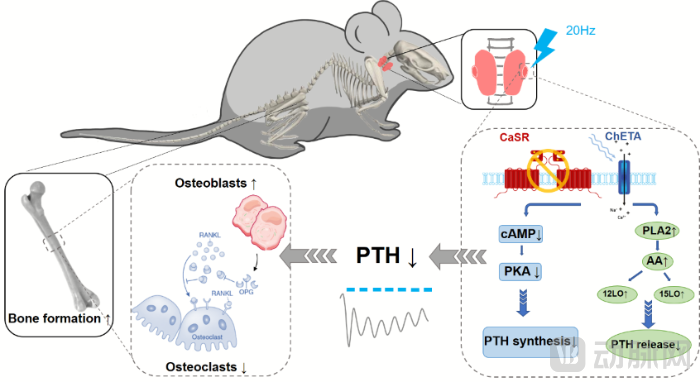
Rhythmic Light Modulation of Parathyroid Hormone Secretion to Intervene in Bone Loss
Yang Fan shared in detail the research journey and focus, stating:“The greatest innovation of this project lies in the application of optogenetics to the regulation of neuroendocrine functions. Optogenetics is an original technology that has driven innovative advancements in neuroscience. Meanwhile, this technology is gradually expanding into other fields of biomedicine. First, you need to recognize the innovative aspects of this technology,”More importantly, it is crucial to identify the right entry point.
“Take our research project as an example. Clinically, following hyperparathyroidism, all calcium-sensing receptors in patients become dysfunctional. Under this premise, we introduced light-sensitive genes into these cells, enabling them to bypass the originally calcium-sensitive receptors and artificially activate a light-sensitive switch. This signifies that we have identified a novel approach most suitable for regulating parathyroid hormone, and thus our work has gained recognition from certain experts.”
Finding the Key to Solving Clinical Challenges Is as Important as Having a Team with Interdisciplinary Research Backgrounds
From theoretical innovation to the translation into hormonal secretion regulation strategies that are truly applicable in clinical practice, there inevitably existsHow to harness diverse forces to address the same scientific challenges, and how to ensure that scientific research is truly translated into clinical practice.Among them, scientists attempting to address clinical problems inevitably face a long road ahead.
“‘What is the use of this thing?’ ‘What kind of problems can it actually solve?’ These are questions we are often asked by others after we have achieved results,” said Yang Fan.
Despite the significant improvement in understanding of “industry-academia-research-medicine” integration among both academia and industry, a gap still seems to exist when scientific achievements aim to truly move from institutions into clinical practice.
In response, Yang Fan shared openly:“Initially, we also found it challenging to address these issues. You must clearly explain to clinicians the mechanisms underlying your research and its practical utility, among other aspects. However, through multiple rounds of communication, you will find that clinicians gradually come to understand your work, and you yourself will gain substantial insights in the process.”What remains crucial is to maintain continuous communication and dialogue."There is still a long way to go before theoretical innovations can be translated into therapeutic interventions that truly address clinical problems, and greater support from additional factors is required."
However, to conduct valuable scientific research, in addition to finding the key to solving clinical challenges, a team with interdisciplinary research backgrounds is also crucial.
The team led by Yang Fan at the Shenzhen Institute of Advanced Technology is a multidisciplinary group that brings together scientists specializing in neuromodulation, clinicians, and experts in automated optical modulation systems and medical engineering.
“It is crucial that individuals from diverse fields come together to address a common problem and contribute their expertise,” Yang Fan stated. “This has brought significant benefits to the breakthrough in the research on ‘light-mediated regulation of parathyroid hormone secretion for intervention in bone loss.’”Through years of collaboration, each of us has broadened our horizons beyond our original fields.I have long been engaged in research on optogenetics, using it to manipulate neural circuits or modulate specific cells, butThe research group has successfully enabled me to further expand my field of study, thereby enhancing the value of my research.”
Barriers naturally arise in communication and experimental progress among individuals from different fields; how can these be addressed?
Yang Fan stated, “Communication and alignment is an enduring process.”First, you need to understand the other party’s field. Second, you must clearly articulate the issues within your own domain. After reaching a consensus, you can then work together to address the same problem. This may appear challenging, but it is in fact highly meaningful."Take our research team as an example. When addressing the challenge of calcium concentration detection, researchers in biology and medicine may not quickly identify the optimal solution. However, through discussions with engineers, you will find that they possess electrode technologies readily applicable to calcium concentration measurements. The interdisciplinary integration ultimately enables us to advance experimental processes more effectively and efficiently, achieving significant innovative breakthroughs."
Scientists Must Avoid a Narrow Perspective
In fact, both the state and investment institutions have increased their attention to the translation of scientific research.
Since 1985, the state has supported the commercialization of scientific and technological achievements through legislation and tax policies. According to statistics from VCBeat’s Chengguo Bureau, China has issued a total of 435 policies directly related to the commercialization of scientific and technological achievements over the past 37 years. Since the beginning of last year, a large number of investment institutions have also begun to seek out projects led or participated in by professors and scientists.
The trend of translating scientific research into practical applications has long been underway, and scientists’ enthusiasm for medical innovation and translation remains undiminished.
However, for scientists, the journey from academic conception to mature technology and then to a complete product is a long and risky process. In this process, scientists must both keep their heads down to focus on the work at hand and look up to assess the broader landscape. The critical question facing scientists is,How Can Scientific Research Be Closely Aligned with the Market While Truly Addressing Clinical Challenges?
Yang Fan believes that scientists should not be like a frog in a well.
He stated:“While fulfilling one’s own job responsibilities,”First, you must determine whether your research is at the forefront and aligns with international trends in life sciences and medicine; second, whether it can address clinical needs; and third, whether it conforms to the broader direction of healthcare market development.If your work aligns with these three directions, your research is bound to be highly promising, regardless of the specific approach. Our study addresses clinical needs and leverages innovative technologies from a market-oriented perspective to tackle the “bottleneck” challenges associated with certain diseases.
In scientific research, one must avoid relying on “feelings” and “possibilities.” When you have some theoretical innovations,It is crucial to communicate with scientists, clinicians, experts from the industry—including pharmaceutical and medical device companies—and even investment institutions.You need to continuously present your work to audiences from diverse fields. Sometimes, ideas you consider innovative may already exist in the market. However, minor findings from your scientific research may attract significant attention from others.My recommendation is to strengthen communication.This is an area where we, as basic science researchers, are somewhat lacking. However, only by gaining a deep understanding of the market can we better promote the translation of scientific achievements.
"Moreover, the platform is also crucial. Our Shenzhen Institute of Advanced Technology now places great emphasis on translation and has established several translation platforms. Located in Shenzhen, we have also gained many opportunities for communication and exchange with industry peers."
Currently, Dr. Yang Fan’s team at the Shenzhen Institute of Advanced Technology has validated the feasibility of their research in animal models, including in vitro cell studies. Moving forward, they will continue to conduct clinical trials to advance the translation of their scientific achievements.