

Keep, the World's Largest Online Fitness Platform Founded by a Post-90s Entrepreneur, Files for Hong Kong IPO After Raising Over $5.5 Billion
After Nearly Eight Years in Operation, Keep Decides to Pursue an IPO.
VCBeat has learned that on the evening of February 25, online fitness platform Keep filed an IPO application with the Hong Kong Stock Exchange, with Goldman Sachs and CICC serving as joint sponsors.
Since its inception in 2014, Keep has been a “superstar enterprise,” favored by numerous investors.To date, Keep has completed eight rounds of financing, raising a total of over $550 million (approximately RMB 3.47 billion). The investor roster includes prominent firms and corporations such as GGV Capital, Source Code Capital, Tencent, Ventech China, SoftBank Vision Fund, Hillhouse Capital, Times Capital, and BAI Capital. Among these, GGV Capital, Source Code Capital, Tencent, and Times Capital have participated in multiple financing rounds for Keep.
Notably, Keep’s $355 million Series F financing round, officially announced as completed in January 2021, remains the largest funding deal in the online fitness industry to date.
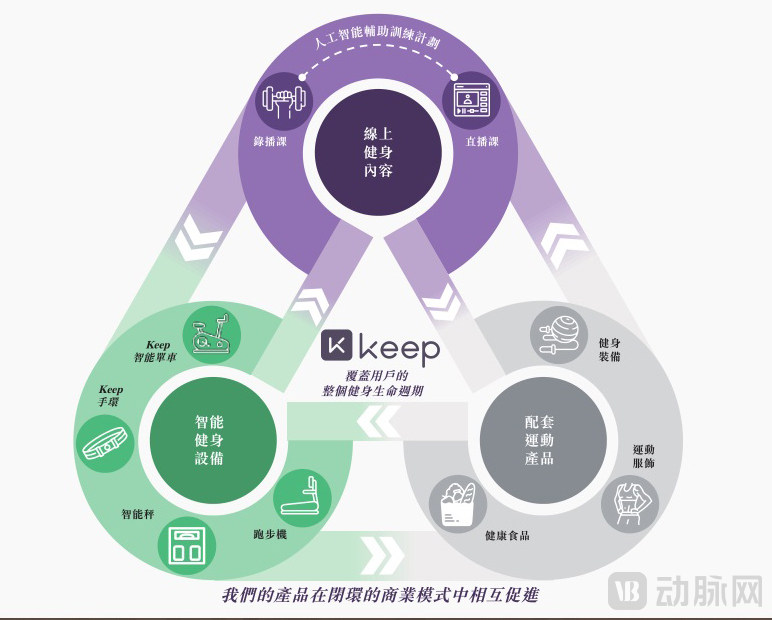
To date, Keep has developed three business lines., including online fitness content, smart fitness equipment, and complementary sports products, which together constitute Keep’s comprehensive fitness solution.
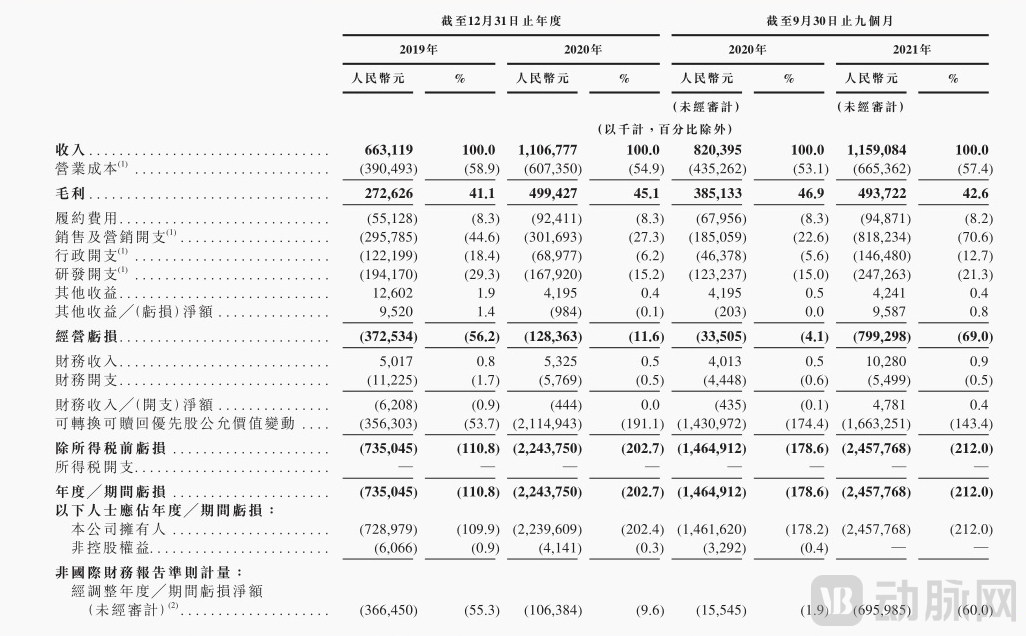
In terms of specific revenue, the prospectus shows that Keep's revenues for 2019, 2020, and the first three quarters of 2021 were RMB 663 million, RMB 1.107 billion, and RMB 1.159 billion, respectively, indicating a very rapid growth rate.
(Image source: Prospectus)
It is worth noting that, according to the Frost & Sullivan report,Based on monthly active users and the number of workouts completed by users in 2021, Keep is currently the largest online fitness platform in China and globally.It is evident that Keep currently holds a leading position in the industry.
However, Keep’s losses are also widening.The prospectus shows that Keep's adjusted net losses for 2019, 2020, and the first three quarters of 2021 were RMB 366 million, RMB 106 million, and RMB 696 million, respectively.
On one hand, revenue is growing rapidly; on the other, losses are intensifying. What strategic intentions does this reflect for Keep? What are the company’s core competitive moats? What challenges remain unresolved? How will the industry evolve in the future? To answer these questions, we may find insights by examining the founding team’s background, the company’s financial performance, its business layout, and the development trajectories of comparable global peers.
Nowadays, obesity has undoubtedly become a nightmare for many young people, primarily due to two reasons.
First, obesity poses significant health risks to individuals.: It is the primary culprit behind chronic diseases, with cardiovascular disease, cerebrovascular disease, and diabetes all being closely linked to it;Second, achieving successful weight loss is truly difficult.: According to the "National Weight Report," only 9.5% of individuals successfully reached their target weight, meaning that the failure rate for weight loss among Chinese people is as high as 90.5%.
As a formerly obese individual who weighed 85 kilograms, Wang Ning, a post-90s graduate of Beijing Information Science and Technology University, successfully reduced his weight to 65 kilograms through diligent fitness training. During this process, he found that online fitness information was disorganized and chaotic, making it difficult to determine which content was reliable. Furthermore, due to a lack of basic health knowledge, he was unable to scientifically structure his workout plans and lacked the mutual encouragement of workout partners. These are common challenges faced by many individuals engaged in fitness activities.
To address this pain point, Wang Ning decided to develop a mobile fitness app, which led to the launch of Keep in late 2014.At that time, as there were no apps specifically targeting consumer users in the fitness and exercise sector, Keep became an instant hit upon its launch, garnering over one million users within just 105 days.
With its impressive user growth performance, Keep quickly attracted numerous investment institutions to conduct due diligence., secured three rounds of financing within just one year, and received strategic investment from Tencent in its C+ round in August 2016.
In retrospect, Keep’s rapid rise was primarily driven by getting two things right.
First, it accurately identified its core positioning and deeply penetrated its main business operations.As an online fitness app, Keep is significantly differentiated from traditional brick-and-mortar gyms in that users cannot access the superior in-person workout experience. In the initial product design phase, Wang Ning aimed to build Keep’s competitive moat by integrating a wide array of features within the app, such as onboarding coaches and establishing a Q&A community. However, this approach proved to be highly “asset-heavy,” imposing substantial financial pressure and talent acquisition challenges on the nascent startup.
At that time, an investor suggested that Wang Ning keep Keep’s business highly focused, positioning the app as a “fitness answer engine”: when users open the app and search for fitness-related questions, they would instantly receive answers. This required Keep to concentrate on content creation, ensuring that its content was both high-quality and comprehensive. “We are making our content increasingly detailed, which in turn enriches our fitness answers. This ability to provide answers (content) that meet the needs of many users constitutes our (initial) competitive advantage,” Wang Ning stated in an interview.
Second, Keep has gained profound insights into user needs and shaped brand awareness through diverse marketing strategies.Amid the surge in user numbers, Wang Ning realized that content served only as a soft barrier; it had not fostered among users a differentiated perception of Keep compared with other information providers such as Baidu, Zhihu, or fitness forums. Consequently, Wang Ning decided to reevaluate user needs and redefine Keep’s brand image.
A typical example occurred after Keep amassed 30 million users, when the company launched an advertising campaign and introduced the iconic slogan, “Self-discipline gives me freedom.” Thanks to extensive promotional efforts, this phrase quickly became a motto or catchphrase for numerous fitness enthusiasts, thereby solidifying users’ brand recognition of Keep.
It is precisely through this series of strategic initiatives and capital infusion that Keep has achieved rapid growth.The COVID-19 pandemic that erupted in 2020 forced people into home isolation, further propelling home-based fitness into the mainstream and driving a surge in Keep’s daily active users.
Subsequently, in May 2020 and January 2021, Keep, boasting a massive user base, completed its $80 million Series E and $360 million Series F financing rounds, respectively, bringing it to the eve of its initial public offering.
On February 25, 2022, one year later, Keep officially decided to make a final push for its IPO.
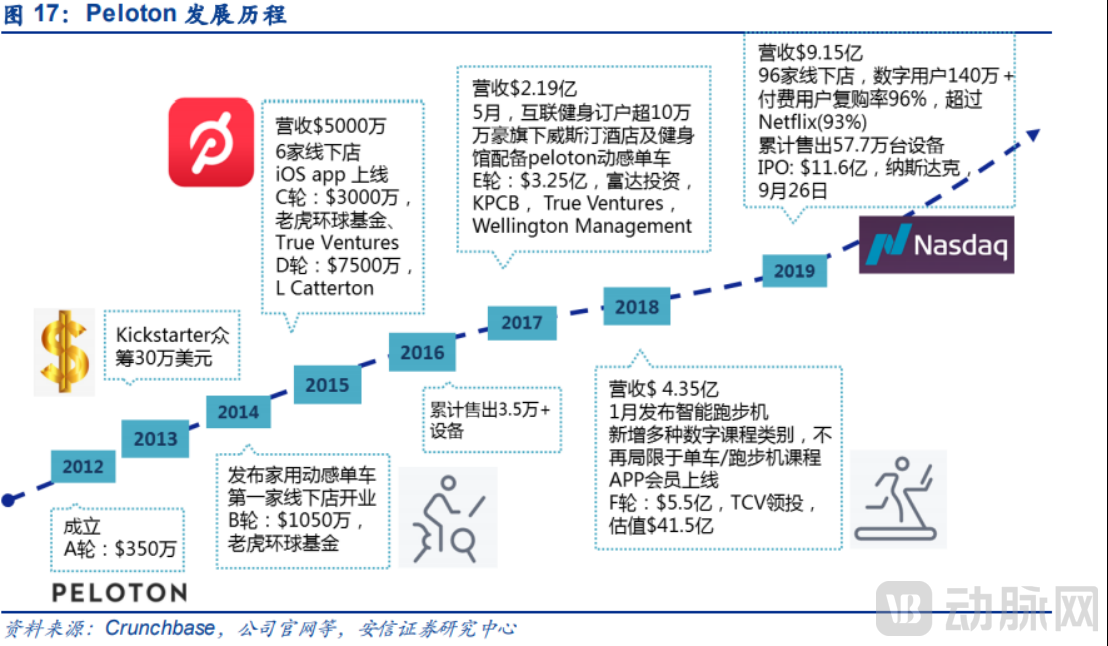
Keep’s rapid growth is, to some extent, closely tied to the development of its U.S. counterpart, Peloton, the leading online fitness company.
Founded in 2012, Peloton is an innovative company focused on the online fitness sector. By building a user community and adopting a hardware-plus-software model, it has created a gym-like fitness experience, rapidly gaining user favor and successfully going public in 2019. In the early stages of the pandemic, Peloton’s stock price surged by as much as 380.39%, with its market capitalization briefly exceeding $50 billion.
(Image source: Essence Securities)
Given their presence in the same sector and similar business lines, Keep is regarded by many investment firms as the Chinese counterpart of Peloton., thereby betting on its promising future growth potential.
How Has Keep Performed? How Is Its Business Model Structured? Next, VCBeat will provide an analysis from two perspectives using data disclosed in the prospectus.
Dimension 1: Rapid Revenue Growth—How Do the Three Major Business Segments Build a Sports Ecosystem?
The prospectus shows that Keep's total revenue increased by 66% from RMB 663 million in 2019 to RMB 1.107 billion in 2020, and further rose to RMB 1.159 billion in the first three quarters of 2021, representing a year-on-year growth of 40%.
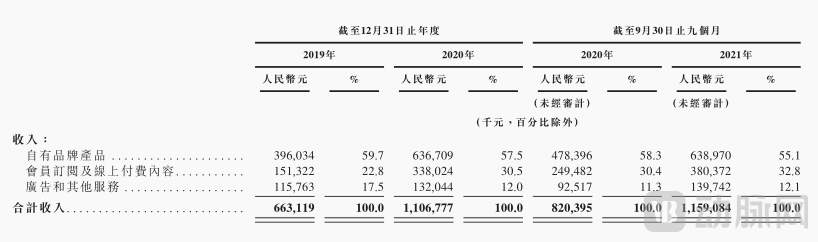
In terms of the three core business segments, revenue from proprietary brand products amounted to RMB 638 million in the first three quarters of 2021; revenue from membership subscriptions and online paid content reached RMB 380 million; and revenue from advertising and other services totaled RMB 139 million.As can be seen, proprietary brand products currently account for the majority of Keep’s revenue., membership subscriptions and online paid content have shown a continuous increase in their share of revenue, while advertising and other services have exhibited a declining trend.
 (Image source: Prospectus)
This is actually thanks to Keep's strong user acquisition and branding capabilities.The prospectus shows that in 2020 and 2021, Keep's average monthly active users were 29.7 million and 34.4 million, respectively. In 2021, Keep users recorded a total of approximately 1.7 billion workouts on the platform.High user retention and strong engagement are the cornerstone of Keep’s commercialization.
According to a survey by Frost & Sullivan, Keep ranks first in brand awareness among fitness app and smart fitness equipment brands, as 70.1% of Chinese fitness users and 64.2% of Chinese smart fitness equipment users are aware of the Keep mobile app. Keep holds the largest market share in China’s online fitness app market for fitness enthusiasts and in the smart fitness equipment market, at 44.7% and 38.8%, respectively.
Starting from its core user base, Keep aims to build a “closed loop of tech-enabled fitness.””, which covers users’ needs in diet, clothing, daily necessities, and exercise.Thus, paid courses, fitness products, offline KeepLand spaces, light meal delivery services, and apparel have emerged.
From a logical perspective, membership subscriptions and paid online content serve primarily as customer acquisition products targeting fitness enthusiasts; these offerings are asset-light and boast high user stickiness. Advertising and other services are mainly directed at B-side brand partners, continuing the model of monetizing traffic. Proprietary brand products provide in-depth services to core user groups, thereby expanding revenue potential and broadening commercial boundaries.
(Image source: Prospectus)
In other words, during its business development, Keep abandoned the advertising-dependent business model typical of fitness tools and gradually shifted toward a platform or consumer brand strategy with greater growth potential.Financial data also corroborates the feasibility of this pathway.
Dimension Two: With Over 200 Million Users, Why Has Profitability Not Yet Been Achieved?
With a user base exceeding 200 million, Keep has expanded into three major business lines and continued to drive rapid revenue growth, butThe issue is that revenue growth does not translate into profit growth.
According to the prospectus, Keep’s adjusted net losses from 2019 to September 30, 2021, were RMB 366 million, RMB 106 million, and RMB 696 million, respectively. Moreover, Keep’s gross profit growth rate has been declining: the year-on-year growth rates for gross profit in 2020 and the first three quarters of 2021 were 83.2% and 28.2%, respectively.
The reason lies in,Since the normalization of pandemic control measures, Keep has invested heavily in the continuous acquisition, activation, and retention of users, as well as in the expansion of new businesses, to retain its newly acquired user base and attract new users.. In other words, despite having amassed 200 million users, Keep still needs to maintain a steady acquisition of traffic and convert its existing user base, which may become a key test for the company in the secondary market after its IPO.
Furthermore, the prospectus also indicates that the current losses are primarily attributable to the prioritization of strategic roadmap development and business model optimization. Judging by the growth rates across various business lines, Keep’s strategic tilt toward its proprietary brand products has begun to yield results and may become a key driver supporting its higher market valuation in the future.
It is worth mentioning Keep’s benchmark competitor, Peloton. Since its stock price surged in the early stages of the pandemic, its market capitalization has fallen from over $50 billion to approximately $10 billion currently, representing a decline of more than 80%.
At its core, Peloton has yet to make substantial progress toward profitability.According to its financial report for the fourth quarter of fiscal year 2021, Peloton reported a net loss of $313 million in the fourth quarter, facing immense pressure on profitability.
Of course, from a longer-term perspective, the fitness and exercise sector represents a vast market. According to a report by Frost & Sullivan, the average annual spending per fitness enthusiast in China was RMB 2,596 in 2021, significantly lower than the RMB 14,268 spent per person in the United States, indicating substantial growth potential.
Therefore, for every enterprise deeply engaged in this field, there remains substantial room for growth.The core issue remains: how to establish a viable profit model to instill greater confidence in the capital market is still a mandatory question that companies must answer.
As the mobile internet wave continued to deepen and reshape industries such as retail, transportation, and catering since 2014, the big health sector also witnessed a wave of entrepreneurial initiatives aimed at reinventing the industry through internet technologies.
During this period, a host of innovative enterprises emerged, including Keep, which focuses on sports and fitness; Meiyou, which centers on women’s menstrual cycle management; Youlai Doctor, which is deeply engaged in medical science popularization and health education; and Chunyu Doctor, which has made significant strides in online consultations. Among them, WeDoctor, Haodf, DXY, and Medlinker all reached the eve of their initial public offerings.
However, for the entire “Internet + Big Health” sector, the financial reports of companies that have already filed their prospectuses reveal the industry’s profitability challenges:Despite the continuous revenue growth of various enterprises, the profitability bottleneck has yet to be effectively resolved, and the industry is generally trapped in a predicament of overly simplistic business model monetization.
Keep’s latest push for an IPO has once again brought this issue to the forefront of industry attention. An analysis of its strategic layout across three core business segments reveals that Keep is already attempting to change this situation, though time is still needed to validate these efforts.
Dingxiangyuan is also exploring new pathways. After accumulating a vast pool of professional and active physicians in China, Dingxiangyuan leverages their expertise to deliver services to consumer-end users, addressing the health concerns of the general public. To date, its “D+C” strategy (with “D” representing doctors and “C” representing the general public) has served 2 million physicians and 80 million patients/consumers in China.
In DXY’s framework, the healthcare industry is divided into upstream and downstream segments. The downstream segment primarily addresses medical demand, while the upstream segment encompasses health-related issues arising from people’s daily lives, including their overall health status, lifestyle, habits, travel, and work. By pursuing an upstream-oriented strategy, DXY has continuously explored new business models and possibilities. To date, it has achieved scaled revenue and profitable operations.
WeDoctor continues to strengthen its multidimensional capabilities in “medical care, pharmaceuticals, insurance, and data.” Leveraging its internet hospital as the platform carrier and driven by reforms in medical insurance payment methods, it builds an internet-based medical consortium. This approach alleviates pressure on large hospitals, enhances the capabilities of primary-care institutions, improves the efficiency of both basic medical insurance and commercial insurance payments, and boosts supply chain efficiency, thereby exploring the establishment of a Chinese-style Health Maintenance Organization (HMO).
Medlinker is continuously evolving its disease and health management pathway to cover the entire patient lifecycle. The integration of Future Doctor at the end of last year has helped Medlinker bridge online and offline services, creating a closed-loop management system. This enables every stage of the medical service framework—spanning prevention, diagnosis, treatment, and rehabilitation—to feature integrated “online + offline” capabilities, thereby further enhancing physician efficiency and improving patient care.
It is not difficult to observe that, although the “Internet + Big Health” sector still faces significant challenges in profitability, industry pioneers have embarked on a new journey, continuously enriching their intrinsic value.
As Zhang Lei of Hillhouse Capital stated, “"There is only one moat in this world, and that moat is whether you can continuously and relentlessly create long-term value."”
After navigating through economic cycles, companies that have consistently accumulated strengths and deeply cultivated their fields will ultimately reap the greatest rewards.
References:
Keep Valued at Over $2 Billion: How Does Burning Calories Translate into Business? — Gelonghui
Peloton Is Up for Sale: Is There Still Hope for Keep and Its Peers? — Jidian Business