

GENEVAX Advances Innovative Vaccine Pipeline Following Nearly RMB 100 Million Pre-A Funding Round
Recently, VCBeat learned that Genovax, an innovative vaccine R&D company, secured nearly RMB 100 million in Pre-A financing led by Puhua Capital within just over two months of its establishment. The company has now launched its Series A financing round to accelerate the development of its R&D pipeline and advance the industrialization of its Phase III projects.
Against the backdrop of innovative vaccines poised to achieve a 30% industry growth rate, driven by policy guidance, technological innovation, and rising public willingness to vaccinate, Geno Bioscience is expected to ascend to the industry’s first tier within the next five years, leveraging the commercialization of innovations from its five major vaccine technology platforms.
Novavax’s (NVAX-US) recombinant nanoparticle protein-based COVID-19 vaccine, NVX-CoV2373, formally submitted its Emergency Use Authorization (EUA) application to the U.S. Food and Drug Administration (FDA) in early February, positioning it as a potential fourth approved COVID-19 vaccine on the market. Previously, this product had already received authorization from the European Medicines Agency (EMA) and the World Health Organization (WHO). Recently, GlaxoSmithKline (GSK) and Medicago jointly announced that their COVID-19 vaccine product, Covifenz (a plant-based virus-like particle [CoVLP], recombinant, adjuvanted), has received marketing approval from Health Canada.
Following the spotlight on mRNA and inactivated vaccines, recombinant nanoparticle technology is achieving new breakthroughs, with its safety and efficacy highly anticipated by the market. Building on extensive research and development efforts, non-VLP recombinant nanoparticle technology platforms, as carriers for next-generation multivalent combination vaccine design, will lead the upgrade and innovation of industry concepts for recombinant subunit vaccines.
Protein nanoparticle (NP) vaccines are primarily classified into two major categories: self-assembling virus-like particles (VLPs) and natural non-viral self-assembling protein nanoparticles. Furthermore, with technological advancements, artificially designed, non-natural engineered protein nanoparticle platforms have emerged, accompanied by the development of corresponding self-assembly methods and technologies.
Virus-like particles (VLPs) are self-assembled from viral envelope or capsid proteins with diameters ranging from 20 nm to 800 nm, and do not contain any infectious components. VLPs, represented by the HPV vaccine, were the first nanoparticles used in vaccines. They were initially isolated from the serum of HBV patients, as some viral capsid proteins have the ability to spontaneously form stable particles, existing as natural byproducts of viral replication. However, due to low expression yields and the presence of host cell contaminants from the expression system, VLPs are difficult to produce stably.
As an alternative to virus-like particles (VLPs), highly oligomeric non-viral proteins can self-assemble into nanoparticles with uniform morphology and size. These are typically enzymes or dynamic equilibrium proteins. A key feature of self-assembling proteins is their single protein component, forming non-infectious particles that mimic viral structures. Compared with protein subunit vaccines, assembled protein nanoparticle vaccines exhibit superior immunogenicity. The advantages of natural self-assembling protein nanoparticles over VLPs mainly include lower intrinsic autoimmunogenicity, greater ease in achieving multivalent and multiplex designs, and scalability for mass production. In addition to vaccine development, they can also serve as drug delivery carriers.
Vaccine design based on VLPs and non-VLP recombinant nanoparticles has become a leading trend. Who are the top contenders in China? As the curtain rises on the development of novel vaccines, let us discover a dedicated pioneer: Genoway Biologics.
With advancements in medical technology and heightened public health awareness, the demand for vaccines among the Chinese population continues to grow, making China the second-largest vaccine market globally. The biopharmaceutical industry, including the vaccine sector, has been designated as a national strategic emerging industry and is subject to government encouragement and support. National industrial policies promote the development of novel vaccines, such as combination multivalent vaccines, genetically engineered vaccines, viral vector vaccines, and nucleic acid vaccines.
In response to the substantial vaccine demand in the current market and industry, Ginovabio, as a rising star in vaccine R&D, has actively expanded from its recombinant fusion protein vaccine technology platform to the highly anticipated and challenging non-VLP recombinant nanoparticle technology platform, building on the team’s more than two decades of accumulated experience in recombinant subunit vaccine development.
GENEVAX brings together senior scientists and senior management professionals from leading domestic and international vaccine research institutions and renowned enterprises, including the Academy of Military Medical Sciences, the U.S. National Vaccine Center, Pfizer, and Sanofi Pasteur, boasting decades of accumulated experience in vaccine development, industrialization, and commercialization.
The company’s founding team is co-led by Professor Wang Xiliang, a renowned expert in anti-infective therapies with over 30 years of dedicated research in preventive vaccines and emergency therapeutic antibodies for major respiratory infectious diseases. Professor Wang previously served as Director of the Immunology Research Office, Researcher, Professor, and Doctoral Supervisor at the Institute of Microbiology and Epidemiology, Academy of Military Medical Sciences / State Key Laboratory of Pathogen and Biosecurity. He is joined by Professor Peter Shi, who serves as Researcher, Professor, and Doctoral Supervisor at the National Vaccine Research Center (NVRC) of the National Institute of Allergy and Infectious Diseases (NIAID), and as Principal Investigator (PI) of the Viral Vaccine Research Center. Recently, the company has invited and appointed Dr. Hu Aizhong as Chief Technology Officer (CTO) and Mr. Feng Kechang as Chief Operating Officer (COO).
During his nearly 20-year tenure at Pfizer/Wyeth in the United States, Dr. Hu Aizhong participated in preclinical and clinical studies for more than 20 different types of vaccine products, led a series of key projects, and made significant contributions to the FDA marketing authorization of multiple vaccines, including FluMist, PREVNAR, PREVNAR 13, PREVNAR 20, and Trumenba. As the Head of R&D at Frontida Biosciences in the United States, he also identified, evaluated, and developed RNA therapeutics for cancer and infectious diseases, including mRNA vaccines for universal coronavirus protection and self-amplifying RNA therapeutics for the treatment of human papillomavirus (HPV).
Prior to joining Genowell, Mr. Feng Kechang served as General Manager of Sales for Sanofi Pasteur’s China region and Head of its Innovation Center. With over 20 years of frontline sales management experience at multinational pharmaceutical companies, he possesses deep expertise in the fields of vaccines and innovative drugs. As Chief Operating Officer of Genowell Biologics, Mr. Feng will be fully responsible for corporate operations and business cooperation, driving the company’s industrialization efforts in the vaccine sector.
Geno Bioscience has established five innovative vaccine technology platforms, including rapid reassortment of reverse genetics vaccine strains, non-VLP recombinant nanoparticle technology, novel vaccine adjuvants, needle-free rapid immunization technology, and RNA vaccine technology. The company currently has more than 10 R&D pipelines in progress, covering quadrivalent and broad-spectrum universal influenza vaccines, multivalent and broad-spectrum universal COVID-19 vaccines, varicella-zoster virus (VZV) shingles vaccines, needle-free rabies vaccines, and respiratory syncytial virus (RSV) vaccines. Geno Bioscience achieves full-chain coverage of core elements in vaccine product development—namely, vaccine strain selection, antigen delivery platforms, adjuvant systems, antigen expression systems, and immunogenic formulations—thereby demonstrating strong capabilities in independent R&D and the translation of innovative achievements, providing robust support for the development of new vaccine products and the attainment of strategic objectives.
Through reverse genetics technology, viral genes can be modified and engineered to obtain strains with desired biological characteristics, as well as vaccine strains with improved production performance, antigenic match, immunogenicity, and biosafety. Reverse genetics not only overcomes the limitations of traditional vaccine strain selection and domestication methods—which are heavily constrained by the natural properties of viruses, time-consuming, labor-intensive, and associated with low success rates—but also enables more proactive and effective construction and optimization of vaccine strains. GenoWise has established a proprietary reverse genetics-based rapid reassortment platform for vaccine strains, which holds promise for the development of broad-spectrum vaccines against COVID-19, influenza, and other diseases.
By integrating a structural biology platform with an innovative adjuvant platform, our team has developed a COVID-19 vaccine featuring a polymeric RBD protein formulated with a novel adjuvant. Studies in rodents and non-human primates have demonstrated that immunization with this vaccine elicits robust and sustained humoral and cellular immune responses, providing effective protection against infection by both the original SARS-CoV-2 strain and its variants.
Meanwhile, the company has successfully established a vaccine platform based on ferritin nanoparticles and phenylalanine synthase non-VLP protein nanoparticles, with independent intellectual property rights. Ferritin and phenylalanine synthase are highly oligomeric non-viral proteins that serve as normal constituent proteins in the human body and are non-immunogenic. Through genetic engineering, they can be assembled into stable dodecahedral and icosahedral oligomers, enabling efficient antigen presentation.
Taking ferritin as an example, it is composed of 24 monomers, each with a molecular weight of 18 kDa. This complex consists of eight trimeric units arranged with octahedral symmetry, resembling a rhombic dodecahedron: a polyhedron exhibiting both three-fold and four-fold symmetry. The N-termini are located in close proximity to the three-fold axes, facilitating the easy attachment of trimeric antigens. Genoway possesses a genetic engineering design platform based on non-VLP recombinant nanoparticles, which enables structure-based design grounded in principles of molecular and structural biology. This allows for precise control over antigen stoichiometry, spacing, and particle size, offering a novel approach to the development of safe and highly effective vaccines.
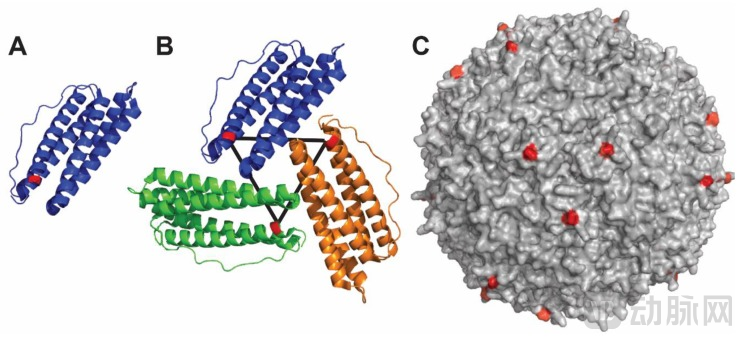
Figure: Example of human ferritin structure
Leveraging this technology platform, Genoway is actively advancing the development of multivalent combination vaccine products, including those targeting respiratory syncytial virus (RSV), broad-spectrum universal coronaviruses, and quadrivalent hand, foot, and mouth disease.