

Incisive Surgical Files IPO: The Company Behind the INSORB Absorbable Skin Stapler Favored by 94% of Survey Respondents

INSORB
Medical Device Developer
In 2021, Intuitive Surgical, headquartered in Sunnyvale, California, announced that robotic-assisted surgeries performed by surgeons worldwide using the da Vinci Surgical System had surpassed 10 million cases. Meanwhile, its fully wristed 8-mm SureForm30 curved-tip stapler received FDA approval.
Beneath the data released by Intuitive lies a “minimally invasive” era that has quietly arrived. According to data from the renowned research firm Evaluate MedTech, the global market for minimally invasive surgical instruments reached $22.7 billion in 2018. Behind this multi-billion-dollar market, staplers—a type of minimally invasive surgical instrument—are particularly noteworthy. As a medical device widely used in surgical procedures, staplers account for nearly 50% of China’s minimally invasive surgical instrument market, with a market size exceeding RMB 10 billion.
In terms of market share for stapler products, Asia accounts for approximately 13% of the global stapler market, while medical device giants in North America and Europe lead the global market with shares of 44% and 35%, respectively.
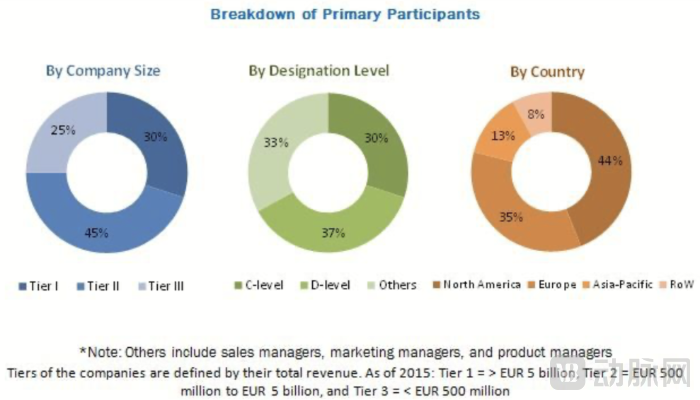
Key Players in the Global Surgical Stapler Market
Source: MarketsandMarkets Report
In the North American and European markets, companies such as Ethicon, Covidien, Smith & Nephew, Intuitive Surgical, Becton, Dickinson and Company (BD), and Incisive Surgical all hold a significant presence.
When discussing surgical staplers, their origins can be traced back to 1908 and the Hungarian surgeon Hümer Hültl. Drawing inspiration from the stapler, he successfully developed a device for hemostatic suturing during surgery—the surgical stapler. This innovation enabled the assistance of previously time-consuming and less precise manual suturing procedures with medical devices, thereby enhancing both surgical efficiency and success rates.
Moreover, he innovatively redesigned the anvil to ensure that the staples form a “B” shape, thereby securely grasping blood vessels while maintaining blood supply and nutrition to the stapled tissue and cutting edges, thus providing superior hemostasis and air-tightness in clinical practice. However, as the applications of staplers have expanded, their external design, functionality, staple materials, and staple-forming technologies have continued to evolve based on Hümer Hültl’s research.
In 1921, the introduction of the linear stapler simplified stapler design and replaced metal wires with nickel-silver alloy. In 1934, H. Friederich and Neuffer equipped staplers with replaceable staple cartridges. In 1978, United States Surgical Corporation invented the circular end-to-end stapler; its double-row circular staples and blade design enabled the formation of end-to-end anastomoses, allowing physicians to perform circular anastomoses in lumens of varying diameters. In 1979, Ethicon developed and launched a variety of staplers, thereby further penetrating surgical specialties.
Accompanying the evolution of stapler technology is the advancement of staple formation technology.
Building upon traditional techniques, Covidien introduced two key innovations to its DST (Directional Stapling Technology). It designed square-column staples with thicker legs that are more resistant to deformation, and developed a teardrop-shaped anvil that increases the contact guidance area by 30%. Subsequently, the company further invented the Tristaple Genesis Intelligent Stapling Technology. Through a design featuring three rows of staggered heights and progressive clamping, this technology achieves precise stapling, adapts to varying tissue thicknesses, and prevents tissue injury, thereby enhancing intraoperative patient safety and postoperative healing outcomes.
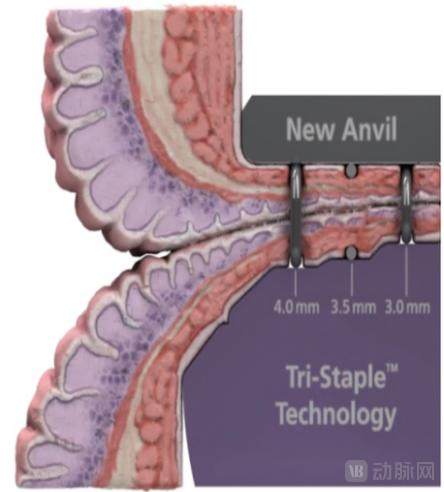
Nevertheless, the safety of surgical staplers has faced challenges. Whether it was Johnson & Johnson’s 2019 recall of nearly 100,000 staplers due to quality issues, or the FDA’s proposal to reclassify surgical staplers as high-risk medical devices—subjecting them to premarket review and performance effectiveness studies—it is evident that market demands for stapler safety continue to rise.
So, the question arises: how can the safety of surgical staplers be ensured? Incisive Surgical, based in Plymouth, Minnesota, USA, offers valuable insights on this matter.
The INSORB absorbable skin stapler, developed by Incisive Surgical, employs a novel skin closure technique that places absorbable staples entirely beneath the skin to close surgical incisions, resulting in less tissue trauma, smaller wounds, lower costs, and faster healing. This solution has earned numerous national awards, including the 2006 Wall Street Journal Health Innovation Award for Medical Device Technology (Incisive Surgical is the only company worldwide offering this technology) and the 2014 Frost & Sullivan Global Customer Value Leadership Award.
Incisive Surgical was founded in 1999. Its founder, Joseph Gryskiewicz, is a clinical professor at the University of Minnesota’s Academic Health Center and a founding partner of Strathspey Crown. He has served as Chairman of Incisive Surgical since 1999.
Beyond his roles as professor and founder, he is also the former president of the Minnesota Society of Plastic Surgeons and the former president of the Rhinoplasty Society. It is precisely this background that accounts for Joseph Gryskiewicz’s profound understanding of skin suturing and wound healing.
He has not only published numerous influential articles on topics such as skin healing and plastic surgery in academic journals, but also delivered hundreds of public lectures on subjects including rhinoplasty and breast augmentation. As a practicing plastic surgeon, Joseph Gryskiewicz exemplifies the seamless integration of academia, industry, and clinical practice.
Academic research has provided him with profound insights and understanding of theoretical knowledge, while his hands-on experience in surgical procedures, extensive patient interactions, and the stringent requirements of plastic surgery for wound healing and low infection rates have enabled him to better grasp genuine clinical needs during product development. He places greater emphasis on the suturing outcomes, physiological characteristics of the wounds, and post-operative recovery when patients use staplers for wound closure.
It was precisely for these reasons that Joseph Gryskiewicz founded Incisive Surgical and developed a series of products, including the INSORB absorbable skin stapler. Just 14 years after its establishment, the company announced that it had sold one million units of the INSORB absorbable skin stapler.
Prior to the launch of the INSORB stapler, there were typically two methods available on the market for closing surgical incisions: one was absorbable sutures, and the other was metal skin staplers.
Generally, due to their superior flexibility, biocompatibility, higher tensile strength, and better extensibility, absorbable sutures provide greater patient comfort during wound healing and promote better healing outcomes. However, this suturing method also has drawbacks, including prolonged surgical and anesthesia times, relatively higher treatment costs, and an increased risk of surgical site infections.
Although metal skin staplers can effectively address the aforementioned issues, traumatic metal staples are prone to piercing or pinching the skin, which may exacerbate patient pain, cause skin damage, and leave “railroad track”-like scars. Furthermore, metal staples require removal after surgery. For patients, this necessitates a second procedure, representing a costly and painful process.
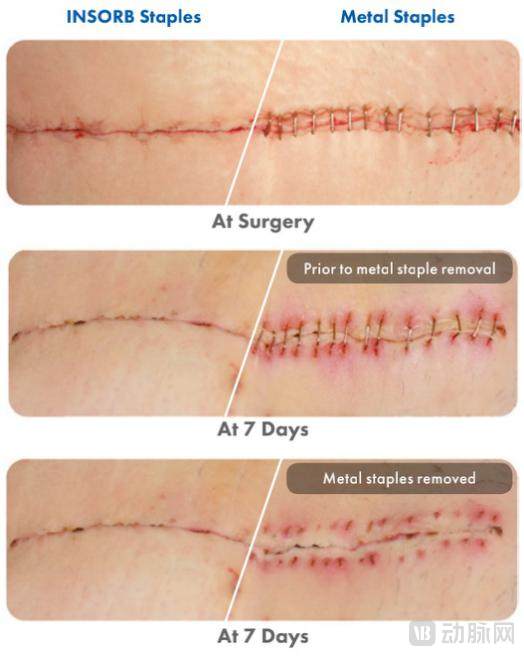
Comparison of Postoperative Recovery Between INSORB and Metal Sutures
The INSORB stapler, developed by Incisive Surgical Inc., ingeniously combines the advantages of both approaches by using bioabsorbable staples instead of metal ones. This design mitigates potential safety concerns associated with metal staples during wound closure and reduces the additional financial burden and physical and psychological trauma for patients caused by postoperative recurrence and subsequent reoperations.
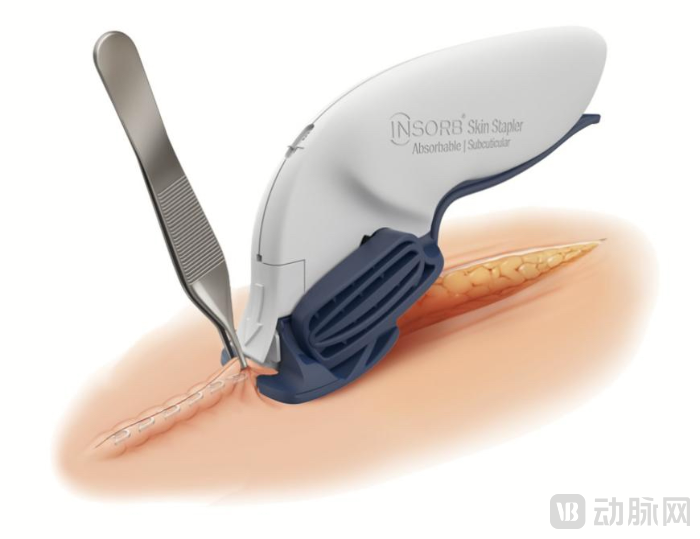
Incisive Surgical’s skin closure technology is particularly commendable.
Specifically, in the INSORB absorbable skin stapler, the staples are composed of a bioabsorbable polyglycolide copolymer. When the absorbable staples are placed entirely beneath the skin, they completely dissolve within the user’s body over the course of several months.
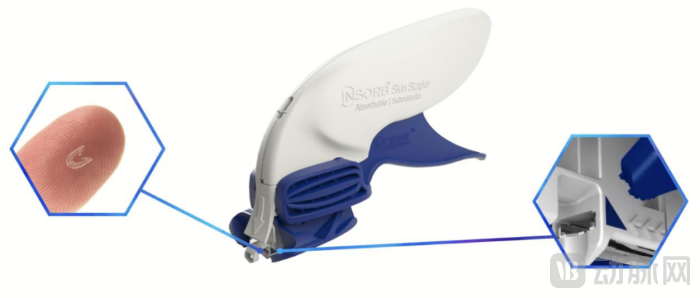
INSORB Absorbable Skin Stapler and Staples
The U-shaped design of INSORB also eliminates the potential for increased pain, wound complications, and scar formation associated with unnecessary skin punctures and staple removal, while promoting skin approximation.
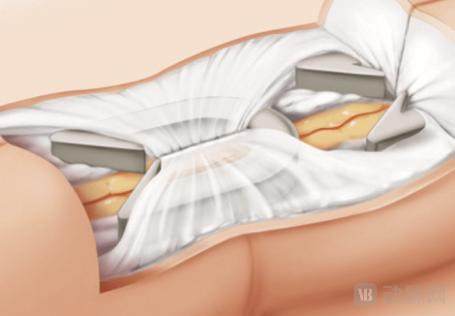
On the other hand, the INSORB absorbable skin stapler features blue triangular and arrow markers on its upper surface to assist physicians in aligning with the wound site requiring suturing, thereby enhancing the precision of wound closure.
It can be said that the INSORB absorbable skin stapler combines the advantages of absorbable sutures and metal skin staplers. It not only improves the efficiency of wound closure for patients but also facilitates the suturing process for physicians. Furthermore, it offers the post-closure comfort associated with absorbable sutures while reducing the formation of scars after skin healing.
A growing body of literature has confirmed the clinical and economic benefits of the INSORB skin closure technology. In this regard, the Department of Plastic Surgery at the University of Virginia conducted a study titled “Impact of Absorbable Subcutaneous Staples, Continuous Subcutaneous Absorbable Sutures, and Percutaneous Metal Skin Staples on Infection Rates in Contaminated Wounds,” which utilized the INSORB stapler during the research process.
Studies have shown that “compared with continuous intradermal suturing, INSORB staples significantly reduce the incidence of wound infection and inflammation.” Therefore, Incisive Surgical’s products are quite compelling in terms of both innovation and stapler safety.
Currently, the INSORB absorbable skin stapler can be used for skin closure in obstetric, gynecologic, plastic, thoracic, general, vascular, and orthopedic surgeries.
Thanks to its unique design, the social and economic benefits brought by the INSORB absorbable skin stapler are self-evident.
From the hospital’s perspective, the INSORB absorbable skin closure device is undoubtedly a more attractive option. For physicians, it reduces operative time and offers ease of use. For hospitals, the absorbability of the INSORB closure staples, along with their wound approximation method, represents a treatment approach that improves clinical outcomes, enhances patient satisfaction, and is preferred by patients. This naturally contributes to improved hospital profitability.
A SurveyMonkey survey revealed that, after viewing postoperative photos of hip replacement surgeries performed with traditional metal staples and INSORB absorbable subcutaneous staples, 94% of respondents preferred Incisive Surgical’s INSORB absorbable staples over metal staples.
To deepen market penetration, Incisive Surgical has established a dedicated sales and marketing team and deployed a global sales network, aiming to enter overseas markets while meeting domestic demand.
Incisive Surgical has currently deployed its related products across Europe, Australia, South Korea, and the Middle East.
In summary, Incisive Surgical first identified points of differentiation from competitors’ products in its product design, or what could be described as technological advantages not possessed by other companies. Leveraging this advantage, the company has further focused on developing patient-centric novel skin closure solutions to maintain its lead over competitors. Moreover, the company maintains close relationships with its customers to understand their needs and incorporates valuable feedback into its existing product portfolio.
Currently, the FDA has strengthened regulatory oversight of the safety of staplers and surgical staples, reclassifying internally used surgical staplers from Class I (general controls) to Class II (special controls), and requiring them to undergo premarket review to mitigate known risks associated with device use, such as improper staple application and staple malfunction.
From this perspective, surgical staplers intended for internal use will undoubtedly be subject to stricter regulatory requirements, with regulatory oversight inevitably continuing to intensify. Against this backdrop, the innovative and safety-oriented design philosophy of Incisive Surgical offers valuable reference points.
Although North American and European medical device companies remain the dominant players in the stapler market, China’s stapler market size grew from RMB 4.827 billion in 2015 to RMB 9.479 billion in 2019, representing a compound annual growth rate of approximately 18%, according to DXY’s “Overview of the Development of the Stapler Industry.” With support from national industrial policies and increasing corporate investment in research and development, innovative domestic stapler companies are continually emerging. Many enterprises, including Tianchen International, Rich Surgical, Partel Medical, Fenghe Medical, Shiai De, and Changzhou Vico, have achieved significant breakthroughs in the stapler sector.
In light of the development trends of surgical staplers overseas and Incisive Surgical’s product R&D strategy, it is undoubtedly important to continue delivering innovative, value-driven products; however, ensuring product safety remains the top priority. Crucially, this entails consistently providing clinicians with valuable therapeutic solutions, reducing surgical risks, adopting a patient-centric approach, and leveraging these principles to guide the innovation and development of new materials and products.