

Lycia Therapeutics, Backed by Lilly and $140M+ in Funding Within Three Years, Nears Clinical Trials with LYTAC-Based Protein Degraders
Lycia Therapeutics
Protein Degradation Drug Developer
In September 2021, biotechnology company Lycia Therapeutics (“Lycia”) secured $70 million in Series B financing, led by Redmile Group, with participation from Alexandria Venture Investments, Invus, Versant Ventures, and others.The financing proceeds were primarily used for the research and development of lysosome-targeting chimera (LYTAC) protein degradation technology.
LYTAC technology overcomes the limitation of traditional targeted protein degradation technologies that only target intracellular proteins, effectively enabling the degradation of extracellular and membrane proteins, thereby expanding therapeutic targets and facilitating the treatment of a broader range of diseases.
As the first company to drive the clinical translation of LYTAC technology, what sets Lycia Therapeutics apart? This article will introduce the company from three aspects: team resources, technological features, and development overview.
Lycia, founded in 2019 and headquartered in San Diego, California, USA, focuses on the untapped extracellular proteome. The company is currently leveraging its LYTAC platform to discover and develop novel therapies that degrade extracellular and membrane proteins, thereby addressing a range of difficult-to-treat diseases, including cancer and autoimmune disorders.
In 2019, Lycia Therapeutics was co-founded by healthcare venture capital firm Versant Ventures and Dr. Carolyn Bertozzi at the Inception Labs in San Diego.
Founded in 1999, Versant Ventures is a healthcare venture capital firm dedicated to helping exceptional entrepreneurs build the next generation of companies. Versant focuses its investments on enterprises primarily engaged in the research and development of novel therapies. The firm has assembled a team with deep expertise in investment, operations, and science, enabling it to take a hands-on approach to company building. Since its inception, more than 75 Versant-backed companies have successfully completed initial public offerings (IPOs) or been acquired. With Versant as a strong backer, Lycia Therapeutics has substantial confidence in its financing, operations, and expert team.

Dr. Carolyn Bertozzi is the Baker Family Dean of Stanford University’s School of Humanities and Sciences and an investigator at the Howard Hughes Medical Institute (HHMI). She was awarded the MacArthur “Genius Grant” at the age of 33. Regarded as one of the highest cross-disciplinary honors in the United States, the award aims to recognize creative individuals who play significant roles in social development. MeanwhileDr. Carolyn Bertozzi is also the academic founder of Lycia Therapeutics.In July 2020, the Bertozzi research group published a breakthrough study in Nature, introducing the concept of LYTAC for the first time.They confirmed that the cation-independent mannose-6-phosphate receptor (CI-M6PR), a lysosome-targeting receptor, can be utilized to capture extracellular proteins and transport them into intracellular lysosomes for degradation.

Dr. Carolyn Bertozzi (Image source: Stanford University official website)
Building on the research findings of Dr. Carolyn Bertozzi, Lycia has positioned its development goal to focus on the utilization of LYTAC protein degradation technology.Dr. Carolyn Bertozzi currently serves as Chair of the Scientific Advisory Board at Lycia Therapeutics, playing a pivotal role in the company’s technology research and development.
In addition to Dr. Carolyn Bertozzi, Lycia Therapeutics boasts a roster of leading scientists, including Dr. Randy Schekman, recipient of the 2013 Nobel Prize in Physiology or Medicine; Dr. Mark M. Davis, Director of the Institute for Immunity, Transplantation and Infection (ITI) at Stanford University; and Dr. Brian Druker, Director of the Knight Cancer Institute at Oregon Health & Science University.
An outstanding biotechnology company requires not only exceptional biomedical talent but also strong leadership. In April 2020, Aetna Wun Trombley assumed the role of CEO at Lycia Therapeutics. Prior to joining Lycia, she held various positions at NGM Biopharmaceuticals (NASDAQ: NGM), including Head of Business Development, Chief Operating Officer, and President and Chief Operating Officer. Earlier in her career, she served as a Strategy Associate at Novartis and as an Engagement Manager at McKinsey & Company.
The onset and progression of most diseases are associated with abnormal protein expression or aggregation. In response to this pathological mechanism, traditional drug development strategies have focused on creating various small-molecule or protein-based inhibitors that suppress protein functional activity by occupying and blocking the active sites of target proteins. This approach requires the target protein to possess well-defined “druggable” active pockets or binding sites; however, approximately 80% of proteins lack such active binding regions and are therefore considered “undruggable.”
In recent years, protein degraders, represented by proteolysis-targeting chimeras (PROTACs), have brought new opportunities for targeting proteins traditionally considered undruggable.However, PROTAC technology can only degrade intracellular proteins, whereas many therapeutic targets (such as growth factors, disease-related receptors, and cytokines) are actually extracellular or membrane-associated proteins, which together constitute 40% of the human proteome.
If the degradation of this portion of proteins can be addressed, the treatment of related diseases will be significantly improved.To this end, Dr. Carolyn Bertozzi and her team developed the LYTAC technology, which leverages the endocytic-lysosomal pathway to target the extracellular domains of proteins, thereby achieving targeted degradation of extracellular and membrane proteins and expanding the range of therapeutic targets.
LYTAC is a bifunctional molecule primarily composed of two binding domains: an oligoglycopeptide group at one end and an antibody, peptide, or small molecule targeting the protein of interest at the other, with these two domains linked by a chemical linker.
First-Generation LYTAC: M6P-LYTAC
In July 2020, the Bertozzi group first proposed the concept of LYTAC in Nature.The lysosome-targeting receptor utilized by first-generation LYTACs is CI-M6PR.(cation-independentmannose-6-phosphate receptor),The corresponding ligand is M6P.(mannose-6-phosphonate)。
The working principle of M6P-LYTAC technology is as follows:
First, the target protein ligand moiety of the LYTAC molecule binds to the extracellular domain of the target protein, while the oligosaccharide structure binds to CI-M6PR, thereby forming the CI-M6PR–LYTAC–target protein complex.
The complex is then engulfed by the cell membrane, forming a transport vesicle.
Finally, the vesicles transport the complex to lysosomes (organelles containing proteolytic enzymes), where the target protein is degraded and the receptor is recycled.
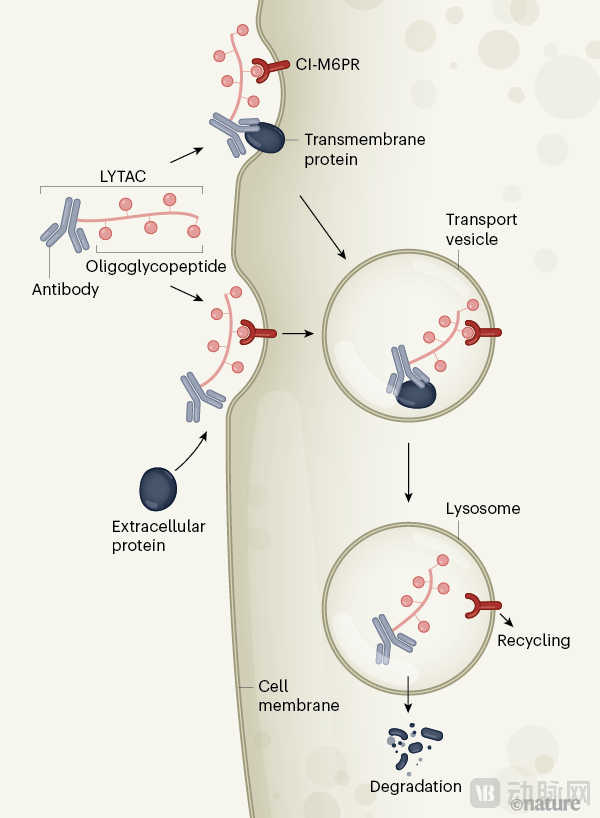
M6P-LYTAC Mechanism of Action (Image source: Nature)
The research group successfully degraded extracellular proteins (apolipoprotein E4) and various membrane proteins, including epidermal growth factor receptor (EGFR), transferrin receptor 1 (CD71), and programmed death-ligand 1 (PD-L1), using M6P-LYTAC, thereby demonstrating the applicability of the LYTAC platform.
Second-Generation LYTAC: GalNAc-LYTAC
Given the widespread expression of CI-M6PR in various cell types, the safety profile of LYTACs with such broad activity remains unclear. Therefore, Bertozzi’s group further explored other lysosome-targeting receptors, aiming to identify receptors with tissue- or cell type-restricted expression for LYTAC development.
Ultimately, the Bertozzi group adopted the lysosome-targeting receptor ASGPR.(asialoglycoprotein receptor),The corresponding ligand is GalNAc.(N-acetylgalactosamine). The related research findings were published in the journal Nature Chemical Biology in March 2021.
The Bertozzi group developed GalNAc-LYTAC, a LYTAC that binds to ASGPR.As ASGPR is a liver-specific lysosome-targeting receptor, GalNAc-LYTAC can degrade extracellular proteins in a cell-type-restricted manner.
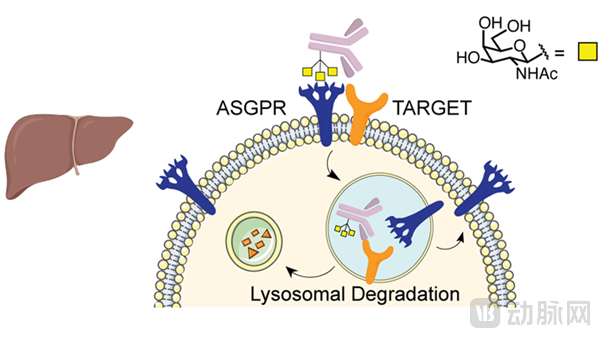
GalNAc-LYTAC (Image source: Nature Chemical Biology)
LYTAC technology overcomes the limitation of previous protein degradation technologies, such as PROTACs, which can only degrade intracellular protein domains, by enabling the degradation of extracellular and membrane proteins, thereby significantly expanding the application scope of targeted protein degradation technologies.
Lycia focuses on the research and development of LYTAC therapies, driving the clinical translation of LYTAC technology, with sufficient innovation and broad market prospects.
Lycia stated that in its early stages, it will focus on cancer and autoimmune diseases. Lycia will primarily develop three classes of therapeutics: molecules targeting transmembrane proteins, molecules capable of clearing protein aggregates or pathogenic immune complexes, and molecules that can degrade circulating antibodies driving autoimmunity.
Through experiments conducted by the Inception team, Lycia Therapeutics carried out validation studies, which demonstrated that both cell surface proteins (such as EGFR and PD-L1) and secreted proteins (such as ApoE4) can be degraded using this technology. Therefore, LYTAC protein degradation technology holds promise for treating a variety of diseases.Receptor tyrosine kinases, which have been difficult to target effectively in the past, or pathogenic immune complexes, are also expected to be degraded through this technology.
In addition, Lycia also plans to leverage LYTAC to develop gene therapies with greater patient acceptance.
Lycia Therapeutics has secured three rounds of financing totaling over $140 million in less than three years since its inception, garnering strong favor from investors.
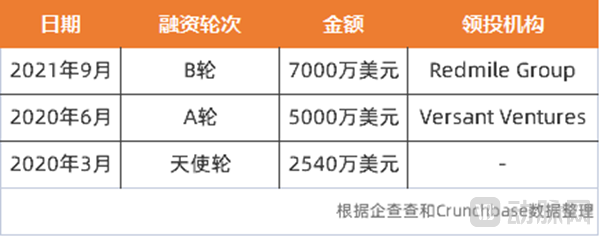
In addition to securing substantial financing, Lycia has also earned the opportunity to collaborate with pharmaceutical giant Eli Lilly.In August 2021, Lycia Therapeutics entered into a strategic collaboration agreement with Eli Lilly and Company (“Lilly”). Under the partnership, the two companies plan to discover, develop, and commercialize protein degradation therapies targeting novel innovative targets using Lycia’s proprietary LYTAC (Lysosome-Targeting Chimeras) technology, with a focus on therapeutic areas including immunology and pain. According to the terms of the agreement, Lycia will receive an upfront payment of $35 million, as well as be eligible for potential milestone payments exceeding $1.6 billion and future sales royalties. Through this collaboration, the two companies will leverage the LYTAC platform to develop up to five protein degraders.
As the earliest company to drive the clinical translation of LYTAC technology, Lycia Therapeutics is backed not only by venture capital firm Versant Ventures and Dr. Carolyn Bertozzi, the pioneer of LYTAC technology, but has also formed a partnership with pharmaceutical giant Eli Lilly. It is poised to become the first company to develop a LYTAC candidate drug, and potentially the first to bring a LYTAC product to market. Let us look forward to that day.