

Breakthrough Discovery in SARS-CoV-2 Antiviral Drug Resistance Mechanism Named Among China's Top 10 Scientific Advances of 2021
Recently, the High-Tech Research and Development Center of the Ministry of Science and Technology (Center for Basic Research Management) officially released the Top Ten Scientific Advances in China for 2021. The research achievement titled “Unveiling the Mechanism by Which SARS-CoV-2 Evades Antiviral Drugs,” accomplished through a collaborative effort by Professor Lou Zhiyong of Tsinghua University; Professor Rao Zihe, who is a professor at Tsinghua University, a distinguished professor at the Institute of Immunochemistry of ShanghaiTech University, and an academician of the Chinese Academy of Sciences; and Associate Researcher Gao Yan’s team from the Institute of Immunochemistry, was successfully selected.
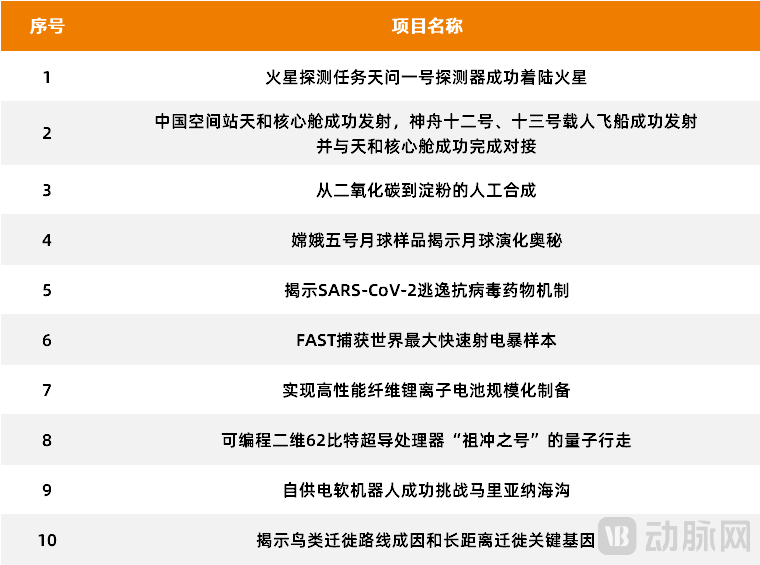
Top 10 Scientific Advances in China in 2021
The “Top Ten Scientific Advances in China” selection activity is led by the High-Tech Research and Development Center (Basic Research Management Center) of the Ministry of Science and Technology, and has been successfully held for 17 editions to date. In this year’s selection, Academician Rao Zihe’s team’s work, “Elucidating the Mechanism by Which SARS-CoV-2 Evades Antiviral Drugs,” was the only research achievement from the medical and health field to be included.
Since the emergence of the COVID-19 pandemic at the end of 2019, a large number of biotechnology companies worldwide have devoted themselves to the research and development of COVID-19 vaccines and therapeutic drugs. Currently, nine COVID-19 vaccines have been launched on the global market, with more than 100 candidate vaccine drugs and over 150 vaccine products under development.
However, the continuous emergence of SARS-CoV-2 variants poses severe challenges to existing antiviral interventions, such as vaccines and neutralizing antibodies, underscoring an urgent need to develop broad-spectrum therapeutics capable of effectively addressing various mutant strains.
Current research on antiviral drugs against the novel coronavirus primarily targets key protein components involved in viral transcription and replication, such as proteases and polymerases. Among these, the process of viral RNA transcription is a critical focus of investigation.
SARS-CoV-2 has the largest genome among all known RNA viruses, encoding a series of nonstructural proteins. These proteins assemble in a specific spatiotemporal order into a complex supramolecular protein machine known as the “Replication-Transcription Complex” (RTC), which includes polymerase, primase, helicase, methyltransferase, nuclease, and various cofactor proteins. The RTC is responsible for the core processes of viral transcription and replication and encompasses many key targets for antiviral drug design.
Due to its large genome and the relatively low fidelity of polymerase replication, SARS-CoV-2 has evolved a unique “proofreading” mechanism: once the polymerase incorporates mismatched bases, the exonuclease (ExoN) nsp14 immediately removes the erroneous bases to ensure accurate replication.
Furthermore, this exonuclease is a unique bifunctional protein that, in addition to its role in proofreading during replication, also catalyzes the critical third step of mRNA capping.
Elucidating the mechanisms of proofreading and capping, as well as how exonucleases function in these two distinct biochemical processes, has been one of the most critical “unsolved mysteries” in coronavirus research over the past two decades.
Following the outbreak of the COVID-19 pandemic, Academician Rao Zihe and Professor Lou Zhiyong’s team at Tsinghua University conducted in-depth research into the transcription and replication mechanisms of SARS-CoV-2. They identified and reconstructed the “capping intermediate complex,” the “mRNA capping complex,” and the “elongation transcription-replication complex,” thereby elucidating their mechanisms of action.
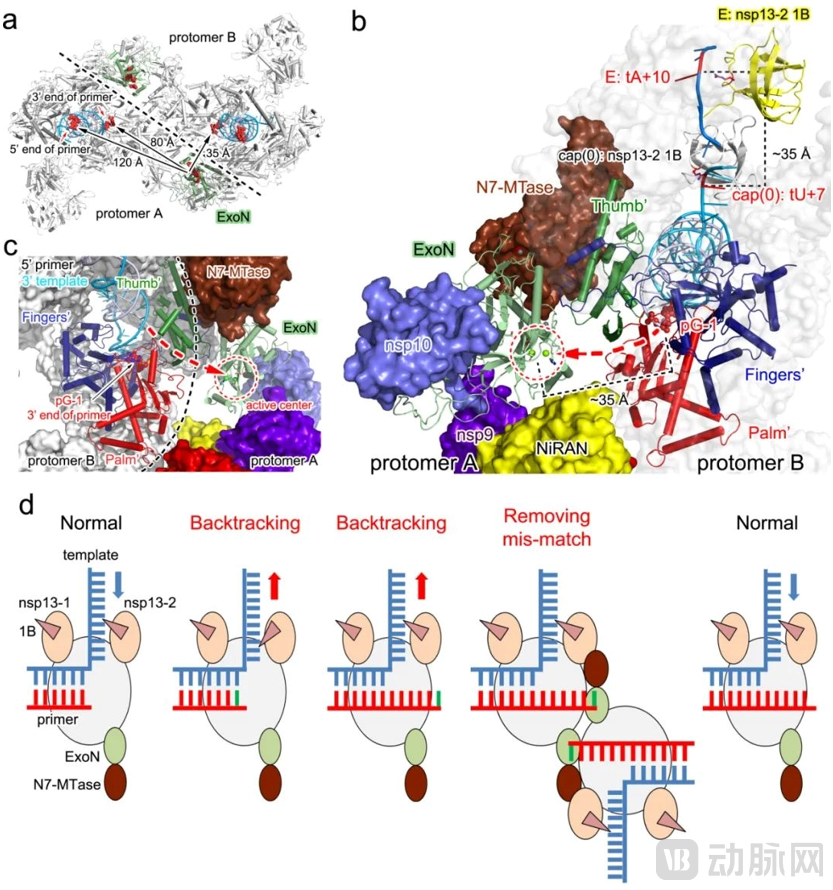
Proofreading and Correction Mechanism of “Reverse Retrospective” Replication of the Novel Coronavirus
Building on this foundation, the team successfully assembled, for the first time worldwide, a supramolecular machine termed Cap(0)-RTC, which incorporates nsp14 protein with proofreading functionality. Structural analysis of this complex elucidated the virus’s “backtracking” mechanism.
In this complex, the nsp9 protein acts as an “adaptor,” recruiting the nsp10/nsp14 complex to the Cap(-1)’-RTC through its interaction with the nsp14 protein, thereby leveraging the N7-methyltransferase domain of nsp14 to complete the third key step of the mRNA capping process. Importantly, the research team discovered that the Cap(0)-RTC forms a stable homodimer in solution. Within this dimer, the helicase nsp13 undergoes significant conformational changes in its 1B domain, directing the reverse movement of the template nucleic acid strand and triggering a product strand backtracking mechanism. This process translocates the 3’ end of the product strand to the active center of the nsp14 exoribonuclease domain in the other Cap(0)-RTC, thereby completing the correction of mismatched bases.
The trans backtracking-based proofreading mechanism proposed by this finding shares certain similarities with the proofreading mechanism of RNA polymerase II (Pol II) in eukaryotic and prokaryotic cells, suggesting that it is the most complex RNA virus in the genome.
The proofreading and backtracking mechanism for replication correction is a crucial mechanism that ensures the accuracy of gene replication in cells from lower to higher organisms, which has not been discovered in previous virus research. The transcription and replication process of the novel coronavirus already exhibits certain similarities with that of higher organisms.
Meanwhile, the proofreading mechanism of replication is a key mechanism by which SARS-CoV-2 evades nucleoside antiviral drugs (such as remdesivir). Once nucleoside analogs are incorporated into the RNA product strand, they are excised by the viral replication proofreading process, thereby losing their inhibitory activity. Currently, only NHC and its derivatives can evade this process. These findings will also provide a critical structural basis for the future optimization and development of novel nucleoside antiviral drugs.
The research team also achieved a world-first by successfully assembling the key state of the transcription-replication complex (RTC) during the transition from step 2 to step 3, naming it cap(-1)’-RTC, and resolving its cryo-electron microscopy structure at 2.8 Å resolution. This complex consists of E-RTC and the single-stranded binding protein nsp9; nsp9 binds to the nucleotidyltransferase (NiRAN) domain of the polymerase nsp12 via its N-terminal amino acids, thereby guiding the transition of cap synthesis from step 2 to step 3.
Subsequently, the team further confirmed that the NiRAN domain of polymerase nsp12 is responsible for catalyzing the second enzymatic step in cap structure synthesis. This achievement resolves a question that has remained unanswered in coronavirus research for nearly two decades, definitively identifying all key enzyme molecules involved in mRNA synthesis for the first time, and providing new targets for antiviral drug development.
Elucidating the mechanisms by which SARS-CoV-2 evades antiviral drugs not only clarifies the molecular basis for the suboptimal efficacy of agents such as remdesivir, but also provides a critical scientific foundation for optimizing polymerase-targeted antiviral therapies.
Building on these achievements, the team published five papers between 2020 and 2021 in Nature, Science, Cell, and Nature Communications. Reportedly, this study is among the most systematic and highly cited works internationally in the field of anti-SARS-CoV-2 drug target research.
References:
1. Gao, Y., L. Yan, Y. Huang, F. Liu, Y. Zhao, L. Cao, T. Wang, Q. Sun, Z. Ming, L. Zhang, J. Ge, L. Zheng, Y. Zhang, H. Wang, Y. Zhu, C. Zhu, T. Hu, T. Hua, B. Zhang, X. Yang, J. Li, H. Yang, Z. Liu, W. Xu, L.W. Guddat, Q. Wang, Z. Lou and Z. Rao, Structure of the RNA-dependent RNA polymerase from COVID-19 virus.Science, 2020. 368(6492): p. 779-782. Yan, L., Y. Zhang, J. Ge, L. Zheng, Y. Gao, T. Wang, Z. Jia, H. Wang, Y. Huang, M. Li, Q. Wang, Z. Rao and Z. Lou, Architecture of a SARS-CoV-2 mini replication and transcription complex. Nat Commun, 2020. 11(1): p. 5874.
3. Yan, L., J. Ge, L. Zheng, Y. Zhang, Y. Gao, T. Wang, Y. Huang, Y. Yang, S. Gao, M. Li, Z. Liu, H. Wang, Y. Li, Y. Chen, L.W. Guddat, Q. Wang, Z. Rao and Z. Lou, Cryo-EM Structure of an Extended SARS-CoV-2 Replication and Transcription Complex Reveals an Intermediate State in Cap Synthesis. Cell, 2020.
4. Yan, L., Y. Yang, M. Li, Y. Zhang, L. Zheng, J. Ge, Y. Huang, Z. Liu, T. Wang, S. Gao, R. Zhang, YY. Huang, L.W. Guddat, Y. Gao, Z. Rao, and Z. Lou. Coupling of N7-methyltransferase and 3′-5′ exoribonuclease with polymerase reveals mechanisms for capping and proofreading. Cell, 2021.
5. Jin, Z., X. Du, Y. Xu, Y. Deng, M. Liu, Y. Zhao, B. Zhang, X. Li, L. Zhang, C. Peng, Y. Duan, J. Yu, L. Wang, K. Yang, F. Liu, R. Jiang, X. Yang, T. You, X. Liu, X. Yang, F. Bai, H. Liu, X. Liu, L.W. Guddat, W. Xu, G. Xiao, C. Qin, Z. Shi, H. Jiang, Z. Rao and H. Yang, Structure of M(pro) from SARS-CoV-2 and discovery of its inhibitors. Nature, 2020. 582(7811): p. 289-293.