

From AI-Powered Oncology to Real-World Data: Zhiben Medical's Digital Transformation Journey
In the past two years, AI has set off a wave of “rapid and aggressive” development in the healthcare sector. According to IDC statistics, the global artificial intelligence market is projected to reach $127 billion by 2025, with the healthcare industry accounting for one-fifth of the total market size. This offers a glimpse into the promising market prospects for AI in healthcare.
AI in healthcare can be segmented into various categories, including AI-driven new drug R&D, AI-assisted examinations, AI medical imaging, smart medical records, surgical robots, and AI-enabled tumor diagnosis and treatment, offering a wide range of application scenarios. Furthermore, digital health is rapidly developing; since 2020, 19 computer vision-based AI products have received Class III medical device approval from the National Medical Products Administration (NMPA), clarifying the application prospects of medical AI. Meanwhile, companies in the AI healthcare industry each possess distinct strengths: Airdoc focuses on AI medical imaging, Senyi Intelligent and Yidu Cloud specialize in AI-powered management of healthcare service workflows, and Infervision concentrates on AI-assisted diagnosis.
As an industry-leading company in digital precision diagnostics and treatment, OrigiMed focuses on the commercialization of AI-powered oncology diagnosis and therapy. In 2020, OrigiMed launched the industry’s first AI-assisted diagnostic model based on genetic variants, which accurately predicts the primary site of tumors with an overall accuracy rate of nearly 90%.
To gain insights into industry developments, VCBeat interviewed Zhang Yuman, AI Director at OrigiMed INC, conducting an in-depth analysis of the AI sector to explore commercialization and technological trends, while seeking to identify the “next chapter” in the evolution of medical artificial intelligence.
Clinically, some patients with metastatic cancer have primary tumors that are nearly undetectable. The primary tumor may be too small to be detected by current technologies, eliminated by the patient’s own immune system, or inadvertently removed during a previous surgery.
The direct consequence of an unidentified primary tumor is a relatively blind treatment approach. Even in the current era where personalized cancer therapy has become mainstream in clinical practice, treatment for these patients still relies primarily on empirical chemotherapy. With a treatment response rate of less than 20%, the threat to their survival is evident. Clinically, patients with cancer of unknown primary (CUP) generally have a short disease course; more than half present with multi-organ involvement, and the metastatic patterns of tumor cells are difficult to trace, leading to a very poor prognosis. Data indicate that the one-year survival rate for these patients is approximately 23%, the median overall survival is 9.1 months, and the five-year survival rate is only 4.7%.
In fact, this patient population is referred to as those with cancer of unknown primary (CUP), accounting for approximately 3%–5% of all cancer cases worldwide. This is a significant cancer category that can no longer be overlooked. Scientists globally are striving to identify methods to locate the primary tumor site in these patients. Clinical diagnostic techniques such as immunohistochemistry (IHC), fluorescence in situ hybridization (FISH), polymerase chain reaction (PCR), and first-generation sequencing have been sequentially employed, but their efficacy remains limited.
Consequently, genetic technologies have progressively entered the field. A study on cancers of unknown primary (CUP) published in JAMA Oncology analyzed gene sequencing results from 200 CUP patients and revealed that 85% (169/200) of them had identifiable targetable genetic alterations through comprehensive genomic testing.
As OrigiCUPAI, the AI-assisted diagnostic product specifically designed for CUP origin tracing under OrigiMed INC, is successively implemented in multiple Grade A tertiary hospitals across China, the landscape of treatment and prognosis for CUP patients may be rewritten.
Prior to the launch of OrigiCUP AI, although genetic testing technologies for Cancer of Unknown Primary (CUP) origin tracing had gradually entered clinical application, the complex data processing involved in the entire workflow could only be performed by traditional bioinformatics analysis algorithms, resulting in prolonged report turnaround times and higher testing costs.
“At present, we are essentially able to apply OrigiCUPAI to the genetic testing reports of every patient with cancer of unknown primary (CUP),” Zhang Yuman told VCBeat. In 2021, OrigiMed pioneered the industry by launching OrigiCUPAI, a CUP prediction model based on genetic variants, thereby breaking the ice and enabling the rapid penetration of CUP testing into clinical practice. It is reported that during the early stages of clinical promotion, OrigiCUPAI has accumulated more than 500 real-world cases. This intelligent auxiliary model, trained on OrigiMed’s Real-World Evidence Precision Database (OKAIN)—which the company has been building since its inception—has received consistent acclaim from clinicians. “We continue to receive invitations from new hospitals seeking to integrate OrigiCUPAI,” stated Zhang Yuman.
Specifically, OrigiCUPAI leverages artificial intelligence deep learning algorithms to deeply mine information from patients’ clinical and genetic testing data, accurately predicting the primary site of tumors. It supports the prediction of 30 common tumor types, with a comprehensive accuracy rate of 87.2% for the top three predictions, thereby assisting clinicians in making accurate diagnoses for patients with Cancer of Unknown Primary (CUP) and enabling timely and precise adjustments to treatment strategies. “OrigiCUPAI has been granted an invention patent certificate by the China National Intellectual Property Administration,” pointed out Zhang Yuman.
In clinical applications, patient samples are first subjected to gene sequencing using OrigiMed’s NGS large-panel testing product, YuanSu. During this process, next-generation sequencing is performed on the complete exons of 672 tumor somatic genes, partial introns of 66 genes, and the complete exons of 65 germline genes. After basic bioinformatic analysis of the raw sequencing data, clinically relevant genetic variant information is generated, including mutations, tumor mutational burden (TMB), microsatellite instability (MSI), and human leukocyte antigen (HLA) profiles.
Subsequently, clinicians need only import genetic variant data into OrigiCUPAI, where algorithms match these variants with disease phenotypes in the database to generate predictions of the primary tumor site with associated probabilities. This enables clinicians to select the most appropriate treatment plan for individual patients based on pathology, imaging findings, and OrigiCUPAI predictions.
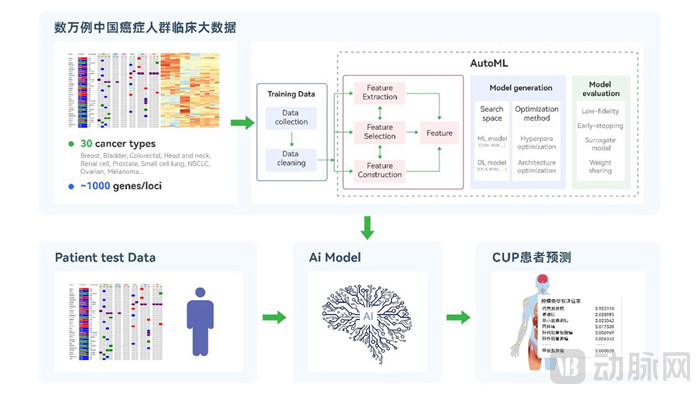
OrigiCUPAI Algorithm Framework
According to Zhang Yuman, OrigiCUP AI has been undergoing rapid optimization and iteration. On one hand, with the accumulation of real-world application data and reverse validation, both the predictive accuracy of OrigiCUP AI and the range of identifiable tumor types have continued to increase. On the other hand, following the promotion of multi-center implementation of OrigiCUP AI, OrigiMed INC has initiated the regulatory submission process for the OrigiCUP AI product certification. Once OrigiCUP AI is clinically deployed as a certified product, the adoption of genetic testing for Cancer of Unknown Primary (CUP) origin tracing will undoubtedly accelerate. Furthermore, OrigiMed INC is also exploring the integration of AI algorithms into genetic testing for other types of tumors to enhance analytical efficiency, thereby further improving the accessibility of tumor genetic testing. “We aim to incorporate AI technology into every genetic testing report,” stated Zhang Yuman.
Underpinning the application of AI in precision oncology diagnosis and treatment is big data in cancer care, which has become a key strategic focus for major genomics companies in recent years.
In February 2018, the multinational pharmaceutical company Roche announced its acquisition of Flatiron Health, a medical big data company. In the same year, it also acquired Foundation Medicine, a leader in cancer genomics data, integrating patients' basic clinical data with tumor molecular genetic testing data to serve as important references for clinical diagnosis and new drug development. In October 2021, OncoKB, the precision oncology knowledge base from Memorial Sloan Kettering Cancer Center (MSKCC), received partial recognition from the U.S. Food and Drug Administration (FDA). It became the first database of cancer somatic mutations to gain such FDA acknowledgment, enabling tumor genetic testing companies to use these data to support the clinical validity of oncology companion diagnostic tests in pre-market submissions. Consequently, the construction and development of clinical oncology genomic databases worldwide have reached a crescendo.
OrigiMed has long recognized the broad applications and value of real-world oncology data in China. In fact, since its inception, OrigiMed has established a clinical real-world database based on tumor genomics. Building on this foundation and integrating vast amounts of literature data, OrigiMed has developed a knowledge network (graph) for precision oncology, providing the essential infrastructure for the development of intelligent applications.
Real-World Data Network (Knowledge Graph): In simple terms, it is a knowledge graph built with artificial intelligence to create a full-course service system for tumor treatment. It organizes and connects multi-dimensional data—including clinical real-world information, molecular-level data, genomic information, and pathological findings—according to technical rules, transforming them into a visualized and structured knowledge network. This is undoubtedly the most ideal application direction for knowledge graphs.
“Our data is collected from multiple dimensions, closely aligning with the needs of database development, and has formed the most highly structured and precise real-world data in the industry. This is a key reason why OrigiMed was able to launch the industry’s first AI-assisted diagnostic model based on genetic variants,” pointed out Zhang Yuman.
“We also found that governance of clinical-grade genomic data is highly specialized,” pointed out Zhang Yuman. “It can only be accomplished through deep collaboration among teams with diverse professional backgrounds, including clinical experts, bioinformatics specialists, and algorithm scientists.” Subsequently, OrigiMed took the rare step in the gene technology industry of building its own AI technical team, accelerating the deployment and breakthrough of related AI applications.
In addition to clinical decision support, OrigiMed is leveraging its database capabilities to empower areas such as digital therapeutics. In 2021, OrigiMed launched its new knowledge base architecture—the ATOM Knowledge Base System—which is being applied across various sectors, including hospitals, patient care, insurance, and pharmaceutical company collaborations.
In the future, as real-world databases continue to accumulate and artificial intelligence expands its reach in digital healthcare, digital precision diagnosis and treatment companies will undoubtedly have even greater opportunities.