

Baidu Health Unveils Innovative Digital Solutions for Pharma Transformation Amid Surging Demand
Previously, rare diseases remained a largely overlooked “hidden corner,” but they are now frequently in the spotlight, drawing collective attention from relevant government agencies and enterprises.
Currently, multiple companies, including internet giants, are actively positioning themselves in the areas of rare disease drug development, disease diagnosis and treatment, and patient science education.
On the recently concluded 15th International Rare Disease Day, Baidu Health launched its Rare Disease Service Platform, offering features such as popular science education on rare diseases, online consultations for RMB 1, and live Q&A sessions with experts. In collaboration with the Boao Lecheng Weijian Clinical Medical Center for Rare Diseases, it also released authoritative educational content on rare diseases. Through public education and awareness-raising initiatives, these efforts aim to advance the development of China’s rare disease health management system.
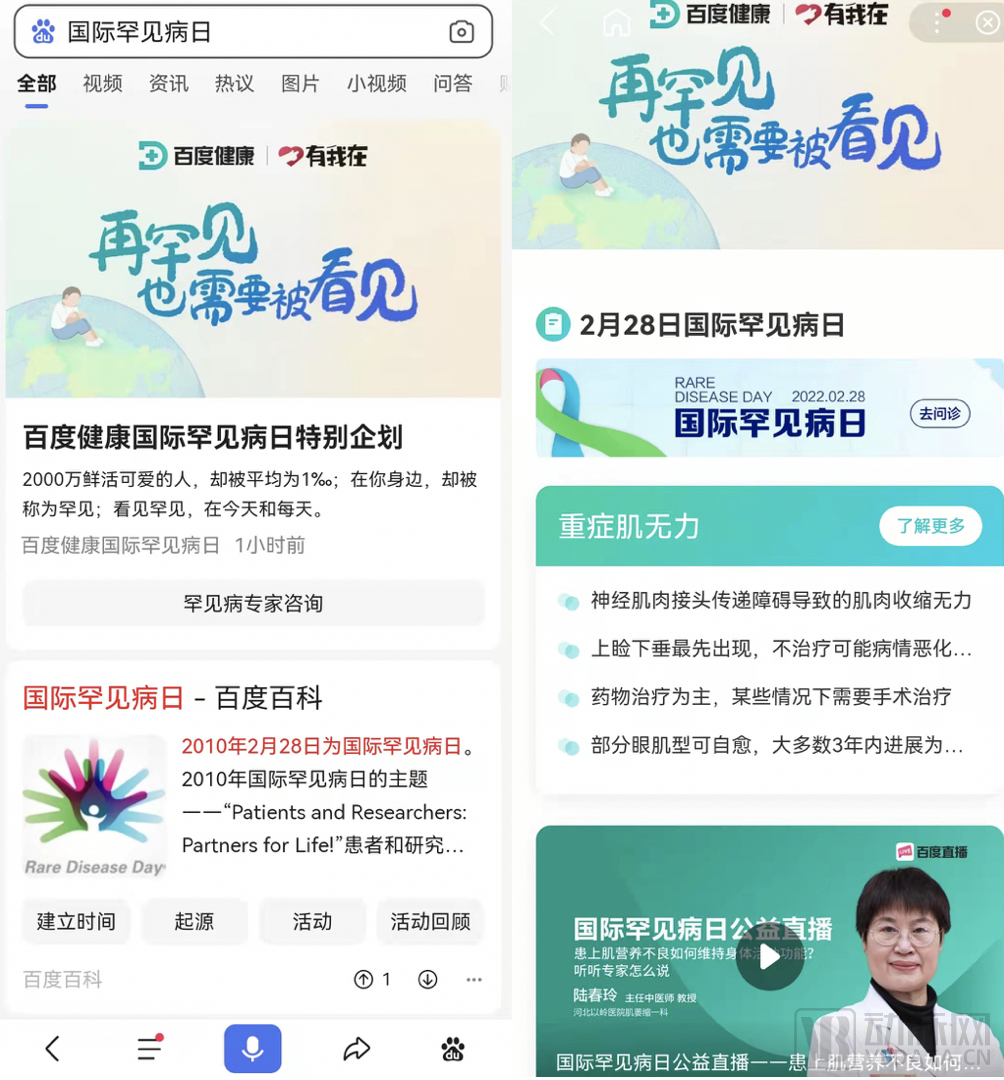
This approach of partnering with innovative industry players enables users to access more authoritative content and services, while the efficient and innovative service models it introduces for pharmaceutical companies have also prompted broader reflection within the industry.
It is no longer novel for internet-based health management platforms to venture into the realm of digital services for pharmaceutical companies. What underpins Baidu Health’s launch of its rare disease service platform at this juncture? Furthermore, how should internet-based health management platforms leverage their inherent characteristics to provide differentiated digital services to pharmaceutical companies?
The digitalization trend in the pharmaceutical industry is undeniable, with market size growing year after year. However, at the specific business level, poor effectiveness and limited methods remain persistent challenges for pharmaceutical companies, driving the entire industry to seek innovation.
The collaboration between Baidu Health and the Boao Lecheng Weijian Clinical Medical Center for Rare Diseases may provide a reference model for pharmaceutical industry partnerships.

At present, enhancing awareness is the primary prerequisite for addressing the difficulties in diagnosing rare diseases, as well as the high rates of missed and misdiagnoses. However, the high threshold of medical knowledge results in significant comprehension costs for users.
Traditional disease education suffers from outdated content and rigid formats. Baidu Health, in collaboration with the Boao Lecheng Weijian Rare Disease Clinical Medical Center, leverages anime-style comics to popularize knowledge about rare diseases, effectively expanding its user base and reaching a younger demographic. In terms of professional expertise, the Boao Lecheng Weijian Rare Disease Clinical Medical Center boasts numerous rare disease specialists, while the Baidu Health platform partners with over 300,000 medical professionals, ensuring the delivery of authoritative health information on rare diseases.
It is reported that the Boao Lecheng Weijian Clinical Medical Center for Rare Diseases, leveraging the “pilot and first-to-try” policies of the Hainan Boao Lecheng International Medical Tourism Pilot Zone, has successfully introduced more than 30 innovative drugs and medical devices for rare diseases, with ongoing efforts to bring in additional products. In close collaboration with the Lecheng Administrative Bureau, the center is committed to improving the accessibility of rare disease medications in China and expanding treatment options, thereby enabling Chinese patients to access innovative therapies and pharmaceuticals synchronized with global advancements.
Meanwhile, Baidu Health handles 15 million annual user searches related to rare diseases. Leveraging the advantages of its search portal, Baidu Health can disseminate innovative and professional health education content to a broader audience. It is conceivable that, in the future, patients with rare diseases and the general public will be able to conveniently access one-stop services—including health information, online consultations, and medication services—through platforms like Baidu Health.
In fact, for a long time,Demand remains high for pharmaceutical companies to engage in drug innovation collaborations through internet-based health management platforms.
Taking rare diseases as an example, there are over 20 million patients with rare diseases in China, who have long faced dilemmas such as low treatment rates, lack of available therapies, and high treatment costs. Fortunately, this situation has improved to some extent as an increasing number of rare disease drugs are included in the national medical insurance scheme. On the pharmaceutical company side, due to the small and dispersed patient population, it is difficult for companies to broadly reach target patients through traditional collaboration models, resulting in low efficiency and high costs. Internet platforms, leveraging their role as “connectors,” can link not only doctors and patients but also pharmaceutical companies.
At present, internet companies are establishing rare disease service platforms to leverage their differentiated advantages for the benefit of patients with rare diseases. Through this innovative approach to rare disease science popularization and collaboration, Baidu Health has not only served users in need but also met the robust demand for digital services from pharmaceutical companies specializing in rare diseases.
In the future, transformation in the pharmaceutical industry will continue. Driven by the implementation of a series of policies—including tiered diagnosis and treatment, consistency evaluation, the “4+7” volume-based procurement program, and Diagnosis-Related Groups (DRGs)—product life cycles are shortening, profit margins are declining significantly, and industry competition is intensifying. As a result, compliant, efficient, and precise digital service models have become an inevitable trend.
Building a Full-Chain Digital Pharmaceutical Service
What Are Baidu Health’s “Trump Cards”?
Throughout the years, there has been no shortage of collaborations between pharmaceutical companies and internet-based health management platforms. However, in multiple fields such as oncology and cardiovascular diseases, many projects have yet to achieve truly low-cost and high-efficiency digital collaboration methods. Currently, most internet platforms on the market still focus primarily on the pharmaceutical e-commerce sector.
Industry insiders state that traditional pharmaceutical e-commerce platforms focus on tapping into the existing market, where users purchase products only after developing medication needs. In contrast, health science popularization can proactively uncover new user demands for health prevention and management, thereby unlocking incremental market growth.
From this perspective,As a gateway for health knowledge searches, Baidu Health may be able to uncover new opportunities in digital services for pharmaceutical companies.Establish user awareness at the initial stage of health management.Currently, Baidu Health fulfills 200 million health-related search queries daily, with over 100 million daily active users. Through various formats such as Baidu Health Medical Encyclopedia entries, popular science Q&A sessions, live streams, short videos, and illustrated articles, the platform collaborates with authoritative experts from pharmaceutical companies to deliver professional educational content. It also addresses user inquiries regarding healthcare products and services, effectively meeting user demands.
Furthermore, Baidu Health integrates one-stop healthcare service scenarios, including online consultations and internet hospitals, to help users address medication-related queries, guide condition-specific drug usage, and facilitate offline medical visits. By reaching users through diverse interaction models and connecting the three key stakeholders—physicians, patients, and pharmaceuticals—it enables multi-channel engagement and provides pharmaceutical companies with effective digital services.
“Beyond tapping into incremental markets, the pain points for pharmaceutical companies in digital services lie in the difficulty of precisely reaching target audiences, the lack of appropriate performance metrics, and a superficial understanding of digitalization that remains confined to tactical innovations,” said a representative from a healthcare company.
In this regard, Baidu Health can leverage Baidu’s AI capabilities to not only precisely match doctors, patients, and hospitals, thereby addressing the mismatch of medical resources, but also effectively align user needs with product and service offerings. Baidu Health de-identifies personal information contained in user search behaviors and results, ensuring that individual identities cannot be recognized. It then conducts research and analysis on healthcare service demands to provide health medical services and content that better meet user needs and serve the public interest.
Currently, Baidu Health has established multiple collaborative cases in the pharmaceutical digital services industry. For instance, Baidu Health announced strategic partnerships with AstraZeneca and GlaxoSmithKline. It is evident that Baidu Health’s footprint in pharmaceutical digital services is rapidly expanding, spanning from chronic disease management and herpes zoster prevention to rare disease services.

The Trend Toward Online Medical Services Is Becoming Increasingly Evident
What Is the Future of Innovative Collaboration in the Pharmaceutical Industry?
On one hand, pharmaceutical companies are under pressure to reduce prices and improve efficiency amid healthcare reforms; on the other, the pandemic has accelerated the digitalization and online migration of healthcare services. The convergence of these two trends has propelled the pharmaceutical digital services sector into an early phase of growth dividends.
Internet-based health management platforms offer pharmaceutical companies a wider range of options for innovative collaborations,Leveraging their advantages in target user acquisition, accumulation of physician resources, and professional health education, internet-based health management platforms are poised to become a primary arena for pharmaceutical companies’ digital services.
As an internet-based health management platform venturing into the field of digital pharmaceutical services, Baidu Health is gradually developing its differentiated capabilities.
Moving forward, continuously expanding business boundaries and forging extensive collaborations with pharmaceutical companies may become a key focus for internet health management platforms in the digital services sector. The partnership between Baidu Health and the Boao Lecheng Weijian Rare Diseases Clinical Medical Center serves as a typical case in point. In the future, we may witness more strategic initiatives between Baidu Health and its pharmaceutical partners.
However, it is also clear that it is no easy feat for internet health management platforms to create standout offerings in the field of digital pharmaceutical services.How to accurately capture user needs and pain points, how to design personalized service solutions based on the characteristics of products and disease areas, and how to set reasonable metrics to measure the final results—all of these rely on the long-term exploration of internet health management platforms and pharmaceutical companies.