

How Johns Hopkins Hospital, Ranked #1 in the U.S. for 23 Consecutive Years, Simplifies Innovation Translation
The hospital was established because John Hopkins witnessed firsthand the epidemics ravaging his hometown of Baltimore. He instructed the trustees that he wished for the hospital “to be comparable in construction and management to any similar institution in Britain or Europe, and to ensure that its services, physicians, and surgeons are of the highest quality and technical proficiency.”
Driven by this vision, Johns Hopkins Hospital was rapidly established in Baltimore, Maryland, and steadily grew to become a household name in the United States, achieving numerous “firsts.”
First is its preeminence in status. Founded 133 years ago, Johns Hopkins Hospital is the birthplace of many renowned medical traditions, including ward rounds, residency programs, and healthcare professional practices. Moreover, it was the first medical institution in the United States to implement standardized residency training.
Next are the clinical “firsts.” Historic milestones in global medicine, such as the first use of rubber gloves during surgery, the first complete gender-affirming surgery, the first coronary artery bypass grafting (CABG) procedure, and the first surgical repair of tetralogy of Fallot in a neonate, all took place in the operating rooms of Johns Hopkins Hospital.
Then there is the “first” in education. The Johns Hopkins University School of Medicine, affiliated with Johns Hopkins Hospital, is the birthplace of modern medical education and has achieved many groundbreaking research findings throughout its history, such as the discovery of restriction endonucleases and endogenous opioids in the brain.
Finally, there is the “No. 1” in terms of influence. Since the inception of U.S. hospital rankings in the early 1990s, Johns Hopkins Hospital has ranked first for 23 consecutive years, making it the medical institution with the most number-one rankings in the United States.
In addition to these well-known “firsts,” Johns Hopkins Hospital also holds a hidden “first”: it is the world’s first research-oriented hospital.
According to the latest financial data, Johns Hopkins Hospital processed 444 invention disclosures in 2021, secured 166 new patents, and executed 144 new licensing agreements, generating approximately $4 million in licensing revenue. In addition, the number of startups incubated by Johns Hopkins Hospital reached 174 in 2021, among which 30 ventures raised $7.68 million in venture capital financing, while initial public offerings totaled $4.96 million.
Behind the Countless “Firsts”: What Makes Johns Hopkins Hospital Truly Unique? A Deep Dive by VCBeat’s Orange Bureau
Incorporating “Inclusivity” Beyond the Standard Model
The “industry-academia-research” integrated ecosystem is hardly a secret in modern medicine; nearly all leading medical institutions worldwide, particularly in the United States where the healthcare industry is highly developed, regard this model as the gold standard for driving medical innovation.
Johns Hopkins Hospital is certainly no exception, but unlike other healthcare institutions, it has specifically established a key term—“inclusivity”—in the process of innovation and translation.
How should this be understood?
Indeed, “inclusivity” has always been rooted in the development philosophy of Johns Hopkins Hospital, serving as a key factor behind its remarkable achievements. The hospital’s founder, Johns Hopkins, stated in his will: “Poor patients from this city and its surrounding areas, regardless of sex, age, or color, who may require surgical or medical treatment… and those injured due to any casualty, shall be admitted to the hospital free of charge.”
It is precisely with this mission in mind that more patients are traveling great distances to seek medical care at Johns Hopkins Hospital. Meanwhile, in order to treat more patients, physicians are continuously refining their clinical skills and exploring new possibilities in therapeutic practice.
Furthermore, the Johns Hopkins University School of Medicine was the first graduate school to admit female medical students and grant them equal rights with their male counterparts. The inclusion of women redefined who could study and practice medicine, as well as how medicine is taught and practiced.
However, on the arduous path of medical innovation and translation, “inclusiveness” alone is insufficient; it must be underpinned by specialized platforms. To this end, Johns Hopkins Hospital pioneered the establishment of a teaching hospital affiliated with its School of Medicine, which gradually evolved into a premier academic medical system integrating clinical care, scientific research, and education—namely, Johns Hopkins Medicine.
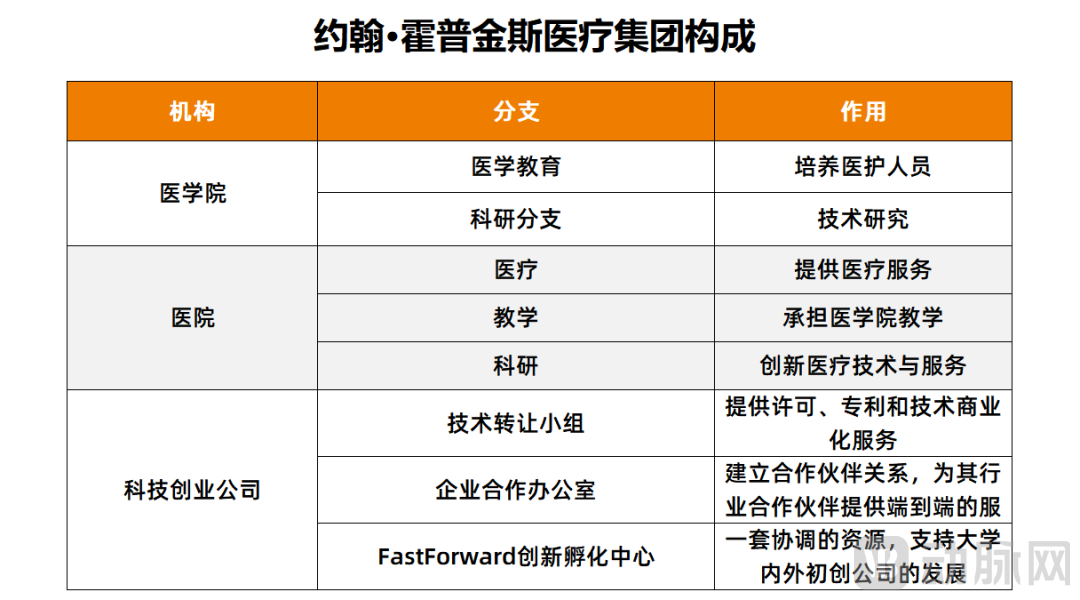
It is reported that the group integrates medical institutions such as Johns Hopkins Hospital with academic and research entities like the Johns Hopkins University School of Medicine, anchored by industry-leading venture capital firms and the university’s intellectual property management arm—Johns Hopkins Technology Ventures (JHTV). This structure creates a complete ecological closed loop from “laboratory” to “market.”
JHTV: Spanning the Entire Innovation Ecosystem
How Exactly Do Johns Hopkins Technology Startups Operate?
In fact, as a key component of innovation and translation at Johns Hopkins Hospital, it is primarily guided by the core values of the Johns Hopkins University School of Medicine, leveraging three major departments to maximize the university’s exceptional research capabilities.
First is the Technology Transfer group. This department provides “one-stop” commercialization services for licensing, patents, and technologies to researchers at the School of Medicine. According to the 2021 annual financial report, the Technology Transfer group processed 444 invention disclosures, secured 166 new patents, and executed 144 new agreements, generating $389,000 in licensing revenue. Furthermore, as of 2021, among the 260 technologies from Johns Hopkins University, there were 2,231 marketed products.
Second, the Office of Corporate Partnerships. This office primarily provides cohesive, end-to-end services to its industry partners by establishing collaborative relationships, and then brings inventions and discoveries from Johns Hopkins laboratories to market through strategic partnerships.
For example, Johns Hopkins University and Bayer recently extended their ophthalmology research collaboration through the end of 2024. The agreement will provide millions of dollars in funding to researchers at the Johns Hopkins Wilmer Eye Institute to pursue treatments for various eye conditions and diseases, while Bayer’s scientists will contribute their expertise in potential therapeutics and drug candidates.
Third, the FastForward Innovation Incubation Center. It is designed to support the development of startups both within and outside the university, providing early-stage financing to high-potential ventures. Reportedly, with the center’s support, 174 startups were active in 2021, 30 entrepreneurial companies secured $7.68 million in venture capital funding, and public stock offerings totaled $4.96 million.
Among these, more than 90% of the startups were founded or co-founded by research teams and student entrepreneurs from within Johns Hopkins University. This undoubtedly provides a complete circulation chain for the technological innovations of Johns Hopkins Hospital and its School of Medicine, facilitating their transition from the laboratory to corporate entities and ultimately to the market.
These three departments operate independently while also collaborating with one another; it is precisely this balance of “independence” and “collaboration” that has significantly facilitated innovation and translation at Johns Hopkins University Hospital and School of Medicine.
Yet its contributions extend far beyond this. To facilitate more effective “engagement” between researchers and the market, Johns Hopkins Technology Ventures provides specialized mentorship and educational resources to researchers and students at Johns Hopkins Hospital and the university’s academic divisions through a variety of initiatives.
First is I-CORPS. The National Science Foundation’s I-Corps program requires participants to test the relevance and feasibility of their technologies through direct customer engagement, helping researchers validate the direction and outcomes of their research.
Next is the Lab-to-Market Bootcamp. Researchers and inventors at Johns Hopkins University learn how to maximize the impact of their research in this bootcamp. The course includes guest lectures by industry professionals, evaluations of key case studies, and weekly demonstrations of the inventors’ technologies.
Next is the Mentors-in-Residence program. This initiative directly brings in seasoned entrepreneurs and pairs them with members of the FastForward Innovation Incubation Center to provide technical expertise and business guidance.
Finally, there is the digital library. Johns Hopkins Technology Ventures provides inventors and innovators with a one-stop resource to learn about commercialization and obtain advice on specific projects. Researchers can access documents and videos online to gain expertise in areas such as translational funding, intellectual property, and venture creation.
Overall, in terms of medical innovation and translation, Johns Hopkins Hospital has successfully established a mature innovation ecosystem by effectively implementing the standardized “clinical–research–education” model. Building on this foundation, Johns Hopkins Technology Ventures leverages specialized platforms and standardized translation mechanisms to continuously accelerate the maturation of the hospital’s innovative projects, ultimately achieving steady growth in both the quality and quantity of translational outcomes.