

China's Two Sessions Unveil 14 Healthcare Priorities and 9 Key Focus Areas to Guide Industry Development
Accelerate the research and development of vaccines and specific therapeutic drugs; advance centralized volume-based procurement of pharmaceuticals and high-value medical consumables to ensure production and supply; regulate fees and services in medical institutions, and continue to provide assistance to medical institutions facing difficulties due to the pandemic... From March 4 to 5, the 2022 Two Sessions convened in Beijing. Notably, on the morning of March 5, the 2022 Government Work Report outlined tasks for the healthcare sector.
In the 2022 Government Work Report, the three tasks of “continuing to carry out normalized epidemic prevention and control,” “enhancing medical and healthcare service capacity,” and “strengthening social security services” encompassed 14 work items related to healthcare.
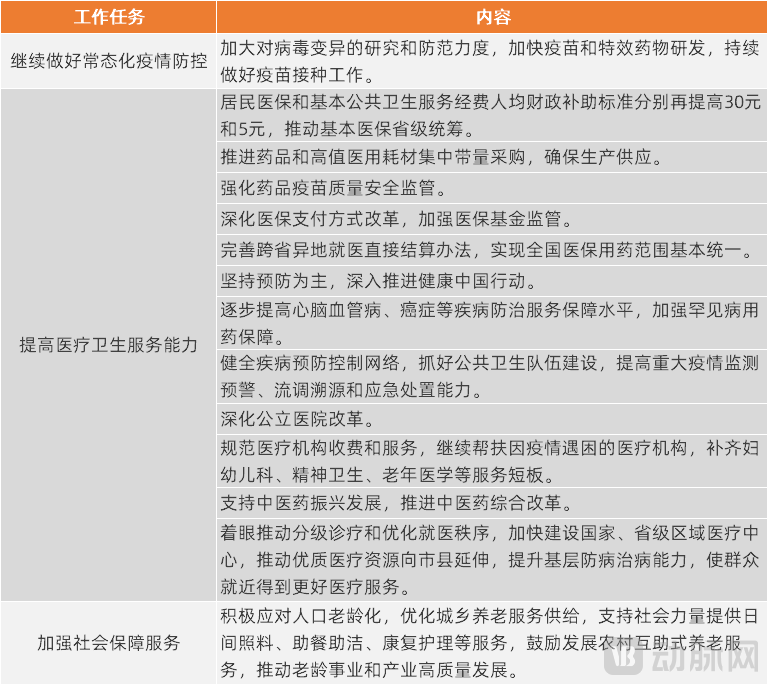
Healthcare-Related Tasks and Goals for 2022 in the Government Work Report, Source: The Central People's Government of the People's Republic of China Website
Among the aforementioned tasks, maintaining routine prevention and control measures remains a key principle for epidemic containment. Meanwhile, as vaccine coverage expands, the focus of epidemic prevention efforts will increasingly include the research and development of specific therapeutic drugs for COVID-19.
In terms of enhancing healthcare service capacity, measures such as increasing fiscal subsidies for basic public health services, advancing centralized procurement of drugs and high-value medical consumables, deepening reforms in health insurance payment methods, promoting the Healthy China Initiative, and implementing tiered diagnosis and treatment have become routine practices. The 2022 Government Work Report specifically emphasized gradually improving the prevention, control, and service guarantees for diseases such as cardiovascular and cerebrovascular disorders and cancer, strengthening medication access for rare diseases; continuing to support medical institutions facing difficulties due to the pandemic; and addressing shortcomings in services for obstetrics and pediatrics, mental health, and geriatric medicine.
It is worth noting that actively addressing population aging has become part of the efforts to strengthen social security services, with support provided for non-governmental entities to deliver services such as daytime care, meal assistance and cleaning support, and rehabilitation and nursing care.
The 14 work tasks outlined the direction for joint efforts by government departments, medical and health institutions, and medical health enterprises in 2022.
During the Two Sessions, what are the top concerns in the suggestions and proposals put forward by deputies to the National People’s Congress and members of the Chinese People’s Political Consultative Conference? To date, VCBeat has compiled more than 50 suggestions and proposals from public reports, covering nine key focus areas across four major sectors: healthcare, pharmaceuticals and medical devices, insurance, and epidemic prevention. These inputs will serve as references for decision-making by relevant authorities over the coming year and beyond, and will influence niche segments within the healthcare industry.
Addressing the Talent Shortage: Empowering Primary Healthcare with Digitalization
Throughout China’s new healthcare reform, tiered diagnosis and treatment has been a central theme; within this framework, primary care, as the weakest link, has become a key focus for development. It also drew significant attention from many deputies and committee members during this year’s Two Sessions.
The shortage of high-caliber professionals and the inability to retain them represent one of the persistent challenges hindering primary healthcare institutions, fundamentally constraining the enhancement of their service capabilities. In response, Wang Jingcheng, a deputy to the National People’s Congress and Chairman of the Medical Group of Northern Jiangsu People’s Hospital, has proposed introducing preferential policies to attract talented individuals to the grassroots level, thereby strengthening internal capacity building. He also advocates for reforming compensation systems to further ensure that personnel within and outside the established staffing quota at primary healthcare institutions receive equal pay and benefits for equal work.
Niu Chaoshi, a deputy to the National People’s Congress and Director of the Department of Neurosurgery at the First Affiliated Hospital of University of Science and Technology of China, has paid particular attention to primary healthcare services. Niu pointed out that retired urban physicians constitute a valuable resource. He expressed hope that relevant authorities would strengthen top-level design to guide experienced senior physicians to practice in primary care hospitals, thereby enhancing service capabilities through mentorship and teaching. He also advocated for preferential policies regarding professional titles and retirement benefits to support rural revitalization.
He Wei, a member of the National Committee of the Chinese People’s Political Consultative Conference (CPPCC) and Chairman of He Eye Specialist Hospital Group, submitted three proposals during this year’s “Two Sessions,” two of which focused on grassroots healthcare and offered insights from a digitalization perspective. He Wei recommended empowering the training of grassroots physicians through internet-based training models and, guided by new health infrastructure initiatives, establishing smart rural health management stations.
In his "Proposal on Caring for Left-Behind Elderly in Rural Areas and Accelerating the Improvement of the Rural Elderly Care Service System," He Wei also recommended encouraging and guiding qualified rural primary healthcare institutions to set up rehabilitation, nursing, palliative care, and elderly care beds. Meanwhile, a health model integrating “Internet + Artificial Intelligence + Big Data + Telemedicine + Health Management” should be established.
Supplement Resources, Innovate Models, and Improve the Rehabilitation Nursing System
While China’s clinical medical standards continue to improve, functional impairments and activity limitations caused by diseases remain a prominent issue, with the development of rehabilitation nursing lagging behind. Against the backdrop of an accelerating aging population, it is particularly urgent to establish a comprehensive rehabilitation nursing system—a priority reflected in numerous proposals and motions submitted by NPC deputies and CPPCC members.
Ma Xiuzhen, a member of the National Committee of the Chinese People’s Political Consultative Conference (CPPCC), Vice Chairperson of the CPPCC Ningxia Hui Autonomous Region Committee, and Director of the Health Commission of Ningxia Hui Autonomous Region, submitted a related proposal. She recommended optimizing and adjusting the layout of rehabilitation medical services, promoting the transformation of some general hospitals into specialized rehabilitation hospitals, and advancing the development of rehabilitation medicine departments in secondary and tertiary hospitals. Rehabilitation talent training should be standardized based on demand, with planned and systematic implementation of degree education, continuing education, and in-service training in rehabilitation-related fields. Furthermore, the number of rehabilitation services covered by medical insurance should be increased, and a reasonable medical insurance payment system for post-acute rehabilitation care should be established.
Zhang Guogang, a member of the National Committee of the Chinese People's Political Consultative Conference and President of the Third Xiangya Hospital of Central South University, proposed a motion to develop the discipline of health management medicine. Zhang believes that advancing this discipline will help alleviate the burden of chronic diseases associated with an aging population. He recommends scientifically defining the scope of health management medicine in clinical practice, collaborating with community and primary healthcare institutions, leveraging technologies such as the internet, big data, and artificial intelligence, and encouraging individual and family participation in health management. The goal is to establish a comprehensive, full-lifecycle health management medical service chain for disease prevention, treatment, rehabilitation, and care, with a particular focus on key populations, especially the elderly.
"Internet Plus Nursing" has emerged as an innovative service model in recent years, with public hospitals deploying their own nursing staff to provide home-based care, while internet platforms aggregate nurses from across China to fulfill service orders.
Huang Xiaoyu, a deputy to the National People’s Congress and Director of the Department of Cardiology at Yangjiang People’s Hospital, believes that accessing medical care and nursing services at home has become a critical need for elderly individuals with disabilities or partial disabilities in the context of home-based elder care. Huang suggests improving the institutional safeguards for multi-site practice by physicians and nurses in community hospitals, revitalizing underutilized resources, and establishing contractual medical service relationships between community hospitals and elderly households. This would involve introducing flexible models such as “home visits by doctors,” “regular home check-ups,” and “purchased medical and nursing care services.”
Home visits by nurses and home-based care can largely address the issue of service accessibility, yet the scarcity of professional nursing resources persists. In response, Zhu Tongyu, a member of the National Committee of the Chinese People's Political Consultative Conference and Vice Dean of Shanghai Medical College of Fudan University, submitted a proposal to strengthen the nursing system. Zhu’s solution involves stratifying the nursing system into different levels—such as nursing assistants, auxiliary nursing, clinical nursing, and nursing science research—based on distinct job contents and responsibilities. Each level would have its own educational focus, with clear pathways for career advancement.
Overcoming the "Data Silo" Challenge, Exploring More AI Application Scenarios
Digital technologies have long been widely applied in the healthcare sector, yet “data silos” remain a stubborn challenge in the process of medical digitalization. In recent years, guided by national policies, driven by health authorities, and built upon the practices of healthcare institutions and enterprises, progress has been made in achieving information interoperability within individual healthcare institutions, between different institutions, and across regions. Nevertheless, there remains substantial room for further improvement.
To address the issue of medical "data silos," Ao Hushan, a member of the National Committee of the Chinese People's Political Consultative Conference and Chief Physician at Fuwai Hospital, Chinese Academy of Medical Sciences, has proposed establishing a unified data information sharing platform for the healthcare industry. This initiative includes developing standardized management and usage protocols with tiered administration, building a comprehensive data security assurance system, fully leveraging modern information technology, ensuring seamless integration with existing systems, and promoting the research and development of equipment related to medical big data.
Xu Ying, a member of the National Committee of the Chinese People’s Political Consultative Conference and Director of the Counselors’ Office of the Hebei Provincial People’s Government, believes that efforts to standardize the medical information system should be accelerated. This includes establishing unified national data standards for health records, electronic medical records, diagnostic systems, diagnosis and treatment catalogs, as well as pharmaceuticals and medical consumables, and issuing unified interface standards to lay a solid foundation for information sharing and interoperability.
During this year’s Two Sessions, Liu Qingfeng, a deputy to the National People’s Congress and Chairman of iFlytek, submitted eight proposals, four of which were related to healthcare. Liu proposed leveraging artificial intelligence to enhance comprehensive screening for adolescent depression. He recommended that the Ministry of Education and the National Health Commission jointly lead the establishment of a mental health service platform and an intelligent depression screening platform to conduct comprehensive screening across all primary and secondary schools nationwide.
In the proposal titled “Recommendations on Accelerating the Application of Artificial Intelligence in Chronic Disease Management and Deepening the Implementation of the Healthy China Strategy,” Liu Qingfeng suggested that the National Health Commission and the National Healthcare Security Administration issue management norms, evaluation standards, and assessment requirements for AI-based chronic disease management applications, and include refined AI-driven chronic disease management services at the primary care level in the national medical insurance reimbursement catalog.
Furthermore, Liu Qingfeng suggested that the National Health Commission take the lead in establishing a standard system for quality control of AI-assisted examination results to facilitate the mutual recognition of imaging findings, thereby accelerating its implementation. Addressing the shortage of elderly care personnel, he also recommended expediting the commercialization of health and wellness robots to enhance their role in rehabilitation training and safety monitoring.
Currently, artificial intelligence is widely applied in the healthcare sector. The approval of Class III medical device certifications for AI-driven solutions in specific disease areas further validates their clinical value, indicating substantial room for future exploration of application scenarios.
Exploring the Unknown: Increasing Investment in Cutting-Edge Technology Research
Overcoming challenges and exploring the unknown have always been enduring themes in the advancement of medicine. During this year’s Two Sessions, some deputies and committee members also put forward suggestions and proposals focused on cutting-edge technologies.
Shen Nanpeng, a member of the National Committee of the Chinese People's Political Consultative Conference (CPPCC) and Founding and Managing Partner of Sequoia China, submitted a proposal titled “Strengthening Brain Science Research and Application to Improve Elderly Brain Health Management,” calling for increased investment in brain science research. In his proposal, Shen recommended expanding cohort studies related to brain disorders, improving the construction of brain databases, and promoting the clinical translation of research findings. He also advocated for funding frontier technologies in brain cognition and brain diseases to enhance the sharing of foundational resources in brain science.
For example, focusing on the clinical treatment of major brain disorders, increase funding for new methods and models of neuromodulation technology, support the integrated application of brain-inspired intelligence and AI, brain-computer interfaces, and wearable devices in the study of brain cognition and brain diseases; simplify application procedures, reduce or waive fees, and enhance technical support from national supercomputing centers for the analysis and processing of massive amounts of data in brain science.
To address the treatment of end-stage diseases, Zhang Guogang, a member of the National Committee of the Chinese People's Political Consultative Conference (CPPCC) and President of the Third Xiangya Hospital of Central South University, submitted a proposal on xenotransplantation at this year’s Two Sessions. Zhang noted that, thanks to the joint efforts of scientists worldwide, including those from China, xenotransplantation has achieved significant breakthroughs and is recognized by the World Health Organization (WHO) as a therapeutic approach for end-stage diseases ready for clinical application. Chinese scientists have demonstrated the safety and efficacy of xenogeneic islet transplantation, earning acclaim from their international peers.
Zhang Guogang recommends formulating a national R&D strategy to bridge the final gap in the clinical application and industrial development of xenotransplantation, thereby securing China’s global leadership in this field.
Innovation’s “Uneven Heat”: A Multi-Stakeholder Effort Needed to Break the Impasse
Innovative drugs have emerged as a hot investment sector in China’s healthcare industry in recent years. However, with the establishment of numerous innovative pharmaceutical companies and the advancement of their R&D efforts, the industry has fallen into the awkward situation of “involutionary R&D competition.”
In this regard, Shen Nanpeng, a member of the National Committee of the Chinese People’s Political Consultative Conference and Founding and Managing Partner of Sequoia China, proposed in a proposal on enhancing drug innovation capabilities that China’s drug R&D needs to better transition from follow-on innovation to source innovation. Improvements and optimizations should be made in multiple areas, including basic research innovation, intellectual property protection, national policy support, the establishment of technical communication mechanisms, and global resource integration, thereby better achieving concurrent progress in new drug development and addressing clinical needs.
Rare diseases represent another frontier for innovative drug development; however, due to the small patient populations, pharmaceutical companies are concerned that substantial investments may not yield commensurate returns. Consequently, in contrast to high-profile areas such as oncology, there is an urgent need for greater corporate participation in the rare disease sector.
Ding Lieming, Deputy to the National People’s Congress and Chairman and CEO of Beta Pharma Inc., submitted the “Proposal on Further Encouraging and Supporting the Research and Development of Orphan Drugs.” First, he proposed strengthening national-level coordination for the diagnosis and treatment of rare diseases by establishing a special working committee to formulate systematic policies and mechanisms covering rare disease diagnosis and treatment, orphan drug R&D, and medical insurance reimbursement. Second, he called for increased incentives for orphan drug R&D. He recommended policy preferences and greater funding support for orphan drug R&D in national research project applications, including a 50% tax reduction based on orphan drug R&D expenditures. Preferential policies for registration and approval should also be provided. Furthermore, he proposed granting market exclusivity protection for orphan drugs, providing approved orphan drugs with a certain period of market exclusivity during which no other drug of the same variety for the same indication would be approved for marketing.
Regarding innovative medical devices, Yuan Yuyu, a deputy to the National People’s Congress and Chairman of Guangzhou Medprin Regenerative Medical Technologies Co., Ltd., proposed implementing the principal role of enterprises in the scientific and technological innovation system, ensuring that companies occupy a significant position in the allocation of scientific and technological resources, and encouraging enterprises to lead or participate in key research and development programs. Mr. Yuan also called on national authorities to issue guidelines to promote market access policies for innovative products across eligible provinces and municipalities nationwide.
Policies such as centralized procurement and the “dual-channel” mechanism will continue to shape the distribution landscape for pharmaceuticals and medical consumables
Amid the normalization of centralized drug procurement, substantial changes have already occurred in the generic drug sector and the pharmaceutical distribution landscape. In the future, these changes will continue to impact a broader range of pharmaceuticals and medical consumables.
Centralized procurement of dental implant consumables showed early signs in 2021. Prior to this, multiple provinces conducted surveys and data collection on dental implants; however, the actual implementation of centralized procurement still faced numerous challenges. During this year’s Two Sessions, Yu Xinwei, a member of the National Committee of the Chinese People’s Political Consultative Conference (CPPCC) and Vice Chairman of the Guangzhou Municipal Committee of the CPPCC, submitted a proposal recommending the launch of national centralized procurement for dental implant consumables and their inclusion in the medical insurance scheme, so as to promote the high-quality development of China’s oral care industry chain.
Yu Xinwei believes that the reasonable collection of a special fund for the oral care industry can sufficiently support the national medical insurance pooling fund, preventing reforms from stalling; nationwide centralized procurement will break down import barriers, accelerate the substitution of domestic brands, and unleash a trillion-yuan market space within China’s oral care industry chain, generating new economic contributions to offset medical insurance expenditures; furthermore, strengthening industry-academia-research collaboration and encouraging the integrated development of oral science with emerging industries will facilitate high-quality development across the oral care industry chain.
It appears that the centralized procurement of dental implant consumables is imminent, and the landscape of the oral care consumables market will consequently undergo changes in the future.
Regarding pharmaceutical distribution, Ke Yunfeng, Chairman of Dashenlin Pharmaceutical Group and a deputy to the National People's Congress, believes that under the national "Dual-Channel" policy, professional community pharmacies will further assume responsibility for dispensing drugs included in national price negotiations, particularly those for special diseases and innovative therapies. This will ensure medication supply for outpatients with special chronic conditions and designated serious illnesses outside hospital settings. Ke Yunfeng recommends encouraging eligible regions to orderly expand both the formulary catalogs and the number of community pharmacies. While supplying medications, professional community pharmacies must also guarantee the effectiveness, safety, and cost-effectiveness of drug therapy. In particular, for long-term prescriptions filled at community pharmacies, these pharmacies should collaborate with medical institutions to provide specialized, continuous medication therapy management covering the entire course of patients' treatment.
How Can the Medical Insurance Fund Increase Its Revenue If the Coverage Scope Is Expanded?
In recommendations and proposals related to medical insurance, a significant number address the safeguarding of people's livelihoods. Deputies and committee members have expressed hope that more diseases or medications will be included in the medical insurance coverage to enhance the level of protection.
For instance, during this year’s Two Sessions, Cai Weiping, Chief Expert at the Infectious Disease Center of Guangzhou Medical University’s Eighth Affiliated Hospital and a deputy to the National People’s Congress (NPC), proposed including non–Expanded Program on Immunization (EPI) vaccines in the national medical insurance coverage. Huang Xiaoyu, Director of the Department of Cardiovascular Medicine at Yangjiang People’s Hospital and an NPC deputy, suggested incorporating intelligent wearable remote monitoring into medical insurance reimbursement to support the sustainable development of internet-based medical services. Du Liqun, Head Nurse at Nanning No. 4 People’s Hospital in Guangxi and a member of the Chinese People’s Political Consultative Conference (CPPCC) National Committee, called for continuing to advance price reductions for more rare-disease drugs through negotiated market access and establishing a “rare-disease diagnosis and treatment cost package.”
A review of past responses from the National Healthcare Security Administration (NHSA) to NPC deputies and CPPCC members reveals that basic medical insurance is positioned to provide fundamental coverage, with limited fund resources. Consequently, the inclusion of any disease category or medication undergoes comprehensive assessment and is implemented in a gradual, step-by-step manner. Therefore, the aforementioned proposal will also be subject to thorough deliberation before a decision on its inclusion can be made.
At the same time, there are also calls to "increase revenue" for medical insurance.
Zheng Bingwen, a member of the National Committee of the Chinese People’s Political Consultative Conference (CPPCC) and Director of the World Social Security Research Center at the Chinese Academy of Social Sciences, submitted a proposal titled “Accelerating the Preservation and Appreciation of Medical Insurance Funds.” For instance, “negotiated deposits” should be implemented for the basic medical insurance funds for urban and rural residents and for the basic medical insurance funds for urban employees that have not yet achieved provincial-level pooling. A thorough reform of the “three-year zero-deposit, lump-sum withdrawal” scheme should be carried out, raising the average interest rate to approximately 3.0%, an increase of at least 1.7 percentage points over current levels. In provinces that have achieved provincial-level pooling but have relatively small fund sizes, the U.S. bond investment model could be adopted by issuing special government bonds to purchase surplus medical insurance funds, thereby ensuring preservation and appreciation. In provinces that have achieved provincial-level pooling and have large fund sizes, the investment model of the basic old-age insurance fund could be referenced, with provincial governments entrusting the National Council for Social Security Fund (NCSSF) to manage investments; alternatively, following the occupational annuity approach, provincial governments could select professional investment institutions to manage these funds. Regardless of the reform model adopted, local authorities should maintain six months’ worth of liquid assets available for payment, particularly during the pandemic period, to ensure the solvency of medical security payments.
Hui Min Bao and Long-Term Care Insurance Remain Key Areas of Focus
In the past two years, following its rapid nationwide rollout, “Huimin Bao” (inclusive supplementary medical insurance) has drawn widespread attention from insurers, insurtech companies, and residents alike; however, its sustainability has also raised concerns within the industry. This year, deputies and committee members have put forward recommendations and proposals in light of the new stage of development for Huimin Bao.
Sun Jie, a member of the National Committee of the Chinese People’s Political Consultative Conference and Deputy Dean of the School of Insurance at the University of International Business and Economics, has proposed strengthening policy support for Huiminbao (inclusive commercial health insurance). Sun argues that it is necessary to improve mechanisms for market entry and exit, subsidies for break-even operations, cross-regional service provision and settlement, and performance evaluation, so as to ensure the long-term sustainable operation of Huiminbao projects. She also calls for the establishment of a data-sharing platform to facilitate information exchange among traditional healthcare institutions, basic medical insurance programs, and commercial insurers, thereby promoting data sharing between public medical insurance and commercial insurance. Furthermore, she advocates for advancing the development of Huiminbao in central and western regions, encouraging insurance institutions to explore pathways for cross-regional integrated development, achieving broader risk pooling, and enhancing risk management and service quality.
Zheng Bingwen, a member of the National Committee of the Chinese People’s Political Consultative Conference (CPPCC) and Director of the World Social Security Research Center at the Chinese Academy of Social Sciences, noted that Huiminbao has accumulated seven years of experience. He recommended that the National Healthcare Security Administration introduce relevant policies to support Huiminbao, which would help bolster individual confidence in enrollment and increase participation rates. He also suggested that the industry establish self-regulatory organizations and develop industry standards.
Long-term care insurance is an insurance category that has been accelerating its development in response to the intensifying aging of the population, with pilot programs being rapidly expanded in recent years. According to Zhang Lin, a deputy to the National People’s Congress and Director of the Institute of Risk Management and Insurance Actuarial Science at Hunan University, long-term care insurance currently faces several challenges, including discrepancies in eligible participants across different regions, ambiguous boundaries of coverage, fragmented fund pooling, and an urgent need to standardize benefit payment standards.
Zhang Lin recommends establishing a sound, independent long-term care insurance (LTCI) system with universal coverage, and alleviating the pressure on basic medical insurance funds by transferring a certain proportion of funds from individual accounts to LTCI funds. She also suggests formulating preferential policies to attract social capital, encouraging broad participation by social organizations, expanding financing channels, and enhancing LTCI service capacity. Furthermore, she proposes developing tax-advantaged commercial long-term care insurance to create a complementary mechanism with social insurance.
Summarize Achievements, Improve Systems, and Implement a Unified Health Code
Since the outbreak of the COVID-19 pandemic, China’s “dynamic zero-COVID” policy has not only ensured effective epidemic control but also maintained the normal operation of the socio-economic system. Based on the arrangements for epidemic prevention and control outlined in the Government Work Report, this principle will continue to be upheld.
Zhang Boli, a deputy to the National People’s Congress and an academician of the Chinese Academy of Engineering, also recommended adhering to the dynamic zero-COVID strategy and making greater efforts to optimize targeted prevention and control measures. Zhang suggested that further work should be focused on refining plans for precise containment, more accurately delineating the boundaries of lockdown zones, controlled-access zones, and precautionary zones, and strictly enforcing isolation periods without imposing excessive or layered restrictions, so as to minimize disruptions to the daily lives of other residents. He expressed hope that relevant authorities would comprehensively review the achievements and shortcomings in epidemic prevention and control over the past two years, and incorporate effective experiences into existing laws, regulations, policies, and institutional frameworks.
During the period of normalized pandemic control, the public has long become accustomed to displaying their health codes in various public places to indicate their health status. Cai Weiping, a deputy to the National People’s Congress and chief expert at the Infectious Disease Center of Guangzhou Eighth People’s Hospital, affiliated with Guangzhou Medical University, highlighted several practical issues concerning health codes: Health codes were developed independently by different localities, with their managing authorities belonging to disparate systems; in some regions, there were even incidents of health code database crashes. Moreover, management practices for “code color changes” varied across regions, leading to situations where the same individual had different health code colors in two different places at the same time.
In this regard, Cai Weiping recommends incorporating health codes into a unified national management system, with centralized deployment, standardization, and administration at the national level. This approach would consolidate epidemic prevention and control information from various regions, thereby breaking down data silos. Health codes should display information on epidemic-affected areas with greater precision, leveraging the advantages of big data to accurately pinpoint such zones. Individuals traveling from areas with different risk levels should be clearly identified and flagged, enabling destination regions to promptly monitor arrivals from medium- and high-risk areas and enhance the effectiveness of health codes. Meanwhile, personal information protection must be strengthened. Health codes should not list all regions visited or transited through within the past 14 days; instead, they should only indicate medium- and high-risk epidemic-affected areas that individuals have previously visited.
According to public information from the National Health Commission, the National Healthcare Security Administration, and the National Medical Products Administration, these three agencies have implemented and responded to suggestions and proposals from the 2021 Two Sessions over the past year, issuing more than 620 responses in total. Among these, suggestions and proposals such as strengthening medical security for rare diseases and including assisted reproductive technology in medical insurance have transitioned from recommendations to concrete measures. What key impact will the suggestions and proposals from this year’s Two Sessions have on major decisions by health and medical-related departments? Only time will tell.