

Policy Tailwinds and Soaring Stock Prices Signal Imminent Breakout for China's Elderly Care Industry
Recently, a document issued by the General Office of the Shanghai Municipal People’s Government has drawn attention to the elderly care sector. The “Implementation Plan for Promoting High-Quality Development of Elderly Care and Childcare Services in Shanghai” states that eligible elderly care institutions will be supported in raising funds through initial public offerings and the bond market.
Subsequently, the State Council and its ministries issued a series of major policies in quick succession, leading to a broad rally in stocks related to the elderly care sector. Notably, Yuexin Health, a company providing integrated medical and elderly care services, hit the daily upper limit five times. As of the market close on March 4, its share price had risen by 67% compared to the level before the Shanghai policy announcement.
“We project that the elderly care sector’s share of the health industry will quadruple, or even more, over the next five to ten years.” According to Wang Bin, Managing Director at iCapital, the “age-friendly” transformation of China’s healthcare services market will be the most significant theme in the coming decade, unlocking incremental market opportunities worth trillions of yuan.
As China’s population aging trend becomes increasingly prominent and severe, the elderly care industry has become a widely recognized blue-ocean sector. However, inherent characteristics of the industry—such as large investment requirements, low profit margins, and long payback periods—have raised entry barriers for investors and slowed the pace of corporate development.
At present, the aging industry appears more “beautiful on the surface.” In the future, time may well prove all things; yet, can the industry accelerate its pace and enhance its certainty? VCBeat seeks to find answers through the following analysis.
The elderly care industry has never lacked policy support; the document cited at the beginning of this article is just one example. In particular, following the release of the “Communiqué of the Seventh National Population Census” in 2021, central and local governments have intensively rolled out relevant policies to support the development of the elderly care sector from multiple angles, including supplementing service supply and strengthening the social security system.
On February 21, the State Council issued the "14th Five-Year Plan for National Aging Cause Development and Elderly Care Service System," which has become the guiding document for elderly care services over the next five years. The document points out that it supports social forces in building professional, large-scale elderly care institutions with outstanding capabilities in integrating medical and elderly care services, promoting their leading role in improving long-term care service standards, cultivating and reserving professional talents, implementing informatized and intelligent management services, and popularizing the application of rehabilitation assistive devices.
The Plan consolidates the development goals for aging-related initiatives and the elderly care service system, which were previously scattered across various policy documents, and establishes nine specific quantitative indicators, including the total number of elderly care beds, the monthly visitation rate for seniors in special difficulties, and the compliance rate of elderly care service facilities.
The National Health Commission, the China Banking and Insurance Regulatory Commission, and other departments have also introduced supportive policies within their respective areas of responsibility, covering integrated medical and elderly care, rehabilitation and nursing services, and commercial pension insurance.
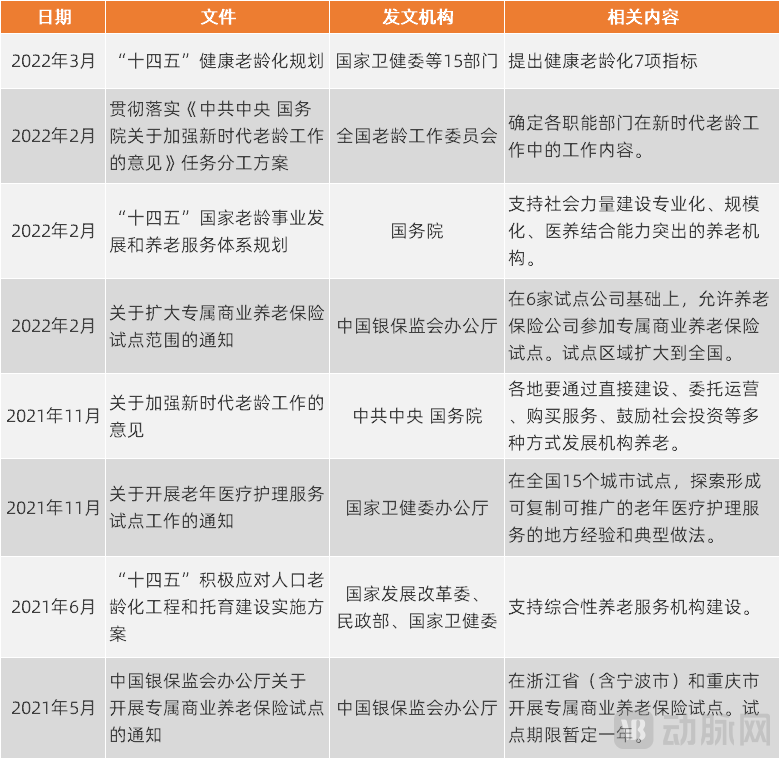
Intensive Elderly Care Service Policies in the Past Year; Source: Chinese Government Website, Official Website of the National Health Commission; Graphic by VCBeat
Behind the flurry of policies lies the anxiety brought about by an aging population.
In 2021, Professor Du Peng from the Center for Population and Development Studies at Renmin University of China published a paper titled “Long-Term Projections of Population Aging in China in the New Era.” By incorporating factors such as current population size and structure, mortality levels and patterns, and fertility levels and patterns, the study projected the scale of population aging over the coming decades using two sets of parameters. The projections indicate that the number of people aged 60 and above in China will continue to grow during the first half of the 21st century, reaching 412 million by 2035 and 480 million by 2050.
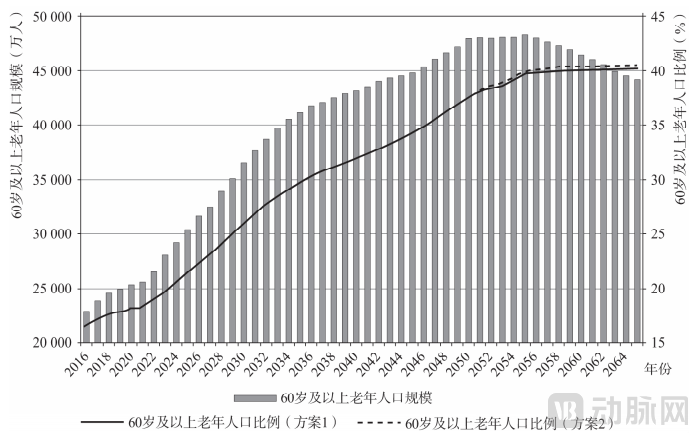
Trends in the Size and Proportion of China’s Elderly Population. Source: Article “Long-Term Forecast of Population Aging in China in the New Era,” Journal of Renmin University of China, Issue 1, 2021.
The aforementioned projections were based on baseline data from the 2015 mini-census. According to the Communiqué of the Seventh National Population Census released in 2021, China’s population aged 60 and above reached 264 million in 2020, slightly higher than the projected figure of 254 million.
Since 2021, China has implemented the three-child policy, with various regions successively adopting measures such as medical insurance reimbursement and direct subsidies to alleviate the financial burden of assisted reproductive technology. These proactive initiatives aimed at encouraging childbirth may, to some extent, influence future demographic structures. Nevertheless, as the populations born during the second and third baby booms in the People’s Republic of China enter old age, coupled with increasing life expectancy, it is inevitable that the size of China’s elderly population will reach its peak in the coming decades.
The aforementioned article also points out that, based on projected figures, population aging in China is evolving in a phased, wave-like pattern characterized by alternating periods of rapid and slow growth. It is essential to grasp this characteristic and shift from a reactive mindset in addressing aging-related issues to a proactive, forward-looking approach.
Currently, it is imperative to plan ahead and make long-term strategic arrangements during the period of gradual population aging.
In addition to traditional forms such as nursing homes, elder care facilities, and welfare institutions, elderly care services have diverged in recent years into two major models based on service settings: First, institutional elderly care, where facilities established with private capital participation are typically comprehensive elderly care communities that integrate residential living, daily life assistance, medical healthcare, and rehabilitation nursing. Second, new community-based elderly care, which establishes chain-operated nursing stations or day care centers to serve surrounding neighborhoods. Centered around the daily living radius of older adults, this model primarily provides in-home or community-based services, including daily life assistance, medical care, professional nursing, and rehabilitation. Some enterprises have also built small-scale elderly care facilities or taken over the operation of public elderly care institutions to meet users’ multi-level needs.
Insurance Companies Accelerate Their Expansion into Institutional Elderly Care
Insurance companies have become significant participants in integrated elderly care communities, with distinct advantages. Through the design and operation of health insurance products, insurers have accumulated extensive medical resources or directly invested in establishing hospitals, thereby laying a solid foundation for integrating medical and elderly care services. Furthermore, insurance companies can integrate elderly care services with insurance products, creating a synergistic ecosystem between service provision and payment mechanisms.
Currently, major insurers such as Taikang, China Life, CPIC (China Pacific Insurance), China Taiping, New China Life Insurance, and Ping An have all entered the elderly care services sector and are accelerating their development. For instance, as one of the earliest insurance capital enterprises to enter the elderly care industry, Taikang has established “Taikang Community,” a high-quality senior living community, and innovatively constructed a business model that combines virtual insurance payment with physical medical and elderly care services. On the payment side, it offers commercial insurance products such as annuity insurance, long-term care insurance, and pre-need contracts. On the service side, it provides integrated, customer- and patient-centered, one-stop services encompassing medical care, elderly care, rehabilitation, and hospice care.
Institutional elderly care is a capital-intensive investment, requiring substantial outlays for real estate, facilities, and equipment. To achieve economies of scale by establishing multi-location integrated communities and senior-living towns, even larger capital commitments are necessary. According to China Pacific Insurance’s financial reports, the company completed its initial RMB 10 billion investment in senior-care real estate by 2020, with seven construction projects launched across six cities: Chengdu, Dali, Hangzhou, Shanghai, Xiamen, and Nanjing.
Therefore, in addition to insurance companies, integrated senior living communities are primarily invested in by well-capitalized investors with ample resources, such as real estate developers, banks, and large healthcare industry groups.
Other industrial conglomerates are also transforming and positioning themselves in the medical and elderly care sector, serving as another type of participant in institutional eldercare. Yuexin Health, mentioned at the beginning of this article, is a company that transitioned from building materials to medical and elderly care. Although Yuexin Health entered the medical and elderly care field as early as 2015, its financial reports show that the revenue share of its medical and elderly care segment currently remains below 10%, which further illustrates the “slow” nature of investments in the eldercare sector.
New Community-Based Elderly Care Service Institutions Are Becoming Increasingly Active
In recent years, a wave of new community-based elderly care service institutions has been established and rapidly developed. The term “new” is used in contrast to traditional nursing homes and eldercare facilities, with their service models showing an increasing trend toward diversification. “These new community-based elderly care institutions require relatively lighter investment and feature more flexible operational models, becoming increasingly active in recent years.” Wang Bin, who has many years of investment experience in the elderly care industry, has observed these changes.
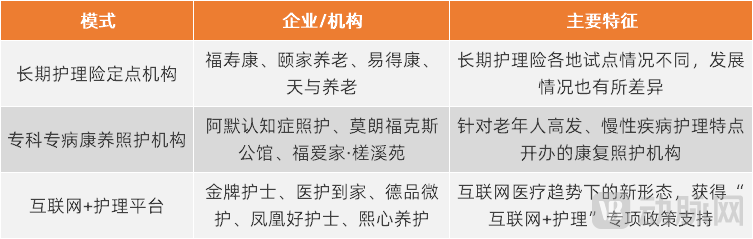
Several Models of New Community-Based Elderly Care Service Institutions. Source: Public information and interviews; graphic by VCBeat
During the national pilot program for long-term care insurance (hereinafter referred to as “LTCI”), a number of new community-based elderly care service providers, including Fushoukang, Yijia Elderly Care, Yidekang, and Tianyu Elderly Care, were included in the list of designated institutions.
Fushoukang has established a service network system comprising “Medical Nursing Stations + Community Care Centers + Nursing Homes,” creating a fully closed-loop service scenario that integrates home-based, community, hospital, and nursing home care. Leveraging long-term care insurance (LTCI) services as a key driver, the company has successfully implemented a comprehensive home-based care model. As the number of pilot cities for LTCI expands, Fushoukang is replicating its service expertise in other regions.
Leveraging the Long-Term Care Insurance (LTCI) program, Yijia Elderly Care began with in-home care services and gradually expanded its community-based service infrastructure. Various operational models have been progressively implemented, including nursing stations, adult day care centers, residential care homes for the elderly, nursing homes, integrated care complexes, senior activity centers, Traditional Chinese Medicine (TCM) rehabilitation clinics, and neighborhood community hubs.
Wang Bin noted that wellness and care institutions specializing in specific medical specialties and diseases represent another avenue for innovation. “For instance, Alzheimer’s disease in the mental health sector has become a market hotspot since last year. It spans multiple fields, including elderly care, brain health, and chronic disease management, drawing significant attention from investors. Currently, numerous rehabilitation and elder-care facilities for Alzheimer’s patients have emerged, but they are all in their early stages.”
It is reported that care facilities such as Hunan’s Ademo Dementia Care, Shanghai’s Morang Fokes Mansion, and Fuaijia Chaxi Yuan specialize in admitting elderly patients with Alzheimer’s disease.
Wang Bin also mentioned that some chain medical institutions specializing in orthopedics and sports rehabilitation are involved in elderly rehabilitation, and due to their proximity to communities and home settings, they constitute part of the new model of community-based elderly care. In addition, some medical institutions are transitioning into health and wellness care facilities, but this segment accounts for a small share of the market and has not yet become a major force.
“We are delighted to see that ‘Internet Plus’ is increasingly penetrating the elderly care industry, with ‘Internet Plus Nursing’ being the most typical example and giving rise to outstanding enterprises such as Gold Nurse,” said Wang Bin.
“Internet + Nursing” is also one of the sectors encouraged by special national policies. Gold Nurse integrates its online app, offline nursing stations, and hospitals and registered nurses across China to ensure grounded offline support and extensive service coverage. Depin WeiHu, leveraging Depin Medical’s smart nursing solutions for hospitals, mobilizes hospital-based nurses to provide home nursing services to users.
VCBeat also learned that Shanzhen enters the elderly health service market through the “Internet + Health Checkup” model, while Chunhui Wisdom integrates smart care devices with home-based caregiving services. These models, which leverage new technologies, are closely aligned with seniors’ living environments, and target specific usage scenarios, can also be regarded as part of the new community-based elderly care ecosystem.
With a potential user base of hundreds of millions, the market appears vast. According to data released by the Ministry of Industry and Information Technology, China’s elderly care industry is projected to exceed 20 trillion yuan in market size by 2030. However, certain inherent characteristics have also become obstacles to accelerating the industry’s development.
From the supply side, high-quality services are scarce, and the return on investment cycle is long.
“China’s elderly care services industry, including senior living communities, remains in an exploratory stage across various aspects such as strategic positioning, development planning, operational models, and business processes,” said a representative from Taikang Community. The elderly care sector is characterized by substantial upfront investments, long payback periods, and relatively low tolerance for financing costs. Meanwhile, the entities investing in and operating senior living communities are diverse in nature—including real estate developers, insurance companies, central and state-owned enterprises, and state-owned asset platforms—leading to significant variations in their regulatory requirements, financing environments, and capabilities.
A review of the financial data from the elderly care segments of listed insurance companies reveals characteristics of long-term investment. For instance, New China Life Insurance has established three service product lines: active wellness, continuing care, and rehabilitation nursing. In the first half of 2021, the elderly care services business under New China Life Insurance reported a negative profit. Most insurance companies have only disclosed the continuously expanding scale of their elderly care service investments, but have not yet released revenue or profit figures.
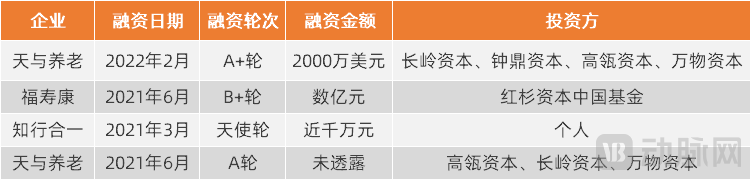
Three New Elderly Care Service Institutions That Secured Financing in 2021, Data Source: Artery Orange, Chart by VCBeat
In the emerging sector of community-based elderly care, companies such as Fushoukang, Zhixing Heyi, and Tianyu Elderly Care have secured new financing since 2021; however, transaction activity remains relatively sluggish compared with other blue-ocean segments.
In Wang Bin’s view, there are several primary reasons for this. First, medical and nursing services have high professional entry barriers, and institutions capable of delivering such high-quality services are scarce. Second, daily living care services, which focus on housekeeping tasks, have low entry barriers. On one hand, users can sometimes rely on relatives or friends for assistance, resulting in low repurchase rates; on the other hand, inconsistent service quality and poor user experience lead to customer churn. Finally, high land prices, housing prices, rental costs, and substantial labor expenses account for a significant portion of the construction and operational costs of elderly care facilities, resulting in low gross profit margins.
From the user perspective, elderly individuals currently exhibit insufficient overall willingness and ability to pay.
Wang Bin noted that the current elderly population is predominantly composed of those born during China’s first post-1949 baby boom. Influenced by traditional values, they believe that elder care should be provided by younger generations, resulting in limited acceptance of socialized elder-care services. Taikang Community also highlighted that seniors and their families often have concerns about opaque service practices and harbor various worries regarding the safety of the elderly.
Regarding elderly care services, some seniors have a low willingness to pay, while many others have limited ability to pay.
In recent years, the enrollment rate in China's basic old-age insurance has increased year by year. According to the "14th Five-Year Plan for Public Services," it will rise from 90% in 2020 to 95%.
Nevertheless, the overall pension insurance system still requires improvement. On March 2, at a press conference held by the State Council Information Office on promoting a virtuous cycle between the economy and finance and achieving high-quality development, Guo Shuqing, Chairman of the China Banking and Insurance Regulatory Commission (CBIRC), stated that among the three pillars of the pension insurance system, the third pillar—commercial pension insurance—is the most lagging compared to the first pillar (basic pension insurance) and the second pillar (enterprise annuities as supplementary pension insurance), and there is an urgent need to accelerate its development.
From the payer perspective, long-term care insurance is still in its nascent stage.
Given the insufficient willingness and ability of elderly individuals to pay out-of-pocket, third-party payment mechanisms are particularly important. To alleviate financial burdens, China has piloted long-term care insurance in multiple regions.
According to data released by the National Healthcare Security Administration, as of August 2021, the number of participants in long-term care insurance (LTCI) across 49 pilot cities nationwide reached 134 million, with a cumulative total of 1.52 million beneficiaries. “There are significant regional disparities in LTCI policies, and the development potential for elderly care service institutions in different regions remains to be seen,” said Wang Bin.
In fact, Fushoukang, Yijia Elderly Care, and Yidekang are all headquartered in Shanghai, with the majority of their service outlets located there; expansion into other provinces is gradually underway. As one of the earlier pilot regions for long-term care insurance (LTCI) with strong fundraising capabilities, Shanghai’s LTCI provides greater support to service providers than many other regions.
“Recently, a series of six first-hand documentary articles published in Beijing Literature, titled ‘When You Grow Old: My Experience Accompanying My Spouse Through Medical Treatment,’ has attracted widespread attention.” A relevant official from Taikang Community also addressed a common societal issue: the current lack of connectivity and integration among general hospitals, primary care, long-term nursing, and rehabilitation systems. “In the articles, writer Gong Yu uses plain language to recount the ‘helplessness, suffering, and indignity’ encountered during medical treatment, including difficulties in hospital admission, transfers, surgeries, and hiring caregivers. This indicates that healthcare and elderly care in society are still in their early stages, characterized by a fragmented payment and service system.”
Despite facing multiple challenges, industry insiders remain optimistic about future trends. Wang Bin believes that user acceptance of diversified elderly care services is an inevitable trend, and signs of this are already emerging. “This will be a long-term process. In the future, companies that have previously scaled up their operations stand to reap substantial returns as user demand and volume stabilize.”
Meanwhile, some problem-solving approaches can also provide inspiration for accelerating industry development.
First, empower services with digitalization to enhance service efficiency and reduce labor costs.
Digitalization is rapidly permeating the elderly care industry, including institutional and community-based care.
Having just secured Series A+ funding in February 2022, Tianyu Elderly Care—which raised capital twice within a single year—is exploring the use of technological means to reduce costs and improve efficiency in elderly care services. For instance, Tianyu Elderly Care has adapted and applied millimeter-wave radar technology, originally used in autonomous driving, for age-friendly applications; it employs AI-based fundus screening to assess health risks in the elderly; and it continues to seek technological partners across various fields to refine solutions tailored to elderly care scenarios.
In 2021, Huayi Grand Health piloted the digital transformation of its nursing hospitals, with a plan to more than double the scale of its existing chain of nursing hospitals over the next five years. Meanwhile, it also plans to export this digital management system for nursing hospitals to empower other nursing hospitals and medical institutions.
Traditional elderly care services are labor-intensive. The application of digital technologies not only makes services more convenient and efficient but also gradually reduces labor costs.
Second, develop commercial pension insurance and long-term care insurance to enhance payment capacity.
Enhanced payment capacity is particularly critical to the long-term, sustainable development of elderly care services.
A relevant executive from Taikang Community proposed that, on the one hand, efforts should be accelerated to expand the coverage of social long-term care insurance (LTCI). This includes broadening the insured population and increasing contribution rates on the funding side to establish a stable source of funds. Support should also be extended to allow private capital to apply for designation as LTCI service providers, thereby diversifying the types of services covered, increasing reimbursement ratios, providing elderly individuals with more service options, strengthening payment guarantees for elderly care enterprises, and encouraging industry development. On the other hand, innovation in financial products that directly pay for elderly care services—such as commercial nursing insurance, “insurance + retirement community” models, and “trust + retirement community” models—should be supported. Regulatory requirements for new businesses and models should be continuously refined, focusing on the substance of risks and avoiding a “one-size-fits-all” approach.
“From the perspective of commercial insurance, whether it is insurance companies owned by central or state-owned enterprises, or leading private insurers, developing more diversified commercial insurance products will make a significant contribution to diversifying payment options for elderly care services,” said Wang Bin.
Guided by policy, six insurance companies piloted exclusive commercial pension insurance in Zhejiang Province and Chongqing Municipality in 2021. Starting from March 2022, the pilot program for exclusive commercial pension insurance was expanded to all pension insurance companies and nationwide, with a wider variety of such products set to be launched.
In the future, a more robust elderly care security system will serve as a sustained driving force for the elderly care services industry.
Third, integrate services to resolve the challenge of fragmentation.
To provide users with a more continuous service experience, an interconnected service network can be established to integrate previously fragmented services.
For example, Fushoukang and Yijia Elderly Care have both established services across different scales and scenarios, including nursing stations, care centers, and elderly care institutions, matching them to user needs and making referrals based on users’ physical conditions.
As a comprehensive senior living community, Taikang Community innovates the integration of medical and elderly care through its “one community + one hospital” model. It also provides a “1+N” multidisciplinary service system, in which the “1”—comprising butlers and case managers—connects N types of specialized roles and diversified services, offering seniors one-stop, comprehensive care and, to some extent, addressing the challenge of fragmented services.
Furthermore, Taikang is exploring a more advanced model of integrated medical and elderly care by combining retirement communities with large general hospitals to provide products and services covering the entire life cycle for customers and residents. In the future, Taikang Home will continue to strengthen its systematic services: for example, by enhancing daily health management to help seniors maintain better health status; piloting an integrated service model that transforms fragmented, fee-for-service medical care into value-based, integrated medical and nursing services, thereby eliminating overtreatment and reducing healthcare costs.
Fourth, we call for the introduction of more detailed policy measures to support financing, construction, and operation of elderly care institutions.
Currently, the state has introduced supportive policies for the establishment and approval of elderly care institutions, and has also issued documents to support eligible institutions in raising funds through initial public offerings and the bond market.
However, Wang Bin candidly acknowledged that the strength of policy support for IPOs warrants cautious observation. “Whether an elderly care institution goes public depends not on whether policies are encouraging, but on whether there are supporting detailed regulations, and whether leading service providers can truly emerge. For instance, they must demonstrate performance that meets listing requirements in areas such as financials, profitability, and business models.”
However, as previously mentioned, investments in elderly care services are characterized by long payback periods, low user conversion rates, high costs, and low gross profit margins. Therefore, Wang Bin suggests formulating detailed policies for construction and operation to effectively reduce the costs of elderly care institutions, enabling more of them to meet listing requirements.
A relevant executive from Taikang Community called for more comprehensive policy support for the elderly care services industry. “It is recommended to formulate and refine operational guidelines for debt financing by financial institutions targeting senior living communities and the elderly care service sector, taking into account the specific characteristics of the industry, while strengthening policy coordination, guidance, and support.” First, market entities should be encouraged and guided to participate in the construction, operation, and management of elderly care service facilities through measures such as land-use guarantees, credit support, and subsidies or interest discounts. Second, the advantages of social organizations should be leveraged to expand the supply of diversified, multi-tiered, high-quality products and services through various models, including government procurement and publicly built but privately operated facilities.
The official explained that, first, coordinated guidance will be provided for debt financing in elderly care communities and the elderly care service industry. Financing thresholds will be appropriately lowered, and financing terms extended, based on the specific circumstances of enterprises and projects. Second, policy-based loans and government credit enhancement will be combined with commercial institutional loans. Drawing on the experience of mature markets, the terms of policy-based loans will be moderately extended and preferential interest rates offered to provide liquidity support and credit enhancement for commercial institutions financing elderly care projects, thereby guiding and encouraging financial institutions to participate in the elderly care market. Finally, elderly care enterprises will be supported in utilizing financial instruments such as corporate bonds and real estate investment trusts (REITs) in the medical and elderly care sectors. Preferential fiscal and tax policies will be implemented to broaden industrial financing channels, establish specialized sub-markets within the elderly care sector, and enhance trading activity and professionalism.
Meanwhile, it is recommended to promote tiered and categorized management in the elderly care sector, establish credit rating and risk management mechanisms for elderly care communities and service providers, grant greater financing convenience and policy support to projects and enterprises with sound qualifications and track records, and encourage market-driven survival of the fittest.
VCBeat has noted that the term “inclusive elderly care” appears repeatedly in national policies, signaling a clear policy-driven direction. Does this present sufficient opportunities for privately operated elderly care services? And does it lower the industry’s growth ceiling?
Wang Bin’s view is that China’s integrated medical and elderly care industry is still in its infancy, with business models gradually becoming clearer and more refined. In the future, many new service formats and models will emerge, giving rise to new incremental markets and multi-dimensional market segmentation. This process will inevitably create numerous investment opportunities suitable for capital market absorption and large-scale capital entry. “In the future, demand, supply, and payment mechanisms will all be diversified. In terms of service types, the majority will be inclusive, while approximately 20% will cater to differentiated needs.”
A relevant official from Taikang Community believes that there is actually significant opportunity for private elderly care institutions to expand into the inclusive sector as part of the development of the elderly care service system:
First, private elderly care institutions are customer- and market-oriented, catering to the diverse needs of elderly populations across different segments. They have accumulated extensive experience in service quality, operational efficiency, chronic disease management, and smart elderly care. By engaging in models such as entrusted management, public-private partnerships (where facilities are publicly built but privately operated), and advisory consulting, these institutions can further integrate with inclusive elderly care services to serve a broader market.
Secondly, private elderly care institutions and inclusive care facilities possess distinct complementary advantages in talent development and training. Whether in terms of training organization, venue provision, or curriculum development, private elderly care institutions can and should actively participate in the cultivation and long-term professional development of the elderly care workforce.
Thus, the term “inclusive” does not imply a limited market space. It is believed that, with policy guidance and the joint efforts of public institutions, private providers, and diverse investors, the elderly care service industry will undoubtedly become a sector that both addresses pressing livelihood issues and achieves robust industrial growth.