

Serial Entrepreneur Paul Hopper's Radiopharm Theranostics Files IPO Prospectus After Assembling Global Nuclear Medicine Innovations and Ex-Novartis Leadership

Radiopharm Theranostics
Radiopharmaceuticals R&D Developer
Serial entrepreneurs, who often serve as professional managers at the forefront of innovation in most industries, are relatively uncommon in the healthcare sector. The high barriers to entry and long development cycles characteristic of the healthcare industry make it difficult for serial entrepreneurs to complete the full cycle from startup to exit. Most serial entrepreneurs in healthcare possess strong technical backgrounds and typically launch successive ventures within domains where they have established expertise.
So, how can one launch a cross-disciplinary startup in the medical field?
Radiopharm Theranostics, an Australian radiopharmaceutical company founded only in February 2021. Despite the founders’ limited background in radiopharmaceuticals, the company managed to recruit senior radiopharmaceutical executives from Novartis within just over a year, complete its IPO and raise capital on the Australian Securities Exchange (ASX), acquire four core technologies from scientists around the world, and advance six pipeline products into Phase II clinical trials.A textbook example of cross-disciplinary entrepreneurship in healthcare.

RAD founder Paul Hopper has over 25 years of experience in the fields of biotechnology, healthcare, and life sciences.As a serial entrepreneur, he has served as founder, chairman, non-executive director, or chief executive officer of more than fifteen companies across the United States, Australia, and Asia. His previous affiliations include Imugene, Chimeric Therapeutics, Viralytics, Prescient Therapeutics, Polynoma, and Arovella Therapeutics, where he accumulated extensive experience in corporate governance, risk management, and strategic planning.
This serial entrepreneur founded the radiopharmaceutical company in February 2021 and quickly secured A$20 million in Series A financing. Then, in November 2021, just nine months after its establishment, RAD listed on the ASX (Australian Securities Exchange), issuing 83.33 million shares to the public at A$0.60 per share and raising approximately A$50 million.

In September 2021, the newly established RAD attracted former AAA(Advanced Accelerator Applications, a subsidiary of Novartis; VCBeat New Medicine has previously published a special feature on the company)The Chief Business Officer joins RAD as Managing Director and CEO.
During his tenure at Novartis, Riccardo served as the Head of Market Growth Strategy and Execution for Lutathera, leading the product to peak sales within just two years. He also spearheaded the pre-launch planning for Lu-PSMA-617 in metastatic prostate cancer, evaluating “go-to-market” models in each priority country and assessing opportunities for entry into other markets. Previously, since 2017, Riccardo served as Senior Vice President and Global Head of the Breast Cancer Franchise at Novartis Oncology, where he oversaw the launches of key breast cancer therapies, including KISQALI and PIQRAY. He has also held various management positions at Novartis Pharmaceuticals and Ethicon/Johnson & Johnson.

Recently, RAD welcomed Antje Wegener as its new Vice President of Clinical Development.Antje joined RAD on March 1, 2022. She brings extensive expertise in oncology clinical development for solid tumors and hematologic malignancies, with a primary focus on the early-stage clinical development of various therapeutics, including radioligand imaging and therapies, nanoparticles, bispecific antibodies, and targeted therapies.Prior to joining RAD, she served as Senior Director of Medical Development at Novartis.Dedicated to radiopharmaceutical compounds for imaging and therapy. Previously, she served as Global Clinical Project Leader at AAA, Global Head of Development at Nanobiotix, International Project Director at Servier, and Global Clinical Lead at Novartis.
The two individuals who once joined forces to propel Lutathera to its peak have reunited at RAD, suggesting that the development pathway for RAD’s products—from clinical trials to post-market adoption—will likely be very smooth.
Furthermore, Dr. Thom Tulip, who oversees technology, is also a seasoned developer of radiopharmaceuticals. With over 25 years of experience in the development and commercialization of radiopharmaceuticals and imaging agents, he has served as Chair of the Society of Nuclear Medicine’s Corporate Advisory Council, Director of the Council on Radionuclides and Radiopharmaceuticals, and a member of the Board of Directors of the Medical Imaging & Technology Alliance (MITA). He has held senior leadership positions at companies including Navidia BioPharmaceuticals Inc., Alseres Pharmaceuticals, Lantheus Medical Imaging (LMI), and Bristol Myers Squibb (BMS).
RAD has introduced a completely new model for building enterprises. Founder Paul, whose primary strength did not lie in research capabilities, chose to acquire licensing rights for multiple technological patents from external sources and integrated these patents to establish his core competencies.
RAD currently has four core technologies: the single-domain antibody platform Nano-mAbs, the radiotracer Pivalate, the integrin ligand AVβ6, and the humanized monoclonal antibody PSA-mAb.
①Nano-mAbs
Nano-mAbs is an invention of Dr. Ding Hanghai, a scientist, entrepreneur, and angel investor. This platform utilizes gene-engineered camelid-derived single-domain antibodies conjugated with radioisotopes for both imaging and therapeutic applications. The choice between imaging and therapy is primarily determined by the radiation intensity of the radioisotope: low-intensity isotopes are used first for imaging, followed by high-intensity isotopes for treatment.
As the inventor of this technology, Dr. Ding Hanghai also founded NanoMab in China, a company that similarly develops products based on camelid single-domain antibody core technology. This represents one of the few instances where an innovative domestic enterprise in the radiopharmaceutical field has exported its technology abroad.
On January 24, 2022, RAD announced the acquisition from HeMai Bio of three nanobodies targeting HER-2 (breast cancer), TROP-2 (triple-negative breast cancer), and PTK7 (solid tumors). Previously, in the Phase I clinical trial of RAD201, RAD had already been using the HER-2-targeting nanobody under a prior license. Following validation through clinical studies, RAD expressed strong confidence in the future potential of Nano-mAb technology in both diagnostic and therapeutic settings, and ultimately decided to fully acquire the intellectual property rights for these three products.
②Pivalate
Pivalate (pivalic acid) technology is a research achievement of Eric Aboagye at Imperial College London. Pivalate, an 18F-FPIA (fluoropivalic acid) radiotracer, targets the early steps of fatty acid oxidation and exhibits high stability. Clinically, Pivalate has demonstrated performance comparable to that of 18F-FDG (fluorodeoxyglucose), which is currently used in PET-CT for diagnosing prostate cancer and brain cancer.
③AVβ6 intergrin
AVβ6, invented by Professor Johannes Notni, a renowned international expert in integrins, is a highly selective ligand for the cell surface protein αvβ6-integrin. Studies have shown that αvβ6-integrin is expressed in many severe cancers, such as pancreatic cancer, cervical cancer, head and neck cancer, and certain types of lung cancer. AVβ6 can accumulate in areas with high expression of αvβ6-integrin; therefore, when conjugated with gallium-68, it can be used for tumor tracing.
④PSA-mAb
PSA-mAb is an invention by Professor David Ulmert at the University of California, Los Angeles. PSA-mAb is a humanized monoclonal antibody that, when conjugated with actinium-225, delivers targeted radiotherapy to prostate cancer, achieving curative treatment outcomes.
Interestingly, none of the four core technology inventors of RAD are directly employed by the company; however, all serve on its Scientific Advisory Board. This model aligns with global trends in industrial commercialization, wherein scientists primarily contribute core technologies and strategic guidance during entrepreneurship, while day-to-day corporate management and operations are delegated to professional managers, without direct involvement from the scientists.
Startups like RAD that scour the globe for promising biotechnologies and assemble them into pipelines are indeed rare, but as pathways for translating scientific research become more diversified, this model has the potential to become a future trend.
A variety of externally integrated technologies have become the foundation for RAD to build its drug pipeline. Paul Hopper has made full use of these technologies, forming four major pipeline categories.
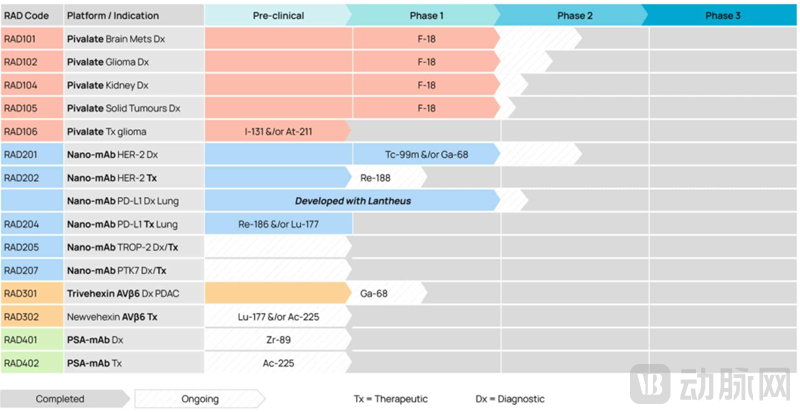
Currently, the products advancing most rapidly in clinical development are a series of diagnostic products based on Pivalate technology, and diagnostic and therapeutic products based on Nano-mAb technology. In addition, one product leveraging αvβ6 integrin technology has entered clinical trials, while PSA-mAb has not yet been applied clinically due to its relatively early stage of technological development.
Multiple products based on pivalate technology have entered the clinical stage,In the four major therapeutic areas of brain metastases, glioma, renal cell carcinoma, and solid tumors, the four products RAD101, RAD102, RAD104, and RAD105 have all successfully completed Phase I clinical studies and entered Phase II clinical development. However, due to differences in timing, their current progress in Phase II trials varies.
Products based on Nano-mAb technology, including diagnostic products targeting HER2 and PD-L1, have both entered Phase II clinical trials.
In December 2021, RAD disclosed the Phase I clinical results of its HER2-targeted breast cancer diagnostic product, RAD201. The study was conducted in China and Germany. The clinical trial at Shanghai General Hospital was led by Dr. Zhao Jinhua and involved imaging-based diagnosis using RAD201 in 40 patients with histopathologically confirmed breast cancer. Tumor tissues labeled with RAD201 yielded clear and well-defined images on SPECT/CT. Only one patient experienced a Grade 1 adverse event, demonstrating that RAD201 was well tolerated and exhibited an excellent safety profile.
Given the positive results from Phase I clinical trials, RAD is expected to accelerate the development of RAD201 and initiate Phase I clinical studies of RAD202 (a therapeutic product using the same ligand as RAD201) as soon as possible, with an Investigational New Drug (IND) application to the U.S. FDA anticipated in the first half of 2022.