

Pause Lab Secures RMB 50 Million Series A Funding to Build a Digital 'Mental Gym' for Mass Mental Wellness

BlueRun Ventures China
Venture Capital Institution

Long Hill Capital
Venture Capital Institution
VCBeat (WeChat ID: Vcbeat) has learned that Beijing Gese Technology Co., Ltd., the company behind “Pause Lab,” a digital health brand specializing in evidence-based psychological interventions, recently announced the completion of its RMB 50 million Series A financing round. The round was led by BlueRun Ventures China, with existing investor Long Hill Capital providing additional support.
Pause Lab is an online “scientific psychological gym”: through evidence-based digital product design, it provides a series of direct-to-user psychological intervention programs to enhance participants’ psychological regulation capabilities and reduce stress-induced psychosomatic distress such as anxiety, depression, and insomnia.
Pause Lab is among the first companies in China to achieve scalable revenue in the consumer-grade digital health market.It fills the long-standing market gap between “self-regulation” and “one-on-one diagnostic intervention,” successfully pioneering a new model of digital, professional psychological intervention that is both scalable and highly effective.
Over the past two years, Pause Lab has cumulatively served more than 35,000 paying participants, with an average of 38 days of intervention per person. More than 80% of participants experienced significant improvement in their distress after completing the first cycle, fully validating the efficacy of this model in real-world settings. Currently, the user base continues to grow rapidly.
Guo Tingting, CEO of Gese Technology, stated that the funds from this round of financing will help the team accelerate product development and market expansion, enabling more people to benefit from professional psychological interventions and improving their quality of life and well-being.
Zhu Tianyu, Managing Partner at BlueRun Ventures China, stated: “China has long faced a shortage of high-quality mental health services. Pause Lab positions itself as a ‘psychological gym,’ having innovatively developed psychological training camp products based on evidence-based principles. These products combine effective intervention outcomes with scalability. The team avoids blind pursuit of rapid expansion, focusing instead on the essence of mental health services and adhering to an approach that best supports users—subtle and unobtrusive, like ‘moistening things silently.’ Since its launch over two years ago, the product has earned strong user acclaim. We are highly optimistic about the Pause Lab team. With their interdisciplinary background spanning academic research and science communication, they are well-positioned to continuously deliver engaging and practical mental health service products. We believe Pause Lab will bring greater value to society and the public.”
Jiang Xiaodong, Managing Partner at Long Hill Capital, stated: “Pause Lab has innovatively introduced digital therapeutics into the field of mental health services, reducing reliance on professional counselors and enabling highly personalized and widely accessible interventions through digital product formats. As the angel investor in the company, Long Hill Capital has established a strong presence in both the digital therapeutics and mental health sectors, and will continue to support the Pause Lab team in building a digital ‘mental fitness gym’ for China’s 1.4 billion people.”
Guo Tingting, founder of Pause Lab and CEO of Gese Technology, pursued her Ph.D. in psychology at the Chinese Academy of Sciences before embarking on her entrepreneurial journey, with a research focus on the neurobiological mechanisms of emotion regulation. During her master’s and doctoral studies, she also received systematic training in clinical psychological intervention.
In her view, prolonged exposure to high-stress environments increases the risk of developing psychological disorders. In the months or even years preceding the full onset of conditions such as anxiety and depression, individuals often exhibit typical “prodromal symptoms,” including fatigue, irritability, tension, and insomnia. This period represents an optimal window for professional psychological intervention.
The “2017 White Paper on the Mental Health of Urban Residents in China” points out that as many as 73.6% of the urban population are in a state of “sub-health.” There is substantial demand for early intervention. However, there is a severe shortage of professional manpower in psychological counseling and psychotherapy. The high cost of one-on-one psychological interventions also deters most individuals in need.
“Like exercise, psychological intervention requires scientifically designed protocols and professional guidance, as well as sustained adherence over a sufficient duration to yield significant benefits. Although lighter forms of intervention are already available on the market—such as popular science books, paid online educational content, and stress-relief tools—they generally fail to constitute truly effective solutions for most people due to the lack of systematic, professionally designed frameworks.”
Guo Tingting stated, “Since initiating the R&D of Pause Lab in 2017, our goal has been to develop digital, standardized products based on evidence-based principles and a deep professional understanding of the mechanisms underlying the efficacy of psychological interventions, thereby exploring the optimal balance among therapeutic effectiveness, ease of use, and economic cost.”
Before the concept of “digital therapeutics” gained widespread traction, Pause Lab had already delivered a track record validated by real paying users through practical implementation:
Participant adherence is the foundation of efficacy and a core metric in product user experience design. Among the 35,000 participants in Pause Lab, the completion rate for a 25-day intervention program reached as high as 68%. The completion rate was 63% for first-time participants and averaged 73% for returning participants.
Due to significant benefits, the overall renewal rate for the intervention program was 42%. As of February 2022, participants in multiple cycles completed an average of 74.7 days of intervention per person.
How effective are the actual improvements? Pause Lab uses internationally recognized professional psychological scales to assess participants’ changes from baseline to post-intervention. Data show that, overall, more than 80% of participants experienced significant relief from distress after the first cycle.
Approximately 45% of users experienced moderate-to-severe emotional distress prior to participation (with scores on the anxiety and depression scale above the clinical threshold). They achieved significant improvement upon completion, with an average symptom reduction of 42% (anxiety:Cohens' d *= 1.41, Depression:Cohens' d = 1.33). Compared with publicly published research literature, this effect approaches that of one-on-one human-delivered interventions.
Participants with mild distress showed moderate improvement, with a mean symptom score reduction of 25% (anxiety:Cohens' d= 0.59, Depression:Cohens' d = 0.61)。
10%–20% of users were in a state of complete psychological well-being prior to participation. Data show that they also experienced improved emotional regulation capabilities and a significant increase in well-being.
Digital mental health commercial applications in China started relatively late, and there are currently no publicly released large-scale intervention data reports. Compared to similar products abroad with publicly available data, Pause Lab demonstrates superior improvement outcomes. Its accumulated real-world effectiveness data, characterized by large sample sizes and high ecological validity, is at the forefront of the industry globally. Pause Lab is also among the earliest Chinese members of the Digital Therapeutics Alliance.
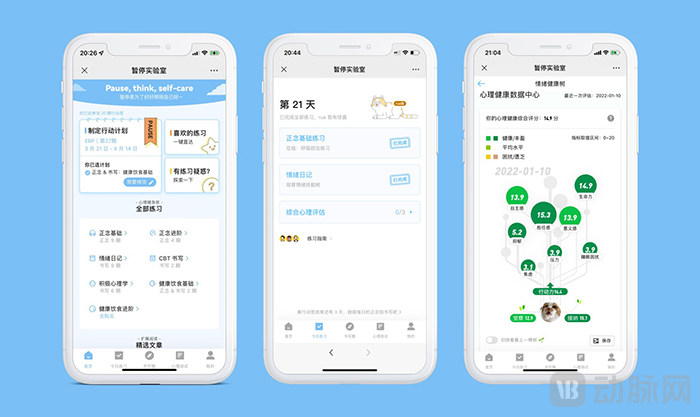
It is reported that the Pause Lab currently serves over 6,000 participants per month. As the participant base continues to expand, its completion and improvement rates have remained stable, significantly enhancing the efficiency of psychological services. Consequently, the Pause Lab has received numerous endorsements from mental health professionals, including licensed counselors and psychiatrists.
Renowned psychological counselor Li Songwei has consistently spoken highly of it. He stated plainly: “For those seeking to improve their emotional well-being, the primary choice going forward should be tools like Pause Lab—they are safe, convenient, user-friendly, and low-cost, with robust data supporting their efficacy.” Another prominent psychological counselor, mental health science writer, and host of the Steve Says podcast, Shi Xiuxiong, expressed strong approval for Pause Lab’s rigorous, evidence-based design and its continuous product optimization.
Eighty-one percent of participants indicated that they would recommend Pause Lab to their friends, family, or colleagues, and even to strangers seeking emotional well-being improvements. Among new users acquired in the past year, 53.5% came from organic traffic or word-of-mouth referrals.
Behind Pause Lab’s robust product, operations, and market data lies the highly synergistic collaboration of an “intellect-intensive” cross-functional team:
The founding team of Pause Lab hails from the Institute of Psychology, Chinese Academy of Sciences, and the School of Psychology at Beijing Normal University. Prior to launching their venture, they underwent systematic academic training and clinical intervention training. Currently, they have developed a clinical R&D team of over ten members with master’s and doctoral degrees, responsible for developing intervention protocols and conducting data research on intervention mechanisms. All team members are professionally trained in renowned clinical psychology departments both domestically and internationally, possessing dual expertise in research and clinical intervention.

The internet product team is largely composed of deep users who have personally benefited from the platform, dedicated to designing a gamification mechanism that helps cultivate healthy habits. This approach makes it easier for participants to initiate activities beneficial to their physical and mental well-being, ultimately integrating them into their daily lifestyles.
The marketing and branding team consists of seasoned advertising and media professionals dedicated to shaping a positive and vibrant image for the new generation of digital mental health products, encouraging more people to embrace professional psychological services.
Zanting Lab’s primary concern is the psychosomatic health issues that affect the daily lives of ordinary people.In the future, Pause Lab will build a comprehensive matrix of digital mental health solutions through continuous basic research and product development, further promoting the widespread adoption of evidence-based psychological interventions.
These initiatives will include: expanding the range of applicable scenarios for our products; beyond addressing emotional distress, we will continue to develop solutions for behavioral challenges in more specific areas such as diet, sleep, mobility, and interpersonal relationships; establishing a stratified and tiered intervention system for different population groups; and, with the continuous accumulation of large-scale real-world data, better addressing frontier questions in clinical psychological research by building more precise mental health measurement and intervention models and designing data-driven personalized intervention plans.
Currently, the Product and R&D Department of Pause Lab has also partnered with leading domestic psychology research teams, including those at Peking University, Beijing Normal University, and the Institute of Psychology of the Chinese Academy of Sciences, to jointly explore digital mental health service models and promote the translational application of foundational research in clinical psychology.
Currently, Pause Lab is hiring for multiple positions, including R&D, marketing, design, and software development. We look forward to welcoming more talented individuals who are passionate about developing and promoting high-quality internet-based psychological products. To view detailed job openings, please search for the “Pause Lab” official account on WeChat and reply with “Recruitment.”
“It is a common misconception that our services are only needed by those with severe psychological issues. Mastering emotional regulation skills is, in fact, an essential life lesson for everyone,” said Guo Tingting. “Everyone deserves to care for themselves in a more professional manner. Just like the body, the brain possesses neuroplasticity; with training based on scientific methods, it can become more flexible, healthy, and resilient. The earlier one starts, the greater the benefits.”
In the next decade, we will have the opportunity to witness history as professional mental health services become truly accessible and widely available to the general public.
Note:Cohens' dStatistical metrics (effect sizes) for measuring intervention effects to facilitate comparisons across different intervention programs. The effect size is calculated as the difference between the pre- and post-intervention means divided by the pooled standard deviation, which quantifies the magnitude of the difference between the pre- and post-test means. An effect size of 0.2 is considered small, 0.5 medium, and above 0.8 large.
The statistical data for improvement effects, compliance, etc., mentioned in the text are as of December 31, 2021.