

WeDoctor's HMO Model Addresses Fragmentation in Digital Healthcare, Files for IPO
In recent years, digital health has experienced rapid growth, accelerated by the pandemic. According to statistics from the Department of Planning and Information Technology of the National Health Commission (NHC), during the epidemic prevention and control period, the number of internet-based consultations at hospitals directly under or administered by the NHC increased 17-fold compared to the same period in 2019, while some third-party platforms saw a more than 20-fold increase in online consultation volumes. However, alongside this significant development in the digital health industry, “growing pains” have also emerged.
“How to position and develop internet healthcare at the current stage to avoid resource idleness and inefficiency has become a critical issue for the industry to address.” During the Two Sessions, Gu Jianwen, a member of the National Committee of the Chinese People's Political Consultative Conference (CPPCC), stated that although China’s medical industry saw significant improvements in digitalization during the 13th Five-Year Plan period, data information cannot be shared among most hospitals. Basic data within hospital systems—such as patients’ vital signs, imaging and laboratory reports, internet diagnosis and treatment records, and medication usage—remain like isolated “data silos,” making it difficult to form a synergistic, interconnected network.
Chen Jinxiong, Chairman of the Professional Committee on Electronic Medical Records and Electronic Health Records under the Chinese Medical Information Association, has also stated that internet-based healthcare is far more than simply shifting offline services online. In many medical institutions, online and offline systems and data remain siloed and independently managed, lacking effective data-driven support and empowerment, thereby failing to unlock the true value of data.
As can be seen, the development logic of the digital health industry and user needs are very clear. The internet is merely a tool that facilitates efficiency improvements and service innovation; at its core, what is required are digital tools. Digitalization must be integrated with institutional innovation to achieve better outcomes.Therefore, only by accumulating quantitative changes in the digitalization of healthcare delivery, pharmaceuticals, and health insurance, and achieving synergy among these three sectors to “alleviate pressure on large hospitals,” “enhance the capabilities of primary care institutions,” and “improve efficiency on the payer side,” can we bring about visible changes in service models and quality of care.

In recent years,Explorations within the industry into digital Health Maintenance Organizations (HMOs) have provided a viable and innovative pathway for digital healthcare to achieve standardized protocols, interoperable data sharing, and health insurance fund reimbursement, thereby breaking the current impasse of “systems built but unused, and networks connected but not integrated.”
Taking Tianjin’s exploratory practices as an example, in 2020, Tianjin WeDoctor Internet Hospital took the lead in collaborating with 267 primary healthcare institutions across Tianjin to jointly establish the “Tianjin Primary Care Digital Health Community.” By implementing the “Four Clouds” platforms—cloud management, cloud services, cloud pharmacy, and cloud diagnostics—the initiative digitally empowered primary care settings, providing comprehensive medical and health maintenance services throughout the pre-diagnosis, during-diagnosis, and post-diagnosis phases. This effort has gradually built an efficient, health-centric healthcare management system, implemented a health accountability framework, and formed a digital “Urban HMO.”
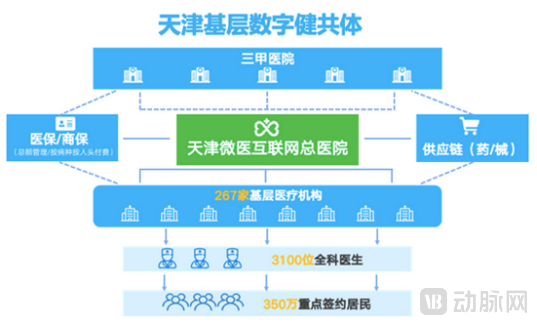
Under the “Urban HMO” model, the Health Community leverages a digital platform to coordinate with primary care hospitals and standardize clinical pathways. Using chronic disease management as an entry point, it has explored payment mechanisms such as bundled payments and capitation/diagnosis-related group (DRG) payments, while implementing performance constraints based on the principle of “retaining surpluses and covering no deficits.” Data show that after more than a year of implementation, the standardized management rate for diabetic patients in pilot primary care institutions within the Health Community reached 76.68%. Analysis of patient samples under management revealed a 21.58% increase in blood glucose control rates. Meanwhile, primary care institutions that have implemented capitation-based payments achieved medical insurance surplus rates of 16%–31%. With concurrent improvements in primary care service capacity and patient access to care, outpatient visits at pilot primary care hospitals within the Health Community increased by 120%.
In TianjinBehind the practice of the “Digital Health Community” lies a supporting capability system encompassing healthcare services, pharmaceuticals, health insurance, and digitalization. As the lead entity responsible for construction and operation,In“In terms of ‘medical services,’ WeDoctor has already established a presence in over”30 internet hospitals; in terms of "pharmaceuticals," WeDoctor owns the Haixi Pharmaceutical Trading CenterWaitPlatform;At the “insurance” level, WeDoctor has enabled medical insurance payments across 18 of its internet hospitals; at the “data” level, WeDoctor has integrated digital healthcare infrastructure, forming a system that includes internet hospital development, intelligent medical insurance monitoring, and digital chronic disease management.and integrated digital capabilities combining software and hardware, such as smart terminals.
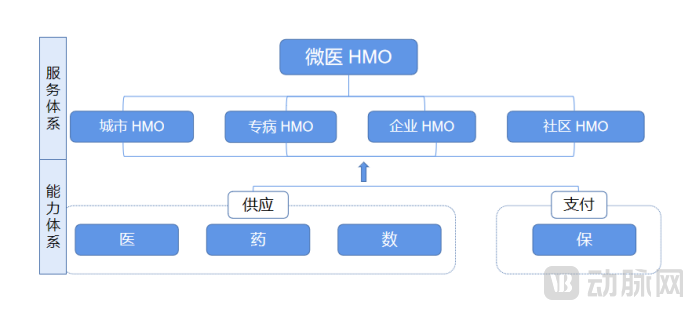
Image source: Internet
Media reports indicate that WeDoctor’s core business has achieved strategic focus and upgrading over the past two years. Its HMO-centric business model has been solidified, demonstrating hyper-growth driven by the pandemic and supported by healthcare insurance reforms. By integrating business units, capability modules, and regional operations, WeDoctor has established four operational hubs centered on “medical care, pharmaceuticals, insurance, and data,” thereby forming a closed-loop system of “payment + supply.” Building on this foundation, WeDoctor is rapidly deploying various forms of Health Maintenance Organizations (HMOs) across China, including “City HMOs,” “Disease-Specific HMOs,” “Community HMOs,” and “Enterprise HMOs.”
It is evident that digital HMOs, with their focus on transforming underlying logic, will become the true expectation for the industry to break through its “ceiling” of imagination. For the entire sector, the growth logic and fundamentals have remained unchanged, and the value delivered to both the industry and users has not diminished. Looking at the development of digital health, the industry has progressed through continuous exploration and trial-and-error, with each challenge making it more mature and resilient. It is believed that after the current phase of “separating the genuine from the fake,” the industry will enjoy a more favorable environment for development.