

Syros Pharmaceuticals Advances Pioneering Gene Control Therapies Targeting Super-Enhancers with $450M Raised and Multiple Clinical Candidates

Syros Pharmaceuticals
Biopharmaceutical Manufacturer
Gene expression refers to the process by which cells convert genetic information stored in DNA sequences into biologically active protein molecules through transcription and translation during their life cycle. Normal gene expression is essential for DNA to exert its hereditary effects and manifest specific phenotypic traits. Aberrant gene expression, such as occurring at the wrong time or in incorrect quantities, can alter cellular functions and lead to disease.
Syros Pharmaceuticals (NASDAQ: SYRS, hereinafter referred to as “Syros”), founded in 2011 and headquartered in Massachusetts, United States, is a clinical-stage biopharmaceutical company,Focused on developing gene regulation therapies to improve outcomes for cancer and monogenic diseases. Syros possesses a proprietary gene regulation technology platform designed to systematically identify pathogenic alterations in gene expression and create drugs that control gene expression, aiming to cure diseases that other genomics approaches cannot address.
Currently, Syros has established a diverse pipeline of gene regulation products tailored for various solid tumors and hematologic malignancies. Breaking away from current therapeutic approaches that rely on inhibiting or otherwise altering the function of abnormal genes and proteins, Syros has pioneered an alternative strategy by modulating gene expression to address disease mechanisms, thereby creating new treatment opportunities for patients.
Syros was co-founded by three experts in the fields of gene regulation and translational medicine: Richard A. Young (currently a board member), Nathanael S. Gray, and James E. Bradner.
Richard A. Young holds a Ph.D. from Yale University and is currently a Member of the Whitehead Institute and a Professor of Biology at the Massachusetts Institute of Technology (MIT). Dr. Young has extensive expertise in the field of gene regulation. In May 2012, he was elected to the U.S. National Academy of Sciences. His research focuses on the regulatory circuits that control gene expression programs in every cell, including mapping the regulatory circuits that govern cell states and differentiation in mouse and human cells, and employing experimental and computational techniques to determine how signaling pathways, transcription factors, chromatin regulators, and small RNAs control gene expression programs in embryonic stem cells. In 2006, Dr. Young was named one of the 50 leading figures in science, technology, and business by the renowned popular science magazine Scientific American. He has received numerous awards, such as the Burroughs Wellcome Fellowship, the Chiron Corporation Biotechnology Research Award, and the Wilbur Cross Medal from Yale University.

Founder: Dr. Richard A. Young (Image source: Syros official website)
The other two co-founders also possess extensive expertise in gene regulation and translational medicine, and both have worked at Harvard Medical School. Dr. Nathanael S. Gray is a Professor of Biological Chemistry and Molecular Pharmacology at Harvard Medical School and the Dana-Farber Cancer Institute; Dr. James E. Bradner formerly served as an Assistant Professor of Medicine at Harvard Medical School and is currently the President of the Novartis Institutes for BioMedical Research.
The current CEO is Nancy Simonian, who has extensive experience in the biotechnology sector and a wealth of expertise in drug development.Dr. Nancy began her career as an Assistant Professor at Harvard Medical School and as a staff neurologist at Massachusetts General Hospital. Prior to joining Syros Pharmaceuticals, she served as Chief Medical Officer at the biotechnology company Millennium, where she led the successful development of numerous drugs, including VELCADE for the treatment of adult multiple myeloma. She also spearheaded the development of the clinical pipeline, featuring NINLARO (approved) for hematologic malignancies and ENTYVIO (approved) for inflammatory bowel disease. Before joining Millennium, Dr. Nancy was Vice President of Clinical Development at the biotechnology company Biogen, playing a pivotal role in the development of AVONEX and TYSABRI for the treatment of multiple sclerosis. She currently serves on the boards of directors of Seagen, the Biotechnology Innovation Organization (BIO), and the Damon Runyon Cancer Research Foundation.

Syros’ President and Chief Executive Officer: Nancy Simonian
Genes are small segments of DNA that contain the information required to produce proteins through the process of transcription. These proteins are essential for the development and survival of organisms.
In the human genome, only about 2% of DNA sequences are responsible for protein coding, while the remaining approximately 98% of DNA sequences, which do not encode proteins, were long referred to as “junk DNA.”
However, recent scientific research has demonstrated that a portion of “junk DNA” contains regulatory elements capable of determining the timing and manner of gene activation or silencing; these elements also serve as binding sites for transcription factors on DNA, thereby modulating the transcription process.
Among these, a type of so-called "junk DNA" known as enhancers can bind to proteins that assist in activating the transcription process, thereby improving transcriptional efficiency. Transcriptional regulatory regions in the genome that are highly enriched with enhancers are termed super-enhancers; they can substantially activate gene expression, exhibit high tissue specificity, and play critical roles in processes such as development and tumorigenesis. Super-enhancers function like dimmer switches, controlling key genes in cells by turning them on or off, or by upregulating or downregulating their expression.
Syros focuses on super-enhancers, which are gene control elements, and has developed a proprietary gene regulation technology platform based on its deep and integrated understanding of regulatory genomics, disease biology, and small-molecule chemistry. This platform is designed to systematically and efficiently analyze unexplored DNA regions associated with human diseases, aiming to develop novel therapeutics that control gene expression and provide treatments for conditions that are incurable by other genomic approaches.
Leveraging its proprietary gene regulation technology platform, Syros has significantly enriched its R&D pipeline, which currently comprises three investigational drugs in clinical development and multiple projects in preclinical development and discovery research.This article will focus on the three candidate drugs with the most rapid R&D progress: tamibarotene (formerly known as SY-1425), SY-5609, and SY-2101.
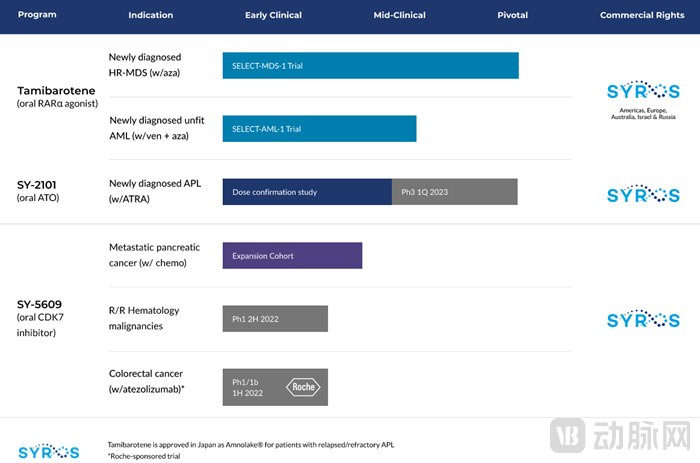
R&D Pipeline (Image source:SyrosOfficial Website)
Tamibarotene
Tamibarotene (formerly known as SY-1425) is an oral selective retinoic acid receptor alpha (RARα) agonist indicated for the treatment of subpopulations of patients with genomically defined high-risk myelodysplastic syndromes (HR-MDS) and acute myeloid leukemia (AML).
MDS is a bone marrow disorder in which the patient’s bone marrow fails to produce sufficient healthy blood cells, leading to symptoms such as infections, anemia, spontaneous bleeding, or bruising.
MDS carries a risk of transformation to AML. The Revised International Prognostic Scoring System (IPSS-R) stratifies the risk of AML progression in MDS patients into five categories—very low, low, intermediate, high, and very high—based on factors such as the percentage of blasts in the bone marrow, the type and extent of chromosomal abnormalities, and hemoglobin levels reflected in red blood cell counts, as well as platelet and neutrophil counts. Studies have shown that more than half of patients with high-risk MDS (HR-MDS) eventually progress to AML. This secondary AML arising from MDS transformation is not entirely identical to primary leukemia; in these patients, nearly all hematopoietic cells in the bone marrow exhibit abnormalities, making treatment more challenging and leading to poorer clinical outcomes.
Syros demonstrated in an earlier, now fully enrolled Phase 2 study that tamibarotene in combination with azacitidine (a novel hypomethylating antineoplastic agent) achieved high response rates, rapid onset of action, and clinically meaningful durability in patients with RARA-positive AML who were ineligible for standard chemotherapy.
Currently, Syros is conducting two trials on tamibarotene. One is SELECT-MDS-1 (Phase 3), which evaluates the safety and efficacy of tamibarotene in combination with azacitidine for the treatment of newly diagnosed RARA-positive patients with high-risk myelodysplastic syndromes (HR-MDS). Data from this pivotal trial are expected to be released in the fourth quarter of 2023 or the first quarter of 2024, with a potential New Drug Application submission anticipated in 2024.
Tamibarotene was granted orphan drug designation by the FDA in 2022 for the treatment of MDS.
Another trial is SELECT-AML-1 (randomized Phase 2), which evaluates the safety and efficacy of tamibarotene in combination with azacitidine and venetoclax for the treatment of patients with newly diagnosed RARA-positive acute myeloid leukemia (AML). Safety lead-in data from the trial are expected to be released in the second half of 2022.
SY-2101
SY-2101 is a novel oral arsenic trioxide (ATO) indicated for patients with acute promyelocytic leukemia (APL).
Acute promyelocytic leukemia (APL) is the M3 subtype of acute myeloid leukemia (AML), accounting for approximately 10% of AML cases. In APL, there is a significant accumulation of immature hematopoietic cells, known as promyelocytes, in the blood and bone marrow. This buildup of promyelocytes leads to a deficiency of normal blood cells and platelets, resulting in symptoms such as bleeding, infections, and fatigue, and can even be fatal. The combination of intravenous arsenic trioxide (IV ATO) and oral all-trans retinoic acid (ATRA) can cure more than 80% of patients. As part of this combination regimen, IV ATO requires patients to undergo 140 prolonged infusions over nearly one year, imposing a substantial burden on patients.
In earlier Phase I clinical trials, once-daily dosing of SY-2101 demonstrated oral bioavailability that achieved exposure levels within the range of approved intravenous (IV) doses and was generally well tolerated. Currently, Syros is conducting a dose-confirmatory study of SY-2101 and plans to initiate Phase III trials in 2022.
SY-5609
SY-5609 is a highly selective and potent oral CDK7 inhibitor indicated for patients with certain solid tumors and hematologic malignancies.
Data from the dose-escalation study indicate that SY-5609 demonstrated single-agent antitumor activity across multiple tumor types, including prolonged disease stabilization, tumor shrinkage, and reduction in tumor markers.
Syros has currently initiated expanded cohort evaluations to assess the efficacy of SY-5609 in combination with chemotherapy for patients with pancreatic cancer; and plans to launch a Phase 1 monotherapy trial to evaluate the efficacy of SY-5609 across a broad range of hematologic malignancies, including B-cell lymphomas such as mantle cell lymphoma.
In addition to the clinical trials conducted independently by Syros, SY-5609 is also being evaluated in Roche’s Phase 1/1b INTRINSIC trial in combination with the PD-L1 inhibitor atezolizumab for the treatment of BRAF-mutant colorectal cancer.
New drug development is an arduous endeavor, characterized not only by an exceptionally long R&D cycle of 12–15 years but also by an extremely high risk of failure. Among 5,000 preclinical compounds, only approximately five advance to clinical trials, and of these five, only about one ultimately gains regulatory approval for market launch. Therefore, a larger R&D pipeline can, to some extent, translate into a higher probability of R&D success.
To this end, Syros is actively seeking partners to identify new therapeutic targets, expand its indication portfolio, and advance the development of next-generation drug candidates. Currently, Syros has two strategic partners. Syros collaborates with biopharmaceutical company Global Blood Therapeutics (GBT) to discover an oral therapy that increases fetal hemoglobin expression, aiming to provide a functional cure for patients with sickle cell disease and β-thalassemia. Meanwhile, Syros partners with biopharmaceutical company Incyte Corporation to identify and validate novel therapeutic targets in myeloproliferative neoplasms (MPN).
Furthermore, new drug development is an extremely capital-intensive endeavor. According to incomplete statistics, global pharmaceutical companies spend an average of over $2 billion on the development of a single innovative drug, from initial discovery through to market launch.
Since its establishment in 2011, Syros has completed nine rounds of financing, raising a total of nearly $450 million. Meanwhile, its collaboration with GBT brought in a $20 million upfront payment and up to $40 million in preclinical research funding, while its partnership with Incyte generated a $10 million upfront payment and a total of $10 million in stock revenue.
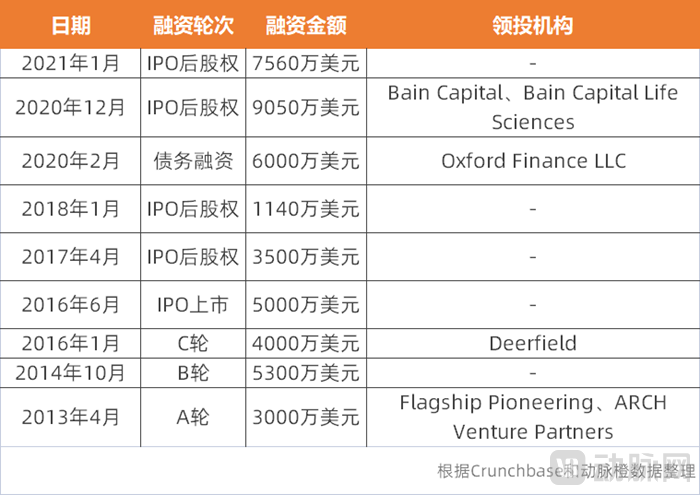
Stable revenue streams have enabled Syros to consistently allocate sufficient funding to drug R&D. As of September 30, 2021, Syros’ R&D expenses for the first nine months of 2021 amounted to $73.08 million, representing a year-on-year increase of 55.4%.
Recently, Syros announced that it would present the latest preclinical data on its CDK12 inhibitor program at the American Association for Cancer Research (AACR) Annual Meeting 2022 in April, and nominate a new development candidate from this program in the second half of 2022. With a specialized team, a mature technology platform, and stable funding sources, Syros is well-positioned to expand its product pipeline. Looking ahead, it is anticipated that Syros will secure regulatory approvals for its products at an early stage, thereby achieving diversified product commercialization.