

Medisotope Breaks Through Domestic Production Bottleneck to Enter the Global Molybdenum-99 Market
MSTP
Medical Device R&D Manufacturer
Nuclear medicine has entered the public spotlight due to its significant efficacy in tumor diagnosis and treatment, while the preparation of radiopharmaceuticals must be based on isotopes. Molybdenum-99 is one of the most important isotopes, accounting for 80% of the nuclear medicine market, and is a widely used “star” isotope.
Molybdenum-99 yields Technetium-99m through beta decay. When properly labeled, Technetium-99m can bind to various ligands for functional imaging of multiple organs, such as the brain, heart, liver, and thyroid, enabling the diagnosis of various organ diseases.China has approved 35 domestically produced in vivo radiopharmaceuticals, 16 of which contain molybdenum.
However, the global supply of molybdenum-99 (Mo-99), the parent isotope used as a raw material, is under significant strain. Nearly all medical-grade Mo-99 worldwide relies on production from a handful of foreign nuclear reactors. This dependence has precipitated a production crisis for Mo-99, driven by constraints related to nuclear proliferation and radioactive waste disposal, frequent reactor failures due to prolonged high-load operations, and the impending decommissioning of most of these aging reactors.China faces substantial demand for Molybdenum-99, relies entirely on imports, and is exposed to the risk of supply chain chokepoints.
Current methods for producing Molybdenum-99 include reactor irradiation and electron accelerator-based production. Among these, electron accelerator production is considered one of the major trends in the future development of isotope production due to its high efficiency, convenience, absence of radioactive waste, and superior environmental friendliness. Companies worldwide are actively strategizing in this area, such asU.S. Polaris Company, Canadian CIIC Company, Japanese MPI CompanyandASML (EU)are all actively pursuing strategic layout and commercial development.
Xi’an Medisotope Technology Co., Ltd. (hereinafter referred to as “MSTP”)Through more than a decade of dedicated research and by leveraging its unique advantages, MSTP has established an independent set of production technologies and process flows for producing molybdenum-99 (Mo-99) and other isotopes using electron accelerators. This achievement fills the domestic gap in both the technology and the supply of Mo-99 isotopes, helping to overcome critical bottlenecks in the localization of medical isotopes in China. Notably, MSTP’s electron accelerator-based project for producing Mo-99 and other isotopes was selected by the Ministry of Science and Technology as a disruptive innovation technology.
MSTP, whose corporate name is a transliteration of the English word “medisotope,” was established in 2019.It is a high-tech company specializing in the R&D and technical services of nuclear radiation, nuclear technology, and isotope production, as well as the R&D of related nuclear medicine equipment and software.The company is dedicated to the production and R&D of medical isotopes, such as molybdenum-99, and related products. Its core technology isProduction of medical isotopes such as Molybdenum-99 using accelerators, proprietary ancillary equipment, and key technologies and processes。The company benchmarks against U.S.-based Boston Scientific.
Founder Zhang Quanshi,M.S. in Nuclear Physics from Peking University; formerly affiliated with the Northwest Institute of Nuclear Technology. He previously served as a Research Fellow at the Northwest Institute of Nuclear Technology, Director of the Radiation Therapy Center at Chang’an Hospital, and Vice President/Dean of the Research Institute at a medical equipment company in Beijing. He has received numerous honors, including the Second Prize of the National Science and Technology Progress Award, the Second Prize of Beijing Municipal Scientific and Technological Achievements, the Second Prize of the Commission for Science, Technology and Industry for National Defense (COSTIND) for Scientific and Technological Progress, the Third Prize of the Military Scientific and Technological Progress Award, and the Third Prize of COSTIND for Scientific and Technological Progress. He was also recognized as a High-End Innovative Leading Talent under Beijing’s “Yiqilin” Program.
Dr. Wang Bo, who is responsible for R&D in radiopharmaceuticals and radiochemistry,Graduated from Peking University, studied under Academician Liu Boli, a renowned expert in China’s field of nuclear medicine. Has long been engaged in research on radiochemical separation, production and application of radiopharmaceuticals, nuclear environment and monitoring, and materials chemistry. Has received multiple Military Science and Technology Progress Awards, published more than 50 papers, and obtained over 10 national invention patents.
Wang Baisong, responsible for engineering and process technology,Graduated with a degree in Chemical Engineering from Tsinghua University, he has long been engaged in nuclear chemistry, radiochemical analysis, and nuclear chemical engineering. He served as the sub-project leader for isotope-related work in the Xi’an Pulsed Reactor Project. His accolades include one Second-Class Prize and one Third-Class Prize for Military Scientific and Technological Progress, one Third-Class Merit Citation, and honors such as the Award for Outstanding Contributions and Outstanding Communist Party Member.
Although the company was founded in 2019,The core team members began related technical research as early as 2006.. The vast majority of them come from nuclear research institutes and have long been engaged in related disciplines such as nuclear technology, radiochemistry, Monte Carlo simulation, and radiation safety. They possess a profound understanding and insight into the technology and the industry. The talent pool is dense and comprehensive, with professionals covering all aspects of R&D, production, radiation protection and safety, and marketing.
In addition, MSTP has also hiredInternational Expert Team, and withPIPE at the Canadian Light Source (CLS)(Prairie Isotope Production Enterprise)、Acsion(Acsion Industries Incorporated) andMevex CorporationThe company signed the relevant agreements.
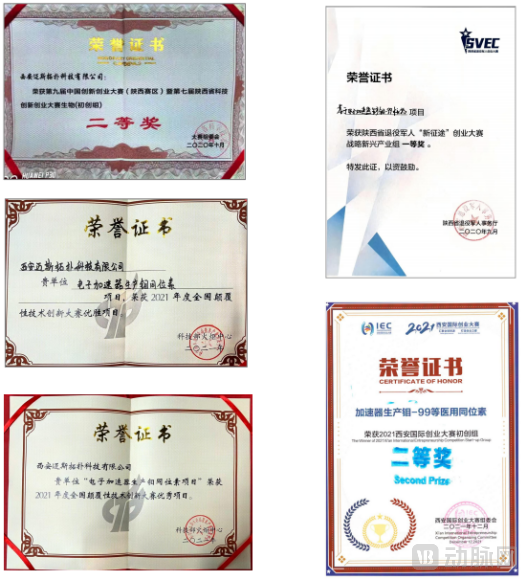
MSTP, empowered by top-tier industry experts, has forged ahead on its entrepreneurial journey and garnered numerous accolades—
In 2020, won second place in the Biotech Startup Category of the 9th China Innovation and Entrepreneurship Competition (Shaanxi Division);
In 2020, won the first prize in the “New Journey” Entrepreneurship Competition for Veterans of Shaanxi Province;
In 2021, won the Second Prize in the Biomedical Startups Category of the Xi'an International Entrepreneurship Competition;
In 2021, it was registered as a technology-based small and medium-sized enterprise with the Ministry of Science and Technology.
In 2021, won the Excellence Award at the inaugural Disruptive Technology Competition organized by the Ministry of Science and Technology;
In 2021, it was selected for the Ministry of Science and Technology’s reserve pool of disruptive technologies;
2021, Winner Award in the Field Competition of the First Ministry of Science and Technology Disruptive Technology Competition (Qingdao).
MSTP: Riding the Waves on Its Path of Development
At the age of 60, forsaking a life of leisure and comfort to embark on the arduous journey of entrepreneurship.Zhang Quanshi has his own special reasons: “We have been dedicated to this cause for decades, accumulating extensive technology and experience. This enables us to continuously innovate in scientific research, leverage our expertise, fill domestic technological gaps, and contribute to the nation. It is a highly meaningful endeavor in life!”
A First-Class Team Brings Advanced Technology.
As previously discussed, current methods for producing molybdenum-99 (Mo-99) include reactor-based irradiation and accelerator-based production. Traditional reactor-based production of Mo-99 requires a series of complex operations—such as irradiating high/low-enriched uranium in a nuclear reactor, separating fission products, industrial processing, and solution dispensing—before the product can reach end users. The entire process is technologically complex and involves a lengthy workflow.
MSTP’s electron accelerator-based photonuclear reaction method for bombarding stable molybdenum-100 to produce molybdenum-99 has disrupted the reactor-based uranium-235 fission technology for molybdenum-99 production, offering significant advantages:
In terms of process, products prepared using electron accelerators have fewer impurities and simpler irradiation processing;
In terms of input,Low investment, construction, and operational costs; the production cost of accelerators is 30%-45% that of reactors;
InIn terms of construction period, building the simplest production system for a solution reactor takes more than five years, whereas MSTP’s system requires only two to three years;
InIn terms of layout, enabling regionalized production with low consumption and low transportation costs;
In terms of environmental protection,No risk of nuclear proliferation, reduced radioactive waste;
In terms of approval,Administrative licensing is simple and easy.
Since 2006, after more than ten years of dedicated research and development, the team has established a multi-functional R&D platform. This achievement spans from the initial proposal of methods for producing medical isotopes such as Molybdenum-99, Copper-67, and Actinium-225 using electron accelerators, through theoretical feasibility analysis, simulation calculations, and experimental validation of production principles, to the breakthrough design of key technologies, critical components, and process flows for industrial-scale production., completed small-scale experimental validation.Furthermore, the experimental results are consistent with those obtained by Argonne National Laboratory and NorthStar Medical Radioisotopes in the United States, demonstrating the feasibility of this method for the industrial production of molybdenum-99. On this basis,Pilot-scale cold experiments and Monte Carlo thermal nuclear simulation studies,The design objectives were achieved.
The multi-functional R&D platform established by MSTP is capable not only of large-scale production of Molybdenum-99 (Mo-99), but also of producing imaging isotopes such as Oxygen-15 (O-15), Carbon-11 (C-11), Iodine-123 (I-123), Indium-111 (In-111), and Cobalt-57 (Co-57), as well as targeted therapy isotopes including Copper-67 (Cu-67), Scandium-47 (Sc-47), Rhenium-186 (Re-186), and Actinium-225 (Ac-225).In particular, the production of targeted therapeutic radionuclides with significant market prospects is the ultimate goal of MSTP.“Zhang Quanshi introduced.”
MSTP has been diligently strengthening its internal capabilities while also placing great emphasis on building patent barriers.Build. Currently, MSTP has filed eight invention patent applications and been granted two invention patents, with several additional inventions pending application. Moreover, the company possesses core non-patented proprietary technologies, formingIndependent Product R&D and Production Technology SystemandIntellectual Property Moat.
Regarding the future of MSTP, Zhang Quanshi has a clear blueprint—the companyTaking Molybdenum-99 as the entry point,In-depth technical research and the establishment of an isotope production platform, with market entry achieved through this product; next, the company willPoint-to-Area, focusing on current hotspots such as Cu-67, Sc-47, Re-186, and Ac-225Comprehensive Layout and Production of Isotopes for Targeted Therapy.
Considering the maturity of the application-side market and the logistical requirements imposed by isotope half-lives, MSTP will prioritize in its industrialization layoutYangtze River Delta, Pearl River DeltaandBeijing-Tianjin-Hebei RegionProceed with the layout. Currently,MSTP is seeking RMB 20 million in its next funding round to enhance industrialization capabilities...