

Exploding Demand for Geriatric Mental Health Services: How Innovative Healthcare Models Are Responding
The article “Shenzhen Business Owners Are Flocking to Psychiatric Clinics,” published by Daily Person, has raised awareness that middle-aged individuals are grappling with anxiety, depression, and insomnia due to various factors. In fact, beyond the widespread anxiety and depression observed among the middle-aged population, a substantial number of elderly individuals also suffer from mental and psychological issues—such as low mood, slowed thinking, and diminished willpower. While attention is being paid to the mental health of middle-aged adults, the psychiatric and psychological needs of the elderly should not be overlooked.
As health awareness rises, people are paying increasing attention to mental disorders. The market for diagnosis and treatment services for mental disorders, as a hot sector, is also drawing growing attention from various industry stakeholders.
In terms of disease prevalence, the results of China’s first nationwide epidemiological survey on mental disorders, published by The Lancet in 2019, indicate that the overall prevalence of mental disorders in China has been on the rise. The lifetime prevalence of mental disorders was 16.6% in 2013, significantly higher than the 1.3% reported in 1982. This increase in prevalence signifies a further growth in the patient population and the demand for diagnosis and treatment services.
As the market size for the diagnosis and treatment of psychiatric disorders continues to expand, the number of elderly patients with mental disorders—a significant proportion of the overall population with psychiatric conditions—is also on the rise. How to provide innovative medical services tailored to this specific group of elderly patients with mental disorders has become a pressing challenge for industry practitioners.
Over 10 million elderly patients with mental disorders,
# Numerous Pain Points in Healthcare Services
Among patients with mental disorders, a significant proportion comprises those with senile mental disorders (including senile mental disorders caused by conditions such as senile dementia and Alzheimer’s disease, which are often associated with old age; other conditions such as schizophrenia, bipolar disorder, and paranoid psychosis that occur in old age are not necessarily related to aging). In this article, we aim to elucidate the current situation and pain points faced by patients with senile mental disorders caused by Alzheimer’s disease.
First, there is a substantial demand for medical care services.The deepening aging of society has led to a rise in patients with age-related diseases, such as Alzheimer’s disease accompanied by mental disorders. In May 2020, the China National Committee on Aging released the Report on the Current Status and Development of Care Services for Elderly People with Dementia in Beijing, pointing out that there are approximately 15.07 million elderly people aged 60 and above in China suffering from dementia, and the demand for care services for the elderly with cognitive disorders (most commonly Alzheimer’s-type cognitive impairment) is showing a rapid growth trend.
Secondly, current medical services fail to meet patient demands.The “Notice on Issuing the Opinions on Strengthening and Improving Specialized Psychiatric Medical Services” proposed that “by 2022, the number of psychiatrists would increase to 45,000, reaching 3.3 per 100,000 population; by 2025, the number of psychiatrists would increase to 56,000, reaching 4.0 per 100,000 population.” This indicates that there are still shortcomings in the supply side of current medical services.
In fact, by focusing on the primary care scenarios for elderly patients with mental disorders, we can more acutely perceive the existence of pain points.:
In home care settings, family members bear the responsibility of patient care, which consumes significant time and energy while exacerbating their psychological burden.Furthermore, even with the assistance of nannies to alleviate the burden on family members, their lack of professional medical nursing knowledge often makes them unable to provide adequate rehabilitation services for patients.
In the context of nursing homes, there is generally a lack of relevant medical service support for psychiatric disorders associated with Alzheimer's disease.Currently, most Alzheimer’s patients receive care in nursing homes. While this arrangement can alleviate the caregiving burden on some family members, the quality of a nursing home’s facilities ultimately determines whether it can provide other corresponding services to patients.
In hospital settings, there is an insufficient supply of medical services. First, the number of public psychiatric specialty hospitals is limited and their distribution is uneven. Second, other private psychiatric specialty hospitals also rarely provide medical services tailored to patients with Alzheimer’s disease accompanied by mental disorders.According to the "2021 China Health and Health Statistical Yearbook," there were 1,801 psychiatric hospitals in 2020. There are 787 located in urban areas and 1,014 in rural areas. The limited number of beds in psychiatric hospitals within individual cities is inherently insufficient to meet the needs of patients with conditions such as mental disorders associated with Alzheimer's disease, often resulting in overcrowded wards.
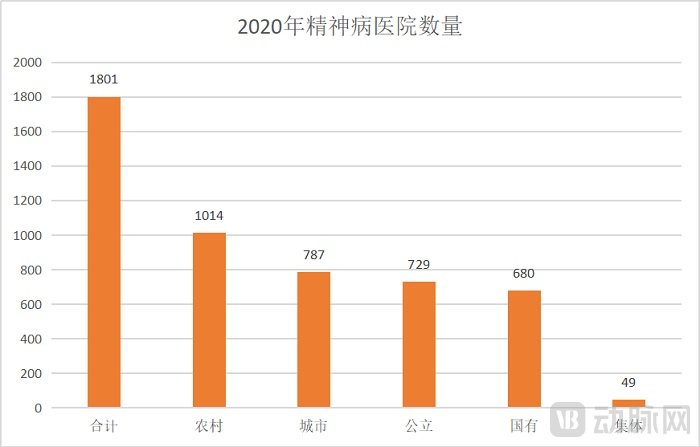 Data source: "China Health and Health Statistical Yearbook 2021"; graphic by VCBeat
How to Address the Predicament Faced by Patients with Alzheimer’s Disease-Associated Psychotic Symptoms and, Representatively, Other Elderly Patients with Mental Disorders? Are There Lessons to Be Learned from Overseas Practices?
From “Locking Up” to “Respecting Patient Rights,”
The Rise of Overseas "Community-Based Rehabilitation"
From the perspective of historical development, overseas regions (represented by Europe and the United States) initially went through a phase of restricting the personal freedom of movement of patients with mental disorders to prevent harm to the public. Subsequently, with the advancement of related disciplines,Management concepts have gradually shifted from “confinement” to active treatment of patients, and further to today’s greater emphasis on patient rights and collaborative negotiation of treatment plans through equal communication.
During the process of fundamental paradigm shift,"Countries such as the United States have also experienced difficult phases."—While the number of psychiatric hospitals has increased and the efficacy of pharmacological treatments has improved, challenges such as a shortage of psychiatric beds, high out-of-pocket costs for patients, and difficulties in social reintegration post-treatment have also emerged.
In this context,Since the 1960s, the “deinstitutionalization” movement has gained momentum in countries such as the United Kingdom and the United States, giving rise to community-based mental health services.As legal policies increasingly support and reinforce this movement, ultimately,Countries Have Demonstrated Diverse Explorations in Service Delivery Models for the Diagnosis and Treatment of Mental Disorders:
For instance, France has developed a “zonal model” for community-based treatment of patients with mental disorders, while the United States has pioneered Assertive Community Treatment (ACT). Australia has taken this approach to an extreme: psychiatric departments in Australian general hospitals provide only acute inpatient services, and nearly 98% of patients with mental disorders in the country receive treatment at community health service centers.
Inpatient treatment during acute episodes, combined with a long-term model integrating medical social workers and healthcare professionals during the rehabilitation phase, is undoubtedly a core focus of overseas psychiatric specialty development. However, the current domestic situation places greater emphasis on in-hospital treatment while neglecting out-of-hospital and home-based disease management for patients.
How Can China Learn from Overseas Practices,
Innovate the business model?
How can China address and resolve the pain points patients face in the diagnosis and treatment of mental disorders? Partial answers may be found in the business layouts of Wenzhou Kangning Hospital and Kaixin Medical.
As a publicly listed company and currently the only non-public Grade 3A specialized psychiatric hospital in China, Wenzhou Kangning Hospital has developed into the largest chain group specializing in psychiatric disorders in the country. At present, leveraging the construction of key disciplines in Zhejiang Province, it has established six major clinical centers, including a geriatric psychiatry department and an addiction behavior outpatient clinic, and has further expanded its service network through continuous self-construction and acquisition of hospitals. In April 2016, Wenzhou Yining Geriatric Hospital, built and opened by the group, began providing specialized diagnostic and treatment services as the first geriatric hospital under the Kangning Hospital Group. Four years later, its Yining Psychological Internet Hospital officially commenced operations on July 29, 2020.
Judging from the layout of Wenzhou Kangning Hospital, they have undoubtedly recognized the importance of geriatric psychiatry and are alsoContinuously establish geriatric hospitals to strengthen expansion and layout in this field, further increasing the number of beds.Furthermore, according to Tianfeng Securities, the Yining Psychology clinics operated by hospitals under the Kangning GroupInternet hospitals primarily provide mental health education to the general public, offer online mental health services to individuals with mild psychological distress, and deliver chronic disease management support to psychiatric patients who have been hospitalized for treatment.The overall strategy follows the logic of “shifting from gatekeeping to management,” while also exploring the expansion of online medical services to fill gaps in the healthcare delivery process.
Shanghai Kaixin Medical, established in 2015, is a healthcare service provider specializing in full-course management of psychological and psychiatric disorders. It is particularly dedicated to delivering professional diagnostic and therapeutic services to patients with Alzheimer’s disease accompanied by mental disorders, as well as children and adolescents with psychiatric conditions. Currently, it operates a tertiary-level psychiatric hospital and a chain of psychiatric clinics across Shanghai, Hangzhou, Zhengzhou, Changsha, Nanjing, Shenyang, and other cities.
The proposal of Kaixin Medical’s innovative concept is the result of recognizing pain points in the domestic market and drawing on overseas market development experience.It innovatively proposes the concept of “full-course medical and nursing management for mental disorders,” encompassing “screening, consultation, hospitalization, and home care.”This philosophy requires achieving comprehensive, blind-spot-free, zero-distance coverage for patients. Based on this principle, Kaixin Medical has developed the HSH Integrated Medical and Elderly Care Rehabilitation Model, leveraging advanced artificial intelligence and mobile internet technologies to integrate online and offline services.
HSH Medical-Nursing-Rehabilitation Model Shortens Patient Hospital Stays and Reduces Patient Costs
To address the prevailing challenge of hospitals lacking visibility into patients’ origins and post-discharge destinations, Kaixin Medical has diligently developed the HSH (Hospital + Society + Home) integrated medical-care-rehabilitation model, which connects hospitals, communities, and households. By collaborating with community organizations, establishing internet-based consultation rooms, and building a team of medical social workers, this model optimizes key processes—including patient screening, clinical consultation, hospital admission, and post-discharge management—thereby fulfilling patients’ needs for comprehensive, whole-course care services. This system effectively resolves numerous pain points currently experienced by patients and healthcare institutions.
First, through the establishment of a comprehensive system, we have truly realized a model in which patients originate from the community and ultimately return to it.By collaborating with communities and leveraging long-term partnerships established with medical social workers, we achieve comprehensive patient record management, regular follow-ups to monitor patient conditions, and the delivery of in-home nursing care and chronic-phase treatment. The treatment of mental disorders often entails recalibrating the relationship between patients and their environment (society). Through modern approaches such as community-based internet clinics, Kaixin Medical realizes its service mission of “reaching deep into communities, into families, and into hearts,” ultimately helping patients gradually reintegrate into society.
Secondly, it addresses the pain point where short-term treatment during the acute phase relies on long-term treatment, rehabilitation training, and care during the chronic recovery phase.Kaixin Medical’s HSH Rehabilitation and Integrated Care Model shortens the duration of disease onset and hospitalization through early detection, early treatment, and early recovery. By providing long-term attention and continuous care to patients, it facilitates better identification of psychological conflicts between patients and their environment, as well as the underlying triggers and core issues of potential conditions, thereby assisting physicians in formulating precise treatment plans. While safeguarding patient privacy and dignity and preventing psychological contagion within ward settings, the model addresses environmental barriers to rehabilitation through home-based medical and nursing services, ultimately achieving the goal of patient reintegration into society and family life.
Furthermore, by establishing the HSH rehabilitation and medical care model, Kaixin Medical can serve a broader patient population while reducing out-of-pocket costs for patients.For patients, shorter hospital stays translate to lower out-of-pocket costs. Disease management within communities and households, coupled with affordable long-term care services, further enhances the sustainability of treatment. In the future, the integration of insurance coverage—such as long-term care insurance, basic medical insurance, and commercial health insurance—is expected to further alleviate patients’ financial burden. For hospitals, Kaixin Medical can expand its patient reach by leveraging internet technologies and community-based medical social work care services. Through continuous, low-cost online-to-offline (O2O) home care services, the company can achieve sustainable revenue growth.
Integrating Online and Offline Management to Expand the Disease Management Service Chain
The integration of online and offline services is a major trend in the development of internet healthcare. Kaixin Healthcare has also established an internet hospital to provide patients with more accessible medical services. The expansion of online medical services can further reach a broader audience while providing continuous healthcare management for its patients. By covering both offline physical hospitals and online virtual hospitals, as well as extending services through the Medical Internet of Things (MIoT), Kaixin Healthcare has formed a closed-loop business model.
Exploration of Online Digital Technologies,For instance, by launching internet-based clinics with social networking features, listing on the Kaixin Medical APP, and leveraging internet hospitals to facilitate offline hospital appointments as well as online follow-up consultations, medication purchases, and home delivery services; by providing mental health monitoring via wearable devices; and by developing mobile games for psychological rehabilitation, Kaixin Medical willTo provide a more convenient and accessible home-based medical service for the vast number of patients.Offline, currently it is also drawing on the U.S. model,Establish a "small yet beautiful" multi-site chain clinic expansion layout. This further enhances the accessibility of Kaixin Medical's offline medical services.
Uphold long-termism,
The Medical Field Needs to Be Both "Fast" and "Slow"
From the perspective of the overall market for the diagnosis and treatment of mental disorders, public awareness and understanding of these conditions are improving as societal health consciousness rises. Furthermore, spurred by certain high-profile social incidents, the national government is placing increasing emphasis on mental health issues.
Amid the overall positive market development, the number of psychiatrists is continuing to grow. However, given the existing shortage of physicians and the inability of current services to meet patient demand, how to better provide medical services to patients has become a pressing issue. Kaixin Medical suggests that improvements could be made in the following areas:
① In terms of disease education, transform patients’ conservative mindsets. Intervene earlier in the course of mental illnesses to improve patients’ quality of life and reduce healthcare expenditures.
② In terms of digital technology, by adopting digital means to deepen medical services, while improving doctors' work efficiency, managing patients and their treatments more efficiently, reducing the frequency of acute episodes in patients, and lowering the burden on patients.
③ In terms of service model innovation, we will better leverage multi-tiered diagnosis and treatment systems and community-based rehabilitation management to innovatively meet patients’ diverse needs, achieve full-lifecycle patient management, and proactively prepare for national healthcare system reforms.
As Cao Li, co-founder of Kaixin Medical, pointed out, the goal of business model innovation is to meet enterprises’ needs for more rapid market expansion. Therefore, effective model innovation should not only enhance managerial efficiency but also enable faster and broader delivery of deeper, higher-quality services, thereby leading industry development and benefiting both healthcare providers and patients. Meanwhile, it is important to note that“Just as Aier Eye Hospital has ‘honed its sword for a decade,’ delivering truly high-quality medical services inevitably requires a commitment to long-termism. This is precisely the path Kaixin Medical is dedicated to pursuing.”
References:
1. Chen Yewei, Study on the Current Status and Influencing Factors of Mental Health Service Supply in Jiulongpo District, Chongqing City, Master's Thesis, Chongqing Medical University.
2. China Health and Family Planning Statistical Yearbook 2021, Peking Union Medical College Press.
3. China’s Largest Specialized Psychiatric Hospital Group: Steady and Promising Performance Growth, Tianfeng Securities, July 2021.