

Xigao Tech's Bone Age AI System 'Chengying-05z' Achieves Industry-Leading Performance with Over 93% Accuracy
Bone age is the primary indicator for assessing biological age. It not only comprehensively reflects the growth and maturation status of the entire skeletal system but also helps evaluate the growth potential in children. Therefore, the accuracy of bone age assessment is crucial. However, racial differences exist in children’s growth and development. The commonly used Greulich-Pyle (G-P) atlas and Tanner-Whitehouse 3 (TW3) standards are based on samples of Caucasian children from Europe and America and are not applicable to Chinese children.
In 2005, China completed the research on the “Revision of the Standard for Skeletal Age Assessment of Chinese Children’s Wrist Bones,” proposing the CHN-05 standard for skeletal age assessment and establishing a standardized national system for skeletal age evaluation. Based on a large sample of contemporary Chinese children, this standard has been validated for its accuracy through years of clinical testing.
Furthermore, traditional manual bone age assessment relies heavily on the evaluation methods and the expertise of the assessors, resulting in significant subjectivity. In recent years, thanks to advances in computer-aided technology and deep learning, artificial intelligence (AI)-based bone age systems utilizing algorithms and models have substantially improved the accuracy of bone age assessment.
Recently, Professor Yin Chuangao’s team from the Department of Radiology at Anhui Provincial Children's Hospital, in collaboration with Zhang Miao, founder of Xi Gao Technology, and others, published their latest research findings titled “Computerized Bone Age Assessment System Based on the Chinese-05 Standard.” Clinical studies have revealed that the mean difference in bone age assessed repeatedly using the GP atlas and TW methods ranged from -2.46 to 2.18 years. In contrast, the national standard-based AI bone age assessment system “Chengying-05z,” which utilizes the Chinese-05 standard, reduced the bone age difference to within ±0.5 years (inclusive) and achieved an overall accuracy rate exceeding 93%. These findings were recently published in the prestigious international journal Advances in Nano Research (JCR Q1, Impact Factor: 13.052).
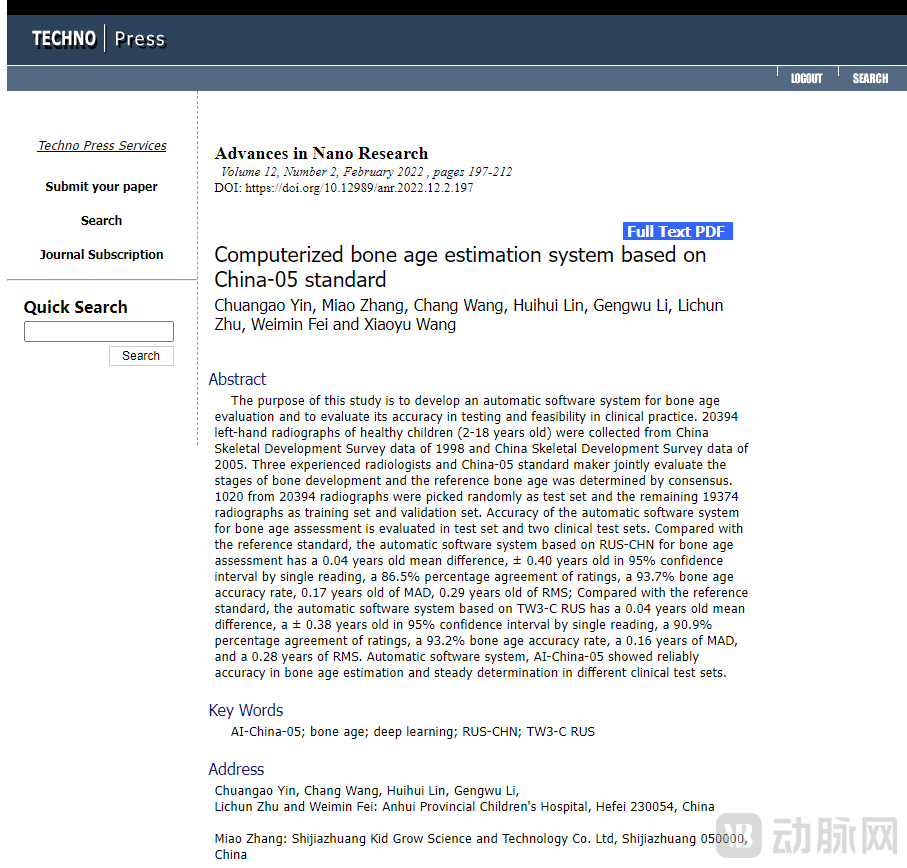
It is reported that “Chengying-05z” was independently developed by Xigao Technology, breaking through existing limitations in computing power and model development. It adopts the AI algorithm technology known as Xigao “AI-China-05,” which offers superior performance, surpassing other international automated bone age assessment systems and reaching an industry-leading level. Xigao “AI-China-05” features high accuracy, strong stability, fast processing speed, and robust self-learning capabilities, providing rapid and accurate bone age assessments for the evaluation of growth and development in Chinese children.
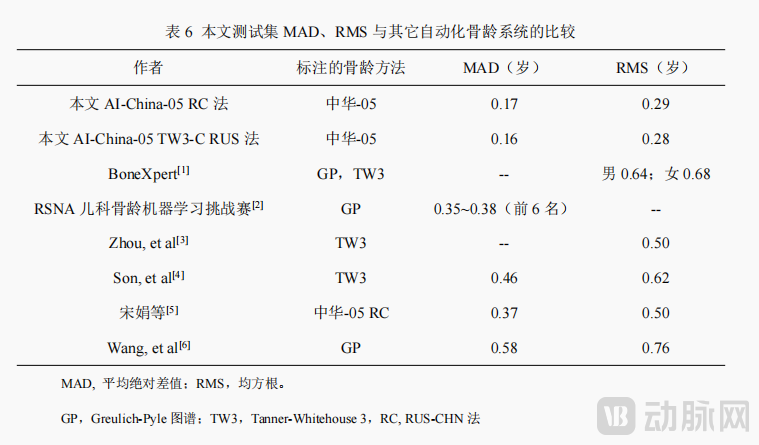
High accuracy, with an overall rate exceeding 93% and outstanding performance across all age groups
To ensure the accuracy of detection results, Xigao’s “AI-China-05” has been “trained” to be better suited for assessing bone development in Chinese children. For this study, researchers collected a total of 20,394 left wrist X-ray images from healthy contemporary urban Chinese children as “samples” for AI learning. They also evaluated the reliability of the radiologists’ interpretations used for annotation, confirming that it reached or exceeded the upper limit of reliability reported internationally for the TW method.
In the test set, XiGao “AI-China-05” demonstrated exceptionally high accuracy in assessing bone development stages among children and adolescents aged 0–18 years across all age groups, with an overall accuracy exceeding 93%.
The large, uniformly distributed data samples with high-quality annotations provide a solid foundation for the accuracy of XiGao’s “AI-China-05.”
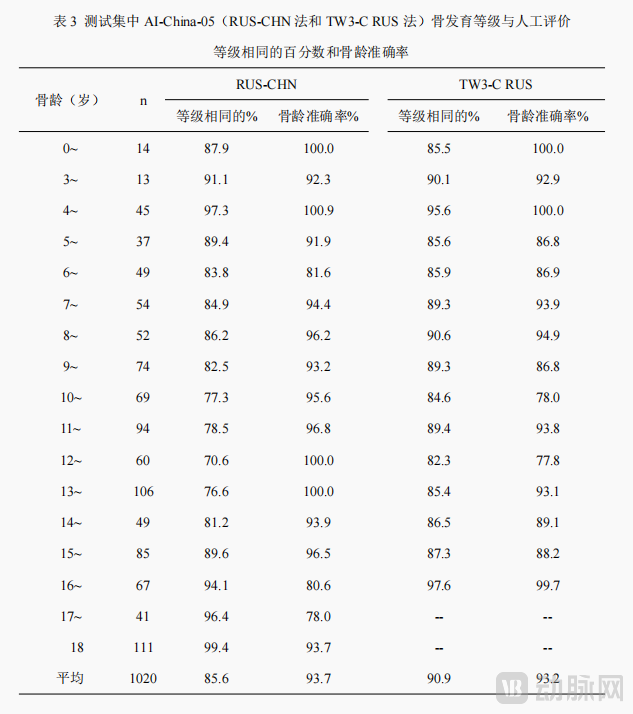
Good stability, low rejection rate
Son et al. applied VGGNet to study an automated bone age assessment system based on the TW3 method, extracting key epiphyses by locating regions of interest (ROIs). However, this approach is susceptible to background interference, resulting in a high rejection rate and poor stability. In contrast, Xigao “AI-China-05” has demonstrated its stability and reliability through clinical validation. To evaluate the performance of Xigao “AI-China-05,” our team included nearly 2,000 clinical radiographs, primarily obtained from the Department of Radiology at Anhui Provincial Children’s Hospital between January and August 2020, covering patients aged 1 to 18 years.
Validation results showed that among all validated X-rays, the rejection rate was only 0.15%, indicating that XiGao “AI-China-05” demonstrated stable performance in clinical studies, with negligible differences from the test set results. In addition to this clinical study, XiGao “AI-China-05” has been evaluated on over 621,000 clinical X-rays during the past two years of clinical research, fully validating its accuracy and stability.
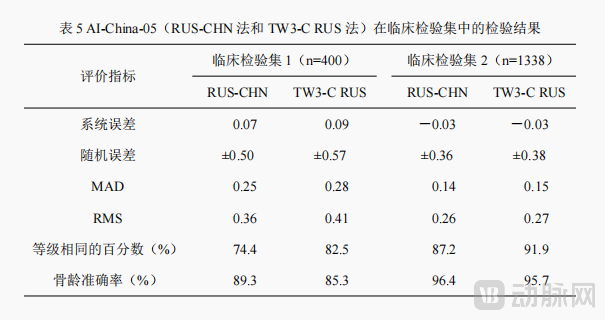
Balancing Speed and Accuracy: Average Image Interpretation Time of 0.76 Seconds
Xigao “AI-China-05” not only ensures the accuracy of results but also significantly accelerates AI-based image interpretation, truly achieving a balance between accuracy and speed. The classification model of Xigao “AI-China-05” incorporates the Convolutional Block Attention Module (CBAM), substantially enhancing the classification performance of the AI model. Furthermore, during the development of Xigao “Chengying-05z,” transfer learning and optimized loss functions were employed to deliver more precise results.
Moreover, the Xigao “AI-China-05” model utilizes smaller input dimensions while preserving epiphyseal features, thereby reducing computational load and accelerating processing speed without compromising accuracy. With an average image interpretation time of 0.76 seconds, it significantly reduces the workload and time costs for healthcare professionals.
A Good Model Enables AI to “Draw Inferences”
Xigao’s “AI-China-05” employs an Inception-ResNet-V2 model with 164 layers and 54.3 million parameters, characterized by a wider and deeper architecture. As the “brain” of AI-China-05, the Inception-ResNet-V2 model offers greater “capacity” and enhanced self-learning capabilities for generalization, enabling it to capture richer features of bone maturity and more complex representations.
Xigao’s “Chengying-05z” leverages a vast dataset of bone age images and deep learning technology, demonstrating superior performance in accuracy, stability, and interpretation speed. While enabling efficient and precise image analysis, it also eliminates the influence of physicians’ subjective biases on results, significantly enhancing clinicians’ diagnostic capabilities. By improving accuracy while reducing time costs, it alleviates the burden of repetitive image interpretation for physicians, thereby freeing up valuable medical resources.
In response to the growing demand for pediatric health screening and full-lifecycle child health management, Xigao’s “Chengying-05” not only ensures consistency in bone age interpretation but also rapidly meets the increasing need for such assessments. As artificial intelligence continues to evolve and learn, it will play an increasingly significant role in scientific research by refining the evaluation of key indicators in Chinese pediatric auxology and contributing to the establishment of national standards for bone age assessment.
In the future, Xi Gao Technology will continue to deepen its expertise in pediatric growth and development research, bone age assessment, and child health management. The company aims to expand the scope and capabilities of its platform’s scientific research services, further empowering medical partners. By delivering child health management services to more doctors and parents in need through diversified channels, Xi Gao Technology is committed to safeguarding the healthy growth of children in China.
Note: Some of the above materials and data are sourced from the "Computerized Bone Age Assessment System Based on the Chinese-05 Standard"