

Pause Lab Secures RMB 50M Series A Funding, Pioneering Digital Mental Health with Over 30,000 Paying Users and 68% Completion Rate
“Did you hear that a young employee in the neighboring department resigned due to depression?” When the explosive message popped up in the company’s WeChat group, Old L, a senior employee at an internet media firm, felt his heart skip a beat: “I didn’t realize there were so many people struggling with psychological issues these days.” Including relatives, classmates, and friends, Old L has witnessed one or two cases of mental health problems among his acquaintances nearly every year in recent years.
Unlike others, Old L is more concerned about his own condition. In middle age, he has recently endured considerable hardship due to the demanding and harsh behavior of clients and supervisors, and his hair is gradually turning gray. Countless times, Old L has felt the urge to lash out. Faced with the high tuition fees for his child’s extracurricular classes and the bank’s relentless payment reminder messages, he can only maintain a sense of “professionalism” typical of middle-aged adults, mechanically replying “OK, received” in WeChat groups. “Could I also be suffering from depression?” Recalling the increasingly frequent mental exhaustion, lack of energy, declining memory, and even being awakened from nightmares about unmet performance targets, Old L feels somewhat apprehensive.
“Should I go get checked? Where should I go for the examination, and will my colleagues and family find out? …… Maybe I should just forget about it……”
Apart from the name, this account is based on real events. At this point in the story, many readers may see reflections of themselves in Old L’s predicament. In fact, Old L had already begun to recognize the early signs of psychological distress and was considering seeking professional help—a step that should have marked the beginning of positive change. However, widespread stigma and avoidance surrounding mental health issues in societal attitudes, coupled with a scarcity of high-quality mental health services, have left many individuals like Old L uncertain about what concrete actions they can take for themselves.
This is the status quo that Pause Lab aims to change. Recently, Beijing Gese Technology Co., Ltd., the company behind the digital mental health brand “Pause Lab,” completed a RMB 50 million Series A financing round led by BlueRun Ventures, with follow-on investment from existing shareholder Changling Capital. This represents one of the significant investments in the mental health sector.
Guo Tingting, Founder and CEO of Pause Lab, pursued studies in clinical and psychotherapeutic approaches as well as cognitive neuroscience during her academic career. While pursuing her Ph.D. at the Institute of Psychology, Chinese Academy of Sciences, she primarily investigated the mechanisms of emotion regulation—specifically, why individuals experience negative emotions, which actions can alleviate such emotions, and the corresponding neural activities that occur in the brain during this process. Throughout the design of her research protocols, she consistently explored methods to enhance the efficiency of emotion regulation.
Beyond her research, she also engages in public education on mental health online and has gained a profound understanding of the significant gap in mental health services in China. In examining overseas health industry models, she gradually realized that research and commerce are not mutually exclusive. Emerging research-driven commercial entities in the healthcare sector can develop products to serve users; meanwhile, real-world data generated by users during product utilization can feed back into product iteration and advance research in this field.
Compared with purely engaging in research, commercializing research findings to directly serve more people in need is clearly a more worthwhile endeavor. This is why Guo Tingting founded Gesek Technology.
GeSe Tech’s first product, called the GeSe DNA Test and nicknamed the “Personal User Manual,” helps people gain a better understanding of themselves through a comprehensive analysis of their innate genetics, upbringing, and current circumstances. The data insights provided by this product enabled Guo Tingting’s team to better understand their users—70% of whom feel uncertain about the future, and 45% of whom experience significant emotional stress. These findings served as the primary motivation for users to embark on self-exploration.
“Most people do not naturally possess the ability to quickly recover from stress, yet stress and setbacks are inevitable experiences in everyone’s life. This is why anxiety and depression are so prevalent. The good news is that, just as physical fitness can enhance bodily functions, emotional regulation and stress resilience can also be improved through psychological training. Therefore, we began developing more practical solutions to alleviate emotional distress,” said Guo Tingting. Thus, the brand “Pause Lab” was born.
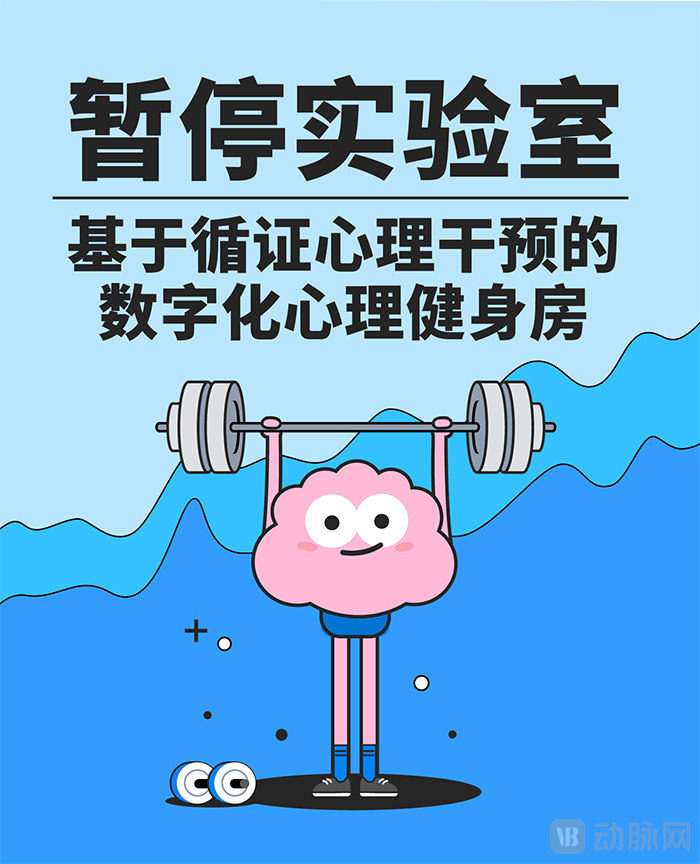
Pause Lab is positioned as a digital “psychological gym”: it provides users with an online intervention program designed to enhance emotion regulation skills. By consistently practicing through structured cycles, users can effectively alleviate emotional distress.
These intervention protocols are derived from evidence-based psychotherapy, which has traditionally been delivered through in-person one-on-one or one-to-many sessions. However, faced with the severe shortage of professional mental health providers and the high cost of services in China, Guo Tingting and her team sought to reduce costs and enhance efficiency through model innovation: “We are a rare hybrid team with formal training in psychology, combined with experience in science communication and consumer-facing internet product development. This background has shaped the unique DNA of Pause Lab, characterized by a scientific core encased in a consumer-friendly exterior.”
The team has invested significant effort in the research and development of the Pause Lab product line. Following the intervention protocol design phase from late 2017 to late 2018, and nearly a full year of internal beta testing throughout 2019, the R&D team continuously iterated and optimized the intervention protocols based on feedback, while progressively refining the user-side interactive experience. It was not until May 2020, when the team determined that the Pause Lab product had met expectations across key metrics—including efficacy, adherence, retention rate, and referral rate—that it began external promotion.
After registering online for Pause Lab, participants must first complete an initial online screening assessment of their mental health status to determine whether their current condition is suitable for using digital intervention products. For users currently experiencing an acute episode of a severe psychological disorder, Pause Lab will still recommend seeking further diagnosis and one-on-one intervention. “Our services are best suited for the general population and individuals with mild to moderate distress, playing an effective role in early prevention and halting symptom escalation. For more severe cases, medication remains the first-line treatment. Of course, self-help products can also be used as adjunctive tools with the approval of a physician.”
Subsequently, the system will push a daily exercise plan to participants, which can be completed by following the guidance on their mobile phones. Each plan operates on a 25-day cycle, requiring approximately 20 minutes per day. Participants will begin with a basic exercise plan. Upon completion of the basic plan, the system will provide recommendations for either repetitive training or progression to an advanced exercise plan, based on the user’s status.
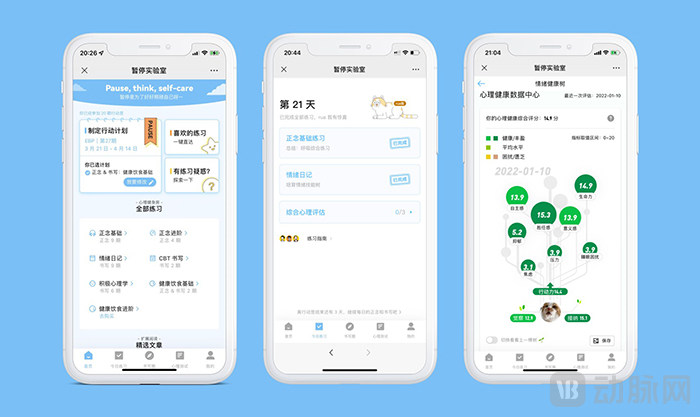
“I often struggle with how to introduce Pause Lab, as there are so few people doing this kind of work. It is a new breed of service that can be viewed as an online mental fitness gym, somewhat similar to Keep. The brain is plastic; if you are willing to invest time in caring for it, you can enhance its function through daily, systematic practice—just like training the body—thereby alleviating various emotional issues and building greater resilience to stress.”
Thanks to its meticulously refined product, Pause Lab gained widespread recognition immediately upon launch—by the end of 2020, it had amassed 10,000 paying users, and just one year later, by the end of 2021, that number tripled to exceed 30,000. From the outset, Pause Lab eschewed free or low-price strategies; the initial enrollment fee was approximately RMB 500–600, which includes unlimited repeat training, equivalent to the cost of a single counseling session. For users grappling with long-term emotional distress, this represents a highly cost-effective option. “Users deserve professional services and are willing to pay reasonable fees for such expertise. Our responsibility is to ensure our professional interventions are effective,” stated Guo Tingting.
Pause Lab, through statistical analysis of participant data, has found that it significantly outperforms its U.S. counterpart, the Happify digital therapeutic, on several key metrics, as compared to publicly available reports.
In terms of adherence, only 9.76% of Happify users completed more than a certain proportion of exercises within one treatment course. In contrast, among the 35,000 participants in Pause Lab, the rate of full completion of the 25-day intervention program was as high as 68%. Specifically, the completion rate for first-time participants was 63%, while the average completion rate for returning participants was 73%.
In terms of improvement efficacy, Pause Lab also demonstrates advantages. Happify’s effect sizes (a metric quantifying the magnitude of change, where a larger effect size indicates greater improvement) for alleviating negative emotions such as depression, anxiety, and stress are generally around 0.5. Depending on the specific symptoms, Pause Lab’s effect sizes range from 0.73 to 0.91. Overall, more than 80% of participants achieved significant relief from their distress within the first cycle.
Among them, approximately 45% of users experienced moderate-to-severe emotional distress prior to participation (with scores on the anxiety and depression scale above the clinical threshold). They achieved significant improvement after completing the training, with an average symptom reduction of 42%, largely approaching the efficacy of one-on-one human intervention. Participants with mild distress showed moderate improvement, with an average symptom reduction of 25%. Additionally, 10%–20% of users were in a state of complete psychological health before participation; data indicate that their emotion regulation skills and well-being also improved significantly.
Driven by strong efficacy, the overall renewal rate for the intervention program reached 42%, with multi-cycle participants completing an average of 74.7 days of intervention per person (as of February 2022). Eighty-one percent of participants expressed willingness to recommend the training to others; meanwhile, among new users acquired in the most recent year, 53.5% came from organic traffic or word-of-mouth referrals.
Achieving these results is no small feat for a product that has been on the market for just over a year and features forward-thinking concepts.
In fact, not only Happify, but compared to various digital emotional intervention products with publicly available effectiveness data reports currently, the Pause Lab's effects are significantly superior.
Guo Tingting, who has received formal professional training, and her product development team have gradually identified four key efficacy factors in the design of digital psychological intervention products over the past four years of research and development. These factors comprise four components: the intervention system, the motivational system, the tracking system, and the human support system.
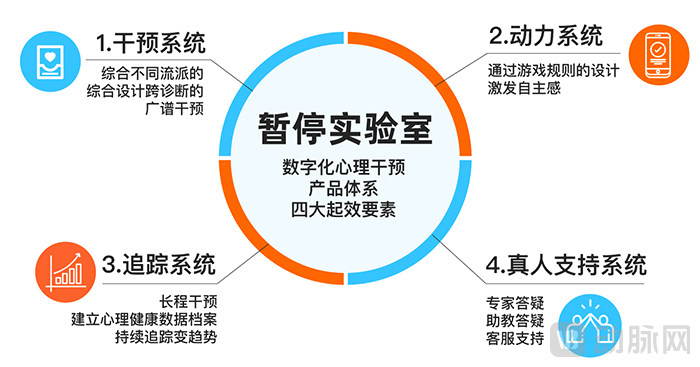
The intervention system consists of daily training plans. At Pause Lab, these include “audio-guided exercises,” “educational sessions on the principles of emotion regulation,” “daily written emotional processing and journaling,” and psychological state assessments, among other formats. The design of these components is grounded in first-line, evidence-based interventions for anxiety and depression, such as Cognitive Behavioral Therapy (CBT), Acceptance and Commitment Therapy (ACT), Mindfulness-Based Cognitive Therapy (MBCT), and Positive Psychology.
However, the Pause Lab does not simply replicate these protocols. Instead, it draws on its own understanding of the core factors that drive the efficacy of psychological interventions to originally construct a process-based model of psychological intervention, which then informs the design of daily practice modules. For instance, in a basic 25-day intervention program, they distill the mechanisms of action into three key concepts: “awareness, acceptance, and action.”
In layman’s terms, this involves first clarifying one’s current feelings, then gradually learning to acknowledge and accept one’s experiences, and finally identifying goals and directions for subsequent action. The Pause Lab posits that this process model is applicable to transdiagnostic interventions for a broad range of emotional distress. Data also robustly demonstrate that the program yields broad-spectrum, significant efficacy in alleviating various forms of emotional distress, including stress-induced anxiety, depression, and insomnia.
The motivational system comprises various elements designed to enhance user adherence, including the establishment of an intervention relationship, scheduling of action plans, setting of rules, and implementation of incentives.
“In fact, the effectiveness of psychological intervention largely depends on the establishment of the therapeutic relationship. We refer to this as unconditional positive regard, genuineness, and acceptance. The quality of this relationship directly impacts participants’ adherence.” To build a trusting relationship with users, Pause Lab pays close attention to many details. For instance, privacy protection settings are in place for any self-disclosure activities, thereby fostering a sense of security among users.
“In addition to establishing the initial rapport, game mechanics are also a significant factor influencing adherence. ‘We inform users that this is a habit-formation game; the key is not the quality of daily practice, but the long-term persistence in maintaining the habit. We strive to lower the difficulty level, set necessary reminders, and provide immediate incentives for completing tasks on a daily and phased basis. Many individuals experiencing emotional distress also struggle with procrastination, yet our full completion rate stands at 70%. Participants frequently tell us that this is the only online program they have ever completed in its entirety. This approach incorporates many scientific principles of behavioral intervention,’ explained Guo Tingting.”
Tracking System: Pre- and Post-Psychological Assessments for Each Psychological Intervention Plan"Professional psychological scales in self-report format remain the most reliable method for mental health assessment. This is also an essential step for users to gain a deeper understanding of their psychological state, much like the body composition analysis systems used in gyms. Each user maintains a personal mental health profile, enabling them to easily review the long-term effects of their practice and their specific status at any given point in time."
Pause Lab’s unique “semi-self-help model with live human guidance” is also a key reason for its significant effectiveness. Guo Tingting believes that in traditional one-on-one psychological counseling, the empathy, attention, and listening provided by the counselor, as well as the establishment of a safe and trusting relationship with the counselor, are all important techniques in psychological counseling and among the underlying factors contributing to the efficacy of interventions. Therefore, Pause Lab’s product design strives to incorporate the “human element” into the online experience as much as possible.
In light of the severe shortage of psychological intervention professionals in China, Pause Lab has also designed a “pyramid”-style service system to maximize the utility of its limited human resources. At the top tier are the lead researchers, who design the exercise programs. Like Guo Tingting, they all hold master’s or doctoral degrees in clinical psychology. They address participants’ questions through weekly unified live-streaming sessions, and in the process, develop standardized response guidelines for frequently asked user questions.
Beneath the core creators are community managers, comprising an operations lead and several seasoned users from multiple cohorts who have passed rigorous assessments. They receive training from the core creators and provide immediate support to users in accordance with standardized guidelines established by the core team. Their responsibilities include promptly addressing various exercise-related concerns and demonstrating a non-judgmental, supportive attitude. Currently, each community manager can simultaneously provide Q&A support to 1,000–3,000 participants.
In addition, a one-on-one customer service assistant is available to provide immediate support for users’ non-technical operational inquiries.
This pyramid-style system ensures that all user inquiries are promptly addressed, fostering a secure and supportive intervention environment.
“In fact, interventions are complex, with relationships and dynamics being the most challenging aspects. Consistent action and sufficient practice time are the core elements that make an intervention effective. Our design, which focuses on prompting initiation, building trusting relationships, and providing timely support, has been proven to significantly improve adherence rates. This is also the most unique aspect of Pause Lab,” said Guo Tingting.
Behind the unique model design is a multidisciplinary professional team. Currently, its two largest teams are the clinical and internet divisions, each accounting for one-third of the total workforce. This results in R&D personnel comprising approximately 70% of the staff, clearly highlighting its R&D-driven background.
The founding team of Gese Technology hails from the Institute of Psychology, Chinese Academy of Sciences, and the Faculty of Psychology, Beijing Normal University. Prior to launching their venture, they underwent systematic academic training and clinical intervention training. Currently, the company has developed a clinical R&D team of over ten members with master’s and doctoral degrees, responsible for developing intervention protocols and conducting data research on intervention mechanisms. All team members are professionally trained in renowned clinical psychology departments both domestically and internationally, possessing dual expertise in research and clinical intervention.
Interestingly, most members of the internet product team are converted from deep users who have personally benefited from the service. They are dedicated to designing a gamification mechanism that helps cultivate healthy habits, making it easier for participants to initiate activities beneficial to their physical and mental health, and ultimately integrating them into their daily routines. “Our users choose to join us because they identify with our company culture and product value. I am deeply grateful to them, as many of these high-caliber talents are typically difficult for early-stage startups to recruit,” said Guo Tingting.
Following the completion of its RMB 50 million Series A financing, Gese Technology announced that it would build a comprehensive matrix of digital mental health solutions through sustained basic research and product development, thereby continuing to promote the widespread adoption of evidence-based psychological interventions. Digitizing psychological interventions is a key component of this strategy.
Currently, the R&D department of Pause Lab has also partnered with leading domestic psychology research teams, including those at Peking University, Beijing Normal University, and the Institute of Psychology of the Chinese Academy of Sciences, to jointly explore digital mental health service models and promote the translational application of basic research in clinical psychology.
Nevertheless, Guo Tingting maintains that Pause Lab will continue to explore ways to digitize those aspects of traditional one-on-one psychological interventions that can be abstracted, summarized, and standardized, thereby forming digital therapeutics. However, if certain critical components lack sufficient interpretability and standardization, they should not be digitized for the sake of digitization alone; human involvement remains essential. “After all, I have always believed that efficacy is paramount.”