

WeDoctor Breaks Through the Ceiling of Digital Healthcare with a China-Style HMO Model
Recently, the China Internet Network Information Center (CNNIC) released the 49th “Statistical Report on the Development of China’s Internet,” which showed that as of December 2021, the number of internet users in China reached 1.032 billion, among whom the number of online medical service users amounted to 298 million, representing a year-on-year increase of 38.7% and maintaining rapid growth.
In the post-pandemic era, digital health models such as online diagnosis and treatment, telemedicine, internet-based health consultations, and online pharmaceutical purchases have gained widespread popularity. Meanwhile, the industry is continuously innovating its business formats to further unlock the social and industrial value of digital healthcare.
In particular, the release of the “Implementation Opinions on Deepening the Promotion of Sanming City’s Experience in Fujian Province and Furthering Healthcare System Reform” (Guo Yi Gai Fa [2021] No. 2) is regarded by the industry as a landmark step toward establishing Chinese-style Health Maintenance Organizations (HMOs) driven by payment reform. Against this backdrop, WeDoctor, China’s largest digital healthcare platform, is rolling out new HMO models across the country by leveraging its multidimensional capabilities in “medical care, pharmaceuticals, data, and insurance,” and is viewed as the most promising candidate to become China’s equivalent of UnitedHealth Group.
Since the unveiling of China’s first internet hospital, Wuzhen Internet Hospital, in 2015, which ushered in the new business model of “Internet + Healthcare,” China’s digital health industry has experienced rapid growth. Particularly in 2020, its pivotal role in responding to the COVID-19 pandemic propelled the “Internet + Healthcare” model from an “optional” service to a “mandatory” one, making digital health a market favorite.
According to the “2021 Global Healthcare Industry Capital Report” released by VCBeat Research Institute, the digital health sector, represented by internet-based solutions, saw its total financing increase by approximately RMB 118.5 billion in 2021 compared to 2020, reaching a total of RMB 251.9 billion, a year-on-year growth of nearly 89%. The E-Commerce Research Center of Netjing She, a social think tank, published the “2021 China Digital Health Market Data Report,” which estimates that the size of the digital health market reached RMB 446.4 billion in 2021 and is expected to surpass the trillion-yuan mark within five years.
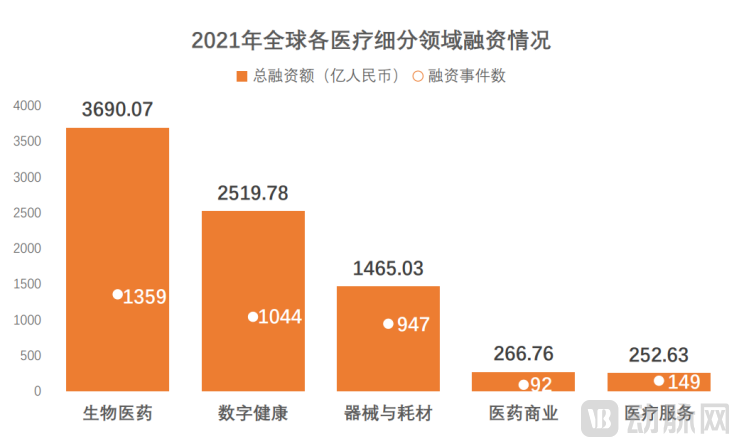
2021 Global Investment and Financing Trends in Various Healthcare Subsectors (Source: VCBeat)
However, amid the booming development of the digital health industry, a diverse array of business models has emerged successively, including pharmaceutical e-commerce, online consultations, and chronic disease management. Meanwhile, certain business forms have faced considerable controversy due to their “isolated and superficial” service models. How can internet healthcare, often criticized as being “detached from reality,” achieve practical implementation? This remains a highly debated issue within the industry.
In October 2021, the National Health Commission released the “Announcement on Publicly Soliciting Comments on the Detailed Rules for the Supervision of Internet-Based Diagnosis and Treatment (Draft for Comments)” (hereinafter referred to as the “Draft”), which clarified the previously ambiguous boundaries of internet-based healthcare, resolved the lack of clarity among medical services, pharmaceuticals, and technical support, and charted the development direction for “serious medical services.” As a result, the entire industry has undergone a value reassessment and ushered in new development opportunities.
In response, Chen Jinxiong, Chairman of the Professional Committee on Electronic Medical Records and Electronic Health Records under the Chinese Medical Information Association, stated that for internet-based healthcare to truly be effective, it is essential to better and more accurately understand its essence. Internet-based healthcare is by no means simply a matter of shifting offline services online.
Liao Jieyuan, founder of WeDoctor, believes that the value of digital healthcare lies not only in its ability to “deliver” medical service capabilities to the grassroots level; more importantly, against the backdrop of medical consortiums becoming the central axis of China’s new healthcare reforms, digital healthcare will serve as a driving force for the development of these consortiums, helping to achieve the goal of being “health-centered.”
Guided by national healthcare reform policies and driven by continuous industry innovation, digital healthcare has finally ushered in new opportunities.
In late September 2021, the Sanming Municipal Government issued the Action Plan for Implementing the “Six Major Projects” to Relaunch Healthcare Reform in Sanming City, which emphasized improving projects such as the universal health management and care system to propel the “Sanming Healthcare Reform” forward. In October of the same year, the State Council’s Leading Group for Healthcare Reform issued the Implementation Opinions on Deepening the Promotion of Sanming City’s Experience in Fujian Province and Furthering Healthcare System Reform, further stressing that all provinces must tailor, refine, and promote measures based on the “Sanming Healthcare Reform” experience in light of their local conditions.
In Phase 3.0 of the “Sanming Healthcare Reform,” the focus has officially shifted from “disease-centered care” to “health-centered care.” Aligning with the top-level design of the Sanming Healthcare Reform, leveraging the advantages of digital technologies to build a “health-centered” digital Health Maintenance Organization (HMO) is becoming the new expectation within the industry.
As early as when the “Sanming Healthcare Reform” began to show initial results, various regions started exploring and developing resource integration models with their own characteristics, based on public health needs and local medical resource distribution. Taking Tianjin’s exploratory practices as an example, in 2020, under the guidance of the Tianjin Municipal Health Commission, Tianjin Weiyi Internet Hospital took the lead in collaborating with 267 primary healthcare institutions across Tianjin to jointly establish the “Tianjin Primary Care Digital Health Consortium.” By implementing the “Four Clouds” platform—comprising cloud management, cloud services, cloud pharmacy, and cloud diagnostics—to digitally empower primary care, it provides comprehensive medical and health maintenance services covering pre-diagnosis, during-diagnosis, and post-diagnosis stages. This has gradually established an efficient health stewardship system centered on health, implemented a health accountability system, and formed a digital urban HMO (Health Maintenance Organization).
Leveraging a digital platform, the “Health Community” integrates primary care hospitals and standardizes clinical pathways. Using chronic disease management as an entry point, it explores payment models such as bundled payments and capitation or diagnosis-related group (DRG)-based payments under medical insurance, while implementing a performance constraint mechanism of “retaining surpluses and covering no deficits.” Statistical data show that after more than a year of development, the rate of standardized management for diabetic patients in pilot primary care institutions within the Health Community reached 76.68%. Analysis of patient samples managed for over three months revealed a 21.58% increase in blood glucose control rates. Moreover, primary care institutions that have implemented capitation-based payment achieved medical insurance surplus rates of 16%–31%. With simultaneous improvements in primary care service capacity and patient access convenience, outpatient visits at pilot primary care hospitals within the Health Community increased by 120%.
According to media reports, WeDoctor has integrated its various business units, capability modules, and regional operations, focusing on the payment and supply sides of healthcare services. It has established four business hubs centered around the core capabilities of “medical care, pharmaceuticals, insurance, and data,” thereby forming a closed-loop system of “payment + supply.”
Based on this, WeDoctor has implemented “Urban HMOs” across China, organized as tightly integrated medical consortia and primarily funded through global capitation payments from medical insurance. It has also explored “Specialty Disease HMOs,” focusing on chronic disease management and piloting condition-based and per-capita bundled payment models. Furthermore, it offers “Community HMOs” and “Enterprise HMOs,” providing online-to-offline integrated digital healthcare and health maintenance services to community residents and corporate employees. These diverse forms of Health Maintenance Organizations are effectively improving user health indicators and curbing the growth rate of medical expenditures, with a Chinese version of “UnitedHealth” taking shape.