Stryker Acquires Amplitude Vascular Systems to Expand Peripheral Vascular Portfolio with Next-Gen IVL Technology

Stryker
Medical Device R&D, Production, and Sales Company

Inari Medical
Cardiovascular Disease Treatment Device Developer
▲ Source of the article: Yixiehui
▲Please indicate the above source for reprinting.
On April 13, Stryker announced that it had signed a definitive agreement to acquire Amplitude Vascular Systems (AVS).
In February 2025, Stryker has just completed the acquisition of Inari Medical for $4.9 billion (approximately 36 billion RMB), setting a record as the largest M&A deal in the medical device sector that year.
This deal allows Stryker to make a strong entry into the venous thromboembolism (VTE) market., obtainFlowTriever (Pulmonary Embolism Treatment) and ClotTriever (Peripheral Thrombectomy)Two Major Ace Products.

From "Thrombus Removal" to "Calcification Fragmentation," Stryker is building a closed-loop capability in peripheral vascular intervention. This "access first, then treatment" logic is identical to the development path of "thrombectomy first, then stenting" in the neurointervention field—Stryker is the hidden leader in neurointervention.。
After the company was established, it maintained a single-direction investment for a long time.Focus on the R&D and clinical validation of IVL technology, rather than expanding multiple product lines.. This path is quite typical among medical device startups and helps in building technical depth.
Core Product: Pulse IVL System
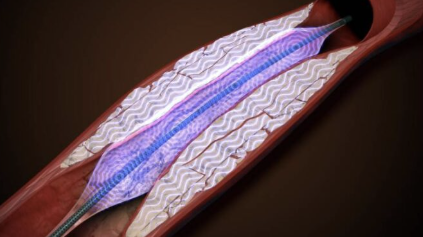
The core product of AVS is the "Pulse Intravascular Lithotripsy System," which belongs to the IVL technology system.
Its working principle is:
Through the balloon catheter into the vascular lesion site
Release of pulse pressure waves driven by CO₂
"Shockwave" Treatment for Intravascular Calcified Structures
This technology can improve vascular elasticity without significantly damaging soft tissues, and create conditions for subsequent dilation or stent implantation.
Technical Features: From "Hard Opposition" to "Structural Transformation"
Compared with traditional technology, IVL has obvious differences:
Traditional Method: Calcification treated by high-pressure dilation or mechanical rotational grinding
IVL Method: Altering calcified structures through energy (shock waves)
AVS technology further emphasizes "uniform release of shock waves" to improve treatment efficiency and catheter accessibility while shortening operation time.
Stryker's entry this time means that the "three-way battle" among global medical device giants in the IVL field has officially taken shape.

The essence of this competition is the争夺 "calcified lesion treatment rights."
Peripheral Artery Disease (PAD) affects over 230 million patients globally, with severe calcified lesions accounting for a significant proportion. As the aging population increases, this number continues to rise. The market size of IVL technology is projected to exceed $20 billion by 2030, with an annual compound growth rate of 18%.
Stryker's "Latecomer Advantage" Strategy:
Johnson & Johnson and Boston Scientific are buying "ready-made market share," while Stryker is buying "future technological possibilities."
AVS's products have not yet been approved, which means that what Stryker has gained is not only a technology but also the initiative for customized development—Can reverse-shape the clinical positioning of the IVL system based on the needs of their own peripheral vascular product portfolio.。
More crucially, Stryker has the peripheral vascular sales channel established by Inari.Once AVS technology is approved, it can quickly access the already covered hospital network, achieving a "plug-and-play" acceleration of commercialization.
Stryker's strategic transformation is reshaping the competitive landscape of the medical device industry.
Traditional Labels:Orthopedic implants, surgical navigation systems, neurointervention — "Hard tissue" expert;
New Identity:The "Integrator" of Peripheral Vascular Interventions – From Thrombectomy to Calcification Modification, From Veins to Arteries, From Diagnosis to Treatment.
Stryker's Q2 2025 Earnings Show the Power of This Transformation: Vascular business revenue reached $498 million, a year-over-year surge of 52.3%, making it Stryker's fastest-growing segment. In contrast, the traditional orthopedic business grew by only 2%.
The Triple Strategic Significance of Acquiring AVS:
First, complete the "calcification treatment" with the final piece of the puzzle.
After Inari Medical solved the "thrombus problem," AVS addressed the "calcification problem."Stryker's Peripheral Vascular Product Line Upgrades from "Single Tool" to "Full-process Solution"。
Second, seize the opportunity of technological iteration.
IVL technology is at a critical stage of "expanding from peripheral to coronary applications."Shockwave's Javelin coronary catheter has launched a global study, while Stryker is strategically advancing through AVS, paving the way for future coronary business.
Third, continue the "M&A-driven growth" gene.
Stryker in recent yearsAnnual average M&A expenditure exceeds $5 billion, and is adept at combining the technical potential of innovative companies with its own global channels, clinical resources, and registration capabilities to rapidly amplify commercial value.
When 230 million PAD patients worldwide face the challenge of vascular calcification, and when an aging society gives rise to a huge demand for vascular intervention, "how to manage calcification" has become a key variable in determining the success or failure of interventional treatments.
Johnson & Johnson has proven the value of this market with $13.1 billion, Boston Scientific secured its entry ticket to a differentiated technology route for $664 million, while Stryker is attempting to redefine the rules of the peripheral vascular intervention game with a "thrombosis + calcification" combination strategy.

Based inChina, Connecting Globally
Zero Inventory GroupFocus on one-stop procurement and overseas supply chain services for medical devices.
Aggregating a vast amount of high-quality equipment and consumables (with CE/FDA certification).
Sincerely seeking partners/trading companies with overseas hospital, clinic, and medical channel resources to cooperate, realize resource monetization, and jointly expand the overseas market.