

Ping An Health's Medical Services Revenue Rises to 31.2%: Unpacking the Growth Drivers Behind Its Strategic 2.0 Transformation

Ping An Healthcare
One-stop Solution Provider for Health Management
Since 2020, numerous companies engaged in internet healthcare services have progressively reached the IPO stage, with firms such as WeDoctor, Zhiyun Health, and Simpai all filing prospectuses. However, they still fall short of the final step required for an official listing. Internet healthcare, which played a role as a “second front” during the pandemic, has demonstrated its value but continues to face significant development challenges due to an unclear profit model.
Recently, Ping An Healthcare and Technology Company Limited released its 2021 annual results announcement. As an early explorer in the internet healthcare sector, Ping An Healthcare’s achievements following the introduction of its “Strategy Deepening 2.0” initiative, along with its HMO-based business model integrating health management, family doctor membership services, and O2O medical care, may offer valuable insights for industry practitioners.
Revenue and Number of Paying Users Continue to Rise, with Significant Enhancement in Medical Service Capabilities
A review of Ping An Healthcare’s annual report reveals that the trends in revenue figures and paid user growth are particularly noteworthy.
First, in Ping An Healthcare’s 2021 annual report, the company demonstrated to the market the potential for further growth in its revenue, particularly in medical services revenue.
The announcement showed that Ping An Healthcare’s full-year revenue in 2021 reached RMB 7.334 billion, representing a year-on-year increase of 6.8% from RMB 6.866 billion in 2020. Among this, revenue from the medical services segment grew by 8% from RMB 2.119 billion in 2020 to RMB 2.288 billion. The proportion of medical services revenue in total revenue further increased to 31.2%.
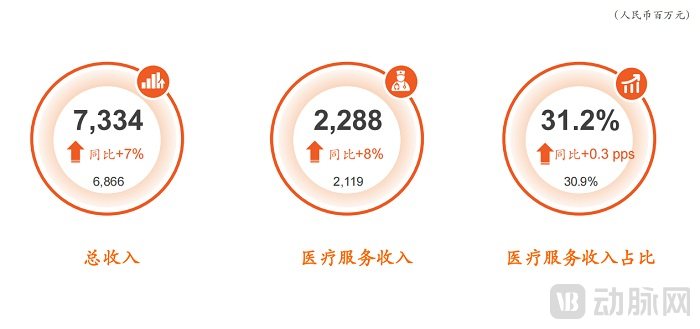
Source: Ping An Healthcare 2021 Year-End Results Presentation Materials
It is worth noting that Ping An Healthcare currently categorizes its revenue streams into two segments: Medical Services and Health Services, both of which may involve healthcare-related offerings. However, the growth demonstrated by Medical Services, regarded as its core business, tends to carry greater substantive value.
On the one hand, medical services themselves constitute the foundational logic for the development of internet healthcare enterprises. Only upon this foundation of medical services can various other service models, such as health management and insurance services, be built. On the other hand, as a complement to current offline medical services, internet healthcare works in tandem with traditional care to address issues such as the uneven distribution of medical resources, difficulty in accessing medical care, and high costs. Leveraging its advantages of timeliness and efficiency, internet healthcare can better break down temporal and spatial barriers in healthcare delivery, thereby providing continuous, high-quality medical services.
Secondly, with the implementation of Ping An Healthcare’s business model integrating HMO-based health management, a family doctor membership system, and O2O medical services, its annual cumulative number of paying users grew rapidly to exceed 38 million, while the paying user conversion rate increased to 24.8%.
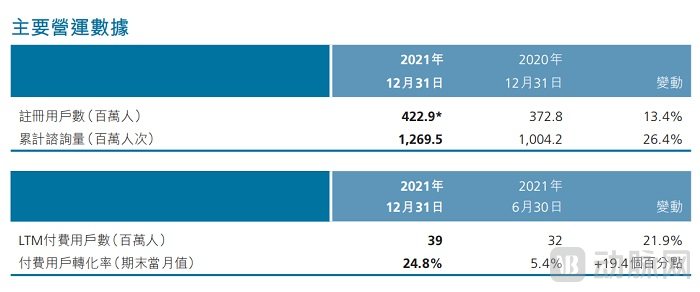
Source: Ping An Healthcare 2021 Annual Report
In 2021, Ping An Healthcare achieved steady growth in its cumulative registered users, paying users, and total consultation volume. Its cumulative registered user base reached 420 million, a year-on-year increase of 50 million. The total consultation volume amounted to 1.27 billion, maintaining its leading position in the industry.
The growth in the cumulative number of registered users, particularly paying users, signifies potential for sustained user retention and conversion into consumption behaviors. In practice, as Ping An Healthcare facilitates the conversion of registered users into paying customers, it continuously enhances user stickiness and conversion rates through user segmentation and product categorization. For instance, Ping An Healthcare provides light users with free, authoritative medical and health encyclopedias and online consultations via AI-supported services. Through its family doctor membership products, it further nurtures users by delivering comprehensive, end-to-end services that integrate health management with medical care. Additionally, by offering diverse, high-quality value-added service packages, Ping An Healthcare provides exclusive benefits to precisely meet individual user needs.
Overall, the growth in both total revenue—including income from medical services—and the number of paying users is driven by Ping An Healthcare’s enhanced capacity to deliver medical services.
How Can Ping An Healthcare Strengthen Its Core Competencies Amid Continuous Enhancement of Medical Service Capabilities?
Behind the continuous enhancement of medical service capabilities lies Ping An Healthcare’s emphasis on building such capabilities and its ongoing efforts to promote them through concrete measures.In summary, the main points are as follows——
Strengthen Internal Physician Training to Enhance the Service Capabilities of the “Medical Entry Point”
Ping An Healthcare rapidly responds to user needs 24/7 through its in-house medical team and AI-assisted diagnosis and treatment system, and leverages both internal and external teams of physicians, health coaches, nutritionists, and psychological counselors (The platform has accumulated a team of over 48,000 internal and external physicians, health coaches, nutritionists, and psychological counselors.) comprehensively address users' medical and health needs.
Following the strategic upgrade of Ping An Healthcare, its “Family Doctor Membership” service is built around the core offering of “1 family doctor + 5 specialized professional services + 1 member health record.” It matches users with resources across five key scenarios—health management, sub-health management, disease management, chronic disease management, and elderly care management—according to their needs. This approach helps create a comprehensive membership profile for each user that covers their entire lifecycle, while coordinating and arranging healthcare services that span both online and offline channels.
To further enhance the operational efficiency of family doctor teams, Ping An Healthcare has fully rolled out an AI-powered health record workspace, adopting a model that refines intelligent triage down to the departmental level to improve triage accuracy. Additionally, Ping An Healthcare continues to strengthen its training management.Training was conducted across multiple dimensions, including medical regulations, healthcare management systems, and professional knowledge. Throughout the year, more than 1,000 training sessions were organized, covering all medical personnel, while actively expanding opportunities for external exchange and advanced studies for physicians.
For example, in March this year, the physician rotation and advanced training program jointly organized by Ping An Healthcare and Peking University International Hospital was officially launched. More than 40 full-time physicians from Ping An Healthcare will participate in offline rotational training at Peking University International Hospital in batches, thereby helping internal physicians master clinical diagnosis and treatment of diseases within their specialties, exchange medical expertise, and enhance their professional diagnostic and therapeutic capabilities. According to financial report disclosures, Ping An Healthcare’s “Excellent Physician Advanced Training Program” also includes dispatching personnel to attend academic conferences hosted by authoritative medical organizations and participating in offline professional training.
Establish Renowned Physician Studios in Collaboration with External Experts to Improve the Diagnosis and Treatment Rate of Complex and Refractory Diseases
Ping An Healthcare has established a four-tier physician network system, delivering systematic, end-to-end medical and health services to users through its AI physician assistant, in-house medical team, external physicians, and renowned medical experts. Currently, Ping An Healthcare is rapidly expanding its network of distinguished medical specialists. According to the financial report,The number of contracted external renowned physicians on the platform has reached over 1,100. Ping An Healthcare is also collaborating with these experts to establish specialized studios, providing consultations focused on specific specialties and conditions to deliver more convenient medical services to users.
Take, for example, the first batch of key specialty disciplines it has prioritized:Department of Traditional Chinese MedicineTop TCM dermatology experts, including Qin Wanzhang, and National Medical Master Li Diangui, have joined the platform;Obstetrics and GynecologyNotable specialists who have joined include Director Huang Suying, Chief Physician of Gynecology in Traditional Chinese Medicine (TCM) at the Shanghai Municipal TCM Literature Museum and the eighth-generation representative inheritor of the Cai’s Gynecology lineage; and Director Qiu Lihua, Chief Physician of Gynecology at Renji Hospital, Shanghai Jiao Tong University School of Medicine, and Doctoral Supervisor.Dermatology DepartmentAcademician Liao Wanqing of Changzheng Hospital serves as Ping An Healthcare’s first “Chief Expert in Internet Dermatology,” while other experts, including Zhang Jianglin, Chief Physician of the Department of Dermatology at Xiangya Hospital of Central South University, and Xi Liyan, Chief Physician of the Department of Dermatology at Sun Yat-sen Memorial Hospital of Sun Yat-sen University, have also joined the platform.
The Renowned Physician Studio has further enhanced the accessibility of diagnostic and therapeutic services for patients with complex and refractory diseases.For example, Ms. Huang from Anhui Province experienced recurrent blistering and exudation on both feet as summer approached. The severe itching and pain significantly impaired her work and daily life. Despite consulting numerous renowned specialists and trying various folk remedies without success, she was only able to temporarily control the progression of her condition with medication over a four-year period. After connecting with Academician Liao Wanqing, a distinguished expert in medical mycology and dermatovenereology in China, through the Ping An Healthcare Renowned Physicians Studio, the true cause of her disease was promptly identified. Targeted treatment subsequently enabled her to overcome the ailment that had plagued her for four years.
Continuously optimize the O2O service system, partnering with thousands of hospitals and other institutions.
Ping An Healthcare recognized the importance of the supply side of medical services at an early stage.To provide users with continuous medical services that span online and offline channels, in-hospital and out-of-hospital settings, and the pre-, intra-, and post-consultation phases, Ping An Healthcare has been continuously optimizing its O2O service system.
As of December 31, 2021, Ping An Healthcare collaborated with over 3,600 hospitals, more than 50% of which were Grade 3A hospitals; the number of partnered pharmacies reached 202,000, achieving a national coverage rate of approximately 34%; it established over 225 central warehouses and enabled one-hour medication delivery in 140 cities; the number of partnered health institutions reached 96,000, meeting users’ demands for various offline service fulfillment scenarios and enhancing the service ecosystem. Leveraging its proprietary medical capabilities and traffic advantages, Ping An Healthcare has focused on developing premium health check-up programs, forming a closed-loop service model of “pre-checkup guidance + post-checkup interpretation + solutions.” The number of partnered check-up institutions has exceeded 1,700, covering 321 cities across China, with a health check-up report interpretation rate exceeding 39%.
Through collaborations with hospitals and a network encompassing pharmacies, physical examination centers, and other healthcare institutions, as well as the development of a product and service middle platform covering product management, supplier management, service management, and quality control experience, Ping An Healthcare achieves precise demand matching for users, delivering online, offline (clinic/hospital), and home-based health and medical services tailored to different user segments.Leveraging its comprehensive O2O healthcare service network, Ping An Healthcare also provides enterprise clients with more diversified customized services, fully realizing the synergistic effects of its offline healthcare service network in areas such as employee health examinations, employee health management, and corporate benefit redemption.
Uphold Compliance-Driven Development and Deepen Paid Membership Services
Addressing numerous pain points in the current market, such as the imbalance between supply and demand for medical services, gaps in high-quality healthcare, low efficiency in the utilization of medical resources, and information asymmetry between supply and demand, Ping An Healthcare has built a service system with competitive barriers based on industry insights and its own advantages. This has established an integrated business model combining HMO-style health management, a family doctor membership system, and O2O medical services, thereby better serving payers and empowering providers.
It should be emphasized that,Ping An Healthcare has established a profitability model based on membership services plus value-added service revenue,By providing differentiated services to address users’ diverse needs, Ping An Healthcare has expanded its user base while enhancing user stickiness and boosting profitability. Meanwhile, leveraging a family doctor membership model to precisely match user needs and improve user experience, Ping An Healthcare has built a trusted bridge for doctor-patient communication.
In fact, this also aligns with the development of national regulatory policies. Last October, the Medical Administration and Hospital Administration Bureau of the National Health Commission released the "Detailed Rules for the Supervision of Internet Diagnosis and Treatment (Draft for Comments)," which explicitly prohibits linking physicians' income to drug sales.
This restriction is, in fact, intended to encourage internet healthcare platforms to avoid the reemergence of the offline practice of “subsidizing medical services with drug profits” through thoughtful mechanism design. Consequently, designing an effective mechanism to prevent this phenomenon has become a critical issue that major internet healthcare platforms must address.Ping An Healthcare has taken measures in areas such as its business model (paid membership services) and physician incentives (performance-based compensation linked to the number of patients served and patient satisfaction) to strictly separate medical services from medical device sales, thereby avoiding the phenomenon of “subsidizing healthcare providers through drug sales.”
Furthermore, by serving as a bridge between healthcare providers and payers, we better deliver health and medical products to corporate and individual users, enabling comprehensive lifecycle management for them.Ping An Healthcare has effectively achieved multi-party benefits—through targeted and moderate medical services, it ultimately realizes the dual goals of improving users’ health outcomes and enabling cost containment for both commercial and public health insurance providers.. Looking ahead, Ping An Healthcare will further deepen its paid membership services by building an efficient, comprehensive, and professional family doctor membership model to better serve corporate clients and individual users.