

ZhiPep Bio: Innovating Peptide-Based Drug Delivery with PDC Technology for Precision Oncology
“Innovation is my lifelong passion.” At the very beginning of the interview, Dong Zhichao, founder of ZhiTai Bio, emphasized this point. “My first job involved eight years of teaching and scientific research at my alma mater, the Second Military Medical University. This experience instilled in me an innovative mindset that has permeated my subsequent professional and personal life.” Mr. Dong previously served as Vice President of Fosun Pharma, where he was responsible for establishing the Zhangjiang Innovation R&D Base. He has also held positions such as Chairman and General Manager (CEO) at multiple pharmaceutical companies specializing in biologics, chemistry, and natural medicines, and has overseen the entire lifecycle—from project initiation and R&D to commercialization—of more than 20 drug candidates.
Regarding entrepreneurship, Dong Zhichao remarked that his decision was driven not only by his passion for the pharmaceutical industry but also by the promising prospects of innovative peptide drugs from the perspective of technological advancement. Dong reached out to Dr. Chen Changfa, who has many years of R&D experience in the field of peptide therapeutics. Dr. Chen is highly experienced in peptide cyclization and chemical modifications to improve peptide stability and druggability. He has led or participated in the design and development of multiple peptide drugs, microbial drugs, and recombinant protein therapeutics. He has presided over or collaborated on 17 national and local research projects, with several successfully translated into commercial applications.
With the assistance of Dr. Chen Changfa, Dong Zhichao established Shanghai Zhitai Biotechnology Co., Ltd. (hereinafter referred to as “Zhitai Biotech”) in August 2021. The company’s co-founders also include Dr. Ji Aimin, who brings over two decades of R&D experience in the field of small interfering RNA (siRNA) drug development. Zhitai Biotech is dedicated to building new technology platforms and innovative peptide-based drug technologies, and holds intellectual property rights for both peptide-drug conjugates (PDCs) and peptide-siRNA conjugates.
ZhiTai Bio was founded in Zhangjiang, the “hotbed of pharmaceutical innovation in China.” Over the 20 years since Dong Zhichao established his first company in Zhangjiang in 2001, he has been deeply inspired by the area’s vibrant culture of innovation and entrepreneurship. He remarked, “In Zhangjiang, we feel ‘fully recharged’ every day.”
Peptide-Drug Conjugates (PDCs) represent a class of multi-peptide conjugated therapeutics. Compared to the currently prominent Antibody-Drug Conjugates (ADCs), PDCs feature lower molecular weights and are less likely to induce autoimmune responses. In contrast to the complex manufacturing processes associated with antibodies, PDCs offer advantages such as easier synthesis and purification, which effectively reduce the costs of large-scale production and facilitate standardization. Consequently, PDCs are gradually emerging as outstanding candidates in the next wave of targeted drug development.
To address the challenges associated with the clinical use of Antibody-Drug Conjugates (ADCs), Peptide-Drug Conjugates (PDCs) offer more precise targeting, a wider therapeutic window, and improved safety compared to ADCs.
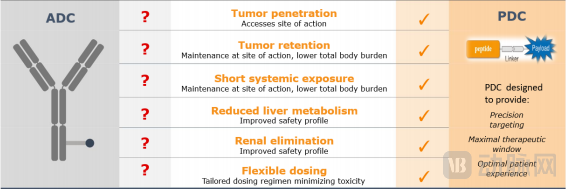
Comparative Advantages of PDCs over ADCs
Driven by advantages in drug discovery, scalable manufacturing, and clinical application, Peptide-Drug Conjugate (PDC) technology has made significant strides across multiple fronts. Targeted peptides with improved druggability, designed via AI and optimized through chemical modification, can be conjugated with proteins, peptides, antibodies, nucleic acids, small molecules (such as antineoplastic agents and immunomodulators), and radionuclides to achieve superior clinical outcomes. From a clinical perspective, PDCs have the potential to address a broad spectrum of therapeutic areas, including oncology, cancer immunotherapy, anti-infective diseases, respiratory disorders, and rare diseases.
On the other hand, many major pharmaceutical companies such as Novartis, AZ, and Roche have already begun to lay out PDCs. Leading innovative peptide technology companies like Peptidream and Bicycle are collaborating with large pharmaceutical manufacturers in areas such as gene therapy, cancer chemotherapy, and tumor immunotherapy, indicating the limitless potential of future peptide targeting technologies.
Currently, the development of peptide-drug conjugates (PDCs) and peptides is largely in the clinical stage, facing various technical challenges. Based on the technical characteristics of PDCs and their comparison with the rapidly advancing antibody-drug conjugates (ADCs), particularly driven by technological advancements such as synthetic biology and further elucidation of target protein crystal structures, it is anticipated that PDCs will enter a phase of more rapid development.
As it stands, there remains a substantial unmet clinical need in the field of oncology. Although cutting-edge anticancer therapies such as cell therapy and immunotherapy are advancing rapidly, it is undeniable that chemotherapy continues to serve as the first-line treatment for the vast majority of tumors. However, cancer chemotherapy is associated with many well-recognized drawbacks, the most prominent being its tendency to cause toxic side effects on normal tissue cells.
Why do chemotherapy drugs damage normal tissues and organs? Dong Zhichao, founder of ZhiTai Bio, explains that this is precisely because chemotherapy drugs lack targeting specificity. This is the opportunity identified by ZhiTai Bio: leveraging PDC technology to develop targeted chemotherapy agents.
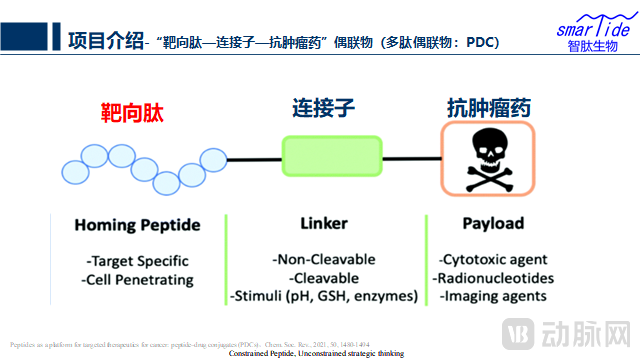
As can be seen from the structural composition of PDCs, targeting peptides can serve as a “navigation system” for tumor targeting, while the other end of the linker can be conjugated to antitumor chemotherapeutic agents, thereby achieving targeted self-guided delivery of chemotherapy drugs. ZhiTai Bio selects mature, clinically well-validated, and approved chemotherapeutic agents as the payload, with the core of this technology lying in the company’s precise design of the “targeting peptide.”
Through steps including target validation, targeted peptide screening, druggability studies, and purification process control, ZhiTai Biologics has initiated research on two targeted peptides capable of binding to specific antigens on the tumor surface. Currently, the first target has yielded a PDC lead compound and has entered biological activity testing; for the second target, targeted peptide screening has been completed, with PDC synthesis planned. Meanwhile, the company has also established a rapid screening platform for targeted peptides.
The second business direction: Based on peptide drug design, ZhiTai Bio is developing combination therapies targeting tumor metastasis and drug resistance. By leveraging protein crystal structures and AI algorithms, the company develops peptide drugs capable of covalently binding to proteins (enzymes) associated with tumor drug resistance, thereby addressing issues such as tumor metastasis and drug resistance. These peptide drugs are primarily designed for use in combination with first-line therapies.
In its third strategic business direction, ZhiTai Biologics will develop complement inhibitors for rare diseases and antiviral therapies. These innovative bioactive peptides can treat rare diseases caused by excessive complement activation. The complement system consists of a series of proteins and is part of the innate immune system.
The company will establish a technical platform for peptide drug delivery systems, focusing on becoming a product development company driven by core technologies, and building a comprehensive market collaboration system; it can also design "guided" peptides for domestic and international enterprises in gene therapy, radionuclides, proteins, and other fields.
Although ZhiTai Bio has been in operation for less than a year, it has made rapid progress in R&D. Following the completion of preliminary target validation in 2021, the company is now collaborating with five leading research institutions—the Peptide Team at the Shanghai Institute of Pharmaceutical Industry, the Shanghai Institute of Materia Medica under the Chinese Academy of Sciences, the School of Translational Medicine at Shanghai University, the School of Translational Medicine at Shanghai Jiao Tong University, and the Suzhou Medical Device Research Institute of Southeast University—to jointly advance the design and development of peptide drugs. Moreover, breakthrough progress has been achieved in assessing the druggability of its two primary targets.
On the other hand, Dong Zhichao emphasized the company’s focus on building organizational systems and culture. In its early stages, the company implemented HR principles such as “N-1,” “seeking utility rather than ownership,” and “one person doing the work of ten, with specialized expertise and versatile skills,” thereby laying a cultural foundation for its transition from a startup to a successful enterprise. Meanwhile, the company maintains close collaborations with the Case Club (an alumni organization of the Chinese Academy of Sciences’ life sciences community) and overseas R&D firms, bringing together outstanding young professionals and attracting top talent.
During Shanghai’s recent epidemic prevention and control period, Dong Zhichao told VCBeat that his team persisted in working remotely, closely monitoring updates from the American Association for Cancer Research (AACR), signing multiple contracts and agreements, publishing and editing numerous specialized articles, and simultaneously reflecting on strategic adjustments under the new circumstances.
It is reported that Zhitai Biologics has also launched its first round of public fundraising. The funds raised will be primarily used for the development of two core target-based peptide drugs under its portfolio, with the aim of completing Investigational New Drug (IND) applications within two years; meanwhile, the company will advance other pipeline candidates and their target validation, as well as expand its team.